
Big Ten’s Hidden NIL Contracts: Buyouts and Player Control
Confidential Big Ten NIL contract templates reveal transfer buyouts, sweeping athlete-rights clauses, and the conference’s power to enforce deals directly.
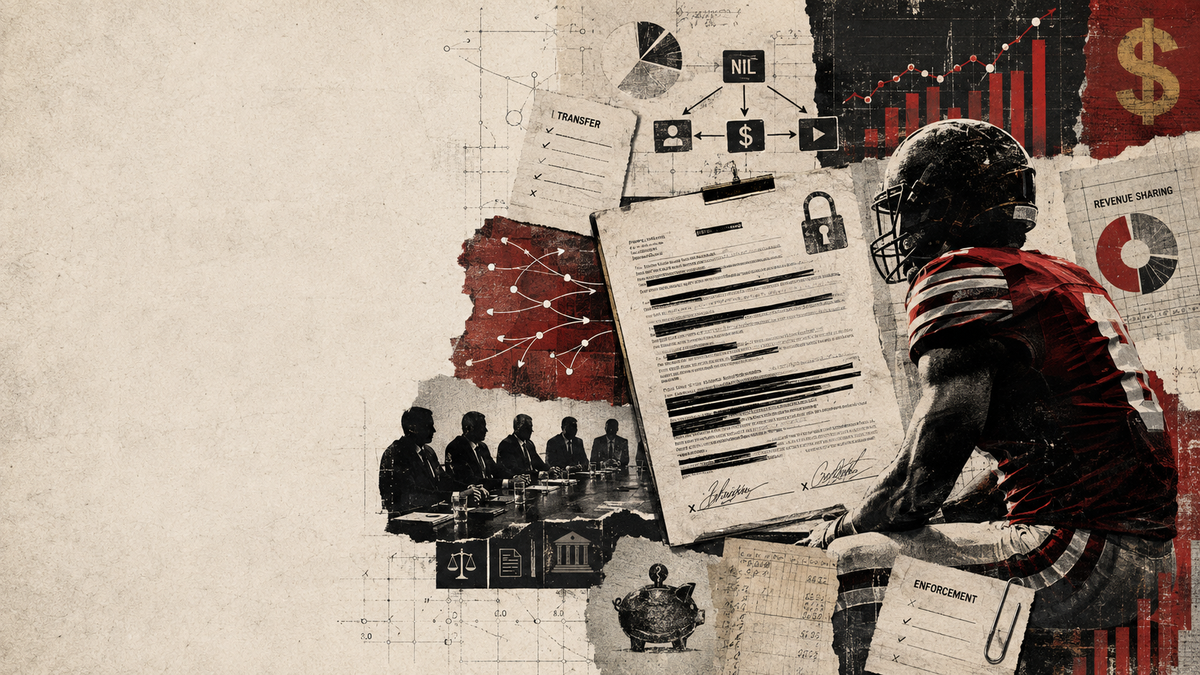
A News Expeditions review of University of Washington contract records, cross-checked against how the conference has handled recent transfer disputes, shows the Big Ten helped design the NIL deals that now govern its athletes and gave itself the power to enforce them directly.
The Big Ten isn't just refereeing the new market for paying college athletes. It helped build the contracts, and it wrote itself a role inside them.
That's the picture that emerges from a News Expeditions review of two University of Washington contract records filed on DocumentCloud, read alongside how the conference intervened when players tried to transfer. Taken together, the documents describe a conference-level compensation system. It hands the Big Ten commercial rights to athletes' names and images, access to contract details that are supposed to stay private, and something even more unusual: the ability to enforce an athlete's agreement even though the conference never signed it.
Here's the clause that makes that possible:
"The Big Ten will be deemed a third party beneficiary of this Agreement, and will have the right to enforce this Agreement directly to the extent it may deem necessary or advisable to protect its rights or the rights of the Institution."
That single sentence turns the Big Ten from a scheduling and media-rights organization into something closer to a legal party in every athlete's paycheck.
The contracts don't stop there. They give the school broad control over an athlete's name, image, likeness, voice, signature, biography, jersey number, and even their social media handle. Those rights can then get passed down, or "sublicensed," to the Big Ten, the NCAA, TV networks, sponsors, and other business partners. The documents also restrict athletes from making promises to other schools, cutting payments the moment a player enters the transfer portal, and laying out repayment terms, negotiated exits, and transfer buyouts. Some rights stick around even after the athlete leaves. The athlete must also sign away their status as an employee, along with several legal claims they might otherwise bring against the school and the conference.
Put it all together, and you get a system that goes well beyond paying players. It's a conference-wide framework for controlling what athletes can do with their name and image, limiting where they can transfer, and protecting the Big Ten's multibillion-dollar business, all while the league insists these athletes aren't employees and aren't being paid to play.
Reading the Documents Against the Conference's Own Behavior
The two records at the center of this review are filed on DocumentCloud: an eight-page pre-House memorandum of understanding and a later eight-page NIL license agreement built for the current era of direct payments to players. News Expeditions reviewed both in full and compared the language against publicly reported transfer disputes to see whether the contract terms matched how the Big Ten operates in practice.
Washington is listed as the institution on paperwork, but this wasn't just Washington's legal team at work. Yahoo Sports reporter Ross Dellenger reported that the Big Ten drafts revenue-sharing contracts for its member schools, and a later review by Extra Points backed that up, finding the conference circulated a shared template that schools like Minnesota and Purdue could tweak but not fully rewrite.
So, this isn't a story about one identical contract forced on every Big Ten athlete word for word. It's something more specific than that. The conference built a common legal framework, sent it to its member schools, and made sure it protected the conference's interests no matter who signed on the dotted line.
That means a football player at Washington isn't just negotiating with Washington. The fine print may also protect the Big Ten, the NCAA, the College Sports Commission, media partners, sponsors, and licensees with a single signature.
How a Conference Enforces a Deal It Never Signed
The third-party beneficiary clause is the biggest disclosure in these documents, and it's worth slowing down on.
Normally, a contract only binds the people who sign it. By naming itself a beneficiary of the Washington agreement, the Big Ten gives itself standing to step in and protect its own interests, separate from whatever the university decides to do.
That could come into play during a transfer dispute, a fight over conference merchandise, or an argument about how an athlete's identity gets used in Big Ten broadcasts and promotions. The conference doesn't have to wait around hoping the university enforces the deal aggressively enough. The language lets the Big Ten step in on its own whenever it decides that's "necessary or advisable."
That's a real expansion of what the conference can do. The Big Ten already negotiates massive media deals, hands out revenue, sets the rules of competition, and shapes national policy in college sports. Now it also has a direct legal stake in individual player contracts.
To see whether that clause was more than boilerplate, News Expeditions checked it against two cases where the conference had a chance to use it. Both line up with what the contract language allows. When Wisconsin defensive back Xavier Lucas tried to transfer to Miami after signing a two-year deal, the Big Ten publicly backed Wisconsin and called the contract binding. Wisconsin later sued Miami, claiming the school interfered with the agreement.
The Washington case pushed things even further. In January 2026, quarterback Demond Williams Jr. said he planned to transfer, just four days after reportedly signing a one-year deal worth roughly $4 million. Washington immediately said it would explore its legal options, and it consulted with the Big Ten, the same conference that helped write the contract in the first place.
Williams never actually tested the deal in court. He returned to Washington, apologized, and said he'd gotten bad advice.
That outcome may have suited the conference just fine. The Big Ten didn't need a judge to rule that every restriction in the contract would hold up. It just needed players and their agents to believe that leaving could trigger a lawsuit, a repayment demand, a buyout fight, or an attempt to block their NIL use at the next school. The threat did the work on its own.
The Transfer Portal Now Comes with a Price Tag
People have compared the transfer portal to free agency for years. These documents show that comparison doesn't really hold up anymore.
A pro free agent is free to leave because their contract ran out. A Big Ten athlete can enter the portal while they're still under a multiyear NIL deal, which means switching schools can trigger a breach of contract.
Washington's earlier memorandum spelled this out in stark terms. It described liquidated damages tied to whatever compensation the athlete hadn't earned yet, a possible buyout paid by the new school, a right of first refusal for Washington, and a window where Washington could try to renegotiate before letting the player go.
The final contract dropped some of that explicit language, but it kept most of the leverage through other means. Entering the portal ends future payments. Washington can demand back whatever portion of an advance the athlete hasn't earned. The player can't strike a competing NIL deal with another school while still under contract. And a negotiated "release" may be required before the athlete can walk away from ongoing obligations.
That release can function exactly like a transfer fee, even if nobody calls it one.
The upshot is a football marketplace where a school might end up paying twice for the same quarterback, once to bring him in and again to buy him out of his last school's deal.
The House settlement got sold as a win for athlete freedom. What the Big Ten built on top of it may turn the portal from an open market into something closer to a controlled trade system.
The School Owns the Athlete's Identity, and Can Hand It Around
The commercial rights the Washington agreement grants are enormous.
The list covers the athlete's name, photo, likeness, voice, signature, quotes, bio, jersey number, and social media handle. Washington can use all of it in ads, promotions, sponsored content, merchandise, broadcasts, and video games. From there, the school can sublicense those same rights to the Big Ten, the NCAA, the College Sports Commission, sponsors, media companies, and other outside partners.
That's a far cry from what NIL was supposed to be about.
When NIL rules first opened in 2021, the whole idea was that athletes owned their own commercial rights and schools couldn't stand in the way anymore. A player could sign an endorsement deal, cash in on a social following, or license an autograph without the university getting a cut or a say.
Under this new setup, the university becomes the main gatekeeper. It bundles up an athlete's rights and hands that package to the same conference and media machine that profited off those athletes before NIL reform ever happened.
The contract payment is generally treated as covering all of that. Athletes typically don't get an extra check when Washington or the Big Ten uses their image in group ads, conference promotions, or licensed merchandise.
The athlete gets a negotiated payment. The school gets a stockpile of commercial rights it can use however it wants.
That distinction matters because these deals get labeled "revenue sharing," but they don't necessarily give athletes a cut of whatever revenue their own image generates. Instead, players get a flat contract price in exchange for signing away a whole bundle of rights.
The Contract Also Reaches for Rights Nobody's Sure Athletes Even Have
One of the more aggressive clauses deals with a right universities currently argue athletes don't even possess.
Washington maintains that individual athletes don't own a separately compensable NIL interest in game broadcasts. That's the same argument college sports have leaned on for years to keep players from claiming a slice of TV money.
But the contract prepares for that argument to be lost someday.
If a court or new law eventually decides whether athletes have an individual right to broadcast compensation, the agreement already licenses that future right to Washington and lets the school pass it along to the Big Ten, the NCAA, and media partners.
It's a legal hedge that only benefits the institutions. If athletes never get broadcast rights, Washington hasn't given up anything. If athletes do win that fight someday, the school and conference can point back to a signature and argue the rights were already signed away.
That clause tells you where the real money is. Big Ten football runs on multibillion-dollar media contracts, and a court ruling that players deserve a piece of broadcast revenue could shake the conference's entire financial foundation. This is the Big Ten trying to defuse that risk years before a court ever gets the chance to rule on it.
Paid Like Pros, Classified Like Amateurs
The contract again repeats that the athlete isn't an employee and the money isn't pay for play. What happens under the contract tells a messier story.
Payment depends on the athlete staying enrolled, staying eligible academically and athletically, staying on the active roster, and staying in what the contract calls "Good Standing." The player must meet team and school requirements, and their pay can be reduced if they fall out of good standing. Entering the portal immediately cuts off future payments.
The earlier memorandum was even blunter, allowing the school to reduce compensation if a player's playing time dropped. That specific line disappeared from the final contract, likely because it drew too clear a line between pay and performance. But cutting the sentence didn't change the relationship underneath it. The athlete still must keep playing, keep their roster spot, meet team obligations, and stay at the school to keep getting paid.
The school calls this an NIL license. In practice, it's buying an athlete's continued availability.
At the same time, the contract includes plenty of protections a real employer would want: exclusivity, confidentiality, behavior rules, transfer penalties, repayment terms, liability limits, and commercial rights that outlast the relationship itself. What it doesn't include is anything close to what workers usually get in exchange for that kind of control: collective bargaining, salary transparency, a grievance process, real free agency, a pension, or union representation.
The Big Ten has taken on an employer's level of control while holding onto none of an employer's legal obligations.
Athletes Have to Keep Their Own Deal Secret
The confidentiality terms tilt things even further.
Athletes must keep their contract confidential for five years. Washington, meanwhile, can share contract details with the Big Ten, the NCAA, the College Sports Commission, and other institutional parties whenever it wants.
The public versions of these documents redact the athlete's name, pay, payment schedule, and contract length, citing privacy and trade secrets. That means schools know exactly what they're paying across their entire roster and can share that information within the conference system. Athletes, on the other hand, generally have no idea what a teammate or a rival is getting paid.
That secrecy cuts off the exact information players would need to negotiate a fair deal. Professional leagues publish salaries and operate under union contracts that everyone can see. The Big Ten's version of a player market runs on individual, confidential contracts built from a shared template, signed by athletes who have wildly different access to experienced agents and lawyers.
The schools have all the data. The conference helped write the rules. The players are negotiating mostly in the dark.
What the Big Ten Actually Built After House
The Big Ten talked up the House v. NCAA settlement as the start of a fairer, more transparent era for college athletes. Schools got the green light to share roughly $20.5 million a year with athletes in year one, with that number set to climb.
The Washington documents show what came attached to that money. In exchange, schools get broad control over an athlete's NIL rights, the ability to sublicense those rights, roster-based pay conditions, leverage over transfers, confidentiality, and a waiver of employment-related claims. The Big Ten, for its part, gets commercial rights, legal protection, and the ability to enforce these contracts directly whenever it wants.
That's the system the conference has quietly built. It probably can't stop an athlete from physically walking off campus, but it can make that decision expensive and legally risky. It won't call these players employees, but it ties their pay to nearly every obligation that normally defines employment. Nobody's calling these payments transfer fees, but the buyouts and releases can produce the same outcome anyway.
Most notably, the Big Ten has gone from setting the rules of the game to becoming a party inside the contracts themselves. The conference helped draft the template, receives a share of the athlete's licensed rights, and sees confidential contract details. It's shielded from certain legal claims. And if the agreement holds up as written, the conference can go to court and enforce it directly, without ever putting its own signature on the page.
The Big Ten didn't just respond to the new era of paying college athletes. It wrote itself into the deal.
Bottom Line: This isn't really a story about NIL money anymore. It's a story about who controls the athletes now that money exists. Public records out of Washington show the Big Ten didn't just adjust to athlete pay; it built the legal machinery underneath it and gave itself a seat at the table in every player's contract without ever signing one. The conference gets commercial rights, confidential financial data, and direct enforcement power. The athletes get a paycheck, a five-year gag order, and a transfer market that now comes with an exit fee. Whether that arrangement survives a serious legal challenge is an open question. Whether it was designed with the conference's interests ahead of the athletes' is not.
Comments ()