
Big Ten Football Coaches: Who Does the Most with the Least?
Which Big Ten coaches create the most value? We compare Ferentz, Braun, Fitzgerald, Cignetti, Rhule, Fickell, and others against their programs’ resources.
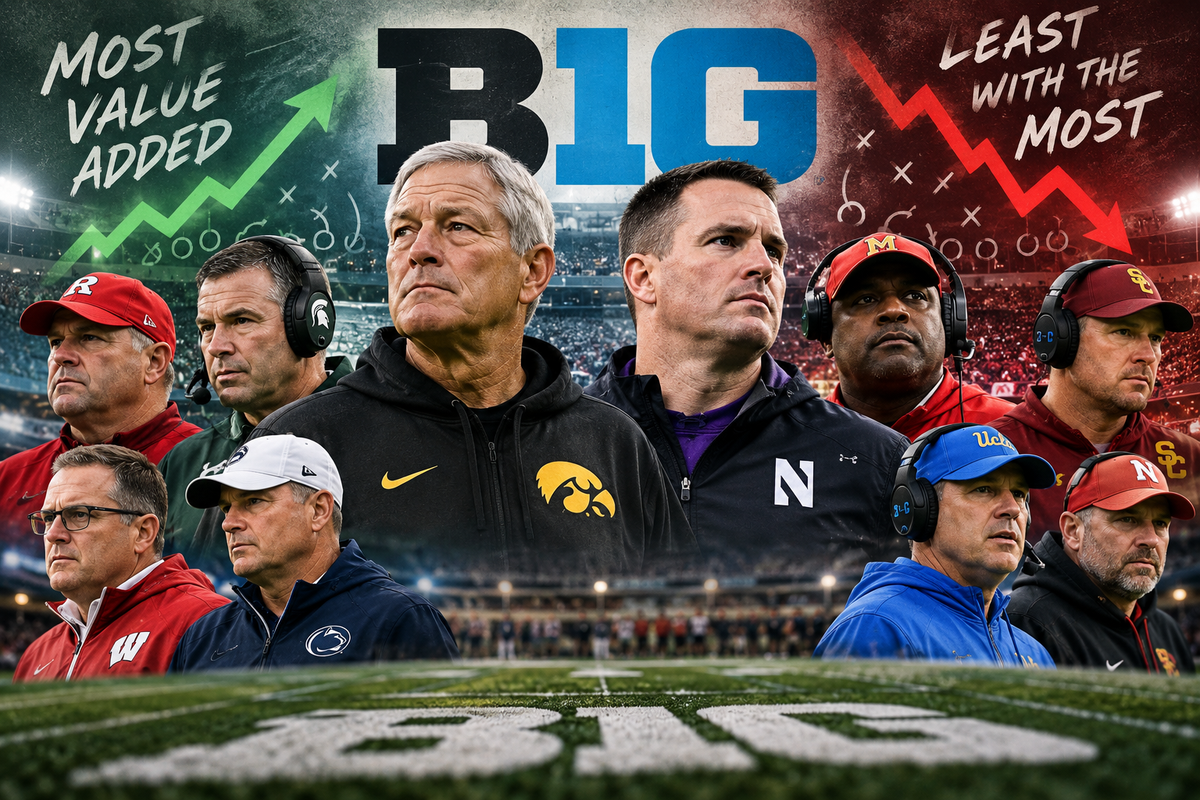
College football has gotten great at measuring players and bad at measuring coaches. Recruiting services put numbers on high schoolers, transfers get scouted like free agents, and athletic departments now juggle revenue-sharing pools, NIL operations, general managers, and roster budgets that keep getting more complicated. Head coaches, though, still get judged mostly on wins and losses. Eleven wins at Ohio State and eight at Northwestern aren't the same achievement, and treating them that way makes no sense.
The better question is how much a coach changes what his resources produce. How much talent did he inherit or bring in? How much support does the school give him? How good is his recruiting territory, and what was the program's baseline before he showed up? Then the big one: does the finished team play better or worse than all of that says it should?
Call it Coaching Value Added. It isn't a hunt for the "best" coach. Ryan Day can be excellent at Ohio State while Kirk Ferentz squeezes more out of Iowa's resources. Dan Lanning can run an elite operation at Oregon while David Braun pulls off a tougher rebuild at Northwestern. And a coach can recruit well, collect a huge salary and run a rich program while getting surprisingly little back.
The Big Ten is the perfect lab for this. Its 18 programs cover nearly the whole economic range of major college football, from Ohio State, Oregon, Michigan and USC down to Northwestern and Rutgers. The conference also has four first-year head coaches in 2026: Matt Campbell at Penn State, Kyle Whittingham at Michigan, Pat Fitzgerald at Michigan State, and Bob Chesney at UCLA, a turnover the Big Ten highlighted before the season. That's a handful of natural experiments in what happens when proven coaches get very different resources. Through this lens, the conference looks a lot different than the standings do.
Ferentz Is Still the Conference's Great Efficiency Experiment
Iowa has been running the same experiment for almost three decades, which makes Kirk Ferentz the obvious place to start. As the Big Ten noted at its 2026 Media Days, he's entering his 28th season in Iowa City as the longest-tenured head coach in major college football. Iowa doesn't recruit like Ohio State, Michigan, or Oregon. It still lands nine- and ten-win seasons, sends players to the NFL, and drags better-stocked opponents into games played on Iowa's terms.
The latest proof came in Ann Arbor. No. 17 Iowa went into Michigan Stadium and beat No. 18 Michigan 20-19 to move to 4-0. Michigan had the more traditional offensive production, but Iowa did what Iowa did and turned the afternoon into a string of high-stakes moments. The Hawkeyes drove 91 yards on their last possession and scored on fourth down with two seconds left, when Hank Brown found Reece Vander Zee. It felt less like a one-off and more like a summary of his whole career.
The formula is simple to describe. Iowa finds players other schools undervalue, develops them, keeps institutional knowledge, and runs defensive and special-teams systems that survive roster turnover. Then it squeezes games down to field position, turnovers, penalties, and a few key drives that decide everything. Ferentz's conservatism has hurt the program at times, especially on offense, and any fair analysis has to say so. But that same stubbornness has produced remarkable continuity without an annual haul of five-star recruits.
The Big Ten put the formula plainly before this season, saying Iowa's defense and special teams continually make the Hawkeyes difficult to beat. After decades of Ferentz football, that sounds almost boring. Repeatability is exactly why it matters. Recruiting rankings guess what a player is worth when he arrives, and Iowa's edge has always been making him worth a lot more when he leaves. That's Coaching Value Added in its purest form.
Braun May Be Creating Even More at Northwestern
David Braun is an even cleaner case, because Northwestern's disadvantages are bigger and we can compare him directly to the program he took over. He came from North Dakota State as defensive coordinator in January 2023 and became interim head coach when Pat Fitzgerald was fired that July. He'd never been an FBS head coach, and he inherited a team coming off a 1-11 season in the middle of one of the messiest offseasons you could imagine. Northwestern went 8-5.
That was a seven-win jump, a 5-4 Big Ten record and a Las Vegas Bowl win, and Braun was the consensus Big Ten Coach of the Year. The Wildcats slipped to 4-8 in 2024, then bounced back to 7-6 in 2025 and won another bowl. On September 17, the university extended Braun's contract through 2031. The numbers in the announcement say more than the extension does. Braun entered 2026 with 19 victories through his first three seasons, the most by any Northwestern coach through three seasons in the program's 120-year history, and he became the first Northwestern coach to reach bowls in two of his first three seasons. He now has 20 victories: 11 Big Ten wins and two bowl victories.
Friday night's 29-23 loss at defending national champion Indiana backs up the argument. Northwestern trailed No. 5 Indiana 12-0 at halftime and still made it a six-point game. That's no moral victory, and Braun doesn't deserve credit just for losing close. But Coaching Value Added asks whether a team keeps beating what its circumstances predict, and Northwestern does increasingly. Braun isn't being paid to turn the Wildcats into Ohio State. He's being paid to make them a miserable opponent despite every limit the school has, and so far, he's done exactly that.
The Fitzgerald Gamble Looks Stranger Every Week
Which brings us to Pat Fitzgerald, because Michigan State's decision to hire him might be the best test of the whole value-added idea. The optimistic case is easy to make. Fitzgerald won 110 games in 17 seasons at Northwestern, took the Wildcats to ten bowl games, produced five AP Top 25 finishes, and reached the Big Ten Championship Game twice, all laid out in the Big Ten's profile of his return to the conference. Winning 110 games at Northwestern is a real accomplishment. Michigan State thought so too, and gave him a five-year, $30 million contract.
There's another way to read the résumé, though, and it deserves more attention than it gets. Fitzgerald's last two Northwestern teams went 3-9 and 1-11, a combined 4-20. The 2022 team won its opener against Nebraska in Dublin and then lost its final 11 games. He didn't walk away after the 2020 Big Ten West title, when his stock was near its peak. He left behind one of the worst two-year stretches in the program's modern history.
Then came the part that makes the "Northwestern is just too hard" argument uncomfortable. David Braun took over. A first-time FBS head coach inherited the same structural problems, plus the chaos of Fitzgerald's dismissal, and won eight games right away. Three seasons later, Northwestern could point to the most victories by a coach through his first three seasons in school history and rewarded Braun with a deal through 2031. That doesn't prove Braun is a better coach than Fitzgerald, whose career has peaks Braun hasn't touched, including two division titles. It does make it harder to blame Fitzgerald's late collapse entirely on academics, money, or recruiting.
Michigan State is making a shakier bet than the résumé suggests. Nobody disputes that Fitzgerald once knew how to win at Northwestern. The question is whether the coach behind those peaks is the one who just showed up, or the one whose final two teams went 4-20. There's also the matter of Fitzgerald spending almost his entire adult football life inside one institution. Michigan State is finding out whether his success was a portable system or the product of an unusually deep bond between one coach and one school.
The first two games told us nothing. Michigan State beat Toledo and Eastern Michigan to start 2-0. The next two games were much more revealing.
After a loss to Notre Dame, the Spartans opened Big Ten play at home against Nebraska and got beaten 31-13. The Michigan State box score shows how lopsided the physical matchup got. Nebraska outgained the Spartans 369-257, outrushed them 157-39 and held them to three conversions on eight third downs. The Nebraska account of the game adds a painful detail: the Cornhuskers forced three turnovers, two interceptions and a fumble, on the way to 4-0.
This wasn't Ohio State or Oregon rolling in with a pipeline of five-star recruits. It was Nebraska, a fair institutional peer, with a huge fan base, big Big Ten resources, strong facilities and goals well beyond bowl eligibility. That's what makes the physical nature of the loss so troubling, because toughness, discipline, and player development are supposed to be the Fitzgerald premium. Michigan State didn't pay $30 million for a coach who needs a crash course in Big Ten football. It paid for 17 years of Big Ten head coaching experience.
Four games can't settle anything. But Fitzgerald's first two real tests have already moved the burden of proof. His 110 Northwestern wins proved he was an excellent Big Ten coach. Michigan State is betting he still is one.
Cignetti Is What Extreme Value Creation Looks Like
If Ferentz and Braun show sustainable efficiency, Curt Cignetti shows something far more dramatic. Indiana was 3-9 before he arrived. The Hoosiers went 11-2 in his first season and 16-0 in his second, winning the Big Ten and the national championship. That's not normal improvement; it's a total transformation.
The money side is just as telling. Indiana didn't find Cignetti and go back to acting like a football pauper. After his stunning start, the school spent a lot of time. Front Office Sports reported that Cignetti's revised contract pays $8.3 million annually through 2032, showing how fast universities move to hold onto a coach once he's proven he can create value.
Cignetti also shows how the transfer portal has changed coaching economics. Programs used to need four recruiting classes to replace most of the roster. Now a coach with a sharp eye for talent can reshape a team's makeup far faster, so spotting undervalued players matters almost as much as developing high school recruits. Cignetti didn't just coach Indiana's existing players better. He built a system for acquiring and developing talent that changed what Indiana football is, which may be the conference's most dramatic example of Coaching Value Added.
Bielema Has Moved Illinois' Baseline
Bret Bielema belongs closer to Ferentz and Braun than most national coaches admit. Illinois has always been capable of a great season but rarely held onto one. Bielema is changing that, following early records of 5-7, 8-5, and 5-7, with 10-3 and 9-4 seasons.
This year has brought some bumps. Ohio State beat Illinois 42-19 this weekend, and Bielema has already parted ways with defensive coordinator Bobby Hauck after four games, according to Illini Inquirer. It's worth watching, because coaching value isn't only about stability. It also means spotting quickly when part of the operation isn't working.
Bielema isn't trying to copy Ohio State. He's built around physical development, line play, evaluation, and transfer acquisition, and like Ferentz, he seems to understand the economic niche his program lives in. The smartest coaches don't just recruit as hard as they can. They build systems around the players they can realistically land.
Schiano and Fleck Show the Value of Raising the Floor
Greg Schiano and P.J. Fleck sit in a different category. Their best case isn't about title contention. It's about lifting the floor at programs that have historically been hard places to win.
Schiano just picked up his 100th Rutgers victory with a 58-7 win over Howard. The round number isn't the point. Winning 100 games at Rutgers is a completely different managerial feat than winning 100 at Ohio State, and he's shown repeatedly that Rutgers can matter despite its disadvantages. That doesn't shield the current team from questions, though. Rutgers is only 1-3, and a good model must separate past achievement from present results. A coach can create huge value for a school without creating it at the same pace forever.
Fleck's Minnesota run is quieter but works on the same principle. Bowl eligibility is now expected there instead of hoped for, and disaster seasons are rare. A raised floor doesn't get the attention of a playoff run, but it has real institutional value. Minnesota added fresh evidence this weekend by going to Washington and winning 27-24, another credible Big Ten road result from a team without the obvious advantages of the league's elite.
Locksley's Problem Is Conversion
Mike Locksley's Maryland tenure raises a different issue. He's long been viewed as a strong recruiter, and Maryland has pulled in real talent and won three straight bowls from 2021 through 2023. But recruiting is an input, and winning is the output. Saturday made the gap painfully clear when UCLA went into College Park and won 54-3.
According to UCLA's official account of the game, the Bruins held Maryland to 181 total yards and 39 rushing yards and returned two interceptions for touchdowns. The 51-point margin was UCLA's largest ever in a Big Ten game. It stings more because this isn't the start of Locksley's run. Maryland isn't living with another coach's roster and culture anymore, and the program increasingly reflects his choices.
That makes Maryland one of the clearest cases of the difference between acquiring talent and converting it. If a coach can land NFL-caliber players and highly rated prospects but can't turn them into upper-half Big Ten results, his recruiting success only shows what resources he had, not how well he used them.
UCLA May Have Found Something in Bob Chesney
The other sideline of that 54-3 game deserves just as much attention. Bob Chesney took over UCLA after leading James Madison to the College Football Playoff, and the early results are hard to ignore. The Bruins are 4-0 and 2-0 in the Big Ten, their first 4-0 start since 2022.
The Maryland win wasn't a lucky escape. UCLA led 20-3 at halftime, scored 34 unanswered points in the second half, and posted the Bruins' biggest conference road win since 1955. Four games won't prove Chesney is a transformational hire, but they can show direction. The whole point of a value-added model is to notice a change in trajectory without waiting five years. If UCLA keeps playing well above its recent baseline, Chesney will be one of the conference's most interesting cases.
Nebraska's Win Demands a Rhule Reassessment
Matt Rhule came into 2026 near the point where "rebuilding" risked becoming a permanent excuse. Nebraska has huge fan support, major facilities, deep donor resources, and a national football identity. It also finished 7-6 in consecutive seasons and hadn't produced a winning Big Ten record under Rhule entering this year, a concern raised in CBS Sports' preseason assessment of the Big Ten coaches.
Saturday moved the evidence. Nebraska is 4-0, and the 31-13 win at Michigan State was no fluke. The Cornhuskers gained 369 yards, held the Spartans to 257, won the rushing battle 157-39, and forced three turnovers. A fair analysis must recognize that Rhule deserves more credit today than he did a week ago because the facts changed. With Nebraska's resources, 4-0 can't be the destination. But if the Cornhuskers keep physically controlling comparable Big Ten teams, the long-promised jump from rebuilding to winning may finally be happening.
Wisconsin Complicates the Fickell Indictment
Luke Fickell came into this weekend as maybe the Big Ten's cleanest negative example. He arrived at Wisconsin after going 57-18 at Cincinnati and reaching the College Football Playoff, yet entered 2026 with a 17-21 record with the Badgers. A preseason look at the Big Ten's coaching pressure points highlighted that 17-21 mark. The decline was hard to explain, because Wisconsin isn't Northwestern or Rutgers. For decades, the Badgers proved that Madison could sustain winning football without top-five recruiting classes.
Analysis must move when results do, and Wisconsin just delivered its best evidence for Fickell in a long time: a 24-20 road win over No. 13 Penn State. One victory doesn't erase several disappointing seasons, just as Nebraska's win doesn't validate Rhule's whole tenure. It does change the direction. If Wisconsin turns results like this into steady conference success, Fickell's assessment should improve too. That's the point of the framework. It shouldn't be a permanent label stuck on a coach. It should measure what he's producing now against what he reasonably should produce.
Riley Has a Different Problem at USC
Lincoln Riley shows why Coaching Value Added can't just become a polite way to praise coaches at weaker programs. USC wins football games, and Riley is an accomplished offensive mind. But USC also has huge structural advantages, which raises the bar for what counts as good.
The Big Ten entered this season seeing USC as a possible playoff team, noting that the Trojans returned quarterback Jayden Maiava and an FBS-high 15 starters. The conference included USC among its major 2026 playoff contenders. Saturday added a wrinkle when Oregon went into Los Angeles and beat No. 12 USC 41-27. Losing to Oregon is nothing like Maryland losing 54-3 to UCLA, since Oregon is an elite program itself. But USC's question isn't whether Riley can produce respectable football. It's whether one of the sport's most powerful brands can turn its recruiting geography, money, and talent into championship results. Nine wins at USC and nine wins at Iowa look identical in the standings, but they don't represent the same coaching efficiency.
Day and Lanning Show Why Resources Can't Become a Penalty
The framework turns lazy if coaches get punished just for having good players. Ryan Day and Dan Lanning shouldn't get less credit because Ohio State and Oregon recruit nationally and have enormous football resources. Their challenge sits at the other end of the curve.
Ohio State just beat Illinois 42-19, and Oregon beat USC 41-27. Those are the results elite programs are supposed to produce, but meeting huge expectations year after year is a management problem. Lanning entered 2026 having won the Big Ten and reached the College Football Playoff in consecutive seasons, with a CFP victory added in 2025. CBS Sports' preseason Big Ten coaching analysis noted how little was left on Lanning's résumé except the national championship itself. Going from six wins to nine can be enormous at Northwestern, and going from eleven wins to a title can be just as hard at Ohio State or Oregon. A useful model must capture both.
Campbell and Whittingham Are Experiments in Scaling Up
Matt Campbell at Penn State and Kyle Whittingham at Michigan are two of the most fascinating cases because both arrived known for maximizing programs that historically sat below the sport's resource ceiling. Campbell brought a big chunk of his Iowa State operation along. The Big Ten reported that Penn State added 40 transfers, including 24 from Iowa State, which lets him transplant part of his old football ecosystem into a much richer program. Penn State's 24-20 home loss to Wisconsin this weekend is early evidence, though not a verdict. Campbell isn't at Iowa State anymore, and Penn State's resources push the expected baseline much higher.
Whittingham is running a similar experiment at Michigan. He spent more than two decades building a developmental culture at Utah and now has Michigan's recruiting platform, facilities and brand. The Big Ten's preseason overview noted that Michigan entered his first season with Bryce Underwood, Jordan Marshall and Andrew Marsh as offensive building blocks and a defense expected to stay a strength. The 20-19 home loss to Iowa is an early reminder of the flip side of more resources: the denominator grows. Whittingham can't just deliver the football that made him a success at Utah, because Michigan expects championship contention.
Purdue Is a Reconstruction, but Reconstruction Still Has to Show Progress
Barry Odom deserves more patience, because Purdue is a true rebuilding job. Value-added analysis must account for the condition of the asset a coach takes over. Otherwise, every coach inheriting a damaged program starts with an unfairly negative score. But patience can't mean ignoring the evidence.
Purdue just lost 49-10 at home to Notre Dame. That isn't disqualifying on its own, since Notre Dame is ranked third nationally. Eventually, though, the evaluation must move past whether Purdue looks a bit better than the program Odom inherited. Near-term markers include competitiveness, player development, roster retention, and progress toward bowl eligibility, and those improvements must turn into wins.
Jedd Fisch and Washington Belong in the Middle of the Conversation
Jedd Fisch is easy to overlook because Washington sits at neither extreme of the conference's resource scale, but that's what makes the Huskies a useful control group. The Big Ten entered 2026 especially interested in Washington's young offense, noting that quarterback Demond Williams Jr. produced 3,676 all-purpose yards and 31 touchdowns in 2025.
That's why Saturday's 27-24 home loss to Minnesota matters. Washington has enough talent and institutional support that merely being competitive shouldn't be the standard. Fisch must show the Huskies can turn their offensive assets and West Coast recruiting access into steady, upper-tier Big Ten play.
What the Conference Looks Like Through a Value-Added Lens
With all 18 coaches in view, the conference gets a lot more interesting than a simple one-through-eighteen ranking. Ferentz, Braun, Cignetti and Bielema have given real evidence that their programs can beat conventional expectations. Fleck and Schiano have shown the quieter value of lifting the floors of hard programs. Chesney's first four games at UCLA are an unusually strong early signal, though the sample is tiny, and Campbell and Whittingham are testing whether developmental coaching advantages scale up when paired with elite resources. Day and Lanning sit at the other end, where value means turning elite rosters into title contention. Odom is still in reconstruction mode, and Fisch has enough resources that expectations should keep rising.
The most interesting movement is among coaches who looked shakier before this weekend. Rhule's Nebraska case improved a lot with a convincing road win at Michigan State, and Fickell deserves the same acknowledgment after Wisconsin won at No. 13 Penn State. Locksley's position went the other way after UCLA dismantled Maryland 54-3 at home. Riley's USC dropped another big test to Oregon, and Fitzgerald's Michigan State got physically controlled by Nebraska in the first Big Ten game of his new tenure.
Fitzgerald is still the most intellectually interesting gamble, because Michigan State knowingly bought a historical résumé while accepting plenty of negative evidence from his latest chapter. The Big Ten's own account of the hire stresses his 110 Northwestern victories, ten bowl appearances and five Top 25 finishes, and those are real achievements. But his final two Northwestern teams went 4-20, and the coach who replaced him inherited a 1-11 team and won eight games. That coach, David Braun, now owns the most wins by a Northwestern coach through his first three seasons in the program's 120-year history. And Fitzgerald's first Michigan State team just got outrushed 157-39 at home by Nebraska. None of that alone proves Michigan State made a bad hire, but together it makes the wager a lot more speculative than "they hired the man who won 110 games at Northwestern."
Bottom Line
Revenue sharing, NIL cash, and enhanced facilities are necessary components of a successful program, but a sophisticated coaching approach that brings extra value from the talent is an inexpensive multiplier. As the coaching carousel continues to provide vacancies, it will be interesting to see what Athletic Directors do with this knowledge.

Comments ()