
The Big Ten's Dark History of Racism, Violence, and Power
From racial exclusion to stadium violence, a century of Big Ten history reveals what happens when universities put institutional interests first.
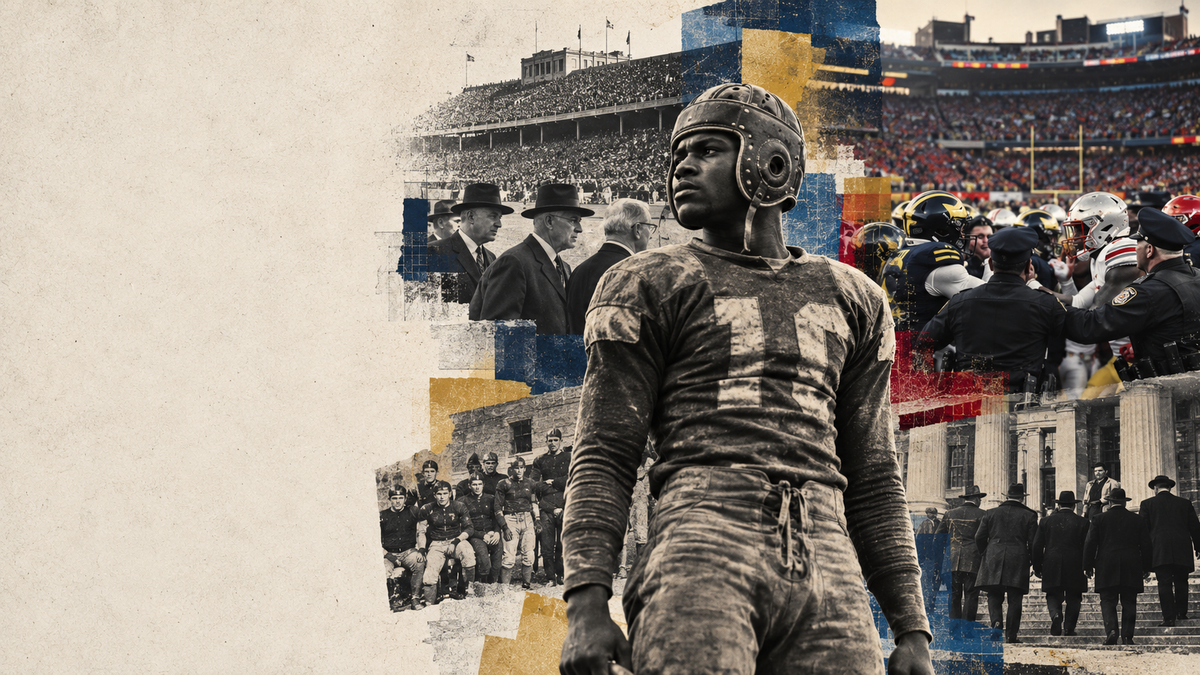
For more than 100 years, Big Ten schools have bragged about sportsmanship, fairness, and character. Their history of racial exclusion, athlete protests and stadium violence points to a tougher measure: whether those values hold up when keeping them could cost a game, a rivalry, a coach or the school’s own reputation.
The Big Ten has spent more than a century telling us its traditions prove something about who it is. The rivalries get handed down like family heirlooms. The stadiums are treated like shrines. And the universities insist they stand for something bigger than a final score. Fairness, sportsmanship, academic integrity, and respect aren’t side notes to the conference’s identity. They’re the whole pitch, what’s supposed to make college sports different from the pros.
Here’s the problem with values, though. Anybody can claim them when they’re free. The real test shows up when living by them means giving up something you badly want.
Would a school risk a football game rather than bench a Black player to please the other team? Would it stand up to a winning coach when his own players say he’s treating them unfairly? Would it toss out fans who cross the line, even if their noise is part of what makes the place so hard to play in? Would it own up to violence it could’ve prevented instead of blaming a few bad actors and moving on? None of these are thought experiments. Big Ten schools have faced every one of them, repeatedly, for more than 100 years.
Those moments give us a fair way to judge the conference. A school shows what it really values when it enforces its rules the same way every time, especially when doing so costs it a win, money, or its good name.
That standard asks three things. First, a school must set clear rules that protect everyone equally and make sure people know them. Second, it must enforce those rules no matter who’s involved, whether that’s a star player, a beloved coach, or someone the program can’t afford to lose. Third, when something goes wrong, it has to investigate honestly, hand out fair punishment, and admit its own part when its decisions helped cause the harm. Measure the Big Ten’s history against that, and the record is all over the place.
In 1934, Michigan played a scheduled football game instead of protecting Willis Ward’s right to play. In the decades that followed, schools upheld segregation to keep athletic relationships intact. In the late 1960s, Black athletes pushed back against unfair treatment inside programs run by coaches and administrators who held their futures in their hands. More recently, stadium assaults and racist harassment have tested whether schools can hold to their own standards when rivalry passions run hot and the whole country is watching.
These cases aren’t morally or historically the same, and pretending otherwise wouldn’t be honest. A school shutting out Black athletes is different from one fan’s racist gesture in the stands. An athlete throwing punches is different from a harassment claim nobody could prove. But each raises the same basic questions. What did the school know? What power did it have? What did it do? And whose interests did that choice protect?
Asking it that way also dodges a trap many college sports histories fall into. This isn’t about whether the Big Ten was worse than other conferences, whether its fans are meaner than everyone else’s or whether bad behavior is more common now than it was a century ago. The evidence doesn’t support any of those claims. The real question is narrower and a lot harder. When living up to its own values meant making a painful choice, did the Big Ten make it? You won’t find the answer in a mission statement. You’ll find it in what these schools did.
Ozzie Simmons and the Story Behind the Pig
Every year, the winner of Iowa vs. Minnesota carries off Floyd of Rosedale, a bronze pig that fans love as one of the sport’s most charming trophies. The story behind it isn’t charming. It starts with Ozzie Simmons, a Black running back who graduated from a segregated high school in Fort Worth, Texas, and rode the rails to Iowa City with his brother Don because he’d heard Iowa let Black players on its team. He walked into the coach’s office, asked for a tryout, and returned two punts for touchdowns at his first practice.
In 1934, Minnesota beat Iowa 48-12, and the way the Gophers played left a mark beyond the scoreboard. “They were blatant with their piling on and kneeing me,” Simmons said decades later. Iowa fans believed Minnesota roughed him up on purpose. By the 1935 rematch, things were so tense that Iowa Gov. Clyde Herring warned the crowd wouldn’t stand for it if Simmons got roughed up again, and Minnesota’s coach asked for a police escort and threatened to cut athletic ties.
Minnesota Gov. Floyd B. Olson cooled things off with a bet: a prize hog on the outcome. That’s the legend everybody remembers. Two governors, a joke and a pig. But notice who got pushed to the edges of the story. A young Black athlete took hit after hit, and the solution to a rivalry on the edge of a riot was a wager between politicians, not a reckoning over how he’d been treated.
Willis Ward and the Game Michigan Chose
That same fall, Michigan faced its own choice. Willis Ward, a Detroit native, was a star end, a track standout, and the team's only Black player. Georgia Tech refused to take the field unless Michigan benched him. Michigan agreed, and Fielding Yost benched Ward.
The campus erupted. Students and faculty were furious, and Ward’s roommate, a lineman named Gerald Ford, threatened to quit the team. Ward himself talked Ford into playing. Michigan won 9-2, its only win of the 1934 season, while the man the game was rearranged around sat and watched.
The damage didn’t end when the clock ran out. Ward had been aiming for the 1936 Olympics, but he lost his drive and never got there. “Georgia Tech game killed me,” he later said. He went on to become a lawyer and a judge, and Michigan declared October 20, 2012, Willis Ward Day, exactly 78 years after the benching. It was a fine gesture. It was also an honor that showed up nearly eight decades late.
Bill Garrett Breaks the Gentlemen’s Agreement
For years after Ward’s benching, Big Ten coaches followed an unwritten rule called a “gentlemen’s agreement,” which kept Black players off conference basketball teams into the late 1940s. Indiana was producing some of the best high school players in the country, many of them Black, and college coaches walked right past them. Nobody wanted to go first.
Bill Garrett changed that. He led Shelbyville to the 1947 state title, and Black leaders in Indianapolis, led by Faburn DeFrantz of the Senate Avenue YMCA, pushed Indiana University to give him a shot. IU president Herman Wells and coach Branch McCracken ignored the gentlemen’s agreement and brought him in. Garrett was the only Black player in the Big Ten for his entire college career.
He paid for being first. He put up with taunts from opponents and segregation at home and on the road, and he still became an All-American and, in 1951, only the third Black player ever drafted into the NBA. Within a year of his graduation, six Black players were on Big Ten rosters. Garrett’s story is the counterexample in this history. It shows what happened when one school stopped waiting for permission, even if outside pressure had to push it there.
Wisconsin’s Night in Houston
On December 6, 1958, Wisconsin’s basketball team traveled to Houston to play Rice. Local hotels couldn’t house the whole team. Jim Biggs and Ivan Jefferson, the first Black players in Badger basketball history, were sent to stay at Texas Southern, a Black college across town, while their teammates checked in together. The game had been scheduled about 18 months earlier, and according to UW’s own campus history project, nobody had considered that the roster might include Black players.
When the team got back to Madison, the student newspaper and Student Senate condemned what happened. On December 19, the athletic board adopted a policy saying UW athletes would “travel together, lodge and dine together and play together as a team without discrimination.” The basketball team didn’t play in the South again until 1963.
That policy was the right call, and it cost Wisconsin real games. But the timing is hard to ignore. Two years earlier, Wisconsin had already canceled football games with LSU rather than accept Louisiana law barring integrated competition. The school knew how to say no. It just didn’t think to say no until two of its own players had spent a night across town.
The Revolt of the Black Athlete, 1968 to 1972
By the late 1960s, Black athletes stopped waiting for schools to fix things. In 1968 alone, there were more than 100 publicized protests by Black college athletes, and the Big Ten was right in the middle of it. That April, at Michigan State, 38 Black athletes handed seven demands to athletic director Biggie Munn and boycotted spring drills until they got a meeting with the school’s faculty representative.
In April 1969, 16 Black players at Iowa boycotted spring practice and were dismissed. Their Black Athletes Union asked for academic counselors, five-year scholarships and a $15 monthly allowance, requests that sound downright modest today. The university’s athletic board said it was working on some of the issues, but it left discipline to the coaches. Some of those demands, like academic counseling and aid until graduation, later became standard across college sports. That Fall at Minnesota, 16 of 18 Black players asked coach Murray Warmath for a Black assistant coach and a counselor for Black athletes.
Indiana’s protest hit hardest. In November 1969, all 14 Black players skipped practice, and coach John Pont dismissed 10 of them under his rule against two unexcused absences. The players said they’d faced racist comments and unequal treatment, and they believed Black players were being “stacked” at certain positions. None of them ever played for Indiana again. It took until 2015 for the university to formally reconcile with the “IU 10.” Linebacker Don Silas said IU finally listened “in a way I felt they wouldn’t in 1969.”
Look at the pattern. The coaches enforced the attendance rules to the letter. The players’ complaints about how they were treated were handled as a discipline problem. That’s the standard flipped upside down, with the rules protecting those who already held power.
The Night Williams Arena Exploded
On January 25, 1972, Ohio State led Minnesota 50-44 with 36 seconds left. Minnesota’s Clyde Turner flagrantly fouled center Luke Witte, and Corky Taylor reached down to help Witte up, then kneed him in the groin. What came next was ugly. Ron Behagen stomped on Witte’s head, fans poured onto the floor and Dave Winfield came off the bench throwing punches. Witte needed 29 stitches and was left with a scarred cornea. Three Ohio State players went to the hospital, and Ohio’s governor called it “a public mugging.”
More than a few punches happened that night, though. Taylor claimed Witte spit at him, which Witte denied, and a review of the game film suggested Witte had elbowed a Minnesota guard at halftime. None of that justifies stomping on a man’s head.
Big Ten commissioner Wayne Duke suspended Taylor and Behagen for the rest of the season. Winfield, a future baseball Hall of Famer, faced no punishment and started the next game. And Minnesota’s own leadership objected to the suspensions instead of owning what happened in its building. If consistent enforcement was the goal, they didn’t reach it that night.
Modern Tests in Evanston and Ann Arbor
On January 18, 2022, a man in Wisconsin gear spent a basketball game at Northwestern’s Welsh-Ryan Arena flipping off the student section and making anti-Asian gestures, and he kept doing it as police walked him out. Nearly a quarter of Northwestern’s freshman class identified as Asian American. Within two days, Wisconsin announced he wasn’t a student or employee and was banned from all future UW Athletics events. That response was fast and clear. It’s also fair to note it cost Wisconsin almost nothing, since the program didn't depend on him.
Nine months later came a harder test. After Michigan beat Michigan State 29-7 on October 29, 2022, a fight broke out in the tunnel the teams shared. The Big Ten found that seven Spartans had been hitting, kicking or using their helmets on Michigan players, and those seven were charged with crimes. Michigan State was hit with a $100,000 fine, the largest in conference history, and cornerback Khary Crump drew a 12-game suspension.
Michigan got a public reprimand for failing to protect both teams as they left the field. Michigan State basketball coach Tom Izzo, while making clear he didn’t excuse his school’s players, pointed out that the shared tunnel had caused problems before. “What the hell does a reprimand mean?” he asked. It was a fair question. The players who threw punches paid heavily, and they should have. The school responsible for securing that tunnel got a strongly worded letter.
The Standard the Big Ten Should Be Held To
The Big Ten’s history doesn’t prove its schools are uniquely racist or violent. It proves something more specific, and honestly more uncomfortable. When principles got in the way of athletics, the university sometimes negotiated them.
Michigan’s treatment of Willis Ward in 1934 is still the clearest example, and it still stings. The university had every right to play him. It didn’t need more information to decide whether he was eligible. It knew exactly why Georgia Tech objected, because Ward was Black, and it chose to give Georgia Tech what it wanted. They kept a young man who’d earned his place on that field off it so a game could go on. By any standard of equal treatment, that’s a plain-and-simple failure.
Wisconsin’s segregated basketball travel in 1958 shows the same kind of choice. The school had integrated its roster, but on one road trip it first went along with separate, unequal lodging for its Black players. Consider what that told those players about where they stood with their school. When Wisconsin later adopted a policy refusing those arrangements, it proved a different answer had been possible all along.
Modern examples call for clearer lines. When Wisconsin banned a fan who made anti-Asian gestures at Northwestern in 2022, it showed it was willing to punish someone wearing its colors. When the Big Ten sanctioned Michigan State after the tunnel assaults, it recognized that violence had to carry a price. Its separate reprimand of Michigan made the point that a school’s security responsibilities matter too.
None of that erases what happened. And a fine or suspension shouldn’t automatically count as enough just because it exists. The questions that matter are whether the investigation was credible, whether the rules were applied evenly, whether the punishment fit, and whether the school addressed what it did to help the problem happen in the first place.
That’s a much higher bar than condemning bad behavior after the fact. It forces schools to take a hard look at their own decisions, including the ones made long before anything went wrong. It also admits that no school can promise every fan will behave or every athlete will keep his cool. Universities aren’t automatically on the hook for every individual’s actions. They’re on the hook for the rules they write, the risks they can see coming, the complaints they look into, and the consequences they hand out.
That difference matters more than it might seem. Without it, accountability becomes one of two useless things: an impossible demand that schools stop every bad act, or a hollow routine of press releases after something embarrassing goes public.
The Big Ten has gotten very good at protecting its traditions and cashing in on them. The Floyd of Rosedale trophy, the Michigan–Ohio State rivalry and the conference’s historic basketball arenas mean something real to generations of fans. Those traditions don't have to clash with protecting athletes and fans. The clash comes when a school decides that keeping a tradition, an edge on the field, or a friendly relationship with another program is worth bending the rules it says it lives by.
Bottom Line
A century of history is enough to retire the idea that these were just unlucky accidents. Time after time, Big Ten schools faced moments when their values came with a real price tag. Sometimes they paid for it. Other times they passed the bill to athletes with the least power to refuse, and those athletes carried it.
That’s the line that matters. The Big Ten shouldn’t be judged by whether bad things ever happen. It should be judged by whether its schools set clear rules, enforce them fairly, own the failures they could’ve prevented, and protect people even when it costs them something they care about.
By that measure, the conference’s history isn’t a nonstop string of failures, and it isn’t a feel-good story where progress was guaranteed either. It’s an ongoing test of whether these principles are real obligations or just traditions people dust off when it’s convenient. That says more about the Big Ten’s character than any trophy, title, or rivalry ever will.
Comments ()