
Where Does the $20.5 Million Really Go? Inside Big Ten Revenue Sharing
Big Ten schools say they are spending $20.5 million on athletes. But scholarships, NIL and creative accounting reveal a far more complicated reality.
College athletics has a new favorite number, and you can't get through a press release without tripping over it. $20.5 million. Athletic directors say it straight-faced. University presidents say it like a dare. Fundraising offices say it with a hand already out.
For the first year of the House settlement, that was the amount major athletic departments could spend under the new athlete-compensation system. It became more than a budget line. It became a loyalty oath. If you plan to compete at the top, you announced you'd go to the cap. The Big Ten did, and so did the SEC. Colorado said it intended to distribute the maximum, and UCF said it would commit the full amount. Minnesota athletic director Mark Coyle committed to the full amount, and all 18 Big Ten schools planned to operate at the maximum. The ceiling quickly started to feel like an entry fee for the Power Four.
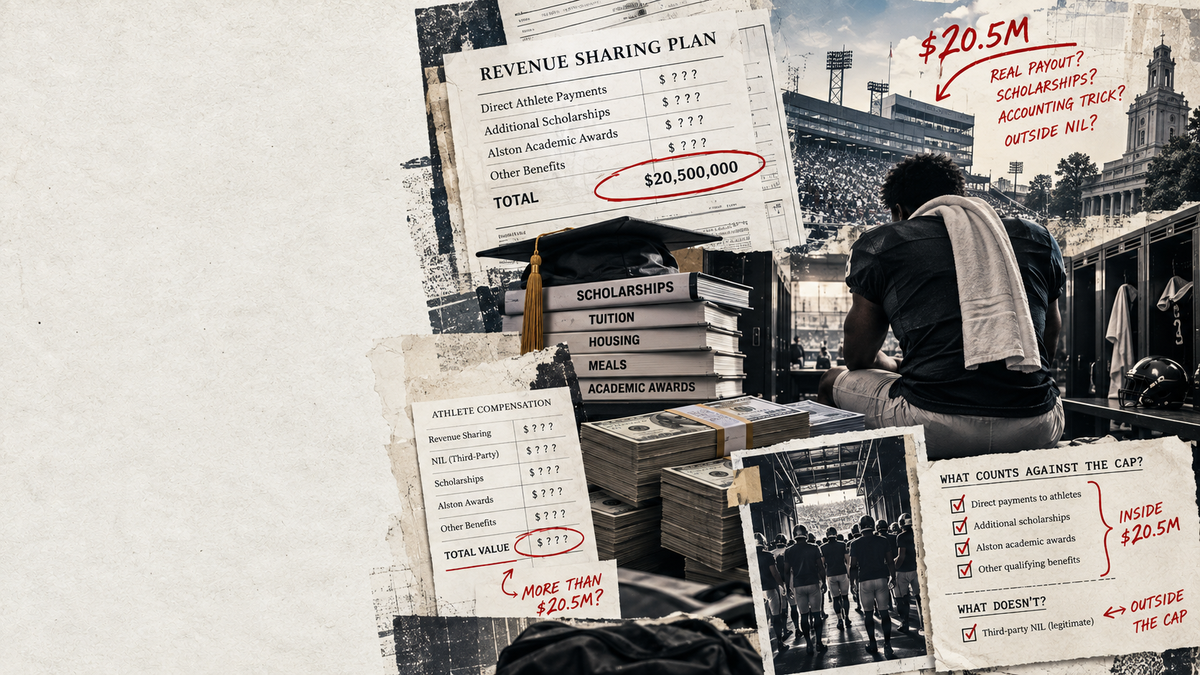
Then the language slipped. "$20.5 million in revenue sharing" started getting used as if it meant "$20.5 million in new cash payments to athletes." It doesn't, and that gap is more than an accounting footnote. It shapes what athletes, fans, donors and taxpayers are being told about where the money goes. Buried under that clean, tidy headline is a messy pile of cash payments, scholarships, academic awards and other benefits. Some count against the cap, and some don't. Some put new money in an athlete's pocket, and some just restate the value of things schools were already handing out. When a school proudly announces it's "fully funding $20.5 million," applause shouldn't be the first response. The first response should be a question: $20.5 million of what?
Everybody Wants to Say They're Paying the Max
The settlement never required anyone to hand athletes $20.5 million. The figure was a first-year ceiling from the settlement formula, and schools were free to spend less. There was no minimum.
But college sports don’t let ambitious schools treat a maximum like a suggestion. Once Ohio State spends to the limit, Michigan has an obvious reason to follow. If Oregon is at the cap, Washington can't sit down with a five-star quarterback and explain that it has chosen fiscal restraint. If Alabama and Georgia are maxing out, every conference rival knows exactly what happens if they don't. What started as compliance turned into an arms race wearing a compliance costume.
Legal analysis from the time reported that every Big Ten and SEC institution had committed to fully funding athlete compensation at the $20.5 million level for the first year. Think about how fast that happened. A few years ago, the organizing rule of college sports was that schools couldn't pay athletes to play. By 2025, dozens of America's richest athletic departments were bragging about spending every last dollar the new ceiling allowed.
There was a catch, though. Not every dollar under that ceiling meant the same thing.
Minnesota Shows How the Sausage Gets Made
Minnesota gives us one of the clearest looks because Coyle was refreshingly open about what the Gophers planned to put inside their $20.5 million bucket. The plan was to operate at the cap, which sounds simple enough. Then he revealed that Minnesota was adding 11 scholarships, five in football and six across women's sports. Football would move to 90 scholarship players, and volleyball, hockey, gymnastics, softball, and soccer would each get additional scholarships.
Scholarships cost money, but here's what matters. Minnesota intended to deduct their cost from the $20.5 million cap.
I'm not accusing anyone of anything. The settlement rules allow it. The NCAA framework lets qualifying additional scholarships count against the athlete-benefit pool, within certain limits, and Alston academic achievement awards can count too. Minnesota followed the rules. But following the rules and explaining economics honestly are two separate jobs.
Picture a school saying, "We are distributing $20.5 million to our athletes." Most people would hear that and assume athletes are getting $20.5 million in new direct pay. Now picture the accurate version: the school is using the full allowable pool, part of which is the assigned value of extra scholarships and possibly other countable benefits, with the rest available for direct payments. Same cap, but a completely different feeling. One is a payroll, and the other is an accounting basket, and the public keeps being handed the first description while the books describe the second.
Oregon's Words Changed, and That Tells You Plenty
Oregon offers an even sharper example because its own language shifted as the system matured. Before year one began, Oregon Athletics said it would "fully fund and distribute $20.5 million to student-athletes as permitted by the House settlement." That sounds like a giant check going straight to athletes.
A year later, Oregon described what it had funded. The university said Oregon Athletics, fans and donors had funded "$20.5 million in additional scholarships and revenue sharing," and that it had provided 41.4 additional scholarship opportunities. Read those two phrases back-to-back. Both can be true under the rules, but they leave you with very different pictures in your head.
Oregon's fundraising material makes the math even plainer. Its SHOUT! campaign projected at least a $2.5 million annual increase in scholarships, while describing the combined spending on additional scholarships and revenue sharing as reaching the $20.5 million cap. That's why "revenue sharing" deserves a hard look. The public hears payroll, and the rules allow something more tangled.
Nobody's Cooking the Books, and That's the Problem
It would almost be easier if someone were. The creative accounting here is baked right into the rules. The House framework lets schools count certain new benefits against the settlement pool, and Oregon State's own explanation of the settlement was refreshingly blunt: the $20.5 million could cover direct NIL compensation, Alston academic awards, additional scholarships and other qualifying athlete benefits.
That gives athletic departments huge flexibility in how they build the number. School A can pour nearly all of its cap into direct contracts with athletes. School B can add millions in scholarships and count the allowable portion. School C can fold in qualifying academic awards. All three can stand up and announce they're at the $20.5 million maximum, and none of them is lying. They just haven't put the same amount of new cash into athletes' bank accounts.
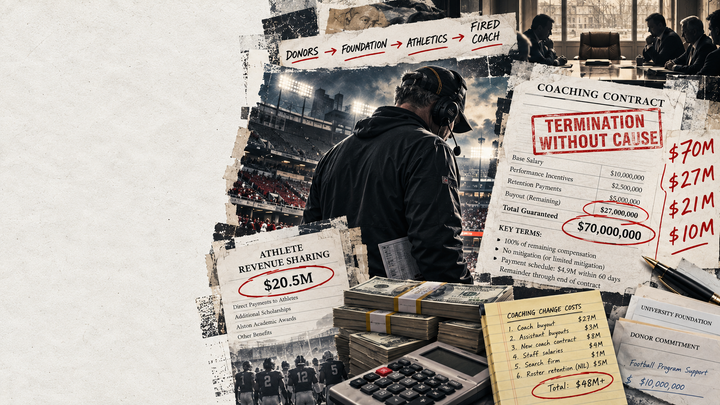
That matters a lot at public universities. These same schools are asking donors for more, raising ticket prices, reorganizing departments, trimming expenses, and warning that athlete pay has created a historic financial burden. If $20.5 million is the evidence for that burden, people have a right to know what's inside it.
A Scholarship Isn't a Paycheck
An athletic scholarship is worth a lot to the person who gets it. Tuition, housing, meals, and academic support are of real value, and nobody should wave that away.
But a school's published cost of attendance isn't the same as what it costs the school to add one more scholarship athlete. If a university prices a scholarship at tens of thousands of dollars, that doesn't mean the athletic department cut a check that size. The classroom already exists, and the professor is already teaching. The dining hall is already open, and the dorm is already standing. The athlete got something valuable, but it isn't economically identical to a $60,000 cash payment.
Under the settlement framework, though, qualifying scholarship expansion can eat up cap space. That means a university can truthfully say it maxed out the $20.5 million pool even when the new cash going straight to athletes is less than $20.5 million. Calling that fraud is wrong but calling it "$20.5 million in revenue sharing" doesn't feel right either.
Then the Trick Runs the Other Way
Just when the number starts to look inflated, the math flips. The same $20.5 million can seriously understate what athletes receive. Third-party NIL that meets the rules sits outside the institutional cap, so a football player can collect money through his school's agreement and more from legitimate commercial deals. UCF described its $20.5 million institutional commitment as existing in addition to ongoing NIL opportunities.
A school might put less than a full $20.5 million into direct revenue-sharing cash because scholarships ate up part of the cap, while its roster pulls in millions more through outside NIL. The famous number ends up doing something remarkable. It can overstate direct institutional cash while understating total athlete compensation at the same time. As a definition of payroll, that's useless.
The richest programs know this perfectly well. A quarterback choosing between two Big Ten schools doesn't care which column his money lands in. He cares about the total package, and so do his agent, the coach chasing him, and the rival school trying to steal him. Athletic departments have to juggle accounting categories, but athletes live in one market. The real competitive number isn't the House cap. It's the total value available to the roster, and that number is much harder to find.
The Receipts Stay Locked Away
Minnesota adds one more uncomfortable lesson. Coyle publicly named five programs that would share in the revenue-sharing payments: football, men's basketball, women's basketball, volleyball and men's hockey. He said they'd get the "lion's share." But when people asked how the money would actually be divided, Minnesota wouldn't say, and like most schools, the Gophers still don't disclose what share each team receives. By 2026, the university was turning down public-records requests for individual athlete payments and even program-level allocations, arguing that disclosure could reveal commercially valuable information.
Sit with how strange that is. A public university can announce it's maxing out a $20.5 million pool. It can point to that expense when it talks about the financial pressure on college sports, and it can ask donors to help cover it. But when the public asks how much football gets, the answer becomes a trade secret. The headline is public while the accounting underneath stays proprietary, and that's awfully convenient for the people writing the headline.
The Number Became a Fundraising Tool
Oregon now uses the settlement expense directly in its fundraising. The school says donors helped fund its first-year $20.5 million investment and is asking supporters to help cover the next year's higher obligation. It says more than 300 Duck Athletic Fund donors made the first-year commitment possible. Asking donors to support athletes is perfectly fine, but once $20.5 million is a fundraising pitch, precision matters more, not less.
If a school tells supporters it needs millions because athlete pay has created a new $20.5 million expense, those supporters should be able to see how much is direct compensation, how much is added scholarships, and how much is other counted benefits. Without that, the number stops being a disclosure and starts being a marketing line. It's big enough to sound alarming and simple enough to remember, yet murky enough underneath that almost no one knows what it means.
It also creates a false sense of fairness. Ohio State gets roughly $20.5 million, and so do Oregon, Iowa, and Northwestern. Everybody plays under the same institutional ceiling. Except the ceiling doesn't cover the whole market. Outside NIL, commercial deals, booster networks, corporate ties, and the pull of a program's brand all still matter, so two schools can both say they've maxed out revenue sharing while their athletes have access to wildly different total pay. The settlement capped one lane of the highway and left the traffic alone.
And the bill keeps growing. Oregon says its comparable athlete investment rises from $20.5 million in 2025-26 to $21.5 million in 2026-27. The settlement was built to climb over time, so athletic departments aren't solving a one-time problem. They're stepping onto an escalator. The financial pressure is real, and finding tens of millions of dollars in a market where schools once couldn't pay athletes at all is no small thing. But because the change is real, schools shouldn't get to hide behind a number that explains so little.
Show Us the Receipts
The fix isn't complicated. Every public Big Ten university should disclose five things. First, how much of its House cap went to direct cash payments to athletes. Second, how much was counted as additional scholarships. Third, how much in Alston academic awards or other qualifying benefits are covered. Fourth, how much went to each sport. And fifth, how many athletes received direct institutional pay.
None of that requires exposing a single athlete's private finances. It just asks schools to back up the number they're already advertising. If Minnesota says it used the entire cap, show how. If Oregon says it funded $20.5 million in scholarships and revenue sharing, separate the two. If Ohio State, Michigan, Iowa, Wisconsin, and the rest say they're maximizing athlete benefits, tell us what that word means.
These schools have spent years asking fans, donors, networks, and taxpayers for bigger commitments, all while insisting that college athletics is in an economic crisis. Fine. Then open the books.
The Bottom Line
The House settlement changed college sports for good. Athletes now get direct pay from the schools whose football and basketball programs bring in enormous money, and that's real. So is the strain on athletic departments and the pressure to keep spending.
But "$20.5 million in revenue sharing" is far too convenient a shorthand. It can include scholarships and academic awards. It leaves out legitimate outside NIL, and it doesn't say how much football gets or how many athletes receive direct payments. Most of all, it doesn't tell us how many real dollars moved from an athletic department into an athlete's bank account. The number gets repeated as if all those questions were already answered, and they weren't.
Year one of revenue sharing was supposed to start a more honest era, one where everyone admitted the people making the product deserved a cut. It's a bitter joke that one of the system's first habits has been squeezing a complicated stack of payments and benefits into one marketable number. $20.5 million isn't false, and that's exactly why it works so well. It just isn't anywhere close to the whole truth.
Comments ()