
Big Ten Coaching Buyouts: What It Costs to Fire Every Football Coach
What does it cost to fire a Big Ten football coach? From Lincoln Riley to Mike Locksley, massive buyouts reveal the hidden economics of the hot seat.
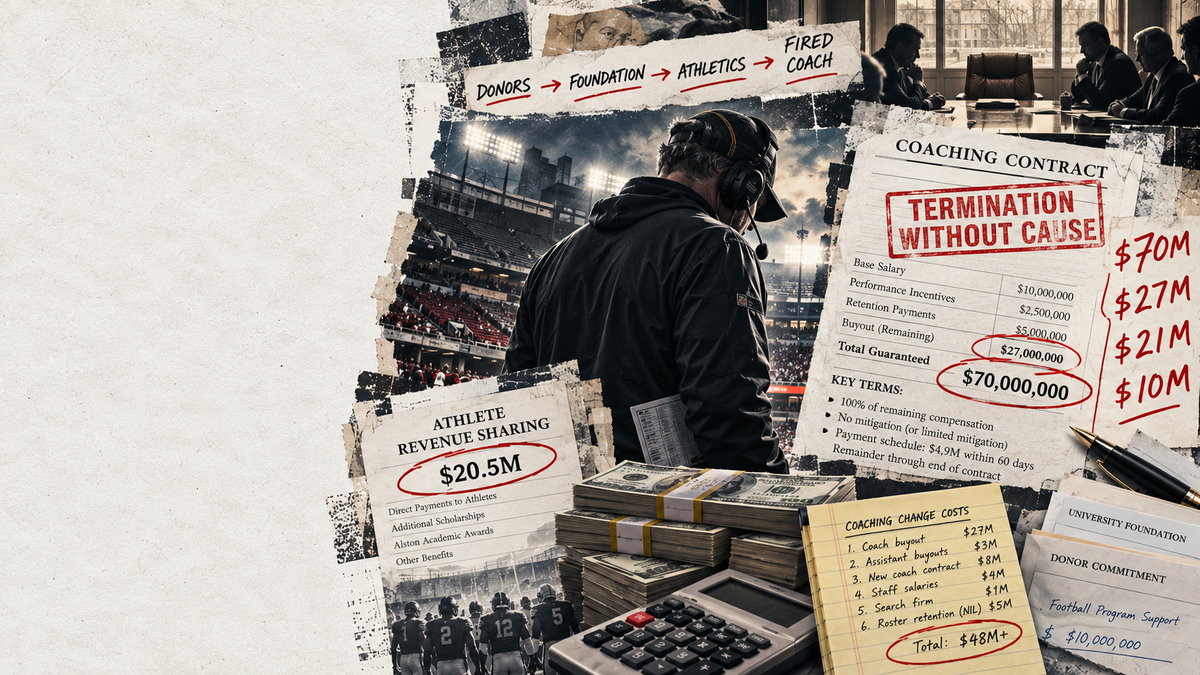
Somewhere right now, a fan is screaming at a television over blown coverage, sure the coach should be gone by Monday. Somewhere else, an athletic director stares at a spreadsheet and feels slightly ill. The fan wants a firing, but the athletic director must pay for one, and those are very different jobs.
What Would It Cost to Fire a Big Ten Football Coach?
Most of these numbers are Dec. 1, 2025, snapshots, so today's real obligations sit a little lower wherever a coach has collected another year of pay. Where a school is private, or a deal has been reworked since, we've said so.
USC, Lincoln Riley: roughly $60 to $70 million. USC is private, so the actual contract isn't public. CBS Sports and Yahoo Sports both put the figure near $70 million, which makes Riley the conference's best example of a contract that can shape the decision itself.
Ohio State, Ryan Day: $70.9 million at the Dec. 2025 benchmark. Day had the largest publicly reported Big Ten termination liability in USA Today's data as summarized by On3. The September 2026 amount has since declined because compensation has been paid in the meantime.
Indiana, Curt Cignetti: $56.7 million at the Dec. 2025 benchmark. His agreement effectively guarantees the remaining compensation, so Indiana's remarkable success has also produced a very expensive commitment.
Oregon, Dan Lanning: $56.7 million at the Dec. 2025 benchmark. His contract was among the most heavily guaranteed in the conference, per the same Yahoo Sports ranking. Today's remaining obligation will be somewhat lower.
Nebraska, Matt Rhule: $49.6 million at the Dec. 2025 benchmark. This one shows how a long-term guarantee can make patience financially rational even when a program gets restless.
Illinois, Bret Bielema: $49.5 million at the Dec. 2025 benchmark. Illinois carries substantial exposure even though its football economics look nothing like Ohio State's or USC's.
Washington, Jedd Fisch: $33.7 million at the Dec. 2025 benchmark. That's a big liability for a school that also entered the Big Ten on a reduced initial conference distribution.
Minnesota, P.J. Fleck: $26.6 million at the Dec. 2025 benchmark. Fleck has since moved another year through his contract, so the published snapshot overstates what Minnesota would owe today.
Iowa, Kirk Ferentz: $25.7 million at the Dec. 2025 benchmark. Ferentz's age and very long tenure make the theoretical termination liability a poor guide to whether Iowa would ever use it.
Purdue, Barry Odom: $25.1 million at the Dec. 2025 benchmark. That's a remarkable potential obligation for a program that hired him only after the disastrous Ryan Walters tenure.
Rutgers, Greg Schiano: $23.7 million at the Dec. 2025 benchmark. Like Maryland, Rutgers shows how a $20-million-plus coaching obligation can dwarf what the athletic department can comfortably absorb.
Michigan, Kyle Whittingham: roughly $24 million, depending on termination date. His new five-year deal carries about $41 million in base salary, and Michigan owes 75 percent of the remaining base if it fires him without cause. That makes the liability a moving calculation rather than a fixed buyout.
Wisconsin, Luke Fickell: roughly low-$20 millions now. The Dec. 2025 comparable figure was $27.49 million, and his shrinking guarantee puts the 2026 exposure near $21 million. It's one of the most relevant hot-seat contracts in the conference right now.
UCLA, Bob Chesney: roughly $20 million, subject to mitigation. His five-year deal pays $5.4 million in 2026 and rises to $5.8 million in Year 5. UCLA would owe 75 percent of his remaining base salary and talent fee if it fired him without cause, but Chesney would have to look for other work, and those earnings could offset what UCLA pays.
Michigan State, Pat Fitzgerald: about $18.1 million after his first season. It would run somewhat higher if he were terminated during 2026. His new agreement guarantees 72.5 percent of remaining salary, which is much friendlier to the university than Jonathan Smith's old 85 percent.
Maryland, Mike Locksley: approximately $9.9 million before the end of 2026. On3 reconstructed the terms, and this is probably the most useful case study on the list. The number is big enough to hurt but small enough that Maryland could realistically absorb it, which isn't true of USC and Riley.
Penn State, Matt Campbell: 100 percent of remaining guaranteed compensation, subject to mitigation. Campbell's deal starts at $8 million in 2026 and climbs to $8.25 million in 2027 and $8.5 million in 2028. Penn State would start with a very large eight-figure bill if it fired him without cause, though his future earnings could shrink what it ultimately pays.
Northwestern, David Braun: undisclosed. Northwestern is private and doesn't publish his terms. That matters more now, because the school extended him through 2031 on September 17, 2026, with the reported significant raise and the new guarantee and termination provisions still private.
Lincoln Riley and Mike Locksley have a lot in common this fall. Both coach Big Ten programs whose recent results have people wondering how long their universities will wait. Financially, though, they might as well play different sports. Maryland's decision on Locksley comes with a price tag that hurts but makes sense. If Maryland fires him before the end of the 2026 season, current reporting puts the bill at about $9.94 million. Half of it, roughly $4.97 million, would reportedly be due within 60 days, with the rest paid out by the end of his contract. The deal reportedly has no mitigation or offsets clause, so whatever Locksley earns at his next job wouldn't reduce what Maryland owes. On3 recently reconstructed the current buyout from Locksley's contract terms.
USC's math on Riley is almost surreal by comparison. USC is a private school, so Riley's full contract isn't available through the public-records laws that expose deals at places like Maryland, Wisconsin, and Iowa. Still, multiple reports now put USC's potential liability somewhere around $60 million to $70 million. Yahoo Sports' Ross Dellenger recently estimated it to be nearly $60 million, and CBS Sports reported roughly $70 million. Both reports landed as Riley's future drew fresh attention after USC's 41-27 home loss to Oregon.
Wisconsin's Luke Fickell offers a third flavor of the same headache. Recent reporting puts the Badgers' potential obligation at more than $21 million, though the win at Penn State changed the conversation around him.
Put the three cases side by side, and the hot seat stops being a weekly ranking of unhappy fan bases. Maryland can ask whether Locksley is worth another $10 million. Wisconsin can ask whether replacing Fickell is worth more than $20 million. USC may have to ask whether replacing Riley is worth something close to $70 million before it hires a single replacement. Those aren't really football decisions; they're capital-allocation decisions, and in modern college athletics the size of the buyout can matter almost as much as the win-loss record.
The Contract Can Be a Coach's Best Defense
Locksley's problem is easy to understand, and it's ugly. Maryland has won only two of its last 17 Big Ten games. The Terrapins just lost 54-3 at home to UCLA while averaging 2.3 yards per play, which is the kind of number that makes a fan base stop arguing and start grieving. Yahoo Sports' current hot-seat look says Maryland could move fast, and other national reporting has pegged Locksley's position as shaky too.
But Maryland can't decide by staring at the scoreboard. It must read the contract. The university reportedly owes Locksley 65 percent of his remaining compensation if it fires him without cause. If it does it before the end of 2026, the reported number is $9.94 million. Wait until after the season, and it drops to about $8.9 million. Wait until after 2027, and it falls to roughly $4.5 million. Suddenly the calendar has a dollar value, and every losing Saturday ticks the meter in a direction nobody can quite predict.
If Maryland believes another coach could truly lift the program, paying $9.94 million might be smart. If administrators think the program is stuck but doubt a new coach would quickly boost revenue, recruiting or donor excitement, waiting starts to make sense. And if deep-pocketed Maryland donors are ready to fund the change, the math shifts again. The question isn't just whether Locksley should be fired. It's whether replacing him today is worth several million dollars more than replacing him later, and that's a much colder question than anything shouted from the stands.
Then There's Lincoln Riley
USC shows what happens when a buyout gets so big it swallows the normal football logic. Riley is 39-19 in five seasons there, but the criticism centers on whether the results match USC's resources and expectations. After the Oregon loss, his record against ranked opponents stood at 5-15. A typical athletic director would weigh recruiting, development, wins, championships, and the program's direction. USC has one more item on the list: potentially $60 million to $70 million just to make Riley stop coaching there.
That isn't even the cost of the change. It's the cost of opening the vacancy. USC would still have to hire someone, which might mean paying another school a buyout, then a new salary, an assistant-coach pool, support staff, a recruiting operation, and enough roster money to keep the transfer portal from gutting the team during the handoff. The real question is closer to this: is replacing Riley valuable enough to justify perhaps $60 to $70 million of termination exposure plus the cost of buying and financing his successor?
That turns the contract into job security. USC doesn't necessarily believe Riley is the right coach forever. It may simply have made being wrong outrageously expensive, which is a strange thing to do on purpose.
Nobody Mentions This on Hiring Day
When a university unveils a giant coaching contract, it sells the guaranteed money as ambition. A seven-, eight-, or ten-year deal signals commitment. A huge salary signals seriousness. A big assistant pool signals competitiveness, and a fat guarantee helps lure a winning coach away from somewhere else. Nobody steps up to the microphone at the introductory press conference and says, "If this doesn't work out, getting out of it could cost us $50 million." But that possibility is baked into the paper from day one.
The university isn't only pricing what the coach is worth if he succeeds. It's also pricing what failure will cost, whether anyone says so out loud or not. That's why the current Big Ten hot seats deserve to be read through contracts rather than emotion. A fan can decide after a humiliating Saturday that the coach should be gone by Sunday morning. The athletic director has to find the money.
Wisconsin Has Been Here Before
Wisconsin makes a useful case study because it has lived this script. When the school fired Paul Chryst five games into the 2022 season, roughly $20 million remained on his contract. The parties negotiated the obligation down to $11 million, and athletic director Chris McIntosh said the University of Wisconsin Foundation would cover the full amount.
Now Wisconsin has another coach under scrutiny and another large contractual obligation. Recent reporting puts Fickell's buyout at more than $21 million. The win at Penn State may have cooled things off for the moment, but it doesn't change the financial structure underneath. If Wisconsin eventually decides the Fickell experiment failed, it could face another eight-figure bill just to start over.
That raises an uncomfortable question. At what point does an athletic director who signed or inherited a giant coaching guarantee get reluctant to admit the bet failed, because admitting it means writing another giant check? The buyout doesn't only pay the coach. It can bend the university's judgment about the coach.
The Dead Zone
Picture two coaches producing identical, disappointing results. Coach A has a $4 million buyout, and Coach B has a $40 million buyout. Their football is the same, but their job security isn't close. An athletic director can remove Coach A fairly easily by calling a few major donors and absorbing some of the cost in the department. Coach B might survive for the worst possible reason: his contract is worse for the university.
That creates a twisted incentive. The more aggressively a school guarantees money on hiring day, the harder it becomes to fix the mistake, and a bad contract becomes a coach's strongest protection. Riley's situation shows why this matters. Current reporting explicitly describes his enormous buyout as a central factor in USC's thinking, though CBS reported that USC could still consider a change depending on how the season finishes. The football question and the money question have become impossible to pull apart.
And the Numbers Keep Getting Sillier
This isn't just a Big Ten story. Florida State's Mike Norvell entered 2026 under heavy pressure after the program's steep decline. Yet firing him during or before the end of the 2026 season would reportedly trigger an obligation of about $51 million, and after the season the figure reportedly drops to roughly $45.6 million. Add Norvell and Riley together and their termination costs alone approach or exceed $100 million.
That doesn't mean either coach will be fired. It shows how expensive their schools have made the decision, and it should change how we talk about the hot seat. Two coaches aren't equally in danger just because their fan bases are equally angry. What matters is whether the university can, and will, pay for the exit.
The Buyout Isn't the Cost of the Change
Even those huge figures understate the damage. If USC decided it wanted a new coach, it could owe tens of millions just to end the old relationship, then must acquire the replacement. The real price tag stacks up like a grocery receipt nobody wants to read: the old coach's settlement, assistant-coach severance, the new coach's buyout, his salary guarantee, new staff contracts, search costs, and whatever it takes to keep the roster together.
That last item matters more every year. Changing coaches now risks changing rosters. Players have contracts, NIL opportunities and transfer options, and a new coach may inherit a group built for the old system. Some will leave, and the program may have to find replacements through the portal. The cost of firing a coach no longer stops at the coaching offices. It can reach straight into the roster budget.
Which Brings Us Back to the $20.5 Million
This is where college athletics' newest financial complaint runs into its oldest spending habit. Athletic departments have spent the past year warning about the pressure from roughly $20.5 million in athlete revenue sharing and other qualifying benefits. They're not wrong, since that's a massive new expense. But set those numbers beside the coaching market and something odd happens.
Maryland could owe Locksley roughly half a year's House-settlement athlete pool just to let him go. Wisconsin could face a bill about equal to an entire year's athlete pool if it changes coaches at the reported figure. USC's reported Riley exposure could reach about three years of the original $20.5 million cap. None of that includes the replacements.
So the supposed crisis of paying athletes looks a little different. Universities do face real new costs. But some of the same schools complain about finding $20 million a year for hundreds of athletes have signed contracts that could send similar or far larger amounts to one coach they no longer want. That isn't an athlete-pay problem. It's a governance problem.
Who Signed Off on This?
Every expensive coaching failure should trigger a string of questions. Who negotiated the contract, and who approved the guarantee? What did the athletic department assume about future revenue, and what did university counsel say about termination exposure? Did trustees vote on it? Did the foundation agree in advance to help cover a buyout? Did donors push for the hire? And when administrators guaranteed tens of millions of dollars, did anyone model what happens if the coach just turns out to be mediocre?
Universities run elaborate financial analysis before building a $70 million academic building. Yet athletic departments have repeatedly created liabilities of the same size through coaching contracts, then act stunned when the bill arrives. The buyout didn't appear out of nowhere. It was created on hiring day.
Then the Donors Walk In
Once an athletic director decides that keeping the coach costs more competitively than firing him financially, the next question is who'll pay. Wisconsin's handling of Chryst showed one answer: foundation money. Indiana's firing of basketball coach Archie Miller showed another. An investigation by Indiana University's Arnolt Center found that anonymous donors supplied the entire $10.35 million cost of buying out and replacing Miller.
This is where coaching changes turn from sports stories into governance stories. Imagine an athletic director needs $15 million to fire a coach and three major donors are ready to provide it. Those donors don't formally gain the power to hire and fire just because they wrote checks. But it would be naive to pretend the people who make the preferred decision possible have no influence. Money doesn't need formal authority to create power, and sometimes access is enough.
Locksley May Be the More Revealing Case
Riley's number is spectacular, but Locksley's may teach us more. USC is one of the richest brands in college football, so a giant financial commitment fits the scale of the place. Maryland sits in a different spot in the Big Ten, which makes a termination payment near $10 million a far heavier institutional choice.
Maryland has to decide whether the program's direction justifies the expense, whether donors will back it, whether waiting cuts the cost enough to matter, and whether a replacement would bring enough on-field and financial lift to be worth it. And every week rewrites the answer. A win can buy time, while an ugly loss can rally donors. A recruit can change the mood, attendance can slip, the buyout can step down, and a candidate can suddenly become available. The hot seat isn't just getting hotter or colder. Its price is moving.
Stop Ranking Hot Seats. Price Them.
That may be the smarter way to read the 2026 coaching carousel. Instead of asking which coach faces the most pressure, ask what it costs to act on that pressure. For every coach whose job is being questioned, find the current termination liability, the date of the next buyout reduction, and the payment schedule. Check for mitigation or offset requirements and for any foundation involvement. Then estimate the assistant-coach severance and the cost of landing a replacement. Seen that way, the carousel looks less like sports gossip and more like distressed-asset management, and maybe that's what it has become.
The Bottom Line
There's one last irony. The university that negotiated the worst contract can become the one least able to respond to poor performance. A coach with a modest guarantee has to keep winning, while a coach behind a giant guarantee has another form of protection: his contract.
None of this means Riley will stay at USC, Locksley will leave Maryland, or Fickell will leave Wisconsin. Those calls belong to their schools, and the seasons are still underway. But their situations expose the economic structure under every modern hot seat. Performance decides whether administrators want a change, and the contract decides what wanting a change costs. The real decision lives somewhere between those two numbers. The most revealing question this fall isn't which Big Ten coach gets fired next. It's how much a university will tolerate losing when firing the coach becomes too expensive.


Comments ()