
The Win Donor Economy: How College Football Teams Get Paid Millions to Be Overmatched
Big Ten schools pay opponents up to $1.9 million for football games. Public contracts reveal the economics behind buying games and college football's "win donors."
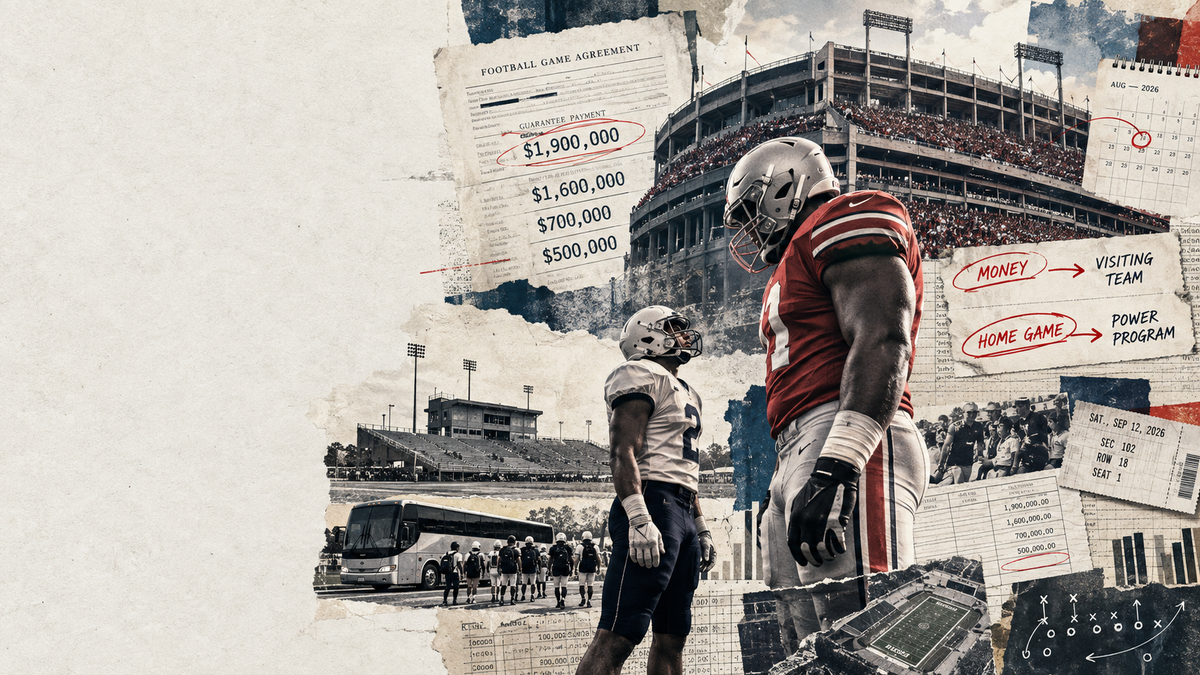
Somewhere in Kent, Ohio, an athletic administrator looks at a $1.9 million check and feels two things at once: relief and a little nausea. Before we get to that check, though, we need to know what a football game costs when nobody's being paid to get run over.
Start with Ohio State and Texas. Texas visited Columbus in 2025, and Ohio State returns the favor in Austin in 2026. Each visitor collects $500,000, mostly to cover travel costs. Texas deputy athletic director Rob Novak put it as simply as possible: "We just trade $500,000 to cover their charter and hotel expenses." The host keeps everything the stadium brings in, including tickets, concessions, and parking. The Houston Chronicle obtained the agreement through a public-records request, and Ohio State athletic director Ross Bjork has since held it up against the far bigger checks it takes to bring smaller programs to town.
That's what a fair fight looks like on a spreadsheet. Both schools get a prized home game, and both must survive a nasty road trip. Nobody owes anybody an apology or a payout, because the favor comes back around. It's almost sweet.
Even the Old Rivalries Play by These Rules
Iowa and Iowa State do it their own way, but the logic holds. Iowa State's announcement of a ten-year extension described games alternating between Ames and Iowa City. For the first five years, the schools kept splitting 20 percent of ticket revenue. In the final five, gate money moved toward the usual home-and-home setup. Iowa State described the arrangement as mutually beneficial, and you can understand why. When both sides put something on the line, both sides walk away with something.
The older Big Ten numbers draw the same line in thick marker. An Associated Press look at the conference's contracts found that games against power-conference opponents with a return trip averaged roughly $329,000. Games against FBS opponents who came once, cashed out, and never returned averaged about $828,000. The study exposed an economically distinct market for one-way games.
That was more than a decade ago. Prices have gone vertically since, and they've created college football's most uncomfortable job title: the "win donor."
What Exactly Is a Win Donor?
Don't picture a hopeless team. Northern Illinois, Western Michigan, and Appalachian State have all made people pay for assuming that. The label has nothing to do with talent. It describes the role a school gets hired to play.
Here's how the deal works. A powerful program wants one more home game but flatly refuses to give up a future one in return. A financially weaker program needs cash badly enough to sign away its half of the normal bargain. So the stronger school writes a check, and everyone pretends it's normal.
Ohio State will pay Kent State $1.9 million for its 2026 trip to Ohio Stadium. Ball State gets another $1.9 million. Iowa agreed to pay Northern Illinois $1.6 million, Washington will pay Utah State $1.5 million, and Indiana will pay North Texas $1.2 million. Down at the FCS level, Northern Iowa collects $700,000 from Iowa, while Howard gets $525,000 from Indiana and $475,000 from Rutgers.
Don't call those travel reimbursements. A charter flight doesn't cost $1.9 million. That money is the price of an arrangement built to be lopsided, and the visiting school knows what it's selling. It gives up its own home date, marches into a stadium several times the size of its own and lines up across from a roster funded at a level it'll never see. Then it takes the beating, sometimes a bad one, and deposits the check.
When the scoreboard turns ugly, nobody should act shocked. The ugliness is a risk written into the deal, and everyone who signed the contract could see it coming.
The Alternative Sets the Price
Put Ohio State's two 2026 nonconference deals side by side, and the contrast almost makes you laugh. In Texas, Ohio State receives $500,000, the same amount Texas got for coming to Columbus. At home against Kent State, Ohio State pays $1.9 million.
So why does Kent State command nearly four times what Texas gets? Because Texas is handing Ohio State something Kent State can't: a game in Texas. The Longhorn’s deal is a trade between equals. The Golden Flashes deal is a sale, and what's being sold is a return game that will never take place. That's what $1.9 million buys. It's a receipt for a trip Ohio State will never have to make.
Bjork admitted as much this month. Talking about marquee home-and-home games, he compared the roughly $500,000 swapped with Texas to the much higher cost of hosting a MAC opponent. He also noted that a Texas-caliber game can bring in more outside revenue than a standard guaranteed game. Bjork described both competitive and financial considerations in Ohio State's scheduling decisions.
This leads to a conclusion that should bother you a little. Texas is a far better opponent than Kent State, yet Kent State costs more. In this market, the team you'd most like to play is cheap, and the team you'd rather not see in the parking lot is premium.
Why Would Kent State Say Yes?
Because from the other side of the table, that money doesn't look like a payout. It looks like oxygen. The Big Ten has giant television contracts, giant stadiums, and giant fan bases. MAC and FCS athletic departments live in a different financial universe, where a single guaranteed check can cover real operating costs.
It's been this way for a long time. Back in 2013, when Big Ten schools paid far smaller guarantees, Tennessee Tech athletic director Mark Wilson said a $500,000 payment from Wisconsin amounted to more than four percent of his school's roughly $12 million athletic budget. Tennessee Tech's football program had already spent guarantee money on things like coaching headsets and a video-editing system. Contemporary reporting documented how important these payments could be to smaller athletic departments.
Sit with that for a second. Somewhere, a coach got to call plays into working headsets because his players took a beating in front of a crowd that barely noticed them. It's hard to know whether to be grateful or furious, and plenty of people in those programs probably feel both.
The dependence hasn't gone anywhere. In 2026, FCS teams are playing a record 127 games against FBS opponents, according to Opta Analyst. Those guarantees generally run from roughly a quarter-million dollars to three-quarters of a million, and they help keep athletic operations alive.
Then some FCS schools copy the model one rung down. They pocket a fat check for visiting an FBS stadium, then spend part of it to pay a Division II or another lower-level team to come to their place. The win donor becomes the win buyer, and the whole ladder starts to look like what it is. It's a market with sellers, buyers, and a price on every rung, and the bottom rung rarely gets a say.
College Football's Food Chain
At the top sit programs like Ohio State, Michigan, Penn State, Oregon, and Nebraska. Their stadiums and media deals turn every home date into a gold mine, which explains why they'll pay almost anything to avoid giving one up.
Just below them are schools from leagues such as the MAC, Mountain West, American, and Sun Belt. They can demand seven-figure guarantees because they supply real FBS opposition without insisting on a return game. Below them are FCS programs, where Big Ten guarantees commonly land somewhere around $400,000 to $700,000. Below are Division II and other opponents that FCS schools sometimes hire themselves.
Money rolls downhill. Home games roll uphill. And wins, often, ride uphill with the home games like they've got a reserved seat.
Let's be honest about that last part. Nobody writes into a contract that Kent State must lose. That would turn a sporting event into something else, and Kent State is being paid to show up, not to fall down. But anyone who tells you the competitive gap has nothing to do with the price is either naive or selling something.
Ohio State isn't paying $1.9 million because it's dying to visit Dix Stadium in Kent. It's paying specifically to skip the trip. The check lets Ohio State keep the game in a 100,000-seat stadium, keep every dollar that comes through the gates, and field a roster built with resources the other sideline can only dream about.
The buyer wants a home game, and the seller wants money. Both know exactly what kind of afternoon is coming, and neither one pretends otherwise in the room.
When Getting Embarrassed Makes Financial Sense
This creates one of the strangest incentives in American sports. For a small athletic department, losing 49-7 can still count as a winning business decision.
That sounds insane until you look at the choices. A smaller school can demand a return game and risk losing the deal entirely. Or it can take $500,000, $1.2 million, $1.5 million, or even $1.9 million, play in hostile territory, and spend the money on everything else it's trying to keep afloat.
The players don't make that call. The kids spending Saturday trying to tackle Ohio State running backs weren't in the room when the contract got signed. They're the ones who'll feel every snap of it, though, and they'll feel it in their legs and their pride long after the check clears. Athletic administrators balancing budgets made the decision, and it's hard to argue with the math they were staring at, even when it's hard to watch the result.
That's why "buy game" is a nastier phrase than it first sounds. The powerful school isn't literally purchasing a victory, and the weaker school isn't literally selling one. But the powerful school is buying the conditions that make a victory much easier to get, while the weaker school collects payment for walking into those conditions. The legal and competitive line between those two things matters enormously. Financially, though, it can get razor thin.
The Schedule Is Part of the Football Budget
Once you see it this way, a schedule stops looking like a list of opponents and starts looking like a line item. When a Big Ten athletic department spends $1.9 million on a nonconference opponent, that money belongs right next to coaching salaries, recruiting budgets, player compensation, analysts, and facilities. Every one of those dollars is meant, directly or not, to help win football games.
Guaranteed payments just come at the problem from the other direction. You can spend another $1.9 million making your own roster better, or you can spend it on an opponent who'll play entirely on your terms. One option involves a lot of sweat and risk, and the other involves a signature.
The opponent gets paid, and the Big Ten school gets its home game. Fans get another Saturday in the stadium, television gets another broadcast, and the athletic department gets another shot at a win without the danger of playing on equal terms. Everybody leaves happy, except maybe the people wearing the wrong jerseys in the fourth quarter.
The Bottom Line
Ohio State and Texas swap travel money and stadiums, and each school takes a real risk. Ohio State and Kent State swap something else. Kent State gets $1.9 million, and Ohio State gets Kent State in Columbus.
Set those two deals side by side, and the modern college football schedule gets a lot easier to read. It's a marketplace, where a home game has a price and so does a bad Saturday. The uncomfortable part is that everyone involved, from the donors to the buyers, knows exactly what they're trading.
As the effects of talent consolidation in larger schools become more apparent in these mismatches, the larger question is whether it is ethical to play overmatched opponents. The incentives are to build win numbers to ensure a bowl appearance; the downside is games that are far from competitive and even embarrassing for both parties. Alas, until there are consequences for padding wins, it appears Big Ten teams are largely conducting preseason scrimmages rather than offering truly competitive sporting events.

Comments ()