
Maryland NIL in 2026: Can the Terrapins Capitalize on Big Ten Money?
How Maryland plans to bundle $20.5 million in revenue sharing and NIL funds to compete in the new Big Ten era.
It Was Always About the Money
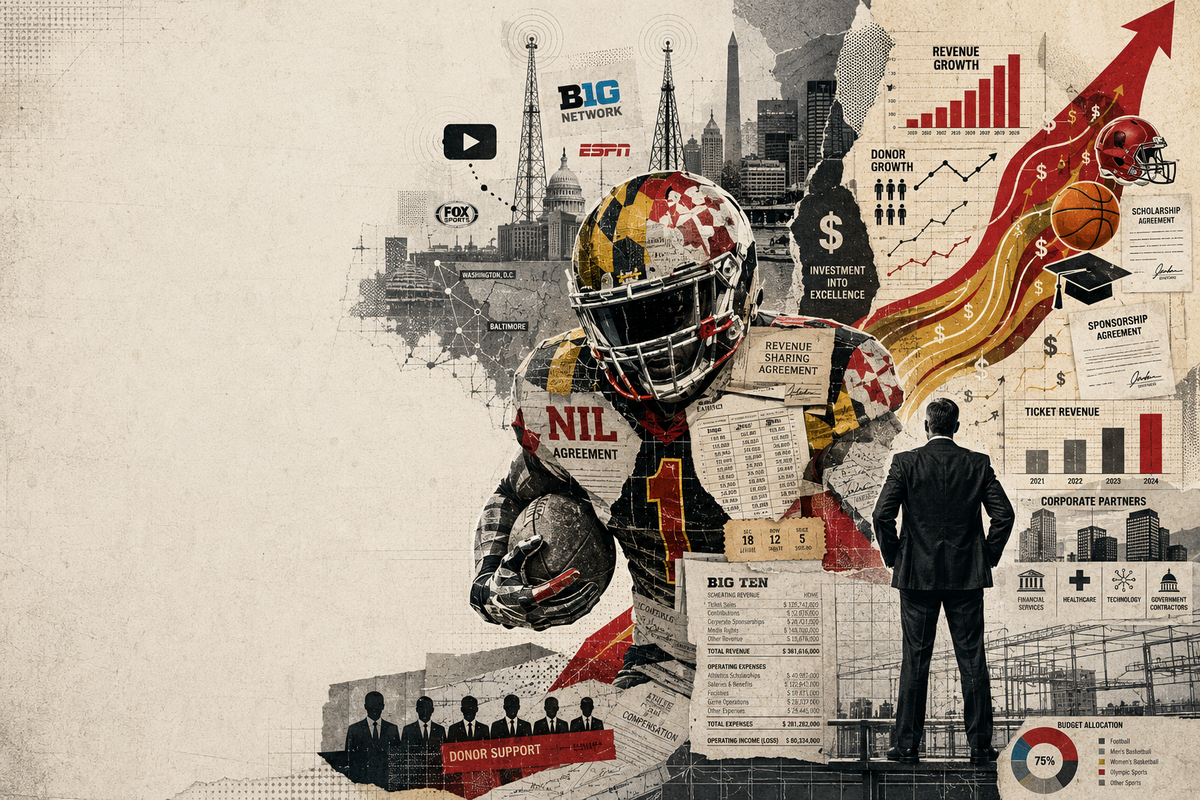
Back in 2014, when the Big Ten brought Maryland into the fold, nobody was pretending it was about football wins. The conference wanted something bigger: a foothold in the Washington-Baltimore TV market. Pair that with Rutgers opening New York, and suddenly, the Big Ten Network was reaching millions of new homes. That move gave the conference serious leverage the next time media contracts came up for negotiation, and it worked. Big Ten schools now split the richest media payouts in all college sports.
But the game has changed again. The House settlement flipped the script, and it's no longer just about who's on TV. Now it's about who can pay their players, through revenue sharing, ticket sales, donor money, sponsorships, whatever it takes. Every athletic department in the country is wrestling with the same problem: how do you cover a roster that now costs tens of millions of dollars a year?
For Maryland, that question hits differently than it does for most schools. The Terps were part of why the Big Ten's TV deals became so lucrative in the first place, so now they must show they can turn that financial head start into wins on the field.
Maryland Is Going All In on Revenue Sharing
Starting with the 2025-26 school year, Maryland is committing the full $20.5 million allowed under the House settlement. Add in bigger scholarship numbers and the other changes that come with it, and the athletic department expects its costs to climb by more than $25 million. That's not a small adjustment; it's arguably the biggest financial shakeup college sports have seen.
Where's most of that money going? Football, men's basketball, and women's basketball, according to university officials. That's not favoritism, it's just math. Football brings in the biggest TV audiences, the biggest conference payouts, and the biggest premium-seating revenue, and it moves donors to open their wallets. In many ways, football quietly funds everything else in the athletic department.
You can find Maryland's official numbers in the university's House settlement updates and the athletic department's communications.
What We Think Maryland Is Actually Spending
Maryland hasn't released a sport-by-sport breakdown, so based on public comments from the school, along with what other Power Four programs are doing, here's our best estimate of how that $20.5 million gets split up:
|
Sport |
Estimated Revenue Sharing |
Share |
|
Football |
$15.2 million |
74% |
|
Men's Basketball |
$3.2 million |
16% |
|
Women's Basketball |
$1.1 million |
5% |
|
Olympic Sports |
$1.0 million |
5% |
|
Total |
$20.5 million |
100% |
Again, these are our estimates, not numbers Maryland has confirmed.
Once you factor in outside NIL deals on top of that, Maryland's football roster could end up costing somewhere between $20 million and $23 million a year. Men's basketball might land in the $5-7 million range, while women's basketball should continue to benefit from what's already one of the stronger institutional commitments in the conference. Don't expect Maryland to spend like Ohio State, Oregon, or Texas, but they should be able to hang with a good chunk of the Big Ten's middle tier.
One Maryland's Job Is Changing
Revenue sharing doesn't replace NIL; it just changes what NIL is for. Before the House settlement, collectives like One Maryland were often the main way players got paid. Now that the university itself is writing the checks through revenue sharing, groups like One Maryland can shift their focus toward what NIL was originally supposed to be: real endorsement deals, appearances, sponsorships, and business partnerships for athletes.
That shift plays to Maryland's strengths. The school sits right in the middle of one of the biggest metro economies in the country, and Washington and Baltimore mean access to Fortune 500 companies, hospital systems, defense contractors, banks, tech firms, and about as many government-adjacent businesses as you'll find anywhere in America. On paper, that should make Maryland one of the best NIL markets in the conference.
The problem was never the location. The problem has been turning that location into actual demand for Maryland football and basketball.
The Big Ten Already Won Its First Fight
When Maryland joined the conference, everything revolved around cable TV contracts. The Big Ten didn't necessarily need Maryland to become a football powerhouse; it needed Maryland to help grow the conference's TV footprint. Mission accomplished: the Big Ten landed media deals worth billions and dramatically boosted what every member school takes home each year.
Revenue sharing throws a wrench into that comfortable arrangement. TV money still matters, obviously, but it's not enough on its own anymore. Schools now must hustle for premium-seating dollars, grow their donor base, land corporate sponsors, sell out stadiums, and keep fans engaged year-round, not just on Saturdays in the fall. That's a completely different kind of challenge, and Maryland is now playing in a league where success depends less on your zip code and more on how well you run your business.
The conference has already won the television fight. Now Maryland must win the revenue fight on its own.
Why Jim Smith Might Be Maryland's Most Important Hire in Years
That shift helps explain why Maryland brought in Jim Smith as its new athletic director. Smith isn't a typical college AD. Most of his career was spent in professional sports, with the Atlanta Braves, the Atlanta Falcons, Arthur M. Blank Sports & Entertainment, and a stint at Ohio State Athletics. His background is business: revenue, sponsorships, ticketing, premium experiences, marketing, and growth. That's not a coincidence; that's exactly where college athletics is headed.
Maryland didn't just hire another administrator to keep the lights on. They hired someone who knows how to build a sports business from the ground up, and that distinction could matter a lot going forward, because schools aren't just recruiting athletes anymore. They're recruiting donors, season-ticket holders, and corporate partners who can help keep revenue sharing funded for years to come.
If Maryland wants to close the gap with the Big Ten's blue bloods, growing its fan base might matter just as much as its recruiting rankings.
Can Maryland Finally Cash in on Its Market?
Maryland has had a lot going for it for a long time. It's in the richest conference in college sports, it sits inside one of the biggest metro areas in the country, it pulls in tens of millions of dollars a year in Big Ten media money, and it's now fully funding revenue sharing. And yet none of that has consistently shown up on the football field.
Attendance has been up and down, and donor support has generally lagged the conference's biggest programs. Mike Locksley has put together some solid seasons, but Maryland still hasn't become a regular contender in the expanded Big Ten. The next several years could decide whether that finally changes.
Revenue sharing gives Maryland the financial tools it needs to compete. The DC-Baltimore market gives it a real commercial edge, and its new leadership brings a pro-sports mindset to growing revenue. All the pieces are on the table now. The only question left is whether Maryland can turn that potential into wins.
Bottom Line
This isn't really a story about $20.5 million and NIL cash. It's a story about Maryland adapting to a completely different economic reality in college sports. The TV-market strategy that got Maryland into the Big Ten worked, and it helped make the conference incredibly wealthy. But revenue sharing demands something new from every school: the ability to generate its own money, build real fan loyalty, land corporate partners, and spend wisely on the sports that drive the athletic department.
Few programs show that shift more clearly than Maryland. The Terps don't need to justify their spot in the Big Ten anymore. Now they just need to prove they can make the most of it.


Comments ()