
Performance Over Potential: Iowa's Biggest Roster Gamble in a Generation
Iowa's 2026 roster bets on proven FCS production over recruiting potential. Will the gamble pay off?
Kirk Ferentz doesn't change much. That's kind of his whole thing.
For almost 30 years, the Iowa head coach has built his program the same way: find high school kids with the right frame and the right attitude, redshirt them, coach them up for a few years, and let patience do the rest. While other programs chased recruiting rankings or flipped their rosters every offseason, Ferentz stuck to his formula, and it worked. Iowa became known as a place that could turn three-star recruits into Big Ten champions and NFL draft picks.
That's what makes the Hawkeyes' 2026 transfer class so strange, and so interesting.
A Different Kind of Transfer Class
Plenty of teams now lean on the transfer portal. That's nothing new. What's new is where Iowa is finding its players.
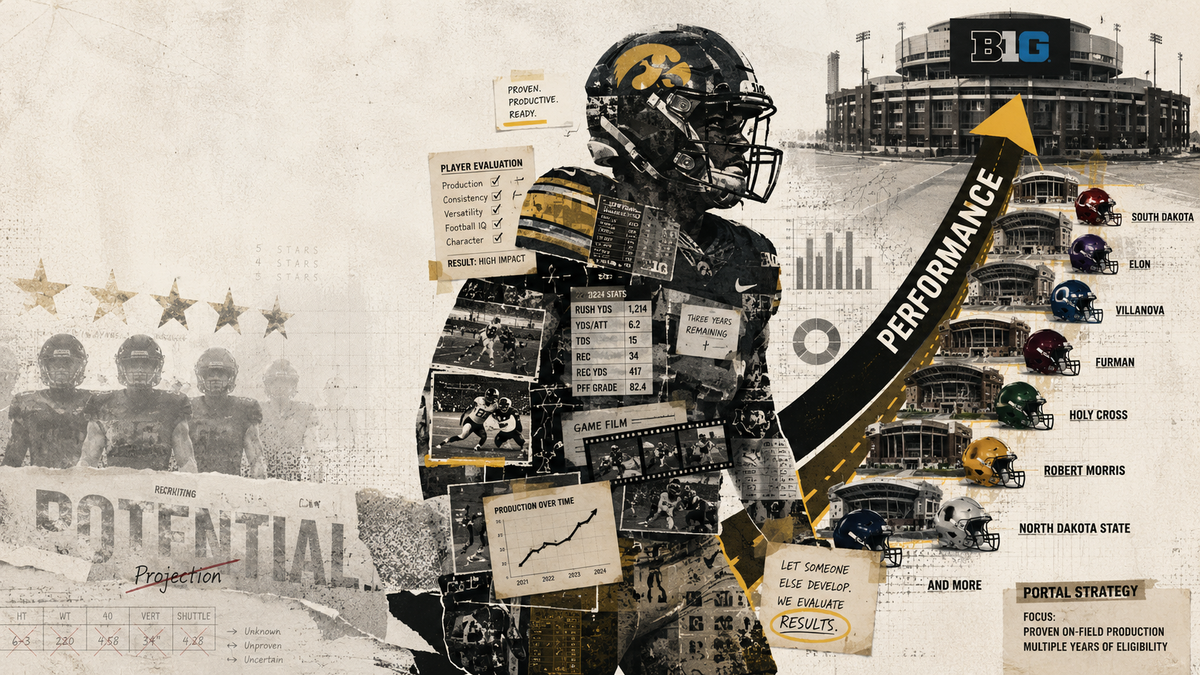
General Manager Tyler Barnes put it plainly: the Hawkeyes wanted guys with "proven on-field production" who still had eligibility left to use. Simple enough on paper, but look at the roster, and the strategy gets a lot more specific.
Of Iowa's 16 transfer additions, nine came from FCS schools. One transferred in from Division III. Another came through the Australian football pipeline. Only five came from FBS programs.
Some of the names stand out. Running back L.J. Phillips Jr. was one of the most productive rushers in the FCS at South Dakota. Kahmari Brown earned All-America honors at Elon. Anthony Hawkins was one of Villanova's best defensive backs. Evan James caught nearly 800 yards' worth of passes at Furman. Eli Ozick became one of the top kickers in the country at North Dakota State. Add Xavier Styles, Brice Stevenson, Tony Diaz, and Emmanuel Olagbaju, and you've got a class built almost entirely off small-school résumés.
These aren't former blue-chip recruits looking for a fresh start. They're players who have already proved, at their level, that they could ball out.
A Real Shift in Philosophy
For most of Ferentz's career, Iowa's edge was development. The coaching staff would find under-the-radar high schoolers, spend years polishing their game, and eventually watch them outplay guys with far bigger recruiting hype. The question driving that approach was always: who can we turn into a great player?
This transfer class asks a different question: who has already become one?
That's not just an Iowa thing; it's happening across college football. The transfer portal has turned the sport into its own scouting department. Coaches no longer must guess how a player will perform against college competition. They can just look at the tape. Every carry, every sack, every start, every all-conference nod is real, documented data.
Indiana is the program that proved this approach could work. Curt Cignetti's turnaround in Bloomington leaned heavily on players, many from James Madison, who'd already shown they belonged. Instead of banking on recruiting stars from three years earlier, Indiana built around guys with a track record. It reshaped how coaches around the country think about roster building.
Funny enough, Indiana has since moved past that model. As the program's name and budget have grown, the Hoosiers now pursue proven Power Four talent rather than small-school standouts. Same philosophy, different shopping list, and presumably, bigger pocketbook.
Iowa, on the other hand, seems to be doubling down on the original idea, and much more than any other established Big Ten program is willing to. Iowa appears to be building its roster in a much different manner, apparently a gamble for elevated prominence.
Why Iowa Stands Out in the Big Ten
Most Big Ten schools still pull the bulk of their transfers from Power Four or Group of Five programs. Nebraska went after experienced offensive linemen and veteran FBS players. Michigan, Ohio State, and Oregon barely looked outside the Power Four at all. A few schools grabbed an FCS standout here or there, but nobody built a class around it like Iowa did.
In a way, the Hawkeyes are letting other programs do the early scouting for them. Elon developed Kahmari Brown. South Dakota developed L.J. Phillips Jr. Villanova coached up Anthony Hawkins. Furman gave Evan James his shot to produce. Iowa only stepped in once those players already had numbers to show for it.
It's basically a farm system, something college football has never officially had, but might be drifting toward anyway.
Will It Actually Work?
Dominating at the FCS level doesn't guarantee success against Penn State's front seven or Ohio State's skill players. Iowa has traded one kind of risk for another. The Hawkeyes are more confident that these players can produce in college football generally, but nobody knows yet if that production holds up a level higher, against Big Ten defenses and Big Ten speed.
No ranking system or transfer grade can answer that question. Only the season can.
For decades, Iowa's advantage was turning raw talent into polished players. This roster suggests the Hawkeyes are testing a new edge: getting to proven players before the rest of the Power Four catches on.
If it pays off, don't be surprised if smaller programs start looking more like Big Ten farm teams, with schools like Iowa buying finished products rather than betting on potential.
If it doesn't, Iowa will have run one of the boldest experiments in recent memory, trying to prove that small-school dominance can travel straight into the toughest conference in the country.
Either way, one of college football's most old-school programs just made one of its riskiest moves in a generation. And if it works, the rest of the Big Ten will be paying close attention.

Comments ()