
How Religion Once Structured American Life and Even Separated the Dead
A forgotten chapter of American history reveals how the Ku Klux Klan used local government to segregate Catholic burial grounds, turning cemeteries into instruments of exclusion and exposing a hidden system of religious discrimination that historians largely ignored.
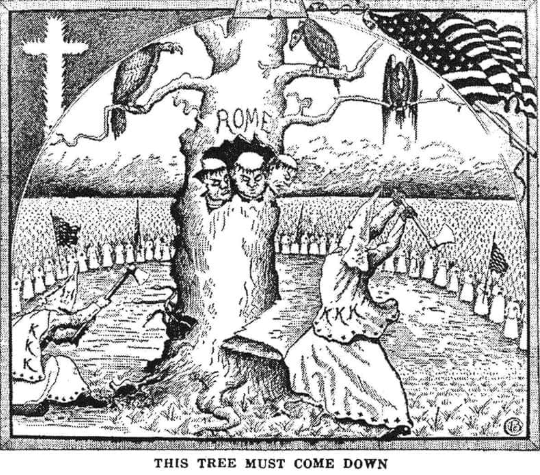
American memory reduces the Ku Klux Klan to a crude binary centered on racial terror in the Reconstruction South. That narrative captures real brutality, but it narrows the field of vision. It obscures a quieter campaign that unfolded through municipal governance across the Midwest and North, where Catholics became a primary target of a system that operated through policy rather than spectacle.
By the early 1920s, the Second Klan had transformed itself into a mass membership organization with millions of adherents and deep penetration into local government. Its ideology fused nativism, Protestant supremacy, and anti-immigrant paranoia into a coherent political program marketed as “100% Americanism.” Catholics occupied a central place in that framework because Klan propagandists framed the Vatican as a foreign sovereign and depicted Catholic citizens as extensions of that foreign power. Irish, Italian, and Polish immigrants did not appear as participants in American civic life. They appeared as infiltrators.
This reframing proved critical because it legitimized state action. Once Catholics became a “foreign threat,” discrimination could present itself as governance rather than prejudice. Klan-aligned officials leveraged that logic to shape school funding, public rituals, hiring practices, and land use decisions. In many Midwestern municipalities, the Klan did not operate outside the system. It controlled the system.
Cemeteries as Quiet Battlefields
Municipal cemeteries reveal how deeply this ideology penetrated everyday governance. Burial grounds should function as neutral civic infrastructure, serving all citizens at the moment when they hold the least power. Instead, many cities converted them into instruments of exclusion through spatial segregation, pricing manipulation, and administrative policy.
Local governments across Indiana, Ohio, and Illinois designated separate sections for Catholic and Jewish burials, often marked by fences, walls, or inferior terrain. Officials justified these divisions through claims about ritual disturbance or maintenance differences, but the underlying objective centered on hierarchy. Protestant dead occupied elevated, well-drained ground near central pathways, while Catholic sections drifted toward flood-prone margins or peripheral acreage. Families encountered not only grief, but a system that reinforced their outsider status even in burials.
South Bend, 1924: Policy as Desecration
The most explicit example emerged in South Bend, Indiana, where the city council passed Ordinance 425 on May 18, 1924. The measure created a designated Catholic section within the municipal cemetery and ordered the relocation of existing Catholic graves into a low-lying area known for seasonal flooding.
This action extended beyond symbolic segregation and entered the realm of physical desecration. Crews exhumed remains and reinterred them on inferior ground while families watched the process unfold. Contemporary accounts described standing water pooling across graves each spring, damaging markers and displacing soil. When parishioners protested, city officials responded with a market-based dismissal, suggesting that Catholics could establish private cemeteries if they objected to municipal rules. That response revealed the governing logic with unusual clarity: public space existed for Protestants, while others could pay to exit the system.
Example Two: Indianapolis and the Politics of “Public Neutrality”
Indianapolis offers a second pattern that operated with less overt brutality but equal structural effect. During the 1920s, Klan influence within city leadership coincided with efforts to standardize municipal cemetery regulations under the language of neutrality and efficiency. In practice, these policies restricted Catholic burial societies from expanding within public cemeteries while granting favorable terms to Protestant-affiliated associations.
The city did not always mandate forced relocation, as seen in South Bend. Instead, it used administrative friction to produce the same outcome. Catholic groups encountered higher fees, slower approvals, and spatial limitations that confined their burials to less desirable sections. Officials defended these measures as technical decisions tied to maintenance and planning. The effect, however, mirrored explicit segregation by channeling Catholic burials into constrained and inferior zones without the spectacle of exhumation.
Example Three: Cincinnati and the Economics of Exclusion
Cincinnati presents a third variation rooted in economic leverage. Municipal cemetery boards in the early twentieth century adopted tiered pricing structures that disproportionately affected Catholic immigrants, many of whom relied on parish-based burial traditions. Premium plots near central avenues carried costs that effectively excluded working-class Catholic families, while cheaper sections clustered along less stable ground or peripheral edges.
Although the policy did not explicitly name religion, its impact aligned closely with existing ethnic and religious divisions. Catholic families faced a choice between financial strain and spatial marginalization, a choice that reinforced segregation through market mechanisms rather than formal decree. This approach proved especially durable because it embedded discrimination within ostensibly neutral economic policy, making it harder to challenge legally or politically.
Resistance Without Leverage
Catholic communities did not accept these conditions passively, but their ability to respond depended heavily on local political strength. In cities such as New Orleans and Philadelphia, where Catholic voters held meaningful influence, parishes expanded independent cemetery systems to bypass municipal control. Those parallel institutions preserved dignity but also reinforced separation by necessity.
At the national level, Catholic leaders pursued legislative remedies and constitutional protections. Those efforts struggled to gain traction in a Congress that viewed such disputes as local matters rather than systemic violations. Without federal intervention, outcomes remained uneven and heavily dependent on regional power dynamics.
Legal Realignment and Its Limits
The mid-twentieth century brought a gradual shift through constitutional interpretation. Supreme Court decisions such as Everson v. Board of Education and Abington School District v. Schempp reinforced a stricter separation between church and state, weakening the legal foundation for overt religious favoritism in public institutions. While these rulings did not target cemetery practices directly, they contributed to the broader dismantling of policies that privileged one religious group over another.
Even as formal rules changed, the physical landscape preserved earlier decisions. Older cemeteries across the Midwest still display segmented layouts, elevation disparities, and boundary markers that reflect prior segregation. The legal system removed the policy framework, but it did not erase the spatial consequences.
Why Historians Looked Away
This history occupies a marginal position within mainstream scholarship, and that absence reflects both methodological and narrative bias. The dominant historiography of the Klan emphasizes racial violence in the South, a focus that remains justified but incomplete. That emphasis narrowed analytical attention and relegated anti-Catholic campaigns in the North to secondary status despite their scale and institutional reach.
Administrative discrimination also lacks the immediacy of violent spectacle. Cemetery zoning does not produce the same archival intensity or moral shock as overt acts of terror, which leads both historians and readers to underestimate its significance. At the same time, Catholic assimilation into the American mainstream during the mid-twentieth century obscured earlier marginalization, allowing the conflict to fade from collective memory.
The result is a fragmented record that never fully coalesced into a central narrative. Local ordinances, burial maps, and municipal proceedings document the pattern, but they remain dispersed across areas. Without synthesis, the system remains difficult to see, even though its physical traces persist.
The Structural Lesson
This episode reveals how discrimination operates most effectively when it embeds itself within systems rather than events. It alters geography, pricing, and access in ways that appear technical rather than ideological. Over time, those changes reshape lived experience without requiring constant enforcement or overt justification.
Cemetery segregation represents the logical endpoint of that process because it extends exclusion into the realm of memory and dignity. When a society organizes even its burial practices along sectarian lines, it demonstrates a comprehensive hierarchy of belonging that reaches beyond life itself.
The Map Remembers
The Klan’s campaign against Catholics did not rely solely on intimidation or rhetoric. It relied on design, using municipal authority to reorganize civic space in ways that encoded exclusion into the physical environment. That strategy proved effective precisely because it avoided spectacle and operated through routine governance.
Historians overlooked part of this story because it did not announce itself loudly. Yet its implications remain visible in the landscape and relevant to modern debates over how policy shapes inclusion and exclusion. The absence of drama does not reduce its importance. It explains its durability.
The map still remembers what the narrative forgot.

Comments ()