
The Big Ten Is Quietly Splitting into Two Conferences
The Big Ten’s television riches are masking a growing internal split. Programs driven by football obsession, billionaire-backed NIL, and year-round relevance are separating rapidly from conference cellar dwellers surviving on geography, nostalgia, and donated losses.
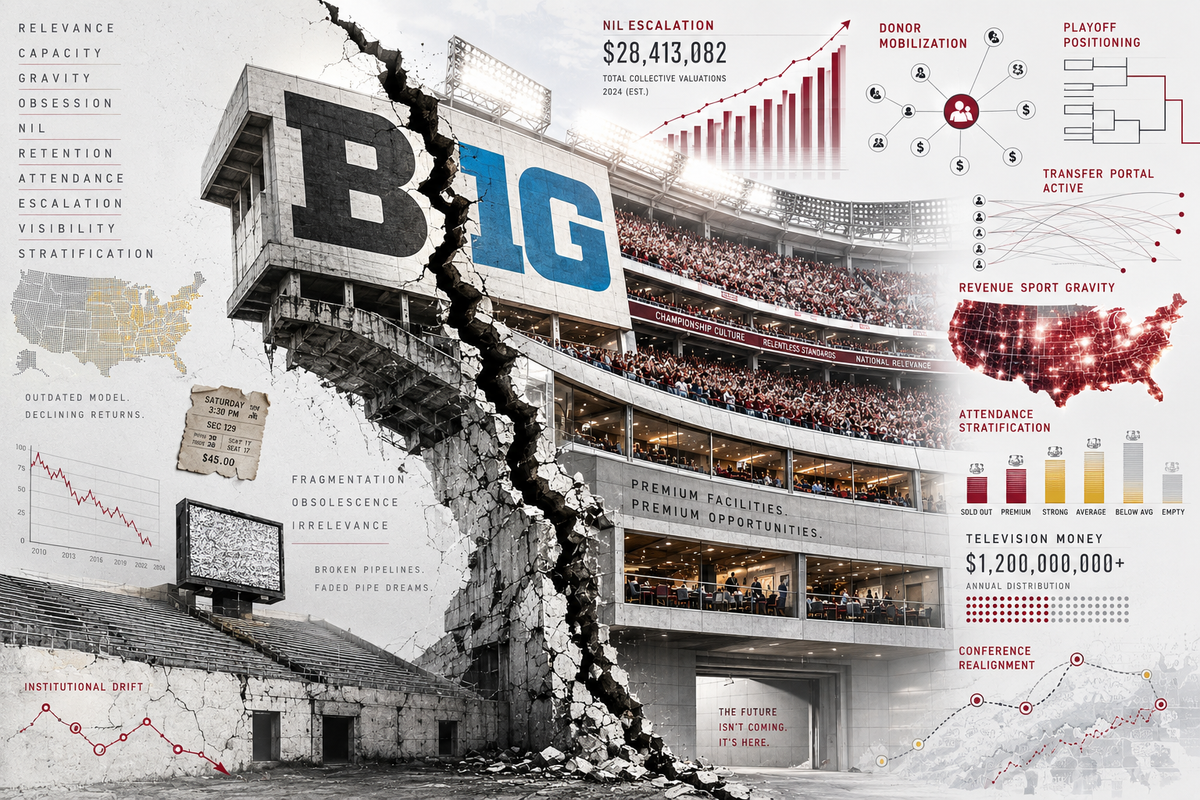
The Big Ten still sells the public a nostalgic fantasy about itself.
Every commercial looks like a committee of university presidents and pharmaceutical advertisers assembled it. Snow falls softly across brick campuses. Engineering students stare thoughtfully into microscopes. Marching bands emerge through smoke while some voiceover about “tradition” and “shared values” plays in the background as if the conference exists primarily to preserve the soul of the Midwest.
Meanwhile, half the league is quietly becoming a professional sports industry.
That is the real story unfolding underneath the branding. The modern Big Ten increasingly resembles two entirely different athletic economies trapped inside the same television contract. One group of schools has fully accepted the reality that major college athletics is becoming a semi-professional entertainment business driven by donor aggression, NIL liquidity, transfer portal acquisition, and nonstop audience capture. The other half still behaves like it can survive indefinitely on institutional prestige, geography, and memories from the cable television era.
That split is no longer theoretical. It is already visible in attendance patterns, NIL infrastructure, donor behavior, recruiting reach, and national relevance across revenue sports. More importantly, the separation is accelerating. The schools building aggressive financial ecosystems now are positioning themselves for the next twenty years, while the schools sleepwalking through the transition may eventually discover that the conference logo alone no longer guarantees relevance.
The Big Ten is not merely reorganizing competitively. It is stratifying economically, culturally, and institutionally.
Television Money Accidentally Concealed the Divide
The conference’s massive media deal delayed recognition of what was happening internally because once every school started receiving enormous annual television distributions, everybody could temporarily pretend the league had achieved structural parity.
On paper, the numbers looked spectacular. Coaching salaries exploded. Facilities turned into luxury compounds with recovery spas and barber shops attached. Athletic departments expanded staffing like tech startups during a venture capital bubble. Every school suddenly looked rich.
But television money turned out to be baseline infrastructure rather than competitive separation capital. The real divide emerged somewhere else: donor aggression, football monetization, recruiting relevance, NIL capacity, statewide emotional investment, and institutional willingness to escalate.
Modern college athletics increasingly rewards obsession, and that reality is devastating for several Big Ten schools because the conference spent fifteen years operating under an outdated assumption that media markets mattered more than emotional intensity. Executives convinced themselves that adding schools near New York, Washington, and Los Angeles automatically created permanent strategic value because population density translated into carriage leverage during the cable bundle era.
The problem is that population density does not automatically create sports fanaticism. Nobody in Manhattan suddenly became emotionally invested in the Rutgers Scarlet Knights because Rutgers joined the Big Ten. The conference imported a commuter-school athletic culture and spent a decade pretending it had conquered New York City. Rutgers football still often feels less like a national athletic brand and more like a scheduling requirement reluctantly fulfilled each autumn.
The same thing happened with the Maryland Terrapins. The Terrapins were supposed to unlock the Washington corridor. Instead, Maryland mostly drifts through the conference landscape with the emotional footprint of a mid-level consulting firm. Teams occasionally become competent, but the fan intensity rarely feels central to the league itself.
The NIL era has completely changed the incentives because modern college athletics now rewards schools capable of converting emotional obsession into money. That distinction matters enormously.
Stadium Occupancy Reveals More Than Television Ratings
The most revealing metric in the modern Big Ten may not be revenue totals or even wins. It may be actual stadium occupancy for events.
The difference matters because occupancy measures emotional saturation. It measures whether fans care enough to consistently fill the building regardless of weather, opponent, or recent record.
The Nebraska Cornhuskers continue packing Memorial Stadium despite two decades of instability and coaching churn. The Iowa Hawkeyes generate atmospheres far larger than their population base should logically support. The Penn State Nittany Lions still turn whiteout games into national television events because the fanbase behaves like football matters existentially.
Meanwhile, the UCLA Bruins routinely struggle to generate atmosphere in the middle of the richest recruiting geography in America, despite elite weather, elite academics, and one of the largest metropolitan populations in the country.
That contrast tells the real story: one fanbase behaves as if football is integral to regional identity, while the other behaves as if it only discovered there was a game happening because traffic near the stadium looked unusually annoying.
The same pattern increasingly appears at Northwestern, Rutgers, and Maryland. Large metropolitan regions do not automatically produce emotional investment. In many cases, they dilute it. Professional sports fragmentation, transient populations, and weak institutional identity create fanbases that feel casual rather than tribal.
The problem is that modern college sports increasingly reward tribal behavior.
The Upper Tier Is Becoming Obvious
The schools rising toward the conference’s upper tier increasingly share the same characteristics: football obsession, donor aggression, year-round visibility, and the ability to sustain relevance across multiple revenue sports simultaneously.
The Ohio State Buckeyes understand this completely. Ohio State no longer behaves like a traditional athletic department. It behaves like a national entertainment brand with lecture halls attached. Football drives the machine, but basketball, recruiting, women’s athletics, merchandising, donor engagement, and national branding never disappear from the conversation.
The Michigan Wolverines occupy a similarly dominant position because Michigan finally realized it no longer had to choose between academic elitism and athletic aggression. The school now comfortably embraces both. The Wolverines possess massive donor capacity, elite institutional branding, football prestige, and enough multi-sport relevance to remain nationally visible continuously.
The Penn State Nittany Lions remain structurally powerful because football and wrestling generate unusually deep emotional investment simultaneously. The Oregon Ducks may be the most modern operation in the entire conference because Oregon fully understands what the sport has become. The Ducks behave like a venture-backed sports startup fueled by branding aggression, NIL escalation, and relentless visibility.
The USC Trojans remain fascinating because USC spent years sleepwalking through its own advantages. The Trojans still possess elite recruiting geography, enormous upside, and one of the most valuable brands in the sport, but the move to the Big Ten increasingly feels less like expansion and more like a financial rescue mission disguised as prestige.
Then there are the Iowa Hawkeyes, which may be the single most important program in the conference. Structurally, Iowa should not work this well. The state population is small. The recruiting geography is mediocre. The alumni base lacks the scale of the conference’s largest powers. NIL capacity does not remotely approach the levels of Ohio State or Oregon.
And yet Iowa continues to sustain nationally relevant football, elite wrestling, major women’s basketball visibility, a resurgent men’s basketball program, premium ticket demand, and unusually cohesive statewide engagement.
The Hawkeyes compensate for structural disadvantages through concentrated emotional intensity. Iowa athletics matter culturally across the entire state in ways many larger universities cannot replicate. Football Saturdays still function like statewide rituals. Wrestling remains one of the few genuinely monetizable brands in the sport. Women’s basketball exploded during the Caitlin Clark era because the infrastructure for obsession was already in place before Clark arrived.
That matters because emotional density increasingly translates directly into NIL competitiveness.
Iowa increasingly resembles an SEC-style emotional ecosystem accidentally dropped into the Midwest, and that is precisely why Iowa sits on the conference fault line. If a program with Iowa’s cohesion and intensity begins slipping downward structurally, the Big Ten middle class effectively disappears.
Stretch Programs Know What Is Coming
The most fascinating schools in the conference are not the giants because everybody already understands what Ohio State is.
The real drama lies in the programs desperately trying to avoid exclusion from the conference’s upper echelons.
The Wisconsin Badgers increasingly resemble a company attempting an emergency modernization campaign while competitors scale around them at frightening speed. Wisconsin built decades of success through continuity, offensive line identity, low roster volatility, and disciplined developmental football. That formula worked beautifully in the old Big Ten.
The problem is that the modern conference increasingly rewards aggression in the transfer portal, quarterback acquisition, NIL escalation, and national recruiting reach. Wisconsin clearly understands the danger. Recent institutional behavior reflects urgency because the Badgers know donor momentum and recruiting relevance are much easier to lose than to regain. Look to Luke Fickell finding his way to the unemployment line this year if football does not drastically improve, as Camp Randall now looks more like a large funeral than a central Wisconsin open bar.
The Nebraska Cornhuskers face an even more psychologically unstable situation because Nebraska still internally believes it belongs among the national aristocracy. That belief creates constant pressure for acceleration. The Cornhuskers retain elite attendance, enormous statewide loyalty, a strong television draw, and donor passion that exceeds religious fervor.
But Nebraska increasingly resembles a legacy industrial brand trying to recover its former dominance inside a transformed marketplace. Every coaching transition feels existential. Every mediocre season produces panic. Nebraska cannot emotionally tolerate becoming merely respectable.
The Michigan State Spartans remain volatile but dangerous. The Spartans possess enough football history, fan engagement, and institutional scale to matter nationally, but the program oscillates wildly between competence and collapse because Michigan State still has not fully decided what level of athletic aggression it wants long term. Additionally, the acquisition of a dented can in Pat Fitzgerald, as the new football coach, indicates a program that makes questionable choices.
The Minnesota Golden Gophers increasingly feel trapped by their own environment. The Twin Cities market creates theoretical upside, but the fragmentation of professional sports constantly dilutes emotional intensity. Minnesota athletics often feel respectable, organized, and emotionally muted all at once, which is a dangerous combination in the NIL era.
The Illinois Fighting Illini face similar problems. Illinois possesses population advantages, wealthy alumni, and institutional scale, yet the athletic department has spent decades teasing relevance without sustaining it. Illinois increasingly resembles a school perpetually preparing for a breakthrough that never fully arrives.
The Indiana Hoosiers may be the most fascinating swing case in the conference because they increasingly understand that nostalgia and basketball tradition alone are no longer enough. Historically, the Hoosiers operated like a basketball aristocracy, reluctantly tolerating football season.
That model no longer scales, but what changes Indiana’s ceiling is money, specifically, billionaire-level money.
Mark Cuban’s proximity to Indiana athletics matters because the future of elite college sports increasingly revolves around schools cultivating “white knight” financial backers who can rapidly accelerate NIL ecosystems. The schools with access to ultra-wealthy donors, private-equity-style operators, and billionaire alumni networks are gaining enormous structural advantages.
But those relationships come with strings attached.
The old donor model involved wealthy alumni funding facilities and occasionally complaining about coaching hires over cocktails. The new donor model increasingly resembles venture capital. Billionaires do not inject massive sums into collectives simply for sentimental reasons. They expect influence, visibility, access, and eventually operational leverage.
That dynamic is only beginning.
Over the next decade, universities will increasingly romance ultra-wealthy investors the way startups court anchor capital. Some schools will effectively build shadow-ownership structures around football programs without ever publicly admitting it. Once billionaires begin underwriting roster construction, they will not remain content to sit quietly in luxury suites while athletic departments make decisions independently.
The schools willing to embrace that reality aggressively may separate themselves permanently, while the schools uncomfortable with it may get left behind.
The Washington Huskies entered the conference in a strong position because they possess meaningful football history, a strong recruiting geography, and a growing economic infrastructure around Seattle. But Washington also faces the same West Coast engagement problem that increasingly threatens UCLA because professional sports fragmentation and cultural detachment dilute institutional obsession.
Then There Are the Cellar Dwellers
The conference’s lower tier increasingly consists of institutions surviving primarily through association with the Big Ten brand rather than through actual athletic gravity.
The Northwestern Wildcats remain the cleanest example. Northwestern represents itself as an elite academic institution and a deeply unserious athletic power. The school contributes very little to the conference’s emotional ecosystem or long-term competitive identity. Northwestern sits beside one of America’s largest metropolitan areas and still struggles routinely to generate meaningful atmosphere because Chicago sports fans simply do not organize their emotional lives around Northwestern athletics. It’s reasonable to conclude that one of the reasons Chicago-area fans do not invest in Northwestern athletics is that Northwestern can’t be bothered to ask them to the party, a sign of poor strategic thinking.
The Rutgers Scarlet Knights continue functioning like a conference expansion hallucination that somehow became permanent. Rutgers football often feels less like a competitive enterprise than a mandatory scheduling inconvenience everybody politely tolerates.
The Maryland Terrapins increasingly drift through the conference with similar energy. Maryland occasionally fields decent teams, but the school rarely feels emotionally central to the Big Ten itself.
Then there are the UCLA Bruins, who may become the conference’s most revealing cautionary tale. On paper, UCLA should be a giant. UCLA has reasonable academic and historical prestige, Southern California recruiting access, a massive media market, and John Wooden's basketball history. And yet the football program draws flies at home while oscillating between mediocrity and irrelevance in what is the richest recruiting geography in America. That combination is catastrophic.
Modern college athletics can forgive losing if the fanbase remains emotionally militant. It can forgive weaker attendance if championships compensate for it. UCLA increasingly offers neither. The Bruins possess one truly major revenue sport in men’s basketball, and even there, the program no longer operates with the overwhelming cultural force its history suggests.
The larger issue is institutional temperament. UCLA often behaves as if it still believes that prestige itself should automatically generate athletic relevance. The modern Big Ten increasingly rewards schools willing to behave irrationally about sports, while UCLA frequently feels too culturally detached, too administratively fragmented, and too casually West Coast to fully engage in the obsession economy driving modern college football.
Then there are the Purdue Boilermakers, who increasingly resemble an athletic department wandering through modern college sports holding a map from 2004.
The football operation has become a mess. Defensive collapses occur regularly. Recruiting momentum evaporates constantly. Coaching transitions feel reactive rather than strategic. Purdue football increasingly exists in a strange dead zone where the program is neither truly competitive nor dramatically ambitious, simply absorbing Saturdays.
Purdue basketball remains the obvious counterargument, but even there the program increasingly feels dependent on isolated excellence rather than integrated athletic power.
And here is the uncomfortable truth nobody inside the conference really wants to say out loud: the Big Ten increasingly needs these schools primarily as inventory and win donation mechanisms.
The upper tier requires conference victories to reach playoff thresholds, maintain rankings, and secure postseason positioning. Somebody must absorb losses in November while the conference’s real powers build résumés for expanded playoff access.
That creates a dangerous long-term dynamic because, eventually, the schools that generate most of the revenue, ratings, playoff appearances, and national relevance begin asking an uncomfortable question: why equal shares still make sense when some institutions contribute mostly to geography and scheduled wins. That conversation sounds ugly now, but in five years, it may sound inevitable.
The modern Big Ten no longer rewards isolated competence. It rewards institutional obsession. Schools capable of sustaining multiple nationally relevant revenue sports, generating emotional fanaticism, and aggressively mobilizing donors are pulling away from schools still treating athletics as a respected extracurricular activity with television benefits attached.
That divide is accelerating rather than stabilizing, and some schools will discover far too late that they spent the most important decade in modern college sports acting as if the old rules still applied.
Comments ()