
Minnesota Athletics Is Getting Professionally Left Behind
Minnesota athletics faces a dangerous new reality in the NIL era. Despite Big Ten money, stable leadership, and major-market advantages, the Gophers risk falling permanently behind as college sports become a professionalized arms race.
The University of Minnesota athletic department currently occupies one of the most dangerous positions in modern college sports: stable enough to avoid panic, respectable enough to avoid embarrassment, and complacent enough to drift quietly into irrelevance while everyone inside the building insists things remain fundamentally healthy. That combination can kill a program slowly because nothing appears catastrophic at the moment. The facilities look respectable. The football team reaches bowl games. Hockey still matters. Volleyball still draws. Athletic director Mark Coyle projects calm managerial competence, and nobody inside the administration appears one bad Saturday away from detonating publicly.
Unfortunately for Minnesota, the modern Big Ten no longer rewards emotional stability and institutional maturity nearly as much as it rewards roster payrolls, donor aggression, and booster irrationality. The conference increasingly resembles an arms race run by hedge funds, while Minnesota still behaves like a well-administered regional bank proud of its customer service ratings and conservative lending practices.
That creates Minnesota’s core problem.
The Big Ten Stopped Being a Conference and Became an Economy
A huge percentage of college sports analysis still discusses coaching, culture, facilities, recruiting pipelines, and player development as though the sport still functions as it did in 2014. It does not. The modern Big Ten operates more like a stratified economic system in which schools compete through television reach, collective funding, donor aggression, and player-acquisition budgets. NIL did not merely tweak the old model. NIL shattered it and replaced it with something much closer to professional free agency wrapped loosely inside university branding.
The old system rewarded patience and development. The new system rewards liquidity.
Programs capable of paying elite athletes now structurally separate themselves from those that cannot. Television contracts establish survival floors while NIL determines competitive ceilings. Once that reality crystallizes, the entire conference hierarchy suddenly makes much more sense.
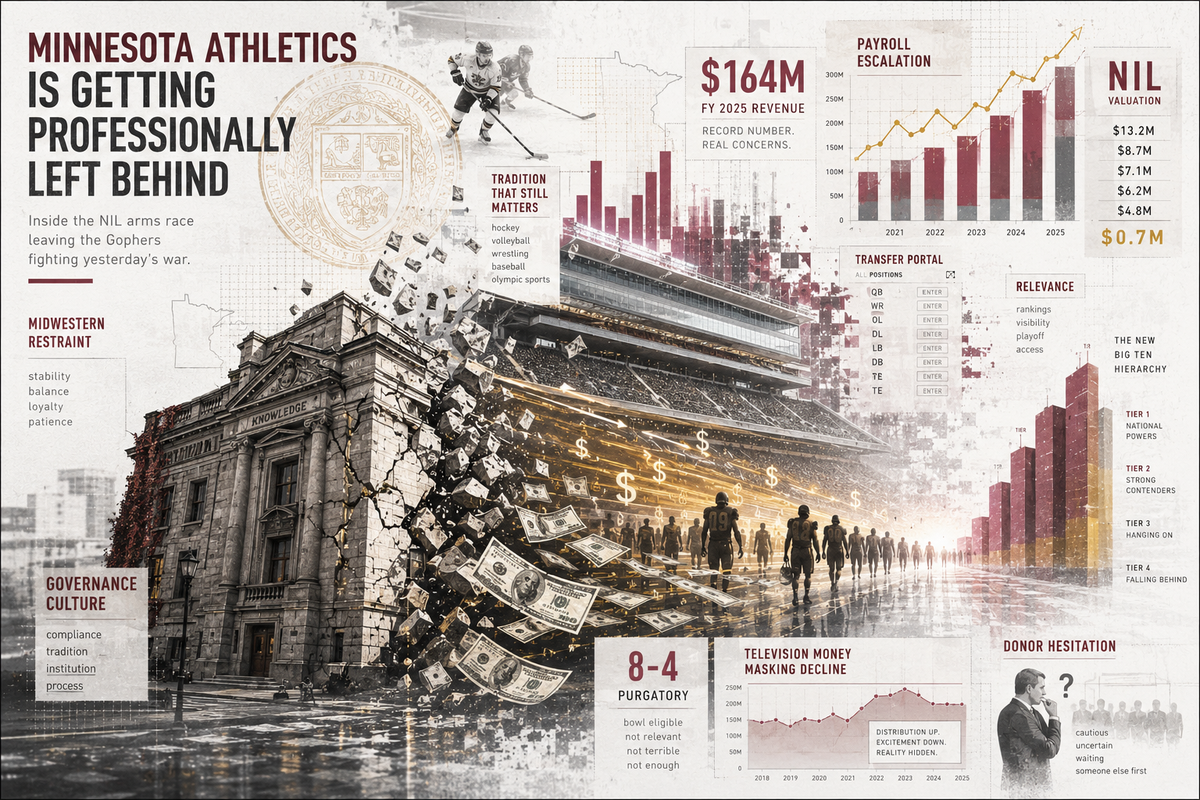
Minnesota reported approximately $164 million in athletic revenue during fiscal year 2025, a record figure largely driven by Big Ten television distributions. At first glance, those numbers suggest institutional strength. Then you start comparing them to conference peers, and the picture changes quickly. The Wisconsin Badgers generate roughly $25 million more annually than the Minnesota Golden Gophers. The Iowa Hawkeyes generate roughly $16 million more.
That gap should trigger alarms because Minnesota theoretically holds stronger structural advantages than either program. The Twin Cities market dwarfs both Madison and Iowa City economically. Minnesota possesses Fortune 500 density, major population advantages, and substantial regional wealth. Yet Wisconsin and Iowa increasingly feel culturally, athletically, and emotionally more relevant.
That should terrify Minnesota administrators because once schools with fewer structural advantages consistently outperform them financially and competitively, the problem usually lies within institutional culture rather than market conditions.
Minnesota Still Thinks This Is About Governance
This remains the central tension running through the entire department. Minnesota athletics still behaves like a university operation attempting to balance institutional values, broad athletic participation, long-term sustainability, and competitive respectability. Administrators continue to emphasize stability, governance discipline, support for Olympic sports, compliance alignment, and broad-based departmental health.
In another era, that approach would have looked wise. Modern college sports now resemble a professional entertainment industry wearing a university Halloween costume.
The schools pulling away nationally have already accepted this reality. The Ohio State Buckeyes, the Oregon Ducks, and the Texas Longhorns no longer operate with the emotional restraint of educational institutions. Their donor ecosystems behave like impatient ownership groups. Their collectives operate aggressively. Their administrations prioritize football playoff viability with the urgency of Fortune 500 quarterly earnings calls.
Minnesota still appears mildly uncomfortable with the entire enterprise. The university talks about NIL the way Midwestern homeowners discuss casino gambling. Everybody acknowledges it exists, but nobody wants to sound too enthusiastic about it in public.
That hesitation now has measurable consequences. Reports surrounding Minnesota basketball in 2025 suggested the program operated with one of the smallest NIL pools in the Big Ten, reportedly around $700,000 total, with a massive percentage tied up in one player. Whether the precise figure proves perfectly accurate almost misses the point because the market behavior already tells the story. Minnesota rarely appears in major transfer bidding wars. High-end roster retention remains inconsistent. Basketball's relevance continues to fade despite the university's location in one of the nation’s largest metropolitan regions.
The program increasingly feels like a once-prominent retailer surviving on location while competitors master online commerce.
Football Feels Stuck in Permanent 8-4 Purgatory
Under P. J. Fleck, Minnesota unquestionably improved its baseline competence. Fleck stabilized recruiting, upgraded infrastructure, normalized bowl appearances, and created a recognizable football brand. Ten years ago, Minnesota fans would have killed for this level of stability.
The problem is that stability stopped being the goal once the Big Ten transformed into a quasi-professional football economy.
Minnesota football now carries the unmistakable vibe of a program optimized to avoid embarrassment rather than threaten the conference hierarchy. The administration seems fundamentally comfortable with seven or eight wins, respectable bowl trips, occasional rankings, and just enough competitiveness to keep everyone from becoming openly furious.
That model worked fine before NIL transformed roster construction into legalized free agency. Now it feels outdated because schools chasing playoff relevance treat roster retention like an emergency-management operation. They aggressively mobilize donors, centralize NIL funding, and continually escalate payroll structures because they understand the basic reality shaping modern college football: players now possess real market leverage.
Minnesota still behaves like the market might calm down eventually if everyone just acts reasonably for a while. That feels less like strategy and more like denial.
Olympic Sports Are Minnesota’s Soul and Possibly Its Trap
Ironically, the healthiest parts of Minnesota athletics may also reveal why the department struggles to adapt to the modern environment. Minnesota remains one of the nation’s premier hockey institutions. Hockey still carries authentic emotional weight throughout the state in a way football sometimes struggles to match. Volleyball developed into a legitimate national program with strong attendance and regional visibility. Several Olympic sports continue operating at impressive levels despite growing resource pressures.
These programs matter because they still feel organic to Minnesota itself. They connect naturally to regional identity, local culture, and institutional history. Minnesota hockey does not feel artificially manufactured through branding consultants and donor presentations. It feels real.
The problem is that modern athletic economics increasingly cares less about authenticity than scale. Minnesota still allocates attention and emotional energy across a broad-based athletic model, while competitors increasingly concentrate resources into football and men’s basketball with frightening intensity. Administrators at schools chasing championships do not spend much time worrying whether rowing receives enough institutional affection. They worry about defensive tackle payrolls and quarterback retention packages.
Minnesota still appears emotionally attached to the older university model, where athletic departments represented broad educational ecosystems rather than football-investment vehicles with side activities tacked on. That philosophical restraint may preserve institutional dignity, but it may also guarantee permanent competitive limitation.
The Most Dangerous Part Is That Nothing Looks Urgent Yet
This is how athletic decline happens in wealthy conferences. Programs rarely collapse dramatically anymore because television money prevents outright disaster. Instead, the decline becomes gradual and psychological. Fans slowly recalibrate expectations downward. Donors contribute cautiously instead of aggressively. Attendance energy softens. Basketball drifts into irrelevance. Football settles permanently into the seven-win range. Rival programs pull ahead incrementally every year until the hierarchy suddenly feels fixed and irreversible.
Minnesota increasingly shows signs of entering that cycle. The department remains too wealthy and professionally managed to implode. Big Ten revenue alone protects Minnesota from catastrophe. The danger comes from something much subtler: normalization of mediocrity inside a conference accelerating toward professionalized athletic stratification.
Once fans internalize the belief that their school cannot realistically compete financially with conference peers, the erosion accelerates fast. Emotional investment declines. Urgency disappears. Entire programs drift into maintenance mode while administrators continue presenting balanced budgets and polished strategic plans.
That may be the most unsettling thing about Minnesota athletics right now because nothing looks broken. Everything just feels slightly smaller than it should.

Comments ()