
Donnelly’s Law: Digital Content Expands to Fill Data Capacity
A systems-analysis essay introducing Donnelly’s Law: as informational capacity expands, content expands to saturate bandwidth regardless of proportional value, driving recursive media, AI content floods, attention scarcity, and collapsing signal integrity.
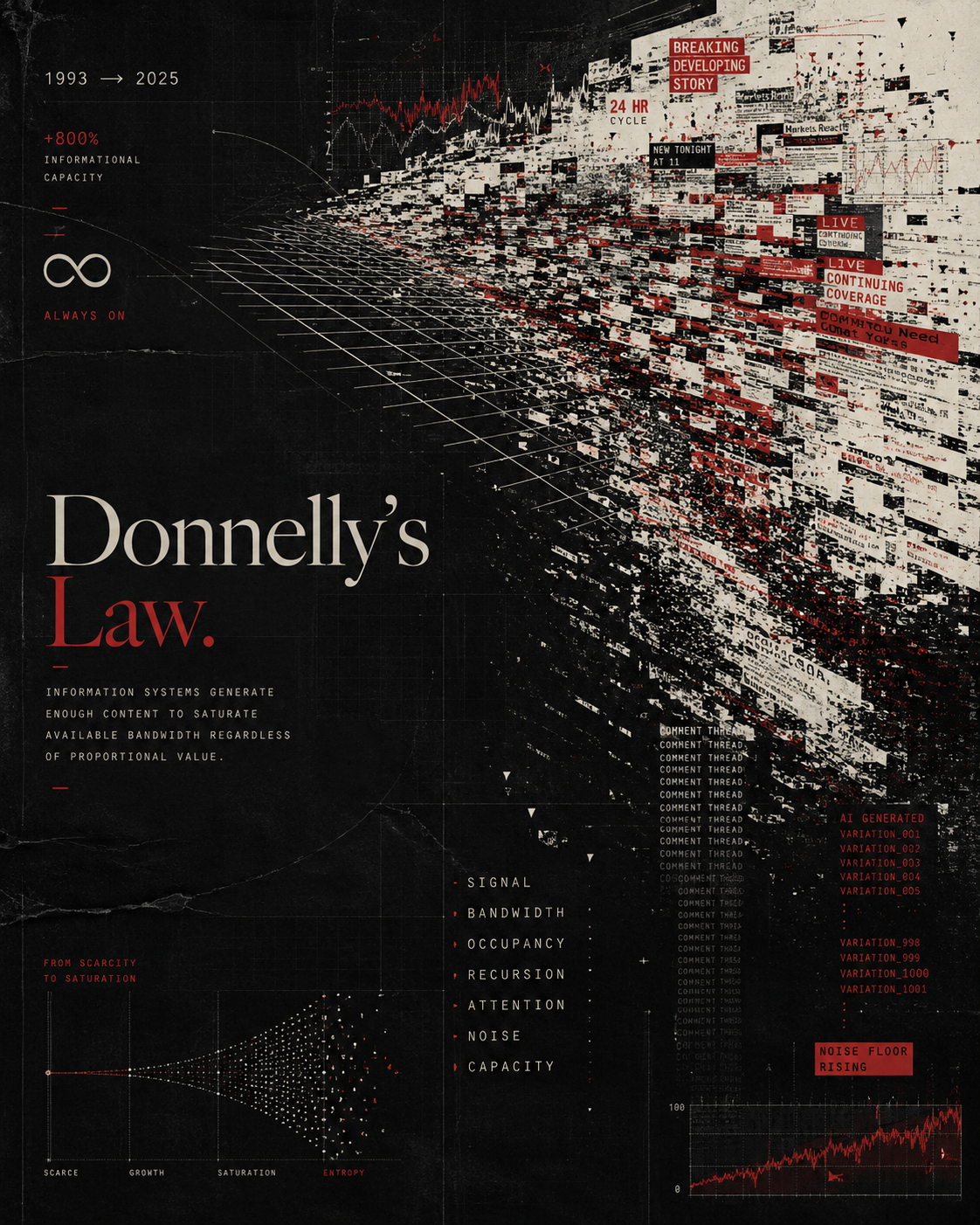
Between 1990 and 2025, humanity increased its informational capacity by thousands or even tens of thousands of times. In 1993, CNN still represented a relatively novel communications model. By 2025, billions of people carried permanently connected video production studios in their pockets while algorithmic systems sorted, amplified, suppressed, and distributed information in real time across planetary networks.
The economics changed faster than the psychology.
The cost of storing information collapsed. The cost of distributing information collapsed. The cost of producing information has collapsed. Smartphones eliminated friction between observation and publication. Social media platforms eliminated friction between emotional reaction and mass distribution. Artificial intelligence now threatens to eliminate the friction between intent and content generation.
Modern societies interpreted these developments primarily as advances in access. More information would create more knowledge. More voices would improve public discourse. More publishing capacity would weaken institutional gatekeeping and democratize expertise.
Instead, modern societies now confront a paradox that many people intuitively sense but struggle to articulate clearly. Humanity possesses more information than any civilization in history has ever had, yet large portions of the population feel increasingly disoriented, manipulated, fragmented, exhausted, and uncertain about what deserves belief.
This outcome did not emerge accidentally. Modern informational systems followed a predictable structural path. As communicative capacity expanded, informational production expanded alongside it until systems approached saturation. Expansion did not distinguish between wisdom and noise, signal and propaganda, discovery and repetition, expertise and emotional stimulation.
Cable television exposed the dynamic decades ago. Once twenty-four-hour news networks emerged, the industry immediately encountered a structural problem. No civilization generates enough genuinely consequential developments to justify permanent breaking coverage. The system solved the problem by redefining what qualified as urgency.
The internet accelerated the same process dramatically.
This dynamic suggests a broader systems principle:
Donnelly’s Law: Information systems generate enough content to saturate available bandwidth regardless of proportional informational value.
Or more simply:
Information systems abhor unused bandwidth.
The implications extend far beyond internet culture. Donnelly’s Law helps explain algorithmic outrage, academic overproduction, streaming media inflation, recursive political discourse, AI-generated sludge, institutional trust collapse, and the growing inability of modern societies to separate meaningful information from industrial-scale distraction.
The central mistake of the digital age was assuming that increased informational capacity would naturally produce greater collective intelligence. Systems theory suggests otherwise. Capacity creates occupancy pressure.
Every Communication Revolution Produces Saturation
Modern societies often treat the internet as historically unprecedented. The same structural pattern has appeared during nearly every major expansion in communicative capacity. Before the printing press, manuscript reproduction imposed severe constraints on the growth of information. Monks and scribes copied texts by hand, which kept production slow, expensive, and labor-intensive. Those constraints served as natural filters because most content failed to justify the costs of reproduction.
The printing press destroyed those bottlenecks and triggered an informational explosion across Europe. Scientific knowledge spread rapidly, literacy expanded, political thought accelerated, and entirely new fields of inquiry emerged on a continental scale. The modern world grew directly from this transformation. But the same expansion also unleashed sectarian propaganda, conspiracy tracts, ideological fragmentation, inflammatory pamphleteering, rumor cascades, and waves of destabilizing political agitation. The printing press did not selectively create enlightenment. It created capacity, and systems rushed to occupy it immediately, with everything from scientific advancement to propaganda and ideological conflict.
The same pattern repeated with newspapers, radio, television, cable television, internet publishing, smartphones, streaming media, and social platforms. Every increase in communicative bandwidth produced an explosion in informational volume. Importantly, systems did not prioritize high-value content during these transitions. Expansion rewarded occupancy efficiency rather than intellectual rigor. Emotional stimulation scaled faster than careful analysis. Entertainment scaled faster than scholarship. Propaganda scaled faster than uncertainty.
This pattern closely resembles induced demand in transportation economics. Build additional highway capacity, and traffic expands until congestion returns. Additional lanes initially relieve pressure, but drivers alter their behavior until usage rises enough to consume the new infrastructure. Informational systems behave similarly because increases in communicative capacity reliably generate enough informational production to saturate the available bandwidth.
Modern societies often treat the internet as historically unprecedented. The same structural pattern has appeared during nearly every major expansion in communicative capacity.
Before the printing press, manuscript reproduction imposed severe constraints on the growth of information. Monks and scribes copied texts by hand. Production remained slow, expensive, and labor-intensive. Those constraints served as natural filters because most content failed to justify the costs of reproduction.
The printing press destroyed those bottlenecks and triggered an informational explosion across Europe.
Europe experienced an informational explosion. Scientific knowledge spread rapidly. Literacy expanded. Political thought accelerated. Entire fields of inquiry emerged at the continental scale. The modern world grew directly from this transformation.
But the same expansion also unleashed sectarian propaganda, conspiracy tracts, ideological fragmentation, inflammatory pamphleteering, rumor cascades, and waves of destabilizing political agitation.
The printing press did not selectively create enlightenment. It created capacity, and systems rushed to occupy it immediately, with everything from scientific advancement to propaganda and ideological conflict.
The same pattern repeated with newspapers, radio, television, cable television, internet publishing, smartphones, streaming media, and social platforms. Every increase in communicative bandwidth produced an explosion in informational volume.
Importantly, systems did not prioritize high-value content during these transitions. Expansion rewarded occupancy efficiency rather than intellectual rigor. Emotional stimulation scaled faster than careful analysis. Entertainment scaled faster than scholarship. Propaganda scaled faster than uncertainty.
This pattern closely resembles induced demand in transportation economics. Build additional highway capacity, and traffic expands until congestion returns. Additional lanes initially relieve pressure, but drivers alter their behavior until usage rises enough to consume the new infrastructure.
Informational systems behave similarly because increases in communicative capacity reliably generate enough informational production to saturate the available bandwidth.
Empty Bandwidth Functions Like an Ecological Niche
Donnelly’s Law becomes easier to understand once informational systems move from moral framing toward ecological framing. Nature rarely tolerates unused niches. If new resources appear, organisms evolve rapidly to exploit them. Empty informational capacity behaves similarly.
Every new platform, recommendation engine, streaming service, social feed, AI generation tool, or communication channel creates fresh territory to be occupied. Economic actors rush toward that territory because unused bandwidth represents unrealized revenue, influence, visibility, and market share. No conspiracy drives this process. Competitive optimization drives it instead as millions of actors independently pursue attention, influence, and market share.
Over time, platforms reward whatever content most efficiently captures and retains human engagement. This creates a structural asymmetry inside informational economies. Low-cost, emotionally stimulating content scales faster than intellectually demanding content because engagement-based systems reward retention efficiency rather than epistemic rigor. Rage outcompetes nuance. Tribal reinforcement outcompetes ambiguity. Fear spreads faster than statistical literacy. Certainty spreads faster than complexity. Short emotional rewards outperform cognitively demanding analysis inside engagement-optimized systems.
This dynamic does not prove that modern populations suddenly became irrational. It demonstrates that digital informational systems evolved around incentive structures that reward occupancy and retention rather than epistemic quality. The distinction matters enormously because it shifts the problem away from morality and toward systems architecture. Modern informational dysfunction may represent a predictable output of high-capacity engagement-driven systems rather than evidence of civilizational stupidity.
Donnelly’s Law becomes easier to understand once informational systems move from moral framing toward ecological framing.
Nature rarely tolerates unused niches. If new resources appear, organisms evolve rapidly to exploit them. Empty informational capacity behaves similarly.
Every new platform, recommendation engine, streaming service, social feed, AI generation tool, or communication channel creates fresh territory to be occupied. Economic actors rush toward that territory because unused bandwidth represents unrealized revenue, influence, visibility, and market share.
No conspiracy drives this process. Competitive optimization drives it instead as millions of actors independently pursue attention, influence, and market share.
Millions of independent actors simultaneously chase attention. Over time, platforms reward whatever content most efficiently captures and retains human engagement. This creates a structural asymmetry inside informational economies.
Low-cost, emotionally stimulating content scales faster than intellectually demanding content because engagement-based systems reward retention efficiency rather than epistemic rigor.
Rage outcompetes nuance. Tribal reinforcement outcompetes ambiguity. Fear spreads faster than statistical literacy. Certainty spreads faster than complexity. Short emotional rewards outperform cognitively demanding analysis inside engagement-optimized systems.
This dynamic does not prove that modern populations suddenly became irrational. It demonstrates that digital informational systems evolved around incentive structures that reward occupancy and retention rather than epistemic quality.
The distinction matters enormously because it shifts the problem away from morality and toward systems architecture. Modern informational dysfunction may represent a predictable output of high-capacity engagement-driven systems rather than evidence of civilizational stupidity.
The Informational Economy Increasingly Consumes Itself
The most important development of the digital age may involve recursion. Large portions of modern informational production no longer emerge from direct observation of material reality. Increasingly, informational systems feed on prior informational output.
Commentary reacts to commentary. Influencers discuss reactions to other influencers. News organizations report on social media responses to previous reporting. Political discourse increasingly revolves around the interpretation of discourse itself rather than direct policy consequences. The informational economy increasingly consumes itself as recursive commentary systems replace direct engagement with material reality.
This shift produces what might best be called derivative informational systems in which informational production increasingly references prior informational output rather than empirical reality itself. Financial systems eventually evolved beyond direct productive investment into layers of derivatives, leverage, abstractions, and speculative instruments detached from underlying economic activity. Informational systems now display similar behavior.
A political statement generates ten thousand reaction videos. A celebrity controversy creates weeks of recursive commentary detached from material consequence. AI systems train synthetic outputs generated from previous synthetic outputs. Search optimized websites endlessly rewrite one another until originality disappears into algorithmic repetition.
The sports media economy already demonstrates this clearly. ESPN long ago shifted from event coverage toward perpetual speculative discourse because debate scales more efficiently than observation. A two-hour game can generate three days of commentary inventory. Modern political media functions similarly. The discussion increasingly matters more than the underlying event.
The system increasingly prioritizes engagement continuity over discovery because perpetual occupancy produces stronger economic returns than empirical novelty. Earlier communication revolutions primarily expanded humanity’s ability to observe, record, and distribute reality. Late-stage digital systems increasingly optimize for perpetual occupancy independent of empirical novelty.
This distinction explains why modern informational environments often feel simultaneously hyperactive and strangely empty. Enormous quantities of informational activity now circulate without corresponding increases in material understanding.
The most important development of the digital age may involve recursion.
Large portions of modern informational production no longer emerge from direct observation of material reality. Increasingly, informational systems feed on prior informational output.
Commentary reacts to commentary. Influencers discuss reactions to other influencers. News organizations report on social media responses to previous reporting. Political discourse increasingly revolves around the interpretation of discourse itself rather than direct policy consequences.
The informational economy increasingly consumes itself as recursive commentary systems replace direct engagement with material reality.
This shift produces what might best be called derivative informational systems in which informational production increasingly references prior informational output rather than empirical reality itself.
Financial systems eventually evolved beyond direct productive investment into layers of derivatives, leverage, abstractions, and speculative instruments detached from underlying economic activity. Informational systems now display similar behavior.
A political statement generates ten thousand reaction videos. A celebrity controversy creates weeks of recursive commentary detached from material consequence. AI systems train synthetic outputs generated from previous synthetic outputs. Search optimized websites endlessly rewrite one another until originality disappears into algorithmic repetition.
The system increasingly prioritizes engagement continuity over discovery because perpetual occupancy produces stronger economic returns than empirical novelty.
This transition changes the nature of informational production itself. Earlier communication revolutions primarily expanded humanity’s ability to observe, record, and distribute reality. Late-stage digital systems increasingly optimize perpetual occupancy independent of empirical novelty.
The distinction explains why modern informational environments often feel simultaneously hyperactive and strangely empty.
The Great Bottleneck Shift
For most of human history, civilizations operated under conditions of scarcity. Modern societies largely solved that problem through massive increases in storage, transmission, and production capacity.
Humanity now stores information cheaply, distributes it instantly, and reproduces it infinitely. Artificial intelligence may soon reduce content-generation costs to near zero across vast sectors of the economy.
But human cognition did not scale alongside informational production.
The bottleneck moved from information production toward human cognitive processing capacity.
Attention became scarce. Trust became scarce. Institutional legitimacy became scarce. Cognitive endurance became scarce. Filtering ability became scarce.
Modern societies, therefore, confront a structural imbalance. Informational production now expands exponentially while human neurological capacity remains relatively fixed.
The consequences now appear throughout nearly every aspect of modern life and institutional behavior.
Citizens now absorb continuous political stimulation, outrage cycles, advertising pressure, algorithmic emotional manipulation, entertainment overload, ideological conflict, status signaling, breaking news alerts, and synthetic engagement systems throughout nearly every waking hour. A typical American now encounters more informational stimuli in a single week than many pre-modern societies encountered in months.
The human nervous system did not evolve for this environment.
Human beings evolved in environments containing limited streams of socially relevant information. Modern informational systems expose individuals to volumes of cognitive stimulation that no prior civilization encountered.
As informational ecosystems saturate, competitive pressure intensifies across platforms, institutions, media organizations, and individual creators competing for finite human attention.
Every actor must fight harder for finite human attention. Platforms respond by escalating emotional intensity, increasing novelty pressure, accelerating the pace, sharpening tribal conflict, and optimizing content to optimize compulsive engagement loops.
The system behaves rationally in line with its incentives. Rational systems can still generate pathological outcomes.
Artificial Intelligence and Infinite Occupancy
Artificial intelligence may accelerate Donnelly’s Law beyond anything previous communication revolutions have produced.
Earlier informational expansions still depended on meaningful human labor. Writing, editing, recording, filming, publishing, and distribution imposed natural constraints on the growth of information.
AI weakens those constraints dramatically by reducing the labor required to generate and distribute informational output.
If content generation approaches near-zero marginal cost, informational occupancy pressure may become effectively infinite. Systems will generate articles, commentary, entertainment assets, synthetic personalities, political messaging, social interactions, marketing campaigns, educational material, and algorithmically personalized engagement systems at an industrial scale.
This development changes the economics of informational value entirely. Abundance destroys scarcity and forces value to migrate toward credibility, trust, and filtration.
When societies produce effectively infinite quantities of content, content itself loses strategic value. Scarcity migrates elsewhere. Human attention becomes the primary limiting resource. Institutional trust becomes economically critical. Credibility becomes increasingly valuable precisely because the volume of synthetic information becomes limitless.
The next major economic struggle may therefore center less on informational production and more on informational filtration.
The winners of the next era may not produce the most content. They may protect the highest signal integrity.
Civilization’s Next Challenge Involves Rejection
For decades, modern societies have focused almost entirely on increasing access to and production of information. Under conditions of scarcity, that strategy generated enormous benefits. Expanded communication systems accelerated science, commerce, education, and coordination across civilization.
But high-capacity informational systems eventually create saturation dynamics.
Noise expands faster than wisdom because noise costs less to produce, spreads more easily, and performs better inside engagement-optimized systems.
This reality changes civilization’s central challenge because informational abundance now creates many of the same destabilizing pressures that scarcity once produced.
The defining problem of the twenty-first century may no longer involve access to information. It may involve selective rejection.
Which institutions deserve trust? Which signals emerged from reality rather than recursive amplification? Which informational systems protect cognition instead of exploiting it? Which organizations preserve epistemic discipline under conditions of infinite occupancy pressure?
These questions now sit near the center of political stability, institutional legitimacy, and social cohesion.
Modern civilization spent decades attempting to maximize informational production. The next phase of civilization may require the opposite discipline.
The next phase of civilization may therefore depend less on maximizing informational production and more on constructing systems capable of disciplined filtration under conditions of infinite occupancy pressure.


Comments ()