
Big Ten Men's Basketball NIL Rankings by Team: Estimated 2026 Payrolls and Revenue Sharing
Estimated 2026 Big Ten basketball NIL budgets, coaching value, and why elite coaches outperform bigger payrolls.
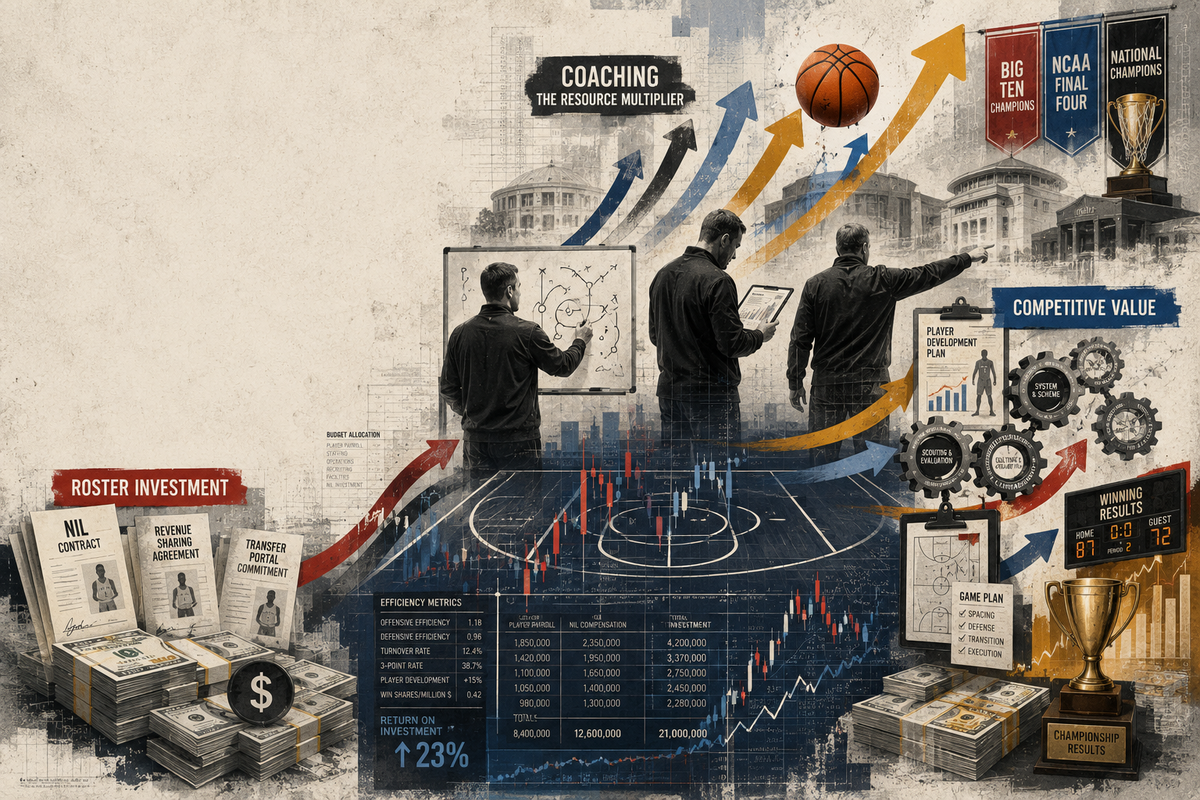
Talk about college basketball these days, and it almost always comes back to money. Every offseason, fans argue over who landed the biggest transfer, which collective wrote the biggest checks, and whose roster looks the most expensive on paper. The House settlement hasn't helped matters either; it added direct revenue sharing from schools on top of the third-party NIL deals that were already driving the market.
None of that means money doesn't matter. It clearly does. You can't build a championship roster on player development alone anymore, not when top recruits and transfers command real salaries. The Big Ten has turned into one of the most aggressive conferences in the country when it comes to funding men's basketball.
But all that spending talk misses something important: the biggest edge an athletic department can buy might not be another star transfer. It might be the coach drawing up plays on the whiteboard.
While everybody's watching roster payrolls, there's a quieter competition happening across the Big Ten: a race for coaches who can take those NIL dollars and squeeze more out of them than anyone else. As championship-caliber rosters start costing eight figures, good coaching has become the one thing that multiplies a program's investment instead of just spending it.
What Big Ten Basketball Costs Now
Industry estimates put the top Power Four basketball rosters somewhere between $7 million and $12 million once you combine revenue-sharing money with outside NIL support. The Big Ten's best-funded programs sit near the top of that range, and even the conference's smaller spenders invested amounts that would've seemed unthinkable five years ago.
Based on public reporting, donor activity, transfer portal moves, and market estimates, here's roughly where Big Ten programs stand heading into the 2026-27 season:
|
School |
Estimated Basketball NIL + Revenue Sharing |
|
Indiana |
$11.5 million |
|
Michigan |
$11.0 million |
|
Illinois |
$10.5 million |
|
Michigan State |
$10.0 million |
|
Oregon |
$9.8 million |
|
UCLA |
$9.7 million |
|
Ohio State |
$9.5 million |
|
Maryland |
$9.3 million |
|
Wisconsin |
$8.8 million |
|
Iowa |
$8.5 million |
|
USC |
$8.3 million |
|
Purdue |
$8.2 million |
|
Washington |
$7.8 million |
|
Nebraska |
$7.5 million |
|
Northwestern |
$7.2 million |
|
Rutgers |
$7.0 million |
|
Minnesota |
$6.8 million |
|
Penn State |
$6.5 million |
These aren't audited numbers as programs keep their actual finances under wraps, but they're close enough to show a real pattern. The gap between the conference's top spender and its smallest one is now measured in millions, not the hundreds of thousands it used to be. On paper, that kind of spending gap should produce a predictable set of standings every year.
It usually doesn't.
Why Spending Doesn't Explain Everything
If payroll were the only thing that mattered, the Big Ten standings would basically mirror the spending chart above. They almost never do. Programs with modest budgets regularly outplay wealthier rivals, and some of the conference's biggest spenders struggle to get the most out of the talent they've paid for.
The reason isn't complicated: money buys players, but coaches are the ones who turn that talent into results. Development, roster construction, defining roles, managing games, building a culture, establishing a defensive identity, closing out close games — none of that shows up on a spending chart, but all of it comes down to coaching.
As rosters keep getting more expensive, getting the most out of every dollar matters more than ever. A coach who turns an $8 million roster into a Final Four team is creating a lot more value than one who needs $11 million to get there. The best coaches aren't just winning games; they're making every dollar their program spends go further.
The Idea of a "Resource Multiplier"
Economists usually measure productivity by comparing output to input, and honestly, that's not a bad way to think about college basketball anymore. A program's roster is its investment. Wins are the return. And the head coach is basically what determines how efficiently one turns into the other.
That's where a useful idea comes in: call it a Resource Multiplier. It's a coach whose player evaluation, development, tactics, and culture consistently produce more wins than the program's spending alone would predict. These are the coaches who effectively stretch every NIL dollar further than it should go, and they’re the best bargains in college sports, even when they're not cheap to hire.
Matt Painter: The Gold Standard
Nobody fits this idea better than Purdue's Matt Painter. For two decades now, he's shown that strong player development can shrink, or sometimes erase entirely, the gap between what a program spends and how it performs on the court.
Purdue almost never wins the transfer portal with the conference's biggest NIL offers. Instead, Painter finds players who fit his system, develops them with patience, and consistently turns players other programs overlooked into NBA draft picks and All-Big Ten performers. The track record backs it up: conference titles, deep NCAA Tournament runs, and a national championship game appearance. Year after year, Purdue holds its own against programs spending noticeably more on talent. Every extra dollar Painter seems to produce more wins than that same dollar would somewhere else — which is exactly what a Resource Multiplier does.
Greg Gard: Quiet Excellence in Madison
Wisconsin's Greg Gard has built one of the most sustainable winning programs in the sport, and he's done it without much noise. The Badgers rarely land the flashiest recruiting classes or make the biggest splashes in the portal. Instead, Gard leans hard into development, continuity, discipline, and finding players who fit his system.
Wisconsin wins with experienced guys who know their roles, defend well, take care of the ball, and keep improving year over year. None of that shows up in recruiting rankings, but it shows up in the standings every single season. If Wisconsin is running an $8.8 million roster and regularly beating programs spending $10 million or more, Gard is essentially manufacturing millions of dollars in competitive value out of thin air. Like Painter, he's proof that great coaching isn't just about strategy; it's an economic advantage too.
Ben McCollum: The Conference's Most Interesting Experiment
No coach heading into 2026-27 is a more interesting test case than Iowa's Ben McCollum. His whole career has been built around winning with less than everyone else around him.
At Northwest Missouri State, he built one of the greatest dynasties in Division II history without anything close to an elite budget. At Drake, he turned a Missouri Valley program into a national story almost overnight by finding undervalued players, developing them fast, and building teams that played well together.
Now he's got the biggest test of his career in front of him: can that same approach work in the Big Ten? If Iowa can consistently compete against programs spending a lot more on their rosters, McCollum could end up being the clearest proof that coaching is still the biggest market inefficiency in the sport. He's spent his whole career finding undervalued talent. Now we'll see if that philosophy holds up in one of the richest conferences in the country.
Why Coaching Might Be the Smartest Investment in College Sports
People love to point at massive coaching salaries as proof that college athletics has lost its mind. But that argument skips over some pretty basic math.
Say an athletic department spends an extra $2 million landing another big-name transfer. The roster gets better for sure. But now imagine that same department instead hires a coach who can make every player on the roster ten or fifteen percent better through development, tactics, and culture. On an $8 million roster, that kind of coaching bump basically creates the value of another elite player, without ever paying for one.
Looked at that way, paying $4 or $5 million a year for a great head coach might generate a better return than spending that same money chasing one more portal addition. The coach becomes a multiplier. The roster gets more efficient. And that value compounds every single season the coach stays.
The Future Belongs to the Smartest Spenders
The next decade of Big Ten basketball isn't going to simply reward whoever spends the most. It's going to reward whoever spends the smartest.
Indiana, Michigan, Illinois, Michigan State, Oregon, and UCLA all have the financial muscle to build great rosters every year, and that's a real advantage, and nobody's denying it. But history keeps showing that spending alone rarely wins championships. Coaches like Matt Painter and Greg Gard have proven, again, that development, continuity, culture, and sharp tactics can close financial gaps that look impossible on paper. Now Ben McCollum gets his shot to prove the same thing at Iowa.
The bigger lesson goes beyond any one coach. As NIL keeps reshaping the sport, player payrolls are going to keep grabbing headlines because they're the easiest thing to measure. The harder, and more important, question is how well each program turns those dollars into actual wins.
The Big Ten's next champion will almost certainly have a talented roster. There's a good chance it'll also have the conference's best Resource Multiplier running the show.
In a sport that's become obsessed with money, the smartest investment might still be the guy standing on the sideline.
Methodology
These payroll estimates combine projected revenue-sharing allocations with informed estimates of third-party NIL support, based on public reporting, transfer portal activity, donor involvement, and general market intelligence. Since athletic departments don't disclose actual player compensation, these numbers are meant to show relative market positioning rather than exact totals.
Comments ()