
Big Ten Venue Revenue: Who Profits When the Teams Aren’t Playing?
Big Ten stadiums are becoming year-round businesses. Which athletic departments get the most money?
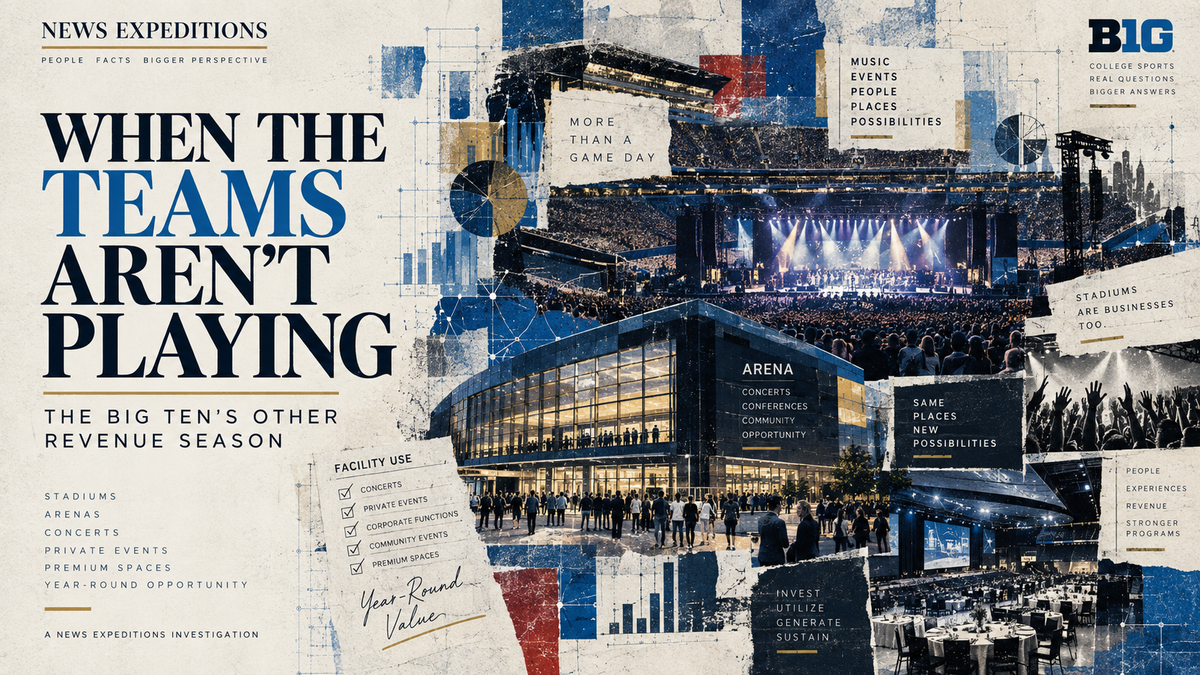
Michigan Stadium made $1.7 million in a single night, and it wasn't even football season. One concert, one building, one athletic department pocketing $1.7 million while the Wolverines were nowhere near the field.
Wisconsin filled Camp Randall three times in one summer and now runs a full entertainment business out of it. Nebraska built an entire department around chasing this kind of money. Iowa sold out Kinnick Stadium two nights in a row for a baseball comedy show and rents its stadium suites for weddings on the side. Across the Big Ten, billions of dollars in concrete, turf, and luxury seating are quietly getting a second job.
But here's the question nobody's really answering honestly: who gets the check?
The Rose Bowl can sell out for a concert, and UCLA Athletics might not see a dime of it. A university-owned arena can run a booming events business while the money lands somewhere else entirely, like a university account that has nothing to do with athletics. Meanwhile, Michigan put Zach Bryan on the field at the Big House and booked $1.7 million of that concert straight into the athletics budget.
Those are two completely different businesses wearing the same stadium logo. So, we went through the Big Ten's stadiums and arenas asking a narrower question than "which buildings host the most stuff." We asked: how much money does the athletic department itself pocket when its own teams aren't playing?
The Rule: If Athletics Doesn't Get the Money, It Doesn't Count
We're only counting money that lands in a Big Ten athletic department's account from non-routine use of its facilities: concert promoter payments, event rental fees, athletics' cut of concessions or parking, premium seating, private rentals, and stadium experience packages.
We're not counting regular football, basketball, or hockey games. That's just the job. And we're not counting an event just because it happened near a Big Ten school. City tax revenue doesn't count. Central university money doesn't count unless it's handed to athletics. Arena authority profits, "economic impact" studies, and a promoter's ticket sales don't count either.
When we can't figure out where the money went, we say so instead of pretending we know. That makes this list more conservative, and a lot more trustworthy.
Michigan Set the Price Tag for Everyone Else
Michigan's the easy place to start, because Michigan tells us the number.
When Zach Bryan played the Big House in September 2025, Michigan Athletics projected $1.7 million in net revenue from that single concert in its FY2026 budget. Not ticket sales, not bar tabs in Ann Arbor, not some made-up "economic impact" figure. Net revenue, straight into the athletic department.
A year later, Michigan doubled down. The FY2027 budget includes $4 million in net revenue from two Morgan Wallen shows at Michigan Stadium on July 24 and 25, 2026. So now we have something rare in this business: the actual market price. A big-name concert at the Big House looks like it's worth somewhere between $1.7 million and $2 million net, per night.
That matters because the same FY2026 budget carried roughly $26.7 million in new costs tied to athlete revenue sharing and scholarships. One concert didn't cover that gap, but $4 million from two nights puts a real dent in a budget hole that is forcing athletic departments everywhere to scramble for cash. Michigan just handed the rest of the conference a ruler to measure themselves against.
Wisconsin Might Be Making More. We Can't Prove It Yet.
Wisconsin may have run the most aggressive stadium-events calendar in the conference last year. Camp Randall hadn't hosted a major concert in almost 30 years. Then Morgan Wallen showed up for back-to-back nights on June 28 and 29, 2025, and Coldplay followed on July 19. Three shows, three sellouts. Wisconsin said flat-out, before the concerts even happened, that these shows would be an important revenue source for UW Athletics.
Wisconsin didn't share the exact dollar figure. If Camp Randall's economics resemble Michigan's, three sold-out shows could plausibly land somewhere in the $4 million to $6 million range, though that's our estimate, not a confirmed number.
Stronger evidence came next. In May 2026, Wisconsin launched Live at Wisconsin, a dedicated entertainment operation covering both Camp Randall and the Kohl Center. Deputy athletic director Mitchell Pinta described an expanding program, and the 2026 lineup already includes Shinedown, two Phish dates, AC/DC, Mumford & Sons, and the Smashing Pumpkins. This isn't a school renting out its stadium when it's free. It's a business Wisconsin built on purpose.
Nebraska Built an Entire Department to Chase This Money
In July 2025, Nebraska Athletics announced a brand-new Special Events Department, with a mission spelled out plainly: get more use out of Husker facilities and create additional revenue through outside events and rentals. Athletic director Troy Dannen put it simply: Memorial Stadium shouldn't just sit there for seven home football games and nothing else. Nebraska followed through with a packed 2026 stadium calendar, including big entertainment acts and the Savannah Bananas.
One caveat: not every dollar spent in Lincoln belongs to Nebraska Athletics. Pinnacle Bank Arena is the clearest example. Husker basketball plays there, but the arena isn't purely an athletics operation, so an unrelated concert's revenue can't get filed under "Husker Athletics money." Memorial Stadium is different, and Nebraska is deliberately squeezing more out of it. Without event settlements, an exact number would be a guess, but using Michigan as a rough scale, a fully running program could plausibly become a multi-million-dollar annual source. Either way, Nebraska hired people whose entire job is making this happen.
Iowa Is Playing Both Ends of the Field
At the big end, Kinnick Stadium sold out two nights in a row, July 3 and 4, 2026, for Savannah Bananas games. But regional spending isn't the number we care about. What matters is Iowa Athletics' actual event settlement, and that figure hasn't been made public, so the honest description is athletics revenue of an undisclosed amount. Our rough estimate puts the combined benefit somewhere between $1 million and $2 million, with much lower confidence than Michigan's disclosed figures.
On the small end, Iowa openly rents out pieces of Kinnick at published prices: the Athletic Director's Suite for $200 an hour, the McCord Club and Mediacom Outdoor Club for $575, the Ted Pacha Family Club for $705, field access up to $500 an hour for groups. Iowa will even sell you a wedding there, a ceremony-and-reception package across two stadium spaces for $1,470 an hour, a Press Box reception for $1,260. Carver-Hawkeye Arena has its own list too, with the Feller Club at $440, the Hadley Club at $220, and the Big Ten/Iowa Room at $175.
A Tuesday night corporate dinner can't touch a 70,000-seat sellout, but that's the point. Iowa squeezes money out of the same building twice, once from thousands of concert fans in July and again from 150 people at a rehearsal dinner in October.
USC's Control, UCLA's Cautionary Tale
USC doesn't technically own the Los Angeles Memorial Coliseum, and UCLA doesn't own the Rose Bowl either. Yet their businesses look nothing alike.
USC operates the Coliseum under a long-term master lease that gives it real commercial control. Even so, that alone doesn't mean every Coliseum concert dollar flows to USC Athletics. The Galen Center gives cleaner proof: USC's own written policy names the Athletic Department as the managing unit there, controlling the calendar and premium rental rates. We're still missing a public number on exactly what that hands over to athletics each year, but USC's almost certainly a real player here.
UCLA is a mirror image. The Rose Bowl is one of the best entertainment venues in the country, but UCLA Athletics doesn't run it, so most of that revenue never touches the athletic department's books. UCLA football playing there doesn't give the department a cut on some unrelated concerts, any more than renting an apartment gives you a share of your landlord's rent next door. Michigan owns the opportunity inside its own stadium. UCLA is just renting a seat at someone else's table.
Penn State and Northwestern Are Building the Future In
Penn State's playing a long game. Its Beaver Stadium renovation is funded by Intercollegiate Athletics itself, not tuition, and the school has said directly that the project is meant to expand revenue opportunities and allow year-round use of the stadium. That tells us the intent is real, even without a dollar figure yet. A 100,000-seat stadium rebuilt with year-round revenue in mind is a different business plan for the same piece of land.
Northwestern's new Ryan Field will be far smaller, but Northwestern specifically pushed for the right to hold concerts as part of the building's financial model. After neighborhood pushback, the school capped fixed concert dates at six a year while insisting the event program mattered to the project's finances. The deal also locked in a $2 million minimum annual guarantee in event-related taxes and fees to Evanston, plus a concert-ticket surcharge expected to bring in $500,000 a year for Evanston's public schools. None of that counts as Northwestern Athletics revenue, but it shows how much these concerts are worth, since they became one of the central fights over the entire project.
Everyone Else Is Still Unproven
Ohio State's Schottenstein Center, Oregon's Matthew Knight Arena and Illinois' State Farm Center all run major entertainment calendars. Michigan State, Maryland, Minnesota, Rutgers, Washington, Purdue and Indiana all have spaces capable of hosting plenty beyond regular games.
But we're ranking which athletic departments get paid, not which buildings stay busy. Until the accounting shows outside-event profits flowing to athletics, we're not handing anyone a made-up figure just because they own the building. Ohio State could end up being one of the biggest businesses in the conference once the numbers come out. Oregon could jump way up thanks to Autzen and Matthew Knight together. Illinois could prove State Farm Center is a real budget contributor. The proof just must show up before the ranking does.
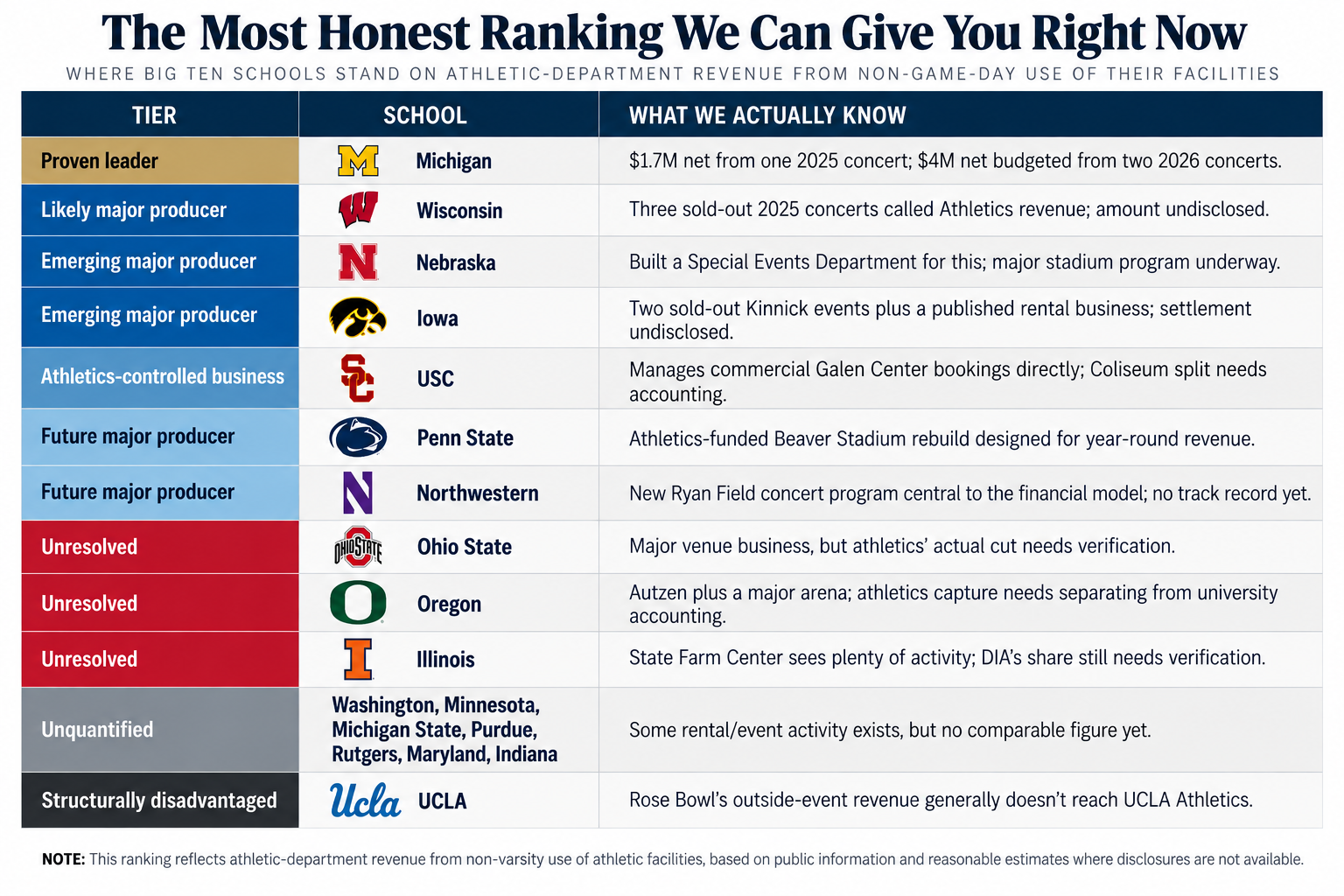
This table doesn't slap a fake number on every school just to look complete. Michigan gets a real figure because Michigan disclosed one, and Wisconsin gets an estimate because Wisconsin openly calls its concerts athletics revenue. For most of the rest, the honest answer is still: we need the actual contracts.
The Stat Nobody's Tracking Yet: Revenue-Producing Days
College athletic departments have measured facilities for decades by capacity, luxury suites, and attendance. The post-House-settlement world is forcing a new question: how many days a year does a building make money for athletics?
Picture two identical 80,000-seat stadiums. One hosts seven football games and sits in the dark the rest of the year. The other hosts the same seven games, plus concerts, a specialty sporting event, private functions, and steady premium-space rentals year-round. On a random Saturday, they'd look identical. Financially, they're not close to the same asset.
Michigan already put a number on that gap. One night with Zach Bryan: $1.7 million net. Two nights with Morgan Wallen: $4 million budgeted net. Every athletic director in the conference has seen that math now, and every empty summer weekend suddenly has a price tag attached to it.
Bottom Line
The Big Ten has poured billions into stadiums, arenas and hospitality spaces, and for most of college sports history, none of it had to work harder than seven Saturdays in the fall. That era's ending fast. Wisconsin turned Camp Randall and the Kohl Center into a year-round entertainment brand. Nebraska hired a department to chase this money down. Iowa's renting Kinnick by the hour and packing the stadium for Banana Ball in the same summer. USC runs the Galen Center as a real business. Penn State's rebuilding Beaver Stadium with this exact strategy baked into the blueprints. Northwestern fought city hall over six concert dates because the revenue was too important to lose.
And Michigan already showed everyone what the ceiling looks like. Two million dollars in a single night is not a number anyone in this conference can afford to ignore. The next arms race in the Big Ten probably won't be about who adds another 10,000 seats. It'll be about who controls the building, who controls the calendar, and who keeps the money when the gates open on a night nobody's playing a game.

Comments ()