
Michigan Athletics, Warde Manuel and the $19 Million Cost of an Internal Crisis
Michigan spent $12M investigating athletics, then paid Warde Manuel $7M to leave. What did the public get?
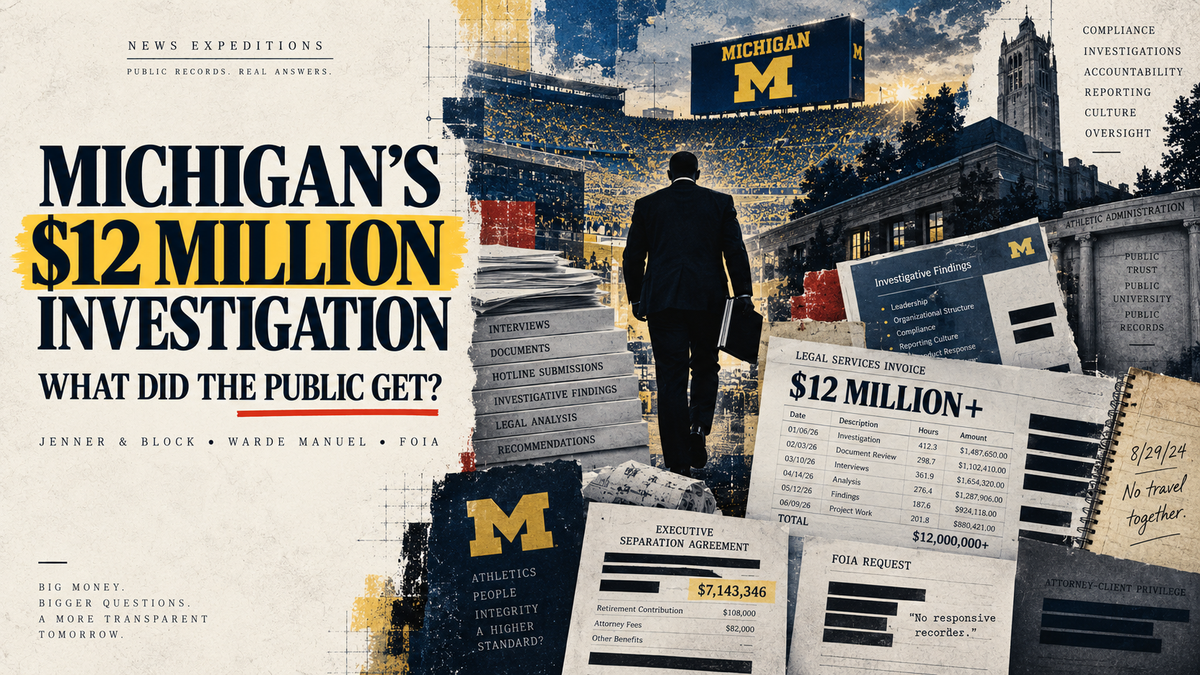
Michigan's regents talk a big game about accountability, but don't seem eager to let the public read the receipts. The University of Michigan paid more than $12 million to find out what was wrong inside its own athletic department, hiring Jenner & Block and turning them loose. Lawyers ran roughly 350 interviews with nearly 300 witnesses, dug through more than 20,000 documents, and fielded over 90 hotline tips. It found real problems: Michigan admitted the department had weaknesses in accountability, structure, human resources, compliance, and how it handled misconduct, and said it failed to act fast enough on some allegations. Reforms got announced, and not long after the investigation wrapped, Michigan agreed to pay longtime athletic director Warde Manuel more than $7.3 million just to walk away.
So, $12 million bought findings, reforms, and an expensive exit package, but not the one thing you'd expect: an actual report anybody outside the building can read. Michigan says flatly that no comprehensive written report was ever commissioned or produced. That doesn't mean nothing exists on paper. Jenner & Block built detailed findings for university officials, including a slide presentation that The Wall Street Journal got hold of, and by that account, the slides held a lot more than whatever summary Michigan gave the public. Michigan walked away with findings, then decided how much of them the rest of us get to see, which is the real question: what did taxpayers and students buy for $12 million?
An Eight-Figure Bill That Nobody Can Say Surprised Anyone
Michigan first brought in Jenner & Block in November 2025 over allegations of policy violations, then expanded the deal in January 2026. The contract terms show how big this was expected to get. Michigan negotiated a discount, but the fine print assumed an eight-figure bill: partners could charge up to $1,990 an hour, with an extra 2.5 percent discount once Jenner crossed $5 million in 2026 fees and 5 percent after $10 million. Pricing tiers built for those thresholds don't happen by accident.
The invoices blew past even that. Early bills topped $2 million, January alone added close to $4 million more, and by the end of April, Jenner's total was north of $11.5 million, pushed past $12 million as more work came in. The longer the investigation dragged on, the less useful the invoices got, since later billing records, pulled through FOIA requests, came back heavily blacked out under attorney-client privilege. The public could watch the meter running but couldn't see what it was paying for.
What Jenner Actually Found
Michigan's public version doesn't describe a department in meltdown. The school said misconduct wasn't "widespread" and credited Manuel for real accomplishments, but the review flagged three problem areas: leadership accountability, organizational structure, and a broken reporting culture. President Domenico Grasso described failures of accountability, structural cracks, weak reporting and support systems, and concerns about retaliation against people who spoke up.
Those problems didn't stay contained to whatever triggered the investigation. According to The Wall Street Journal's look at Jenner's findings, investigators dug into issues across multiple programs and administrations: former football coach Sherrone Moore, compliance problems from the Jim Harbaugh era, how Michigan handled Juwan Howard's conduct as men's basketball coach, complaints against water polo coach Cassie Churnside, and an allegation against former football assistant LaTroy Lewis, which Lewis denies. One section reportedly summed up Howard's 2022 altercation with a Wisconsin assistant coach under a heading: "One Free Punch." The presentation reportedly also included something the public summary left out: a photograph of Moore's vehicle parked at the apartment complex where Paige Shiver, the former football staffer whose relationship with Moore cost him his job, lived.
That's where "not widespread" starts to look shaky. The private findings reportedly touched football, men's basketball, water polo, compliance, personnel management, misconduct reporting, and top leadership, a pattern touching nearly every corner of the building. That doesn't prove Michigan's word choice is wrong, but it's fair to ask what evidence backs it, and the public can't check without seeing Jenner's findings.
The Warning Signs Before Sherrone Moore Was Fired
Michigan fired Moore in December 2025, saying the investigation turned up credible evidence of an inappropriate relationship with a subordinate, as if the school caught something and moved fast. The actual timeline is messier. According to reporting based on Jenner's findings, Manuel wrote a handwritten note on August 29, 2024, two days before Moore's first game as permanent head coach, about Shiver traveling with the team, and reportedly told staff she couldn't travel with him. That's not proof Manuel knew about a romantic relationship, but it shows concerns reached his desk early enough that he restricted her travel. More red flags followed, including hotline tips about Moore's behavior.
Michigan has stressed Jenner didn't find a current employee with direct, real-time evidence before Shiver disclosed it herself, a fair distinction. But "no direct evidence at the time" isn't "no warning signs at all."
Then Manuel Was Suddenly Gone
Right after the investigation closed, Athletics saw a sudden change at the top. Manuel was publicly saying on July 13 that he expected to stay on. Within days, everything changed. Manuel and Grasso signed a separation agreement on July 17, and Michigan announced his departure on July 20, bundled with its comments on the review. According to the separation agreement obtained through public records, Michigan gave Manuel a $7,143,346 lump-sum payment, a $108,000 retirement contribution, $82,000 toward attorney fees, retiree benefits despite falling short of the usual 20-year service requirement, and former athletic-director perks including tickets and golf privileges. His file will say he resigned voluntarily, and the deal bars him from becoming an athletic director or senior athletic adviser at another Big Ten school for two years, though he can work elsewhere without losing the payout.
The separation numbers alone total roughly $7.33 million. Stack that on Jenner's fees, and Michigan has committed more than $19.3 million to the investigation and Manuel's exit, before counting continuing benefits or other legal costs. There's more coming: Michigan hired Weil, Gotshal & Manges for potential litigation involving Shiver, and records on that engagement show rates from $975 to $2,850 an hour, with a 15 percent discount. The final bill will land well above $19.3 million, and nobody seems eager to say by how much.
The Woman Fighting to Read Her Own Interview
The most revealing transparency fight involves Paige Shiver herself. She and Julie Murphy sued Michigan under the state's FOIA law in Shiver v. University of Michigan, claiming the school wrongly denied records tied to Moore and the Jenner investigation. The lawsuit and records requests lay out the dispute. Shiver asked for the transcript, notes, and recordings from her own December 10, 2025, interview with Jenner. Michigan's answer: "no responsive records." She also asked for emails sent to the address Jenner set up for the investigation and got the same response.
That sounds absurd on its face, since Jenner ran the investigation, interviewed Shiver, and presumably kept records of it somewhere. But Michigan saying Michigan doesn't possess a record is different from saying it doesn't exist anywhere, and that distinction leads to a four-decade-old court case that may be the most important precedent in this fight.
A 1984 Case That Explains a Lot About 2026
In Hoffman v. Bay City School District, a school district hired a lawyer to investigate its finance department, and the lawyer kept the file himself, giving the board only an oral report. When someone tried to get the file through FOIA, the Michigan Court of Appeals ruled it never became a public record just because the district paid for the work, a principle courts have leaned on since, including in MacKenzie v. Wales Township, which cited Hoffman while sorting out when records held by outside parties count as public records.
That precedent opens a real loophole. A public university can hire lawyers to investigate itself, and if their material stays with outside counsel and the university never gets its hands on it, FOIA might not turn it into a public record just because public money paid for it. That doesn't mean Michigan broke the law; it means the school might have a legitimate argument for keeping this sealed.
But the Slideshow Is a Different Animal
Here's where the defense gets shaky: Michigan officials reportedly sat in a room and looked at the presentation themselves. Michigan law doesn't limit "public record" to documents government employees wrote on their own; courts look at whether a public body prepared, owned, used, possessed, or relied on a record while doing its job. In Hopkins v. Duncan Township, the Court of Appeals said documents can become public records through later use or possession, though briefly stumbling across one isn't enough.
If Jenner kept notes Michigan officials never saw, Hoffman probably protects the school. But leaders reportedly saw the presentation with their own eyes, and if they used it to restructure Athletics or evaluate Manuel, the question gets tougher to dodge: when does a law firm's work product become a public record once officials use it to run the school? No court has ruled yet, which is why Shiver's lawsuit could matter beyond one former staffer chasing her own transcript.
Michigan Is Fighting the Lawsuit, But Hasn't Won It
Michigan has moved to dismiss Shiver's lawsuit, though its first argument is about jurisdiction, not substance. It says the case belongs to the Michigan Court of Claims, not Washtenaw County Circuit Court, and that August dismissal motion doesn't resolve whether the records should be public. Both sides have real legal arguments, and no court has yet ruled that disputed records are exempt. This fight is still live.
Michigan Already Proved It Can Do This the Right Way
Michigan has already shown it can run a transparent investigation; it just chose not to this time. Five years ago, facing the sexual abuse committed by former university physician Robert Anderson, Michigan hired WilmerHale and structured that investigation very differently. It promised full accounting from day one, and WilmerHale controlled its own process, never gave Michigan a draft before publishing, and stayed separate from the lawyers defending Michigan in related civil suits. On May 11, 2021, Michigan released the full 240-page WilmerHale report, and the Regents said they got it at the same time everyone else did, meaning leadership couldn't spin the findings before anyone else read them.
The differences are real: Anderson was dead, much of the conduct was historical, and the Athletics investigation involves current employees and active litigation. Those differences justify protecting some identities, but they don't explain why Michigan couldn't have built this investigation around eventual public accountability the same way. Michigan knows how to run this play. It chose not to.
Michigan's Confidentiality Argument Isn't Nothing
Michigan's case for keeping some of this sealed isn't pure spin. Confidentiality protects people who cooperated, cuts down on retaliation, and preserves attorney-client privilege- legitimate concerns, not just excuses. Even redaction isn't foolproof in a small department where context clues can out a supposedly anonymous witness. The question shouldn't be why Michigan release won’t everything; that's too simple. The better question is why it didn't build this investigation to produce something releasable in the first place. Anderson already proved confidential and publicly accountable aren't opposites.
What $12 Million Actually Bought
Michigan has real results to show: recommendations on compliance, HR, investigative procedures, misconduct reporting, leadership accountability, and athlete welfare, plus promised reforms and new leadership already in place.
But Michigan is also asking the public to trust its own summary of an investigation into itself. It decides which findings to summarize and which to keep confidential, and it says no comprehensive report was ever commissioned. Meanwhile, the most detailed document known to exist, the one leadership looked at, stays locked away. That might be legal. It isn't transparency.
Bottom Line
The numbers get ugly fast: more than $12 million for Jenner & Block, a $7,143,346 lump sum for Manuel, $108,000 toward retirement, $82,000 for his lawyers, plus retiree perks and ongoing legal costs from Shiver's case. The verifiable total sits above $19.3 million and is still climbing, a wild sum even for modern Big Ten athletics, where nine-figure media deals and revenue sharing have turned departments into private businesses attached to public universities that can afford the country's most expensive lawyers on the public's dime.
Michigan's FOIA law wasn't written for that kind of institution, and this investigation exposes where the mismatch breaks down. Outside counsel can hold records the university never touches, privilege can shield entire conversations, and a university can simply decide not to commission the kind of report it commissioned last time a crisis this serious hit campus. Michigan spent $12 million figuring out what went wrong, another $7 million easing out the man who ran it, and announced reforms about accountability, all while the public still can't check the work. Nobody outside a small circle of officials and lawyers knows what the full evidence shows, because nobody outside that circle has been allowed to look.
Michigan's own investigation concluded that Athletics needed better accountability and real oversight. Right now, the university's handling of that same investigation is failing its own test.

Comments ()