
Notre Dame to the Big Ten? The $450 Million Cost of Independence
The Big Ten once pushed Notre Dame out. By 2030, it may be rich enough to finally pull the Irish back in.
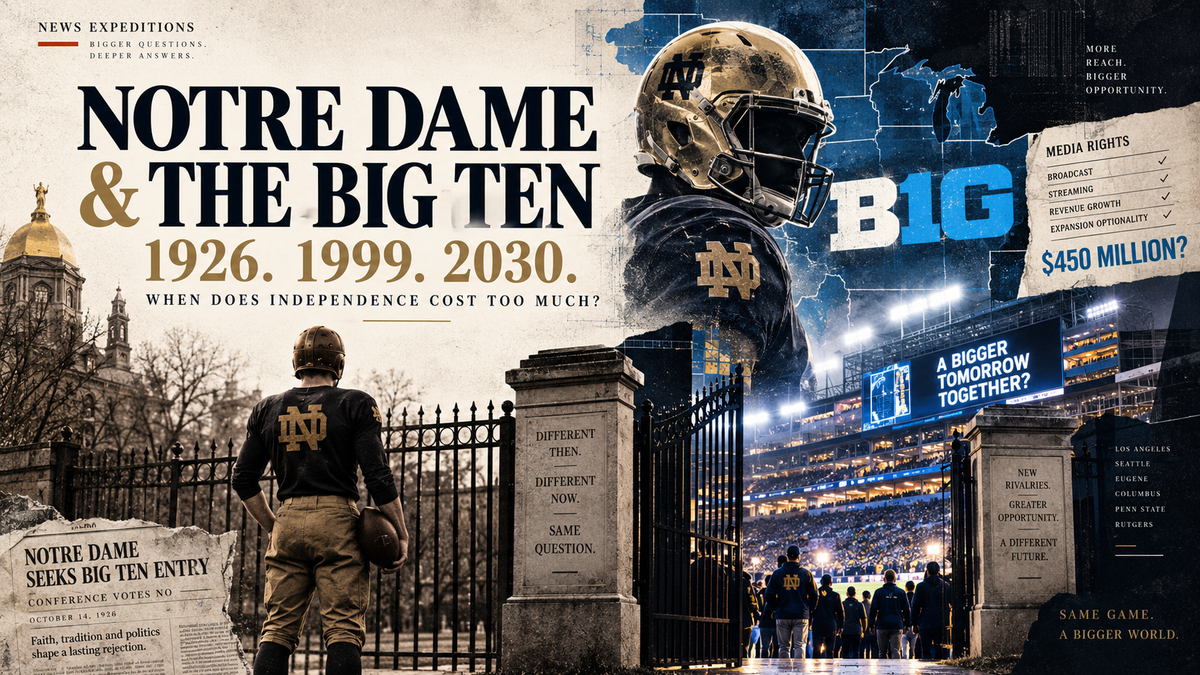
For almost a hundred years, Notre Dame's independence in football has been treated like something sacred, almost untouchable. It's the trait that sets the Irish apart from Ohio State, Michigan, Alabama, and basically every other blue-blood program in the sport. It hands Notre Dame control over its own schedule, its own national identity, and, most importantly, its own television money. Notre Dame doesn't belong to a football conference because Notre Dame has never needed one.
But there's a wrinkle in that story that gets conveniently left out: Notre Dame tried to join the Big Ten, and the Big Ten said no.
Religious prejudice against a Catholic university was part of the ugly backdrop to Notre Dame's early, repeated attempts to join what was then called the Western Conference. That rejection pushed Notre Dame to look outside the Midwest for opponents, and those cross-country trips built the national identity that eventually made conference membership feel unnecessary.
Then, decades later, it all flipped. By 1999, the Big Ten wanted Notre Dame in, and Notre Dame said no thanks.
Today, the Big Ten is an 18-school, coast-to-coast machine pulling in well over a billion dollars a year, and Notre Dame has quietly built its own wildly successful financial setup completely outside of it. But somewhere around 2030, that balance could shift again, and this time the numbers might force Notre Dame's hand.
Notre Dame's current deal with NBC runs out after the 2029 season. The Big Ten's media contracts expire in 2030. Notre Dame already competes in the Big Ten in hockey, and its other sports compete in the ACC. And buried in the Big Ten's current TV contracts is something almost nobody outside the industry knows about: specific clauses that spell out exactly how much more the networks would pay if Notre Dame ever joined. No other school on earth got that kind of treatment written into a contract.
The real question isn't whether Notre Dame can join the Big Ten. It obviously can. The real question, the one that should make Notre Dame fans nervous, is this: how much money is Notre Dame willing to leave on the table just to stay out of a conference that once didn't even want it?
Notre Dame Didn't Invent Independence. It Got Forced Into It.
Notre Dame's national identity looks inevitable when you look back at it now, but it wasn't inevitable at all. The school's location in northern Indiana should have made it a natural fit for the emerging Midwestern sports establishment. Michigan, Purdue, Indiana, Northwestern, Illinois, Wisconsin, and Chicago were all right there. Notre Dame repeatedly tried to build those relationships and explored joining the Western Conference.
But Notre Dame was different in ways that mattered to the people running that league. It was private. It was Catholic. And it existed in an era when anti-Catholic sentiment was a real and powerful force in American culture and politics.
To be fair, legitimate athletic and academic disputes also played a role, and it would be dishonest to boil the whole saga down to religion alone. Questions about eligibility rules, athletic governance, and Notre Dame's own football practices played a role. But historians who've studied Notre Dame football have documented that anti-Catholic bias was central to the exclusion, and that distinction matters.
Nobody's claiming the Big Ten held a formal meeting and declared Catholics unwelcome. The truth is messier and, honestly, more damning. Notre Dame was trying to break into a Midwestern establishment at a time when Protestant America viewed Catholic institutions with deep suspicion, and some of the men blocking Notre Dame's path held those very prejudices. The university kept getting turned away, so it went and built something else entirely.
1926: The Door Slams Shut
The pivotal moment came during the Knute Rockne era, by which point Notre Dame was no longer some obscure Catholic college trying to scrape together a football program. Rockne was building a national powerhouse, and in 1926, Notre Dame made another run at joining the Western Conference. The school tried to address concerns about its athletic and academic practices and even asked conference representatives to investigate campus conditions firsthand.
It didn't work. Historian Murray Sperber later argued that conference officials accepted rumors instead of doing the investigation Notre Dame had requested, and he pointed to Michigan's Fielding Yost and Chicago's Amos Alonzo Stagg as two key figures who spread opposition to the Irish behind the scenes.
Notre Dame stayed on the outside, and the resentment lingered for generations. More than 70 years later, when the idea of joining the Big Ten resurfaced, Notre Dame officials were still hearing the same line from alumni: they wouldn't take us then, so why should we join them now? That's how institutional memory works. Grudges don't expire; they just get passed down.
But that 1926 rejection also set off a chain reaction nobody could have predicted. In trying to keep Notre Dame out, the Big Ten helped build the very thing that would one day make Notre Dame too powerful to need it.
The Big Ten Accidentally Made Notre Dame a National Brand
Notre Dame needed opponents, and if the Midwest wasn't going to provide enough of them, the Irish had to hit the road. So they did. They played Army, Navy, and USC. They played teams up and down the East Coast and out on the West Coast, in big markets that put them in front of huge audiences.
At the same time, Rockne was assembling one of the most dominant programs in the country. The Four Horsemen became national celebrities. New York sportswriters turned Notre Dame players into legends. Catholic communities across the country, most of whom had never set foot on the campus, adopted the school as their own. Notre Dame stopped being a regional football program and became something closer to a national institution, and that sprawling footprint became enormously valuable once radio and then television transformed the sport.
The irony is hard to miss. Excluding Notre Dame from the Midwestern establishment helped create Notre Dame's national brand. And that brand eventually made joining the Midwestern establishment feel completely unnecessary. Independence went from punishment to a competitive weapon.
1999: The Power Flips
Then came one of the strangest reversals in the whole saga. In 1999, Notre Dame and the Big Ten seriously explored membership again, only this time the power dynamic had completely flipped. The Big Ten wanted Notre Dame in, and Notre Dame's own faculty could see real academic advantages to joining the conference and its academic consortium, in addition to the obvious athletic benefits.
But Notre Dame's Board of Trustees turned it down anyway. The university announced it would remain independent, and then-president Rev. Edward Malloy framed the decision as being about far more than football. He said Notre Dame's identity came from its long history of independence and its role as a Catholic university with a national following.
Sit with that for a second. Catholic identity was part of what had led to Notre Dame's exclusion generations earlier. By 1999, Notre Dame was using that same Catholic and national identity to justify staying out on its own terms. The rejection had somehow become the identity, and the identity had become the asset.
The Twist: Notre Dame Athletics Isn't Actually Independent
Here's where the modern argument gets a lot more interesting, and a lot more uncomfortable for Notre Dame purists. The school sponsors 26 varsity sports, 13 men's and 13 women's, covering roughly 650 athletes. So how many of those sports operate under Notre Dame's famous independence?
Just one: Football.
Notre Dame describes its own setup plainly: football is independent, hockey belongs to the Big Ten, and every other sport competes in the ACC. Even football isn't fully detached from conference structures, since the ACC arrangement requires Notre Dame to play an average of five ACC football games each season.
Notre Dame hasn't rejected conference athletics at all. It's done the opposite. Notre Dame has essentially unbundled its entire athletic department, buying conference membership for every sport that benefits from it while keeping independence reserved for the one sport valuable enough to sell on its own. That's not hypocrisy. It's ruthlessly rational economics, and it's worth admitting Notre Dame has played this game better than almost anyone.
Could Notre Dame Actually Join the Big Ten?
Yes, without question. There's no real athletic obstacle standing in the way, and the transition might honestly be easier than the mythology around Notre Dame suggests. Most of the sports fit seamlessly. Hockey wouldn't even need to move, since Notre Dame hockey already plays in the Big Ten.
A few sport-specific headaches would remain. Fencing is the obvious one, since Notre Dame runs one of the premier fencing programs in the country and the Big Ten doesn't sponsor a conference fencing championship. But that's a scheduling problem, not a real barrier. Notre Dame could become a Big Ten school tomorrow if it wanted to. The question has never really been whether it can. The question is why it would bother.
Because Independence Still Pays Off, at Least for Now
Here's the honest answer: money. Notre Dame has effectively built its own private conference distribution by stitching together a few separate pieces.
The centerpiece is NBC. The two have been television partners since 1991, and the current deal runs through the 2029 season, with NBC holding the rights to Notre Dame home games across its platforms. On top of that, Notre Dame collects revenue through its ACC relationship, and it also cashes in through the College Football Playoff.
Put all three pieces together, and Notre Dame has created something genuinely clever: a synthetic conference payout without ever having to hand football over to a conference. That's the model's real genius. Notre Dame gets close to the central revenue a full-share member of the richest conference in college sports would receive, all while keeping total control of its most valuable asset. That makes independence very easy to defend right now. Today, at least.
Meanwhile, the Big Ten Turned Into a Monster
The Big Ten of 1926 wouldn't recognize the conference wearing its name today. It now stretches from Rutgers in New Jersey all the way to USC and UCLA in Los Angeles, plus Oregon in Eugene and Washington in Seattle. Eighteen universities strong, with enough television inventory to fill national windows from noon Eastern straight through late Saturday night, the conference has become a genuine revenue machine.
That matters because Notre Dame isn't really competing against Indiana or Purdue or Northwestern anymore. It's competing against the combined negotiating muscle of 18 major athletic departments selling their inventory as one package. Notre Dame sells Notre Dame. The Big Ten sells an entire ecosystem. So far, Notre Dame's singular brand has been strong enough to make that comparison surprisingly close. Whether that stays true through the next media cycle is anyone's guess, and there's a real reason to doubt it will.
There's a Smoking Gun Buried in the Big Ten's TV Contracts
If anyone still doubts how badly the Big Ten wants Notre Dame, look at what happened when the conference negotiated its current media deals. CBS, Fox, and NBC agreed in advance to specific rights-fee increases if Notre Dame joined the Big Ten during the contract term. Not if the conference simply expanded, but only if Notre Dame specifically joined.
Sports Business Journal reported that Notre Dame was the only school named individually with a predetermined financial escalator built right into the deal. Any other potential addition would trigger fresh negotiations with the networks, but Notre Dame already had a specific dollar value written directly into the contracts before it even considered joining.
That might be the single most revealing fact in this entire relationship. Television executives have already decided Notre Dame isn't just another mouth at the table. Notre Dame makes the whole product more valuable, and that fact completely changes the math on expansion.
Notre Dame Wouldn't Just Take a Slice of the Pie. It Could Make the Pie Bigger.
Conference expansion is usually a simple, unflattering equation. Say 18 schools are splitting a television pie evenly. Add a 19th member, and everyone else gets a smaller slice unless the new school generates enough additional media revenue to offset it. That's exactly why there are so few realistic expansion candidates left for either the Big Ten or the SEC.
Notre Dame breaks that equation entirely. Picture the matchups: Notre Dame–Michigan, Notre Dame–USC, Notre Dame–Ohio State, Notre Dame–Penn State, Notre Dame–Oregon, Notre Dame–Wisconsin, Notre Dame–Nebraska, Notre Dame–Michigan State. Several of those games would instantly become some of the most valuable, most-watched matchups in the entire Big Ten package. And USC-Notre Dame, already one of the sport's great rivalries, would suddenly become an in-conference inventory overnight.
The way broadcasters have written Notre Dame into their contracts tells you they already understand this. Notre Dame wouldn't just receive a slice of the Big Ten pie. It could enlarge the whole pie for everyone else at the table.
And NBC Is Already Playing Both Sides
Here's the part of the story that feels almost too ironic to be real. For decades, NBC is exactly what made Big Ten membership feel unnecessary for Notre Dame, giving the school a national broadcast platform built entirely around one university that no conference could replicate. But today's NBC also broadcasts the Big Ten.
The same network helping Notre Dame preserve its independence is simultaneously writing checks to broadcast Big Ten football. The wall that's supposed to separate these two worlds has gotten remarkably thin. Notre Dame plays Big Ten opponents. Notre Dame Hockey is a member of the Big Ten. NBC carries Notre Dame and the Big Ten, too. And reportedly, NBC's Big Ten contract already spells out what happens financially the moment Notre Dame crosses that final line.
None of that proves a deal is coming. But it shows just how little structural imagination it would take to make one happen.
The Date Everyone Should Be Watching Is 2030
Notre Dame's NBC agreement runs through the 2029 season. The Big Ten's current media package runs through June 30, 2030. That's not a coincidence worth ignoring; it's a genuine collision course.
At roughly the same moment, Notre Dame will need to figure out what independent football is worth in the next media era, while the Big Ten figures out what its enormous national footprint is worth in that same era. Those negotiations could finally answer a question that's been mostly theoretical for decades: what is Notre Dame's independence worth, not emotionally, not historically, but in cold, hard dollars.
Putting an Actual Price Tag on Tradition
Nobody knows exactly what either media structure will generate after 2030, so treat any numbers here as scenarios rather than predictions. But that doesn't stop us from identifying the real pressure points.
Suppose Notre Dame can piece together an independent package worth $100 million a year, while full Big Ten membership would also produce $100 million. Easy call: stay independent. Even if the Big Ten offered $110 million, Notre Dame could reasonably argue that $10 million a year is a small price to protect one of the most distinctive identities in American sports.
But widen that gap, and the conversation changes fast. At a $10 million gap, independence still looks cheap. At $20 million, Notre Dame probably still has a defensible case. At $35 million, the conversation starts to shift. And at $45 million, independence stops looking like a principle and starts looking like an absurdly expensive luxury.
Half a Billion Dollars Buys a Lot of Tradition
Stretch that gap across a full decade, and the numbers get genuinely staggering. A $10 million annual Big Ten advantage adds up to $100 million over ten years. Twenty million becomes $200 million. Thirty million becomes $300 million. Forty million becomes $400 million. And a $45 million gap becomes $450 million, which is close to half a billion dollars.
That's real money in an era where college athletics has fundamentally changed. This isn't just cash for another locker room renovation or another wing on the football facility anymore. Athletic departments now must fund direct athlete revenue sharing, increasingly sophisticated NIL operations, bloated coaching staffs, professionalized recruiting departments, sports science, analytics, and rapidly escalating labor costs across the board.
Notre Dame is rich enough to absorb a revenue disadvantage without blinking. That was never really the issue. The real issue is whether clinging to football independence is still worth the voluntary hit.
What Is Being Notre Dame Actually Worth?
That might be the single most uncomfortable question in this entire story, and Notre Dame's defenders can make a genuinely strong case for staying independent. It gives the school control. It protects the national brand. It lets Notre Dame maintain relationships with fan bases in every corner of the country, and it keeps the university separate from virtually every other major football program on earth. There's real, tangible economic value in simply being different.
It makes sense that Notre Dame should be willing to accept some financial discount to preserve that. The fascinating, slightly uncomfortable question is where exactly that willingness runs out. Would Notre Dame pay $10 million a year to stay independent? Almost certainly. Twenty million? Probably. Thirty million? Now the school is effectively spending $300 million a decade just to keep its name off a conference logo. Forty-five million? That's $450 million, and at some point, even an institution as wealthy and tradition-obsessed as Notre Dame has to ask whether independence is still delivering enough value to justify what it costs. Nobody, including Notre Dame itself, knows that number yet.
Which Brings Us Right Back to 1926
And that's what makes this so much bigger than another tired conference-realignment rumor. A century ago, Notre Dame was desperately trying to get inside the Midwestern football establishment and couldn't. Religious prejudice was part of it. Athletic politics were part of it. Plain institutional distrust was part of it. The door stayed shut, so Notre Dame found another way in. It traveled the country. It won. It went national. It turned being excluded into being different, being different into being valuable, and being valuable into the financial independence it protects so fiercely today.
Then the relationship flipped completely. In 1999, the Big Ten came calling and wanted Notre Dame. Notre Dame turned it down flat.
Now we're heading toward a third act, and this one might finally have real teeth.
1926: Notre Dame wants in. The conference keeps it out.
1999: The Big Ten wants Notre Dame in. Notre Dame chooses to stay independent.
2030: The market may finally slap an explicit price tag on that decision.
There's no guarantee Notre Dame will join the Big Ten, and there isn't even strong evidence today that it wants to. If Notre Dame's next independent television deal keeps pace with what the Big Ten is paying out, the Irish will have every reason to keep running a model that has worked brilliantly for generations.
But if those numbers start to diverge, and diverge significantly, the entire argument changes. Not because Notre Dame suddenly stops caring about its independence, but because independence stops being free.
That would complete one of the strangest, quietly savage reversals in the history of college sports. The conference establishment once helped shove a Catholic university out into the cold. The outsider responded by becoming more nationally powerful than anyone could have predicted. Eventually, the same establishment came back, hat in hand, asking for it back, and Notre Dame said no. Now the Big Ten may be closing in on the moment when its most persuasive recruiting pitch isn't geography, or rivalry, or academics, or even a century of tradition. It's simple arithmetic.
Comments ()