
Big Ten Women’s Basketball NIL Arms Race: All 18 Teams Ranked
We rank all 18 Big Ten women’s basketball programs by estimated NIL strength, roster value, and revenue-sharing power, from USC and Ohio State to the conference’s emerging financial divide.
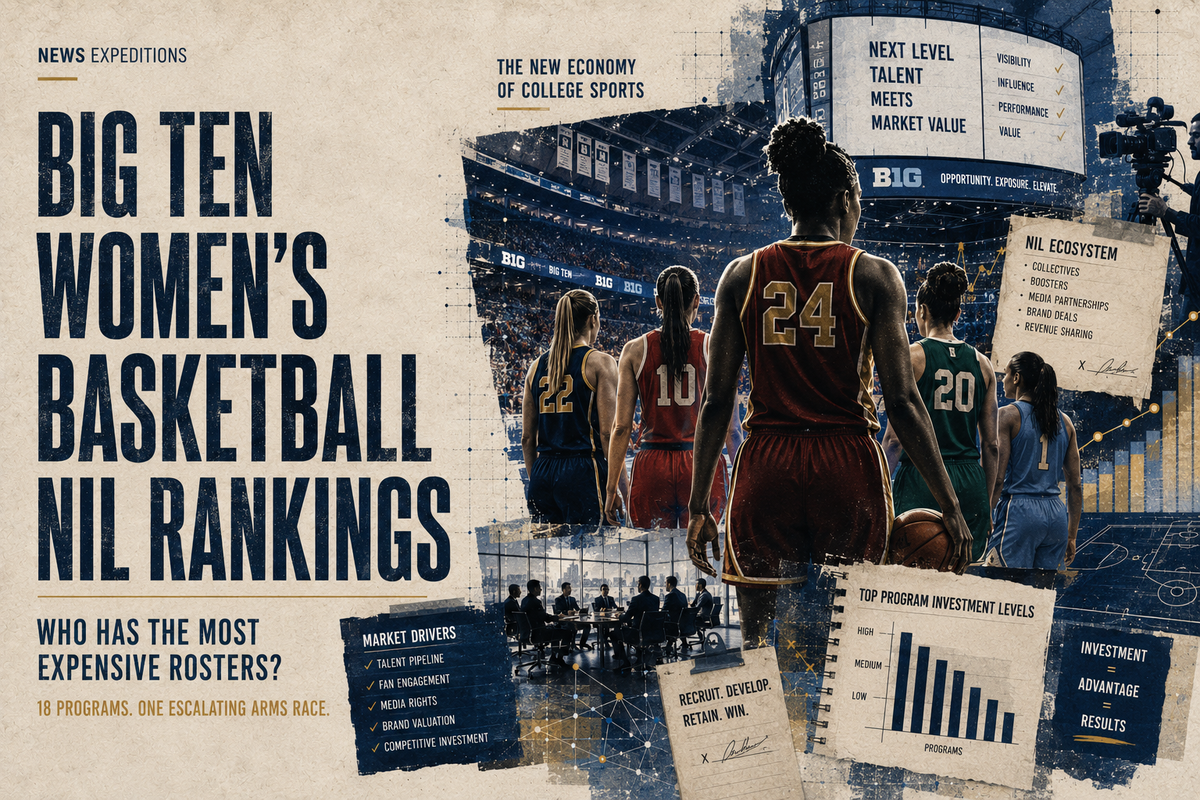
Women's college basketball spent the last several years proving its audience had been undervalued all along. Now comes the harder part: figuring out what that audience is worth in the labor market. Inside the Big Ten, that math is already playing out in real time.
USC gets to build around JuJu Watkins, whose personal brand is one of the most valuable in all of college sports. UCLA has become a championship-caliber program almost overnight. Iowa took the Caitlin Clark phenomenon and, instead of letting it evaporate the moment she left for the WNBA, built an actual business around it. Ohio State has one of the biggest athletic department budgets in the country to lean on. And Michigan, Maryland, and Oregon all have the money and the recruiting pull to play near the top of the market.
Put it all together, and you get a conference where women's basketball has quietly become a real player-compensation business, not just a feel-good storyline.
The tricky part is pinning down exactly what each school is spending. Athletic departments don't publish sport-by-sport NIL payrolls. Collectives disclose numbers selectively, if at all. Individual endorsement deals are almost always private. And now that direct institutional revenue sharing has entered the picture, it often gets lumped in with traditional NIL when people talk about "roster spending," which further muddies things.
That's why this ranking doesn't pretend to know a number that simply isn't public.
Instead, News Expeditions ranked the Big Ten's 18 women's basketball programs using the best available evidence: current NIL roster-market estimates, known individual player valuations, institutional revenue-sharing information where available, recruiting and transfer activity, program operating expenses, and each athletic department's underlying financial muscle.
Read the numbers below as estimated roster-market values and competitive NIL capacity, not audited payrolls. Viewed that way, though, a clear hierarchy emerges.
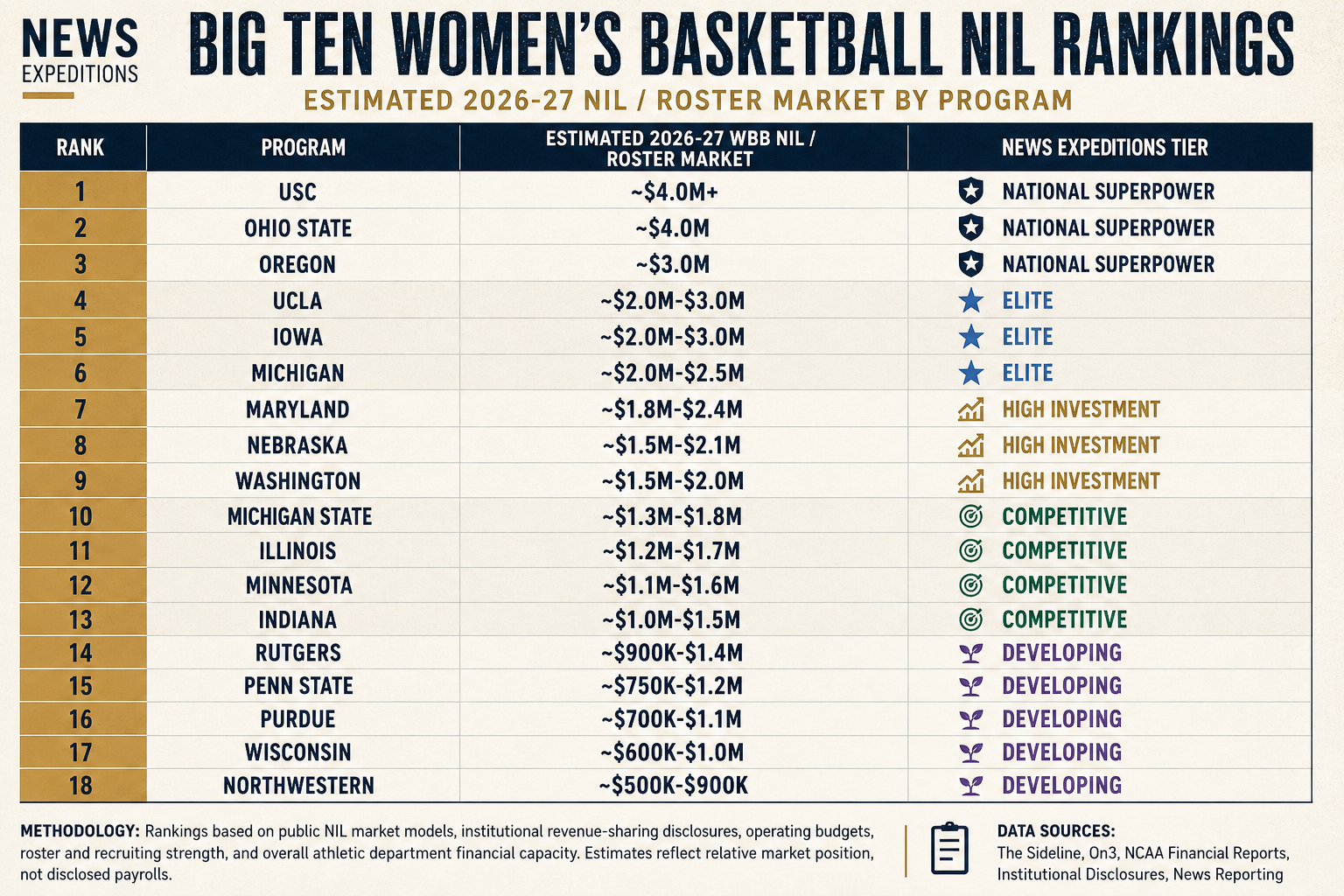
The Big Ten Women's Basketball NIL Ranking
Important: Everything from No. 4 on down is a News Expeditions estimate, not a disclosed team payroll. These ranges show relative market position, not that a school or collective cut a check for that exact amount.
That distinction is worth sitting with for a second.
The Sideline's women's basketball NIL market model estimates the entire tracked Division I women's basketball NIL roster market at roughly $116 million across 133 programs, with UConn at the top. Its current national estimates place UConn at around $7 million, LSU at around $6 million, and Texas, Notre Dame, and South Carolina at about $5 million each. USC and Ohio State land around $4 million, with Oregon just behind at roughly $3 million.
The Sideline makes it clear that these figures represent estimated roster-market value, not verified school payrolls or disclosed contract totals. Even with that caveat, the Big Ten is clearly sitting inside the national NIL elite.
1. USC: The Conference's First True Women's Basketball NIL Superpower
USC occupies a lane that no other Big Ten program can fully match, because its economics are built on both institutional money and individual celebrity at once.
The Sideline estimates USC women's basketball at approximately $4 million in roster market value, placing the Trojans among the most valuable women's basketball rosters in the country. And honestly, that number might undersell what sets USC apart from everyone else.
JuJu Watkins isn't just an expensive basketball player. She's practically an advertising platform in her own right. On3's women's NIL rankings have consistently placed Watkins among the most valuable female college athletes in the country, and her commercial value continues to grow thanks to national visibility, a massive social media following, and an endorsement profile that extends far beyond USC basketball.
That matters more than it might seem at first. A player like Watkins can generate real income that doesn't have to come out of a USC booster's pocket. National brands want her attention, which means USC can bring outside corporate money straight into its basketball economy without spending a dime of its own.
The Trojans then stack elite recruiting on top of that commercial advantage. According to USC's own 2026-27 roster outlook, Watkins returns alongside Jazzy Davidson, Kennedy Smith, and another wave of major recruiting talent.
This is what NIL looks like when geography, celebrity, recruiting, and institutional ambition all point in the same direction. USC doesn't just have money. It has built an entire marketplace around one program, and that's a much harder thing to copy.
2. Ohio State: The Athletic Department That Can Afford Almost Anything
Ohio State is playing a completely different game. The Buckeyes don't need a single transformational celebrity because the university runs one of the largest athletic-revenue machines in college sports, full stop.
The Sideline places Ohio State women's basketball at approximately $4 million in roster-market value, putting the Buckeyes essentially even with USC at the top of the conference. That number gets more believable once you zoom out to the size of the institution behind it. Ohio State runs one of the biggest athletic departments in the country, and that gives women's basketball a financial floor few competitors can even approach.
In practice, that means the program is competing inside an athletic department that can make strategic investments in women's basketball without putting football's economics at any real risk.
That distinction matters a lot in the revenue-sharing era. For plenty of programs, an extra $1 million in women's basketball spending is a transformative, roster-altering decision. At Ohio State, it's closer to a budget-line adjustment. That structural advantage is exactly why the Buckeyes belong near the top of this list even without a Watkins-level individual star driving the numbers.
3. Oregon: When Nike Economics Reach Women's Basketball
Oregon's spot on this list surprises almost nobody. The Sideline estimates Oregon women's basketball at approximately $3 million, putting the Ducks right behind USC and Ohio State among Big Ten programs.
The advantages here are familiar to anyone who's followed Oregon athletics: serious donor capacity, a close relationship with Nike, sophisticated branding and an institutional mindset that treats athletics as an investment rather than a cost center.
Those advantages carry extra weight in women's basketball specifically, since the overall dollar figures remain relatively modest compared to football. An additional million dollars can completely reshape a women's basketball roster. Finding that million is a genuinely different problem for Oregon than it is for Purdue, Northwestern, or Wisconsin. That asymmetry runs through this entire ranking.
4. UCLA: The Champion Whose Market Value Should Keep Growing
UCLA might be the trickiest valuation puzzle in the whole conference. The Bruins have turned into one of the strongest women's basketball programs in the country, and that competitive rise gives them real leverage in both recruiting and roster retention.
The Sideline's UCLA market page currently assigns roughly $2 million in estimated value to UCLA women's basketball. But given the program's competitive standing and the Los Angeles recruiting environment, that number could climb quickly, which is why News Expeditions places UCLA in a $2 million-to-$3 million band rather than a flat estimate.
Winning changes what a player is worth. So does playing in Los Angeles. And so does having USC just a few miles down the road, constantly raising the local price of talent. The most important long-term NIL rivalry in Big Ten women's basketball may end up being USC-UCLA, not any of the traditional Midwestern matchups everyone expects.
5. Iowa: Caitlin Clark Changed Economics Permanently
Iowa is the most unusual case in the conference. Before Caitlin Clark, Iowa already had a very good women's basketball program. After Clark, it had something far more valuable: a program with genuine national name recognition among casual sports fans, not just die-hards.
The university clearly isn't willing to let that go. Iowa has specifically established a Women's Basketball Flight Fund that allows donors to support the program directly in the revenue-sharing era, and it lists women's basketball as one of the sports participating in institutional revenue sharing.
That's a meaningful choice. Instead of treating women's basketball compensation as an afterthought handled loosely by a collective, Iowa built real fundraising infrastructure around it.
The financial numbers back up that decision. Public financial data collected by Extra Points in its FY2025 women's basketball operating-budget analysis shows just how expensive it's become to run a top-level women's basketball program, even before you factor in any athlete compensation at all. The Clark era itself may be over, but the financial infrastructure it built behind the scenes clearly isn't going anywhere.
6. Michigan: A Sleeping Financial Giant That Is Already Waking Up
Michigan's standing here has less to do with a public NIL figure and more to do with the combination of roster strength, institutional wealth, and the ability to retain players.
That last part matters more than people realize. In today's environment, keeping a talented player from entering the transfer portal is no longer economically neutral. Every star who stays put represents a successful, and often expensive, retention decision made in a genuinely national labor market.
Michigan also operates within one of the wealthiest brands in college athletics. If women's basketball keeps turning into a spending contest, Michigan clearly has the financial firepower to compete. The real question isn't whether Michigan can spend. It's how aggressively the athletic department chooses to do it.
7. Maryland: An Established Basketball Economy
Maryland remains one of the league's most durable women's basketball brands. Publicly obtained NCAA financial data compiled by Extra Points shows that elite women's basketball programs routinely run annual operating expenses well into the millions of dollars, and that's all before NIL and direct athlete compensation even enter the picture.
That figure doesn't equal actual NIL spending. But it does demonstrate real institutional commitment, which counts for something when recruits are weighing their options.
Brenda Frese has also built a recruiting network that only becomes more valuable as the transfer portal era rolls on. Maryland can sell playing time, program history, WNBA development, and national visibility on top of whatever compensation package it puts together. That combination keeps Maryland comfortably in the conference's upper financial tier, even if it can't simply outspend USC or Ohio State head-to-head.
8-12. Nebraska, Washington, Michigan State, Illinois and Minnesota: The Conference's Middle-Class Arms Race
This stretch of the rankings might be the most interesting part of the conference to watch. Nebraska, Washington, Michigan State, Illinois, and Minnesota all have enough money to compete seriously in women's basketball NIL, even without the nearly bottomless resources available to the league's wealthiest departments.
The FY2025 operating budget data collected by Extra Points is useful here because it shows just how much money it takes to run a competitive women's basketball program in the first place. Operating expenses aren't athlete compensation. They cover salaries, travel, recruiting, facilities, and general administration. But they do say a lot about institutional appetite.
None of these are cheap operations to run. And once a school is already spending millions a year just to run its program, tacking on another $1 million or $2 million for player acquisition and retention becomes much easier to justify. The middle tier of the Big Ten can get brutally expensive, and fast.
13. Indiana: Strong Basketball Economics, but Where Does the Money Go?
Indiana is a good example of why school-wide NIL numbers can be misleading. The Hoosiers have one of the strongest overall basketball brands in the whole conference. But much of the recent financial escalation across college sports has been concentrated in football and men's basketball, not women's basketball.
That said, women's basketball still has a real commercial foundation to build on at Indiana. The program has consistently ranked among the national leaders in women's basketball attendance, building exactly the kind of ticketing and fan-engagement infrastructure that many other schools are still trying to figure out from scratch.
That's genuine economic infrastructure, not just hype. The open question is allocation. Indiana clearly has the resources to finance elite women's basketball. Whether the athletic department chooses to match USC, Ohio State, and Iowa dollar-for-dollar is an entirely separate matter.
14-18. Rutgers, Penn State, Purdue, Wisconsin, and Northwestern: The Financial Danger Zone
The bottom tier is where the system gets uncomfortable. Being a Big Ten member guarantees a school extraordinary conference revenue. It does not guarantee that money actually reaches women's basketball players.
Penn State offers one of the clearest public examples of this gap. Reporting by the Centre Daily Times on Penn State's revenue-sharing allocations showed that the overwhelming majority of athlete revenue sharing went toward football and men's basketball, while women's basketball received a comparatively small slice of the pie. That number matters because it shows how misleading a conference's overall wealth can be from the outside. Penn State, the institution, is rich. Penn State women's basketball isn't necessarily rich at all. Those are two very different statements.
Rutgers, Purdue, Wisconsin, and Northwestern are all wrestling with versions of the same strategic decision. Every dollar sent toward women's basketball is a dollar that can't go toward football, men's basketball, or another sport competing for the same institutional revenue-sharing pool. The competitive fallout from that trade-off could be severe for all four programs.
The Numbers Nobody Should Confuse
Three separate categories keep getting collapsed into the single word "NIL," and they really shouldn't be.
Direct revenue sharing is money the athletic department distributes under the post-House settlement compensation system. Collective or donor NIL covers payments organized through booster-backed organizations and related commercial arrangements. Commercial NIL refers to actual market endorsements from companies that pay for access to an athlete's name, image, audience, or celebrity.
A player like JuJu Watkins can pull income from all three at once. A less commercially prominent player, on the other hand, might get most of her economic value from institutional revenue sharing and donor-supported NIL alone. That means asking "What's USC's NIL budget?" might not even have a single meaningful answer anymore.
The better question is: what does it cost USC to assemble and retain this roster? That's the economic question increasingly deciding championships.
Women's Basketball Is Becoming Cheap Relative to Its Strategic Value
Here's the most surprising finding in all of this. It isn't that women's basketball has gotten expensive. It's how cheap elite women's basketball still is compared with football and men's basketball.
The Sideline estimates the tracked Division I women's basketball NIL roster market at roughly $116 million. That's an enormous jump compared with the pre-NIL era, no question. But inside modern Power Four athletics, it’s a small number.
A single elite football roster can now represent tens of millions of dollars in player market value on its own. That means a school could spend another $1 million on football and barely move the needle competitively. Redirect that same $1 million into women's basketball, though, and it could realistically transform an entire starting lineup.
That creates a genuinely unusual opportunity. Women's basketball may currently offer one of the best marginal returns on investment in college athletics.
USC Has Another Advantage: Corporate Money
There's one more reason USC sits at No. 1. The most valuable women's basketball players have commercial appeal that football linemen and backup quarterbacks usually don't.
Watkins is the clearest example. On3's NIL rankings show just how much stand-alone commercial value individual women's basketball stars have built for themselves in recent years. That means corporate advertising dollars can subsidize roster retention, a very different funding source than most programs use.
Iowa saw an even more extreme version of this with Caitlin Clark. And it's fundamentally different from booster-funded NIL. If a wealthy donor writes a $500,000 check to keep a player around, that $500,000 has essentially been consumed by the existing athletic ecosystem. But if Nike, State Farm, Gatorade, or another national company pays an athlete because she can genuinely move products, that's outside commercial capital flowing into the system for the first time.
Programs that produce bona fide stars end up with a real economic multiplier the rest of the conference simply doesn't have access to. USC understands this. Iowa learned it the hard way when Clark left. UCLA is positioned to exploit it next. Every Big Ten athletic department ought to be studying exactly how.
The Conference May Be Creating Another Financial Divide
The Big Ten's massive television distributions create an illusion of financial equality across the conference. Women's basketball shows clearly why that assumption doesn't hold up. Every school gets a conference check. What matters is what happens after that check clears.
USC can combine Los Angeles commercial opportunities with elite recruiting and donor money. Ohio State has enormous built-in athletic revenue to lean on. Oregon operates inside the Nike ecosystem. Iowa built a dedicated women's basketball revenue-sharing fundraising mechanism from scratch. UCLA has real championship credibility to sell recruits on.
At the other end, Penn State's disclosed revenue-sharing distribution shows how an enormously wealthy athletic department can still direct comparatively little institutional compensation toward women's basketball. Those aren't accidents. They're strategic choices, and strategic choices eventually turn into competitive outcomes on the court.
The Big Ten isn't really building a women's basketball economy. It's building several at once: a national-superpower tier capable of supporting multi-million-dollar rosters, an increasingly aggressive middle class that can spend enough to protect good teams, and a bottom tier whose conference membership might make it institutionally wealthy without making its women's basketball roster wealthy at all. That gap will only matter more with each passing year.
The Bigger Question: Who Figures Out the Economics First?
The next breakthrough in women's basketball probably won't come from the school with the richest athletic department overall. It'll more likely be the athletic department that understands the sport's relative economics first.
Think through the numbers for a second. If an extra $2 million devoted to football is just a small fraction of an already massive football compensation operation, its competitive effect could end up being marginal at best. Put that same $2 million into women's basketball, though, and it could become the financial foundation of an entire elite roster.
That's not an argument for pulling money out of football. It's portfolio theory. Athletic departments are allocating capital now, whether they frame it that way or not, and rational capital allocation means asking where the next dollar produces the biggest competitive return.
For a growing number of Big Ten universities, the honest answer may increasingly be women's basketball. USC already seems to understand it. Ohio State has the resources to exploit it whenever it wants to. Iowa has already built a fundraising infrastructure around it. Oregon rarely lets a financial advantage sit unused for long. And UCLA has shown exactly what happens when elite talent, institutional investment, and actual winning all converge at once.
The schools farther down this list now face a real decision. They can keep treating women's basketball NIL as just another expense created by the professionalization of college athletics. Or they can recognize something a lot more interesting: perhaps the first time in the history of major college sports, women's basketball might be one of the best bargains on the board.
Bottom Line
The Big Ten's women's basketball hierarchy isn't really about who has the richest athletic department. It's about who decides to spend on the sport once the money shows up. USC, Ohio State, and Oregon have separated themselves at the top through some combination of star power, institutional wealth, and cultural willingness to invest. UCLA and Iowa are climbing fast, powered by winning and a Caitlin Clark hangover that shows no signs of fading. And the bottom tier is stuck making an uncomfortable choice: keep funneling revenue-sharing dollars almost entirely toward football or start treating women's basketball like the high-return investment the numbers say it already is.
Methodology
News Expeditions' ranking uses public and modeled information rather than claiming access to confidential athlete contracts. The principal external sources are The Sideline's women's basketball NIL market model, On3's women's NIL valuations, Extra Points' FY2025 women's basketball operating-budget database, Iowa's Women's Basketball Flight Fund, public reporting on Penn State's revenue-sharing allocations, and individual university roster and recruiting releases such as USC's 2026-27 women's basketball outlook.
The Sideline explicitly describes its figures as estimates rather than school payroll or verified contract totals. Extra Points similarly notes that its operating-expense dataset excludes athlete payroll, NIL, and House-settlement payments. Those limitations are why News Expeditions uses ranges rather than false precision for programs without directly published market estimates.


Comments ()