
Elite Brands Are for Poor People
Luxury brands do not just sell handbags and watches. They sell the feeling of arrival. A systems-level analysis of how companies like LVMH, Kering, and Richemont turn status anxiety into one of the most profitable business models in modern capitalism.
Why Luxury Companies Really Sell the Feeling of Arrival
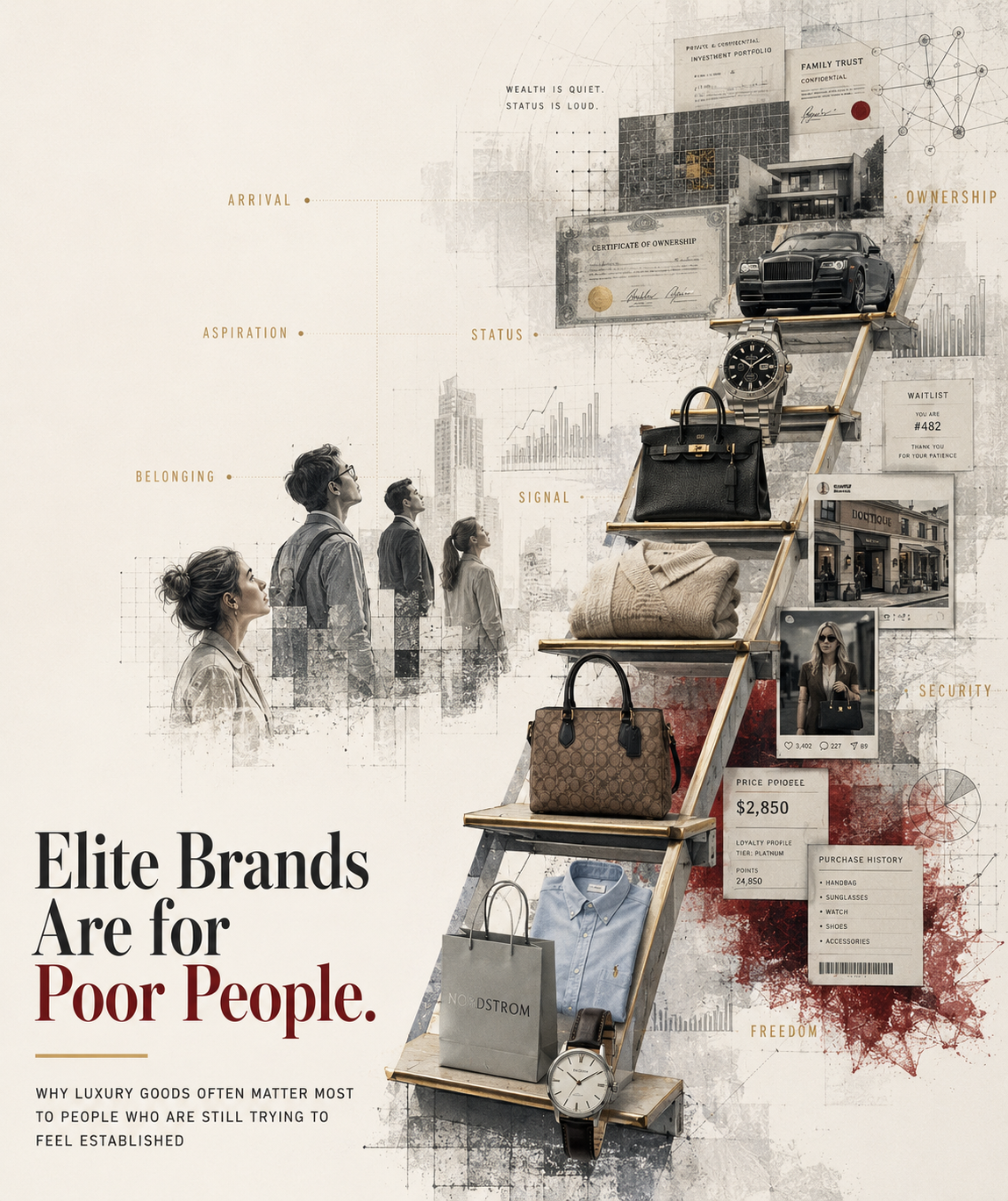
There is a common moment in adult life when a purchase feels more significant than the item itself. A young professional saves for a Coach bag or a newly promoted manager buys a Hamilton watch. Neither person is trying to mimic a billionaire. The appeal is simpler and more familiar: the item feels like tangible proof that life is moving forward.
That logic scales upward. The Hamilton becomes an Omega; the Omega becomes a Rolex. Brooks Brothers gives way to Canali, then to Brunello Cucinelli and Loro Piana. The products improve, but the deeper attraction remains the same. Each purchase offers a small but emotionally satisfying message: you are getting somewhere, and others see it in your affluent purchase.
Luxury firms understand this instinct exceptionally well. They do not merely sell leather, steel, and cashmere. They sell the feeling of arrival.
On the surface, this is an old idea. In The Theory of the Leisure Class, Thorstein Veblen described how people use visible consumption to communicate status. In Distinction, Pierre Bourdieu argued that taste itself functions as a social marker. Modern luxury companies did not create this impulse. They turned it into a global industry.
Most luxury brands are built as ladders. The first rung is accessible: a fragrance, a wallet, a scarf, or a modest handbag. The price is high enough to feel meaningful but still attainable for someone with discipline and aspiration. Once the customer enters the brand universe, the relationship deepens. Products become more exclusive, more expensive, and more symbolically potent. A purchase is no longer just a transaction: it becomes part of a personal narrative about progress.
This strategy is not theoretical. McKinsey has written explicitly about the importance of aspirational consumers to the luxury industry. The term is revealing. An aspirational consumer is not fully entrenched in wealth but wants access to the signals associated with it.
The most effective luxury marketing does not promise utility. It promises recognition. The bag suggests maturity. The watch suggests competence. The coat suggests cultivated taste. The product acts as a visible credential. That helps explain why certain purchases feel emotionally charged. They are not just objects. They prove that years of work have produced something recognizable.
Many consumers who buy luxury goods are objectively successful yet still feel economically provisional. They may have good jobs, rising incomes, and comfortable lives, but they also face expensive housing, uncertain careers, and constant comparison. Modern life makes it surprisingly difficult to feel as though one has definitively arrived.
The data reflects this ambiguity. The Federal Reserve's Survey of Consumer Finances shows that enduring wealth comes primarily from productive assets such as businesses, stocks, and real estate. At the same time, Charles Schwab's Modern Wealth Survey regularly finds that many high earners do not consider themselves wealthy. That gap between visible success and internal security is where the luxury industry thrives.
LVMH, Kering, and Richemont sell beautifully made products, but their most valuable offering is psychological. They sell a temporary sense of certainty. The desired object arrives, bringing a quiet sense of confirmation. For a while, the owner feels more established, more polished, and more convincing. Then the object becomes familiar, and another item begins to seem unusually compelling.
This does not mean luxury consumption is irrational. It means that part of what consumers are buying is symbolic. The craftsmanship is real, but the meaning attached to it is more significant.
People with substantial wealth are not immune to status, but they tend to rely less on visible markers because their position rests on assets, ownership, and durable relationships. Their sense of security comes from what they control rather than what they display. They may own exceptional things, but those objects usually carry less emotional weight.
There is no reason to sneer at someone who saves for a meaningful purchase. Wanting recognition is a basic human impulse. The more interesting realization is that the most durable sense of security usually comes from quieter sources: a strong balance sheet, meaningful work, dependable relationships, and increasing indifference to what other people think.
At that point, luxury goods become lighter. A watch becomes a watch, a handbag becomes a handbag, and a coat becomes a coat. You may still buy beautiful things, but they no longer need to prove anything.
That is the understated form of status that luxury brands can imitate but never fully deliver. True freedom is not rejecting nice things. It is reaching the point where they are simply nice things.


Comments ()