
Why Modern Couples Feel Emotionally Exhausted All the Time
How smartphones, dating apps, and social media destabilized modern relationships through emotional overload, endless comparison, and the collapse of romantic signal integrity.
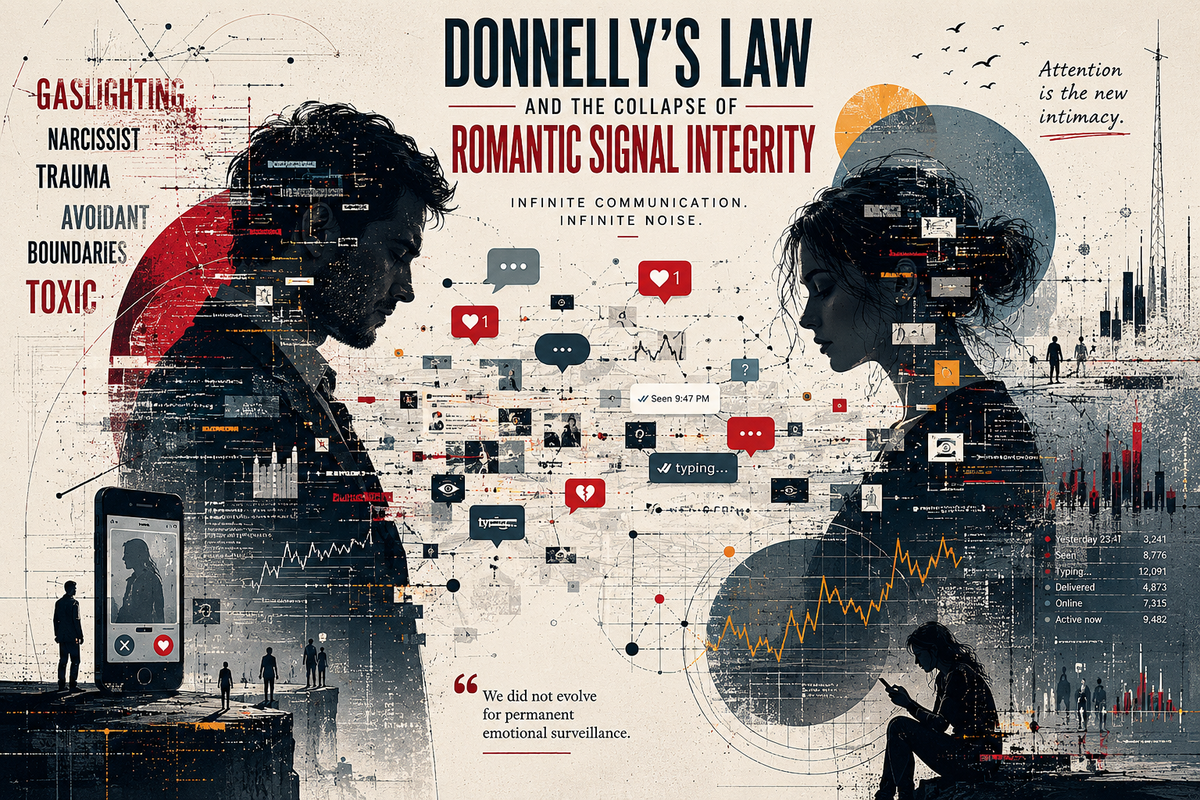
How Infinite Communication Reshaped Modern Relationships
Americans now send trillions of text messages each year. Younger adults spend a large portion of their waking lives in digitally mediated environments while checking their smartphones dozens or even hundreds of times daily, depending on the study. Dating apps transformed courtship into a continuous marketplace, while TikTok relationship psychology evolved into an industrial ecosystem built around attachment theory, narcissism detection, trauma discourse, communication analysis, and the increasingly confident diagnosis of strangers by people sitting in parking lots eating poke bowls.
Despite all this communication, people report rising emotional exhaustion, chronic relational anxiety, communication fatigue, and persistent dissatisfaction. That contradiction deserves more attention than it receives.
For most of civilization, intimacy operated under conditions of informational scarcity. Couples wrote letters that arrived days or weeks later. Phone calls cost money and occurred intermittently. Human beings disappeared into ordinary life for hours at a time without triggering emotional panic because the technological infrastructure for perpetual accessibility did not exist. If a man in 1964 failed to respond for six hours, nobody interpreted the silence as evidence of emotional withdrawal. They assumed he was working, driving somewhere, fixing something in the garage, or trapped at Sears listening to another man explain power tools with terrifying enthusiasm.
The emotional expectations differed because the infrastructure differed.
Modern relationships operate in entirely different conditions. Texting, Instagram, FaceTime, screenshots, read receipts, reaction notifications, location sharing, and algorithmic social feeds created an environment in which communication never fully stops. Couples remain partially connected from morning until sleep through a stream of ambient emotional signaling that previous generations would have considered exhausting.
At first glance, this appears beneficial. More communication should lead to greater intimacy, stronger emotional clarity, and healthier attachment. Instead, many relationships now resemble two emotionally fatigued administrators attempting to manage a permanent low-grade diplomatic crisis through glowing rectangles. At the same time, both parties quietly wonder why everybody feels tired all the time.
The problem is not simply technology itself. Human beings created communication systems capable of transmitting vastly more emotional information than the nervous system evolved to process coherently. We upgraded bandwidth without upgrading cognition.
This is where Donnelly’s Law becomes relevant.
Donnelly’s Law proposes that digital content expands to fill available informational capacity. Once systems create room for communication, commentary, emotional interpretation, signaling, and social performance, those behaviors expand to consume the available space. Relationships were never going to escape this process because intimacy itself depends heavily on the interpretation of signals.
Romance as Signal Processing
Most relationship analysis treats intimacy as an emotional experience. Relationships also function as information systems.
Attraction depends on signal interpretation. Interest, responsiveness, consistency, exclusivity, trustworthiness, and emotional investment all communicate information. Trust itself functions as a signal of stability over time. Healthy relationships require coherent signal processing to maintain emotional equilibrium.
Digital systems massively increased signaling volume without increasing signal quality. That distinction matters enormously. Modern couples exchange exponentially more information than couples did twenty years ago, yet many people feel less, rather than more, emotionally secure. The reason may be simple: the signal-to-noise ratio collapsed.
In telecommunications systems, excessive background noise interferes with accurate signal interpretation. Financial markets experience similar instability during periods of informational oversaturation when traders struggle to distinguish meaningful indicators from volatility and rumor. Modern relationships display comparable dynamics. Every emoji, punctuation mark, delayed response, story view, reaction, and shift in texting cadence becomes available for interpretation. Human cognition evolved to process social signals, but digital systems now generate vastly more signals than the brain can reliably contextualize.
The result is chronic interpretive overload masquerading as intimacy. One suspects future historians may conclude that the invention of read receipts represented a serious tactical error for the species.
Research already points toward the psychological strain produced by this environment. Studies from the American Psychological Association and multiple university research groups show strong correlations between heavy social-media use and rising anxiety, depressive symptoms, social comparison stress, and relationship dissatisfaction among younger demographics. Researchers at Stanford and Columbia examined how constant digital interruptions fragment attention and weaken conversational depth. The findings align with ordinary observation. Human beings struggle to sustain emotional coherence while living inside permanent notification systems. The nervous system did not evolve for this.
Semantic Inflation and Emotional Language
This informational overload reshaped emotional language itself. One of the clearest consequences of Donnelly’s Law inside relationships is semantic inflation. As communication bandwidth expanded, emotional terminology expanded alongside it because emotionally intense language performs well in algorithmic environments. Calm and psychologically stable people produce terrible engagement metrics. Nobody spends four hours doomscrolling because a stranger posted, “My spouse and I had a productive disagreement regarding patio furniture and then watched a documentary about the French rail system.”
Algorithms reward emotional escalation, certainty, conflict, and moral drama. Over time, this distorts vocabulary itself.
Google Trends data show enormous increases over the last decade in searches for terms like “narcissist,” “gaslighting,” and “trauma bond.” TikTok relationship discourse now packages clinical terminology into short-form entertainment environments optimized for virality rather than precision. Emotional vocabulary expanded because it became profitable.
The result is predictable. Mild selfishness becomes narcissism, ordinary dishonesty becomes gaslighting, and temporary incompatibility becomes trauma. A routine disappointment becomes emotional devastation, requiring a seven-slide Instagram carousel in beige earth tones to explain boundary violations to strangers named Madison and Chloe.
None of these concepts is imaginary. Genuine manipulation and trauma exist. Informational systems built around infinite communication, however, incentivize linguistic overproduction. When emotionally charged language becomes socially rewarded, users escalate their use of terminology to maintain signaling power. Vocabulary destabilizes through overuse.
The consequences visited upon relationships are substantial.
Many educated adults now approach ordinary conflict armed with industrial quantities of therapeutic terminology and an emotional posture reminiscent of workplace compliance training. Couples speak as though they are simultaneously romantic partners, therapists, litigators, personal brands, and assistant vice presidents of emotional operations.
Functionally, the relationship itself becomes bureaucratized.
The Administrative Relationship
Professional-class culture accelerated this trend because educated adults spend enormous portions of their lives inside institutional environments governed by performance reviews, administrative language, compliance structures, therapeutic culture, and psychological self-monitoring. Over time, those frameworks migrate into emotional life.
Conversations become processed, emotional expectations become formalized, and conflicts resemble procedural investigations. Boundaries become quasi-contractual obligations negotiated with the seriousness of international trade agreements.
Ironically, the attempt to maximize emotional clarity often produces emotional fragility instead. Constant relational auditing increases cognitive load and emotional self-consciousness. Research on invisible labor and emotional labor already demonstrates that relationship maintenance falls disproportionately on women, particularly inside dual-career professional households where social coordination, family management, emotional regulation, scheduling, and household administration converge onto the same person.
Digital communication expanded this burden.
Modern relational labor now includes maintaining conversational continuity, monitoring relational atmosphere, managing online presentation, interpreting tone shifts, preserving digital intimacy, coordinating logistics, resolving ambiguity, and sustaining continuous responsiveness across multiple platforms. Individually, these tasks appear manageable, but collectively, they produce chronic emotional fatigue disguised as ordinary adulthood.
The modern relationship increasingly resembles a second administrative job, except the meetings occur in bed and nobody gets dental insurance.
The Collapse of Mystery
The informational environment also destabilized one of romance’s oldest psychological mechanisms: mystery.
Historically, attraction depended on gradual discovery. Human beings encountered one another incrementally over time and across circumstances. Curiosity emerged because information arrived slowly, but digital systems aggressively flatten this process. Before a first date even occurs, people often know political opinions, travel history, family structures, former relationships, professional credentials, aesthetic preferences, social circles, dietary restrictions, and whether someone once posted an emotionally unstable caption beneath a sunset photograph in 2017.
Many modern singles now conduct enough pre-date reconnaissance to qualify for low-level intelligence work. Social media creates the illusion of intimacy before intimacy itself develops. The mystery collapses before emotional tension fully forms.
This matters because attraction depends partly on informational pacing. Human beings become fascinated through unfolding discovery rather than raw exposure volume. Modern ideology tends to assume that maximum transparency automatically produces healthier relationships, but beyond a certain threshold, transparency itself becomes destabilizing. Perpetual accessibility weakens anticipation. Constant emotional reporting creates fatigue. Continuous surveillance erodes trust rather than strengthening it. Total informational exposure reduces fascination.
Mystery is not deception; it is controlled informational scarcity.
The Marketplace of Endless Comparison
Dating apps and social media have transformed relationships into permanent environments of comparison. Psychologists have long observed that excessive choice reduces satisfaction by increasing second-guessing and comparison anxiety. Barry Schwartz described this dynamic years ago in research surrounding the “paradox of choice.” Modern dating systems have industrialized it on an enormous scale.
Previous generations certainly compared partners and imagined alternatives, but the alternatives remained abstract. Modern technology transformed hypothetical comparison into a continuously refreshed visual marketplace populated by curated lives, algorithmically amplified desirability, and endless perceived opportunity. The modern user no longer wonders whether someone better exists. Digital systems now deliver a seemingly infinite stream of candidates directly into the hand, each presented through optimized photographs, selectively constructed biographies, and the subtle illusion that emotional perfection may exist just a few swipes deeper into the feed.
This produces a strange psychological environment in which stable attachment competes against perpetual imagined optionality. The comparison never stops because the marketplace never closes. Even emotionally healthy people begin absorbing the ambient logic of optimization. Someone else always appears more adventurous, more successful, more emotionally evolved, more attractive, or more socially validated. Over time, relationships stop existing solely between two people and begin operating inside a broader digital ecosystem of continuous comparison.
The result is not greater freedom. In many cases, it produces chronic low-level dissatisfaction combined with the suspicion that one’s emotional life should perhaps feel more optimized than ordinary reality allows.
Stable attachment requires narrowing emotional focus, but digital systems widen it. This creates structural tension between healthy attachment and platform economics.
Stable, emotionally secure couples generate little engagement. Emotionally uncertain people, however, click constantly. Dating apps profit from continued searching, social-media platforms profit from insecurity and comparison, and influencer culture monetizes perpetual self-monitoring. Outrage ecosystems monetize conflict narratives.
This is not a conspiracy. It is capitalism discovering that emotionally agitated people refresh applications more frequently.
Relational Overfitting
Modern relationships increasingly suffer from what might be called relational overfitting. In machine learning, overfit systems become overly optimized on narrow data inputs while losing resilience in real-world conditions. Modern intimacy behaves similarly.
Couples optimize around texting cadence, attachment frameworks, personality typologies, communication metrics, compatibility scoring, and endless interpretive analysis in an attempt to eliminate uncertainty from emotional life. Overfitted systems become fragile. They struggle under ambiguity, contradiction, spontaneity, and ordinary human imperfection.
Human beings are not software platforms, although millions of educated professionals currently appear determined to troubleshoot their marriages like malfunctioning Bluetooth speakers while sitting beneath framed typography reminding them to “Live Laugh Love.”
Stable long-term relationships require qualities increasingly discouraged by modern informational systems: patience, rootedness, privacy, forgiveness, tolerance for ambiguity, repetition, and the management of imperfection. Contemporary culture instead rewards novelty, optimization, visibility, flexibility, mobility, self-curation, and perpetual reinvention.
The broader culture conditions people for instability while simultaneously encouraging them to desire permanence. That contradiction sits near the center of modern adulthood.
Rebuilding Signal Integrity
If Donnelly’s Law accurately describes the expansionary tendencies of digital communication systems, then healthy relationships require deliberate resistance to those systems. This does not mean rejecting technology entirely or pretending everyone should relocate to Vermont and communicate through handwritten letters and homemade jam. It does mean recognizing that informational maximalism often undermines intimacy rather than strengthening it.
Healthy couples may need to reintroduce informational restraint into relationships. Not secrecy or manipulation, but restraint rooted in the recognition that human beings did not evolve to process permanent emotional surveillance. Modern communication systems encourage people to treat every silence as suspicious, every delayed response as meaningful, and every conversational fluctuation as material requiring analysis. Under those conditions, ordinary emotional variation begins to feel psychologically loaded.
Scarcity restores informational value.
Relationships also suffer when every disagreement becomes psychologically escalated into a moral or therapeutic event. Clinical language can clarify destructive dynamics, but many ordinary conflicts deteriorate once couples begin to approach routine friction, with opposing legal teams preparing documentation for arbitration. Durable intimacy depends less on perfect emotional analysis than on interpretive generosity, emotional resilience, and the ability to survive ordinary imperfection without converting every unpleasant Tuesday evening into a constitutional crisis.
The broader problem is structural. Digital platforms profit from emotional stimulation, comparison, insecurity, and endless engagement. Stable, emotionally secure couples generate little advertising revenue because emotionally secure people tend not to refresh applications every seven minutes while searching for validation, reassurance, or evidence that their partner secretly lacks emotional maturity.
This is not a conspiracy; it is business logic.
The future of stable relationships may therefore belong to people capable of resisting the expansionary pressures of modern informational systems. The highest-status relationships of the future may become the most private ones because privacy itself now functions as a form of scarcity in a culture organized around exposure, performance, and continuous emotional broadcasting.
In an age of infinite communication, selective silence may become one of the last remaining forms of intimacy.


Comments ()