
Nebraska Football's Real Problem Isn't Talent. It's Organizational Debt.
Nebraska has replaced coaches, quarterbacks, coordinators, and more than a roster's worth of players under Matt Rhule. Why do the same problems keep returning?
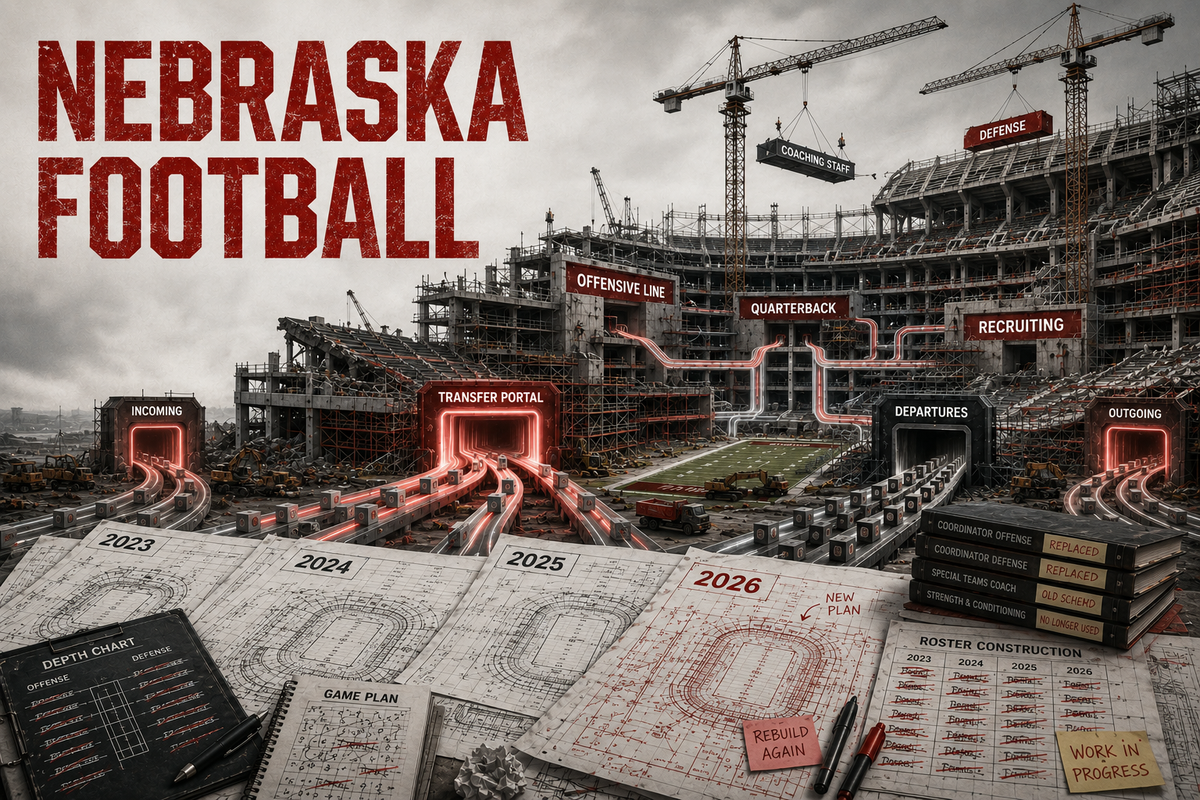
The Strange Thing About Nebraska's Rebuild
Nebraska enters the 2026 season with a new offensive line coach, a new defensive coordinator, a new starting quarterback, several transfer offensive linemen expected to play major roles, and another offseason filled with roster movement. None of those developments would have seemed unusual in 2023 when Matt Rhule first arrived. Rebuilding programs change coaches, replace players, and aggressively seek upgrades, suggesting movement.
What makes Nebraska interesting is not that the program continues changing. What makes Nebraska interesting is that four years into the rebuild, many of the same systems still require reconstruction.
The offensive line remains under repair, the quarterback position remains unsettled, the defense operates under a new coordinator, and transfer additions continue to fill important roles across the roster. The names change, but intervention points remain remarkably consistent.
Most analyses treat these developments as independent events, but viewed collectively, the conclusion is that the organization has created negative feedback loops that ensure underperformance. Nebraska increasingly resembles an organization spending substantial energy servicing old problems rather than creating new advantages.
When Solutions Create Future Problems
The transfer portal has transformed college football by speeding up talent acquisition. Programs no longer need to wait four years for recruiting classes to mature. Coaches can identify weaknesses and address them almost immediately, and that speed comes with a tradeoff that receives surprisingly little attention.
A successful high school recruit can contribute for four or five years, and a successful transfer often contributes for one or two. Every transfer therefore solves an immediate problem while simultaneously creating another future replacement requirement.
Imagine a program misses on two offensive line evaluations in one recruiting cycle. Three years later, the offensive line lacks depth. The portal supplies an experienced tackle. The tackle performs well. Fans view the acquisition as a success, and from a short-term perspective, it is.
From a longer perspective, the original problem never disappeared. The program still failed to develop enough long-term contributors at the position. The transfer merely postponed the consequences. Two years later the tackle departs, and the replacement cycle begins again.
The solution worked, but the dependency remained.
That distinction matters because Nebraska increasingly relies on transfers to reinforce position groups that have previously required attention. The portal can repair a hole, but it cannot erase the process that created it.
The Offensive Line As A Case Study
No position illustrates this dynamic more clearly than offensive line.
When Rhule arrived, Nebraska's offensive line represented one of the largest obstacles separating the program from consistent Big Ten contention. Four years later, Nebraska enters another season with a new offensive line coach and transfer additions required to contribute immediately.
The discussion surrounding the position group focuses almost entirely on whether the latest combination will finally succeed. That is the wrong question. The more interesting question is why the position continues to require intervention.
Strong offensive lines rarely emerge from annual reconstruction. Iowa's offensive line succeeds because players spend years developing within the same structure. Wisconsin built its identity through the same process for decades. Continuity itself becomes a competitive advantage.
Nebraska has repeatedly searched for improvement through recruiting, development, transfers, and coaching changes. Each decision appears understandable, but the cumulative result is a position group that never quite graduates from reconstruction.
Rhule's History of Assistant Coach Churn
One reason Nebraska's current situation deserves closer examination is that the pattern did not begin in Lincoln.
Rhule's career has unfolded through a series of rapid rebuilding projects. At Temple, he inherited a program coming off consecutive two-win seasons and left it with back-to-back ten-win years. At Baylor, he walked into one of the most difficult situations in college football and produced an eleven-win season by his third year. The accomplishments were real and substantial but what tends to receive less attention is that the rebuilding process itself often remained the central story.
At each stop, roster reconstruction, staff adjustments, and organizational restructuring received significant attention. The programs improved, but they also spent considerable time in transition.
The NFL offered a different environment and a different result. Rhule arrived in Carolina with several assistants who had worked with him previously, creating a staff built around existing relationships and shared experience. As losses accumulated, however, continuity gave way to revision. Solutions that looked promising when they arrived no longer looked auspicious a year or two later.
That history does not prove anything about Nebraska's future. It does, however, provide useful context for understanding the present. Nebraska's recent changes are not isolated events. Tony White left for Florida State. John Butler inherited the defense and departed after a single season. Donovan Raiola coached the offensive line for four years before Nebraska moved in a different direction.
Four years into the current regime, many of the same systems that required attention in 2023 continue requiring attention in 2026. That may be the most important fact about the program, because it suggests Nebraska's challenge is no longer starting a rebuild: the task is finding a way to stop rebuilding.
The facts compel a closer look at Rhule's ability to identify, nurture, and manage assistant coaches.
Rhule and Roster Churn
Nebraska's 2026 roster tells the story. The program added 10 high school signees and 16 transfer additions for the 2026 cycle alone. Four years into the Matt Rhule era, the roster bears little resemblance to the one he inherited. Nebraska's 2026 roster includes players who arrived through four recruiting classes, four transfer cycles, multiple coordinator changes, and repeated roster reconstruction efforts. Even after retaining 83 percent of players eligible to return following the January portal window, the program still needed another large infusion of new personnel.
The significance is not that Nebraska has experienced turnover. Every major program experiences turnover. The significance is that the offensive line, quarterback, defensive leadership, and roster construction remain among the program's most-discussed challenges after four years of aggressive replacement. Most rebuilds eventually transition from adding pieces to refining systems, but Nebraska continues adding pieces. The roster looks dramatically different from 2023, but the questions surrounding it look remarkably familiar.
The Coaching Market Remembers
The same dynamic extends beyond players. When Nebraska moved on from Donovan Raiola, the decision reflected a judgment that different leadership could produce different outcomes. The move made sense given the offensive line's performance. Similar logic explains coordinator changes and staff turnover throughout college football.
The broader pattern creates a secondary challenge.
Assistant coaches participate in a labor market. They evaluate opportunities the same way employers evaluate candidates. They study resources, compensation, opportunities for advancement, and organizational stability. Nebraska remains an attractive destination because of its facilities, fan support, and visibility. Yet assistant coaches also possess access to information.
They can see how long previous assistants remained. They can see how coordinators moved through the organization. They can see which position groups continue attracting scrutiny.
Markets learn. The best assistant coaches generally possess options. If Nebraska develops a reputation as a place where recurring structural problems frequently become the responsibility of the latest coordinator or position coach, hiring elite assistants becomes incrementally more difficult, maybe even impossible.
Why Nebraska Keeps Revisiting The Same Positions
The quarterback position provides another useful example.
Since Rhule arrived, Nebraska has moved from Jeff Sims to Heinrich Haarberg to Dylan Raiola to Anthony Colandrea. Each transition made sense within its specific context. The conspicuous feature of the sequence is not any individual player, but the fact that the search never stopped.
Programs that solve quarterback evaluation generally stop looking, but programs that continue looking usually confront deeper uncertainty. That uncertainty may involve talent evaluation, development, or even involve offensive structure. Whatever its source, the outcome remains the same: the position continues to require another answer.
Over time, recurring searches create repeated costs. New quarterbacks require adjustment periods, and new offensive linemen require integration periods, so every solution comes with a learning curve.
Eventually the organization spends substantial energy adapting to change rather than benefiting from continuity.
The Difference Between Activity And Progress
Nebraska's offseason activity often creates the appearance of momentum. New coaches, transfers arrive, and expectations emerge. Fans understandably interpret movement as improvement because movement feels productive, but organizations sometimes mistake activity for progress.
Nebraska's roster construction increasingly resembles that pattern. The program recruits aggressively, uses the portal aggressively, changes coaches when necessary, and continues searching for solutions. None of those actions are inherently wrong. The question is whether the volume of corrective action reveals something about the underlying system.
Programs create competitive advantages when successful decisions compound over time. Nebraska increasingly appears to operate in a cycle in which replacement decisions compound.
Why Five Wins are the Most Likely Outcome
The strongest argument against Nebraska in 2026 has little to do with talent. The roster has enough talent to exceed expectations, and Nebraska constructed the schedule to ensure bowl eligibility. Plus, several offseason decisions may prove successful.
The concern is that Nebraska continues to enter seasons with major systems under reconstruction, while programs such as Iowa, Illinois, and Minnesota enter seasons refining systems they already understand. Those programs benefit from accumulated continuity. Nebraska continues paying the cost of accumulated change.
That is why a five-win season remains plausible despite the presence of legitimate talent. Oregon, Ohio State, Iowa, Illinois, Washington, Indiana, and Michigan State will test communication, cohesion, and organizational maturity as much as athletic ability. Those qualities emerge slowly and disappear quickly.
Four years into the rebuild, Nebraska still is reconstructing its program. The recurring pattern suggests a possibility that rarely appears in football analysis. Nebraska may not suffer from a shortage of talent. Nebraska will bear the accumulated costs of previous decisions. The program keeps finding solutions that only exacerbate the problems, pushing them into a negative feedback loop.
That is what organizational debt looks like, and it may be the single most important factor shaping Nebraska's future.
Comments ()