
Indiana NIL in 2026: Mark Cuban, Revenue Sharing, and Roster Costs
Inside Indiana NIL, Mark Cuban’s support, revenue sharing, and the Hoosiers’ estimated $34M athlete-pay model.
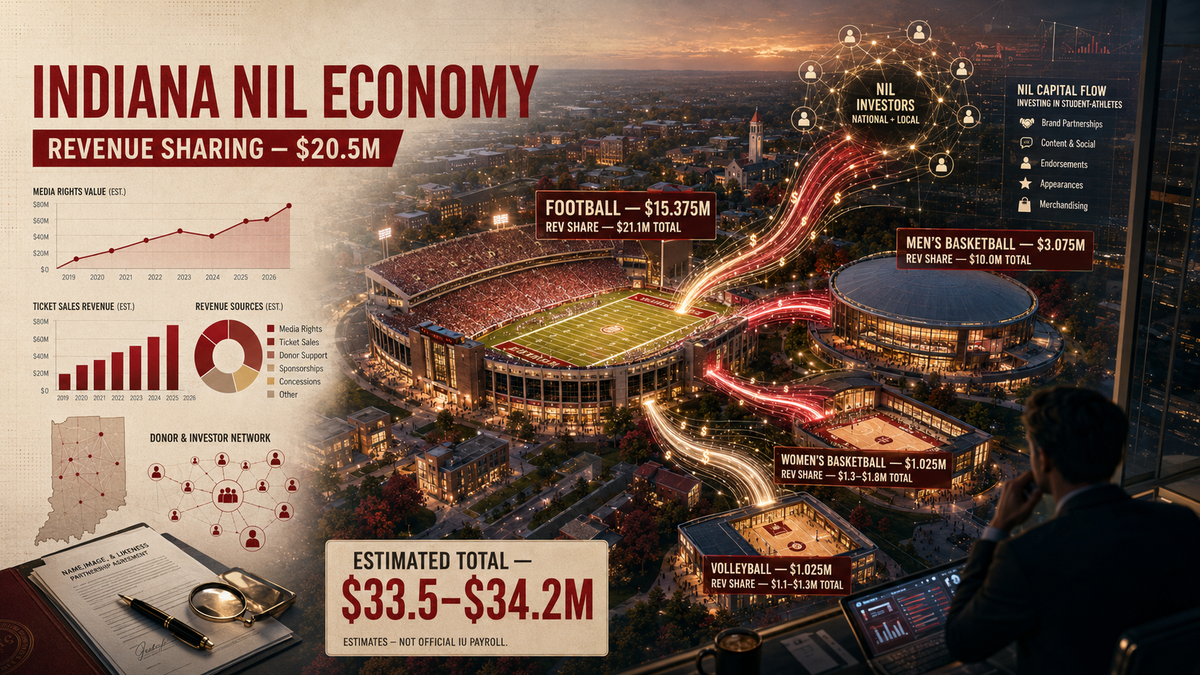
Indiana's rise to the top of college football wasn't just about a billionaire writing checks. Mark Cuban's targeted giving mattered, sure, but so did the program's improving finances and a roster strategy that knew exactly what it wanted to buy. Put those pieces together, and you get the clearest proof yet that NIL money works best when a program already has a plan.
For most of its history, Indiana was the kind of program wealthy alumni supported out of loyalty, not expectation. The Hoosiers could pack Memorial Stadium for a big game and occasionally string together a fun season, but nobody built this program to compete with college football's financial giants year after year.
That's not true anymore.
Indiana heads into the 2026 season as the defending national champion. It now runs a modern player-payment operation, has posted record athletic department revenue, and counts one of the most recognizable names in American business as a major backer. Mark Cuban, the billionaire entrepreneur and Indiana class of 198, has gone from famous alum to a football donor who moves the needle.
The interesting part isn't just that Cuban gave money. It's when he gave it, why he gave it, and how Indiana chose to spend it.
How Indiana Pays Its Athletes in 2026
The House settlement split athlete pay into two separate tracks.
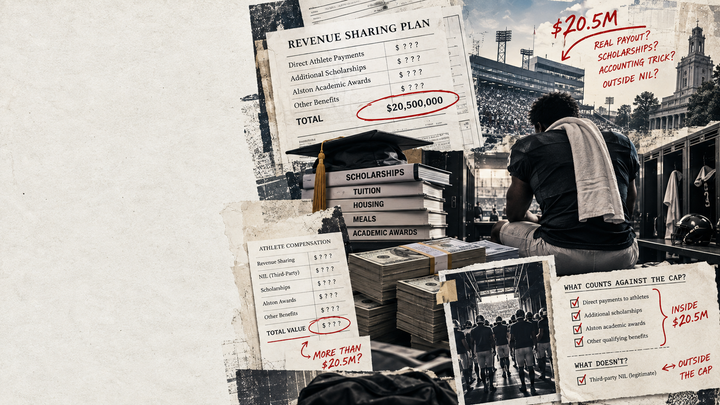
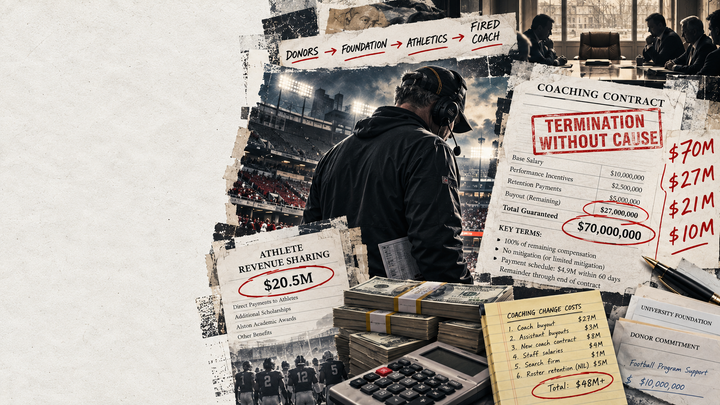
The first is direct revenue sharing. Starting July 1, 2025, schools that opt to pay athletes directly will be subject to an initial cap of roughly $20.5 million per year. That number climbs over time, and it covers the whole athletic department, not just football and men's basketball.
The second track is third-party NIL. Athletes can still cash in on endorsements, appearances, and licensing deals unrelated to the school itself. Those deals now come with more reporting requirements and outside review, but they're still a real source of roster value beyond what the university pays directly.
Indiana hasn't released a full NIL payroll or an official breakdown of its revenue-sharing spending. What we do know, with a decent amount of confidence, is that Indiana reportedly committed the entire $20.5 million allowed for the 2025–26 academic year. According to public reporting, that money is going to four sports: football, men's basketball, women's basketball, and volleyball. The school hasn't said how it's splitting that money between them.
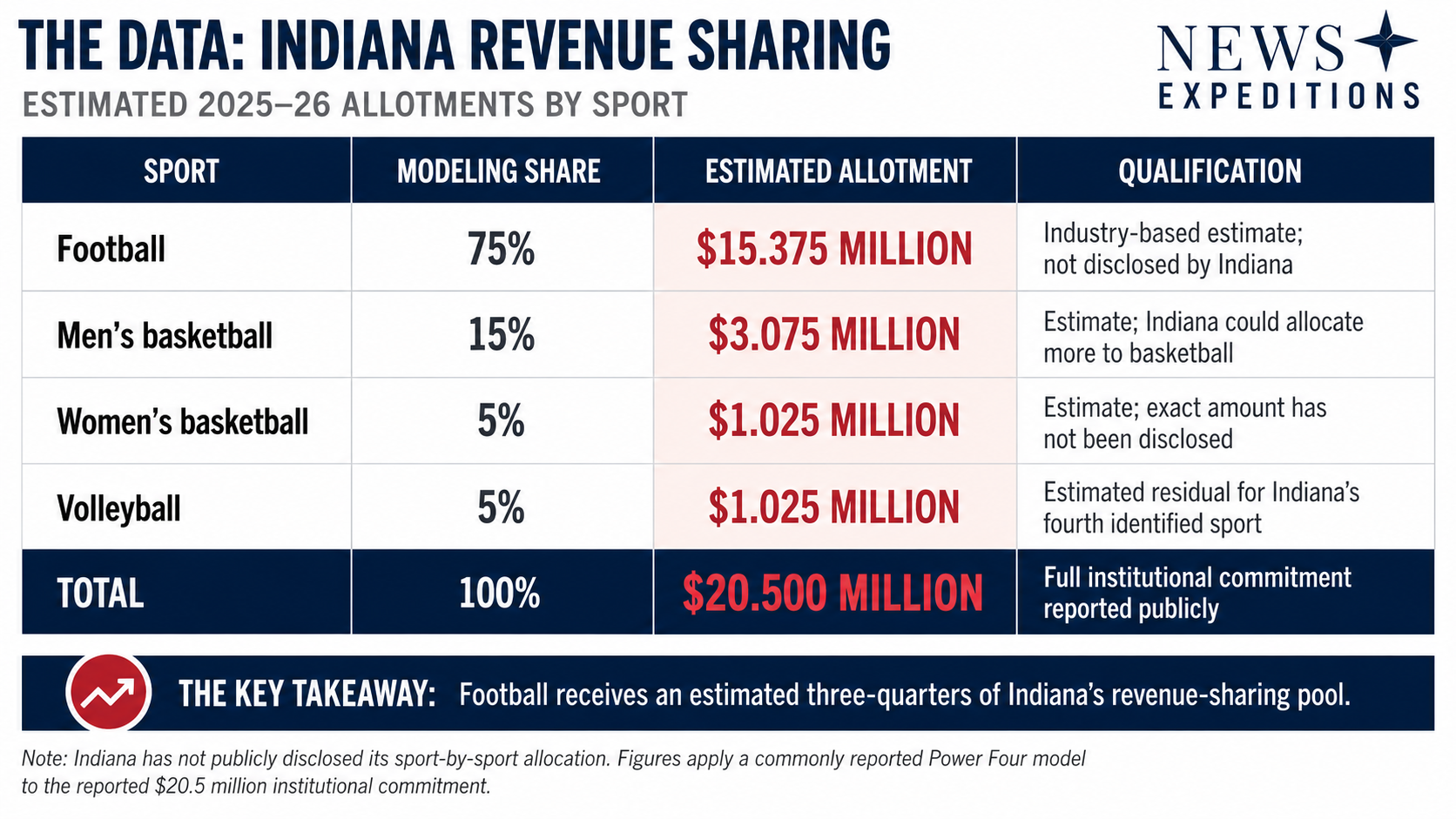
Estimated 2025–26 Revenue-Sharing Breakdown
Here's a planning estimate, not an official Indiana payroll, built off the widely reported Power Four benchmark: 75% to football, 15% to men's basketball, 5% to women's basketball, and 5% to other sports. Since public reporting names volleyball as Indiana's fourth funded sport, this model puts that last 5% there. Indiana's real contracts could look different.
Total Athlete Compensation, Sport by Sport
Outside NIL is even murkier than revenue sharing, mostly because collectives, private businesses, and the athletes themselves don't publish full contracts.
The best public reporting puts Indiana football's 2025 championship roster at roughly $21.1 million in total player compensation, and men's basketball at around $10 million for 2025–26. Both numbers appear to blend direct revenue sharing with roster-related NIL, rather than measuring outside endorsements on their own. Subtract the modeled revenue-sharing numbers from those totals, and you get the inferred NIL figures below.
The women's basketball and volleyball ranges are analytical estimates, since no credible public payroll exists for either team. Think of them as reflections of smaller collective and commercial markets, not official Indiana budget numbers.
Under this model, football makes up about $21.1 million of Indiana's four-sport compensation market. Men's basketball comes in at around $10 million, women's basketball lands between $1.3 million and $1.8 million, and volleyball sits between $1.1 million and $1.3 million. That puts the central estimate at roughly $33.9 million.
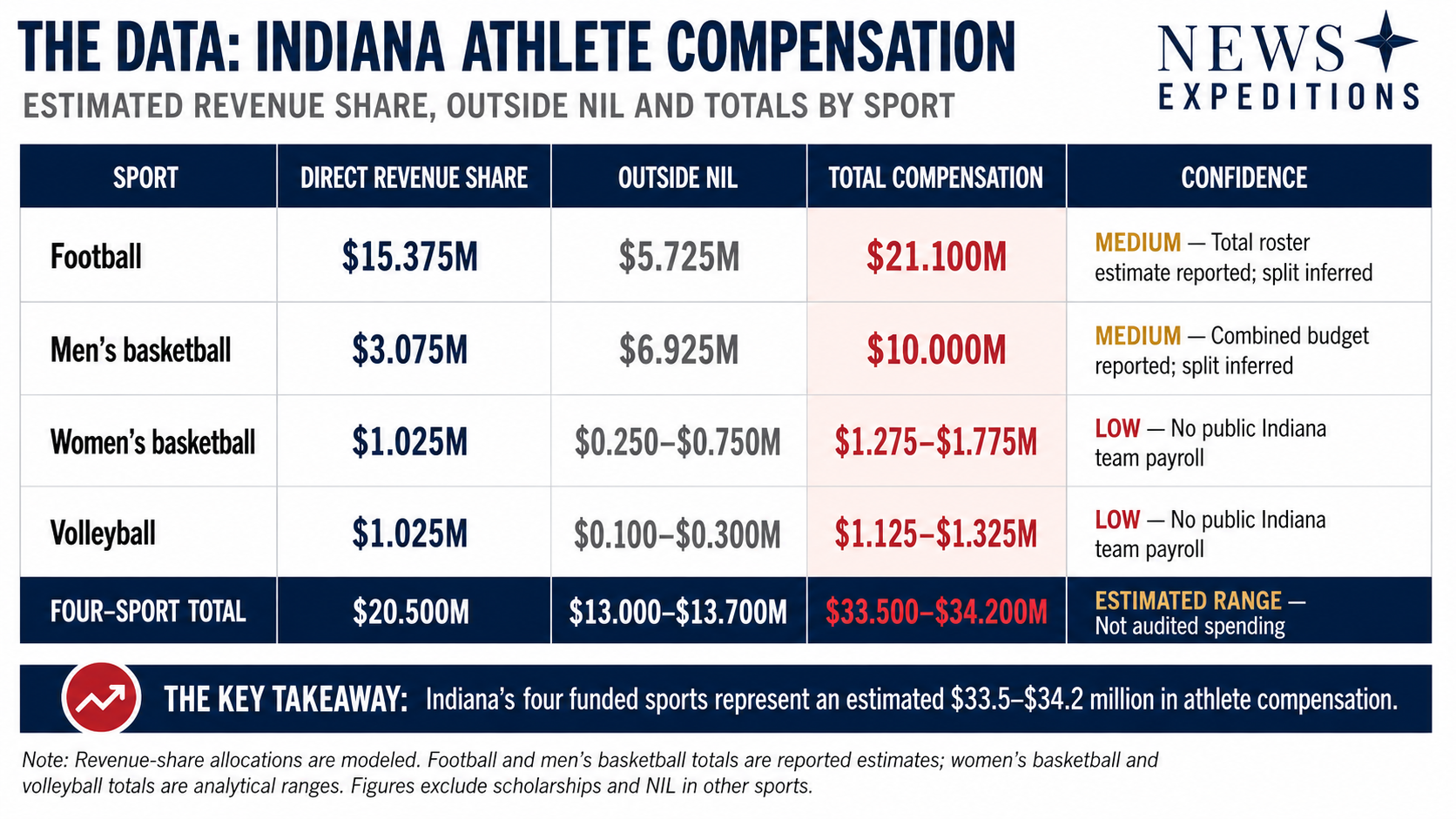
Keep in mind this table leaves out scholarships entirely. It also skips outside NIL money earned by athletes in Indiana's other 20 varsity sports, simply because there's no reliable sport-by-sport data available for them. Individual brand deals can add compensation that never shows up in a reported team budget, so the real campus-wide NIL number could run higher than what's shown here. And these figures shouldn't be added on top of unrelated "roster valuation" numbers floating around online; those often already include projected school payments and collective money, which would double-count everything.
Indiana's Financial Foundation
Indiana's FY2025 NCAA financial report showed $183.4 million in operating revenue against $173 million in expenses, resulting in a reported $10.4 million surplus before revenue-sharing payments were recorded as an expense line.
The department's biggest revenue sources broke down like this:
- Media rights: $62.9 million
- Ticket sales: $29.6 million
- Contributions: $25.9 million
- Royalties, licensing, advertising, and sponsorships: $11.3 million
- Postseason-related conference distributions: $10.7 million
Those numbers give Indiana real firepower in the athlete-compensation market. But that reported surplus needs a caveat.
Indiana's revenue included $24.95 million in direct institutional support. Of that, $18 million went toward men's basketball, according to the NCAA report, while nearly $7 million was reported as general, non-program-specific support. So yes, Indiana closed FY2025 with a positive operating margin on paper, but that filing doesn't back up any claim that the athletic department is fully self-sustaining or independently profitable.
Here's the bigger issue: that $10.4 million surplus was smaller than the new $20.5 million athlete-compensation pool. If Indiana had to fund that entire commitment without extra revenue, more institutional help, or cost cuts, the new expense alone would wipe out more than the department's previous margin.
That's part of why the department cut 25 positions while gearing up for revenue sharing. Thirteen employees were laid off, and another 12 vacant roles went unfilled. No varsity sports or coaching positions were eliminated. The university is trying to keep spending competitive while running a leaner operation behind the scenes.
The Mark Cuban Effect
Cuban's relationship with Indiana athletics goes back further than the current NIL boom.
Back in 2015, he gave $5 million to build the Mark Cuban Center for Sports Media and Technology inside Assembly Hall. The goal was to produce high-end broadcasts, recruiting content, and social media and in-venue video for all 24 of Indiana's varsity sports. That gift looks even smarter now than it did at the time; athlete value today is built partly through attention, content, and distribution, and Indiana had a donor funding that exact infrastructure years before most schools treated player branding as a real recruiting tool.
Cuban's direct involvement in football, though, came later.
According to CBS Sports, Front Office Sports, Reuters, and the Associated Press, Cuban started giving directly to Indiana's athletic efforts after the Hoosiers' December 2024 College Football Playoff loss at Notre Dame. He said 2025 marked the first time he ever donated directly to Indiana sports; before that, he'd stuck mostly to academic giving because he didn't want athletics spending to add to the financial burden on students.
That changed after conversations with head coach Curt Cignetti and watching Indiana's football plan start to work. Cuban didn't earmark his first major athletic gift for a specific player or team, either. He handed the money to athletic director Scott Dolson and let Indiana figure out how to use it. That trust turned out to matter a lot once Indiana went after quarterback Fernando Mendoza.
The Fernando Mendoza Investment
Mendoza transferred to Indiana from California.
Reuters, citing earlier reporting, said Mendoza earned about $1.6 million at Cal and received roughly $2.6 million to make the move to Indiana. Those are reported compensation figures, not numbers Indiana has confirmed through any official contract. Cuban later admitted he supplied the extra money Indiana needed to close that deal, though he hasn't said how much he personally put in.
The payoff was massive. Mendoza won the Heisman Trophy, led Indiana through a perfect season, and delivered the school's first-ever football national championship. He then went first overall in the 2026 NFL Draft.
It'd be misleading to credit one payment with an entire championship; Indiana still needed strong coaching, sharp roster evaluation, a real defense, player development, leadership, and contributions from dozens of guys across the roster. But quarterback is the most valuable position in football, and Cuban's money helped Indiana land the player who became the centerpiece of its championship run. Few NIL investments in sports history have produced a clearer return.
Cuban Keeps Giving
Cuban contributed again during Indiana's 2026 transfer portal cycle. He wouldn't say how much, only that Indiana officials were "happier" with the size of his second gift. That support helped Indiana reload with a transfer class that included quarterback Josh Hoover, wide receiver Nick Marsh, and edge rusher Tobi Osunsanmi.
Nobody outside the program knows Cuban's true total football giving. Any claim pinning a precise eight-figure number to his support should be treated with skepticism unless Cuban, the university, or an official financial record confirms it directly.
Cuban's value to Indiana goes beyond dollars, too. He spent more than two decades building NBA rosters as the controlling owner of the Dallas Mavericks, and he and Dolson have talked through roster construction and organizational strategy, even though Cuban insists he lets the athletic director make the final calls on how his money is used. It's a setup that looks a lot more like professional roster management than the typical booster relationship.
Cuban Is an Accelerator, Not the Whole Engine
It'd be easy to write Indiana off as just another program bought by billionaire money. That misses the real story.
Cuban didn't show up with a blank check and tell the football staff to go grab the most expensive recruits on the board. He backed a plan that Cignetti, Dolson, and university leadership had already built. Cignetti's staff proved first that it could evaluate talent, build a culture, and win with experienced transfers, and only then did Cuban's money step in to solve specific roster problems, including the most important position in the sport.
Coaching and evaluation cut down the odds of expensive mistakes. Donor money raised the ceiling. That distinction matters, because NIL markets punish teams that spend without a plan. A program can overpay for a five-star class and still flop if the roster doesn't fit or the culture doesn't stick. Indiana went the other way: build the system first, then spend aggressively on the pieces most likely to change the outcome. Cuban's money worked because Indiana's leadership knew exactly how to use it.
Football Finally Turned a Financial Corner
Indiana's FY2025 report captures the start of football becoming a real revenue driver.
The NCAA filing attributed about $81 million in revenue to football against $50.7 million in expenses, a positive sport-level gap of roughly $30.3 million. Football brought in $47.2 million from media rights and $12.7 million from ticket sales.
That word "attributed" matters. NCAA sport-level accounting includes allocated media revenue and other accounting assignments, while some shared departmental costs get reported separately elsewhere. So that $30.3 million gap isn't the same thing as an audited, standalone profit. Even with that caveat, football has clearly become a real financial engine for the department, and this report predates most of the commercial upside from the championship season itself. Bigger crowds, premium seating, new sponsorships, licensing deals, and fired-up donors could all push football's numbers even higher in future reports.
Basketball Still Carries Weight
Men's basketball remained a commercial powerhouse.
The FY2025 filing attributed $51.1 million in revenue to the program, including $15.2 million in ticket sales, $15.7 million in media rights, and $18 million in direct institutional support. Expenses came in at $32 million, but that number needs context, too. It included about $13.85 million in one-time coaching and transition costs tied to former coach Mike Woodson, his staff, and the hire of Darian DeVries from West Virginia.
Strip out those one-time costs, and basketball's underlying expense level drops closer to $18.2 million, which lines up better with the program's usual operating range. Indiana's basketball brand is still a major asset, but that NCAA report shouldn't be read as basketball organically pulling in a $19 million profit; a big chunk of the revenue came from institutional support, and a big chunk of the expenses came from a coaching change.
What the Championship Changes Going Forward
A national championship opens doors an ordinary donor campaign never could.
Indiana can push ticket revenue higher, sell premium seating, expand its sponsorship inventory, boost licensing income, and lean on an energized alumni base to keep funding contention. It can also sell something it simply didn't have two years ago: proof. Donors aren't being asked to imagine Indiana football matters someday: they just watched an NIL-supported transfer become a Heisman winner, a national champion, and the No. 1 pick in the NFL Draft. That makes the next fundraising pitch a whole lot easier.
Cuban's visibility helps, too. His involvement signals to other wealthy alumni and corporate partners that this program means business. Still, Indiana's long-term goal must be to broaden its funding base rather than rely on one person indefinitely. One billionaire can close a critical roster deal, but a program built to last needs thousands of donors, steady commercial partnerships, and an athletic department that can fund athlete pay year after year on its own.
The Real Indiana Advantage
Indiana's biggest edge isn't simply that one of its graduates happens to be worth billions, since many major programs have wealthy alumni. The real advantage is alignment.
Indiana runs a large Big Ten athletic department that posted a positive FY2025 margin, even if that number leaned on substantial institutional support. Dolson has a direct line to Cuban. Cignetti has a clear philosophy for building a roster. The football staff has proven it can identify talent and turn targeted spending into wins. Basketball remains a major draw commercially. Women's basketball has built a real audience. Volleyball now has a place in the new revenue-sharing structure. And the Cuban Center gives the department sophisticated media infrastructure that supports recruiting, sponsorships, and athlete branding across the board.
All those pieces reinforce each other.
Indiana still has tough choices ahead: dividing revenue sharing fairly across sports, protecting opportunities outside football and men's basketball, meeting Title IX obligations, retaining championship-caliber players, and building new sources of commercial revenue. The program must also prove that its breakthrough was the start of something sustainable, not just the peak of one great roster. Mark Cuban makes that job easier. He doesn't make it automatic.
Bottom Line
Indiana's NIL story is a lot more interesting than "Billionaire Buys a Championship." Cuban's support mattered enormously, especially in landing Fernando Mendoza, but the money worked because Indiana already had competent leadership, a specific roster plan, and enough institutional backing to build around the investment. That's the part other programs are going to try to copy.
In the revenue-sharing era, every major athletic department can write checks to athletes. Far fewer can build a coherent roster, identify the one target worth chasing, and know exactly when an extra investment could change the entire trajectory of a season. Indiana did all three. The result was a Heisman Trophy, a national championship, and the transformation of one of the Big Ten's least successful historical football programs into a blueprint for spending smart in the NIL era.
Comments ()