
Inside the Big Ten Conference: Leadership, Costs and Operations
Inside the Big Ten’s $1.47 billion operation: leadership, payroll, media power, athlete payments and hidden costs today.
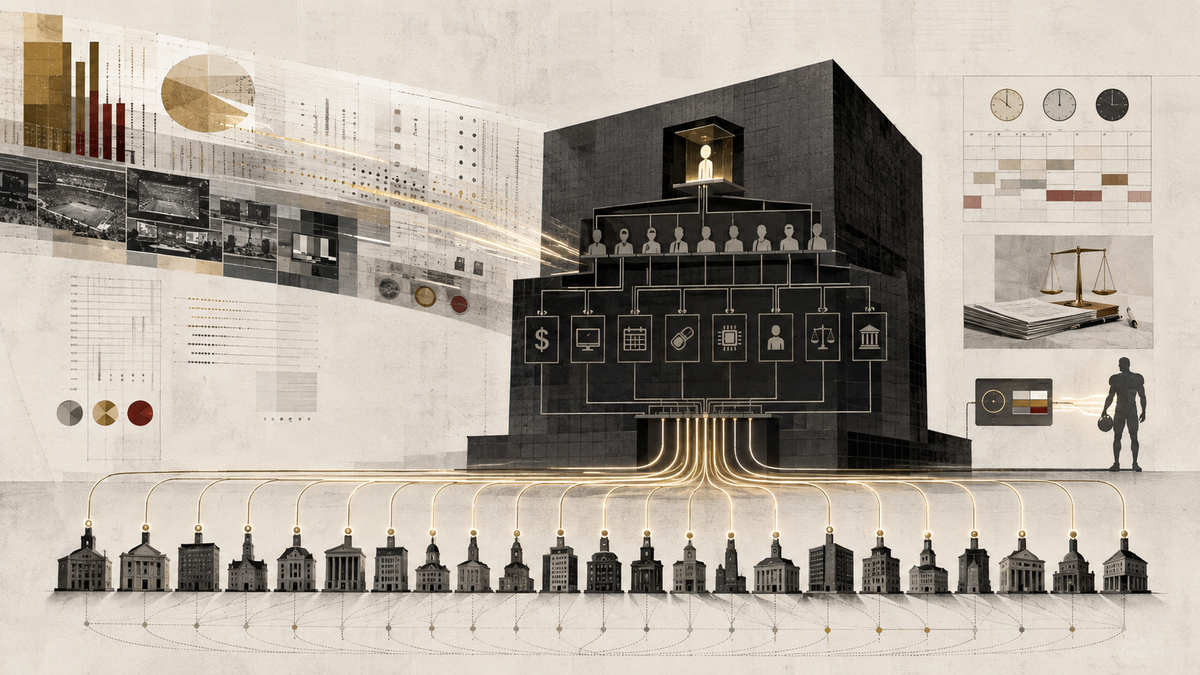
The Big Ten Says It Has 83 Employees, and an Army of Consultants
The Big Ten wants you to believe it runs on a skeleton crew. Just 83 employees. That's it. For a conference pulling in $1.47 billion a year, that sounds almost too lean to be true.
And honestly? It kind of is too lean to be true, especially once you start looking at who's cashing checks from the conference without technically working there.
Buried in the Big Ten's latest tax filing is a list of 36 independent contractors who each pulled in more than $100,000 last year. The top five alone collected a combined $12.4 million. We're talking about two major law firms, two officiating-tech companies, and a firm that handles event services. Add it all up (legal fees, accounting, lobbying, IT, and other outside services), and the conference spent roughly $15.2 million on contractors. That's nearly as much as the $17.5 million it spent on actual employee salaries and executive pay.
So, here's the real picture: the Big Ten's headquarters isn't just 83 people making schedules and assigning referees. It's the nerve center for a much bigger operation: lawyers, tech vendors, media consultants, and event companies who do a lot of the heavy lifting without ever showing up on the conference's official employee count.
The Big Ten hasn't avoided building a bureaucracy. It's just built a big chunk of it outside the walls of its own office.
That outside network is a big part of why a relatively small central staff can pull off coordinating 18 universities spread across three time zones, run 28 different sports, manage deals with the country's biggest broadcasters, hand out more than $1.3 billion to its members, and help everyone navigate the brand-new world of paying athletes directly.
It also raises a fair question: is this conference office bloated, or is it lean? Turns out the answer depends entirely on what you're counting.
A $1.47 Billion Operation That Keeps Almost None of It
According to its IRS Form 990, the Big Ten pulled in $1.468 billion in revenue for the fiscal year ending in June 2025. It reported $1.453 billion in expenses and closed the year with $223.9 million in net assets.
Those numbers make the conference sound like a billion-dollar bureaucracy. It's not, really. Most of that money just passes through Rosemont on its way somewhere else.
About $1.373 billion of that spending was in the form of grants and assistance sent directly to member schools. In other words, the central office is mostly functioning as a giant financial clearinghouse. It collects revenue from media deals, postseason games, and other conference businesses, runs it through the distribution formula, and sends the bulk of it back to the universities.
That distinction matters a lot. The Big Ten's $1.453 billion in total expenses does not include the cost of running the Rosemont office. But even after subtracting the school payouts, you don't get a clean overhead number, because what's left still includes championships, officiating, technology, travel, legal work, and marketing.
Still, the filing gives you a decent look at the scale of everything surrounding those distributions: $38.6 million in investment income, $8.47 million in executive compensation, $9 million in other salaries and wages, $8.37 million in legal fees, and $4.77 million in other non-employee-service fees.
Commissioner Tony Petitti made about $4.50 million in reportable compensation last year, plus another $38,480 in other compensation. Chief Operating Officer Kerry Kenny brought in roughly $627,000. And interestingly, the filing also shows that about $3 million was paid to former commissioner Jim Delany: a reminder that deferred pay and leadership changes can keep showing up in the books years after someone has left the job.
The conference's finances also grew a lot faster than its staff did. Revenue jumped from $928.1 million in FY2024 to $1.468 billion in FY2025: a 58% increase. Meanwhile, combined salaries and executive pay rose from $14.26 million to $17.47 million, an increase of about 22.5%.
On paper, that makes the internal staff look incredibly efficient. But the contractor numbers complicate that story fast.
83 Employees, Surrounded by an Army of Outside Help
The Big Ten reported 83 employees for 2024, unchanged from the previous year but up from 55 in 2014. That's a 51% jump over the decade.
The growth wasn't a straight line, though. The staff count went from 55 in 2014 to 53 in 2015, then climbed steadily: 59, 58, 61, 64, 66, 74, 77, and finally reached 83 in both 2023 and 2024.
That climb tracks with a period when the Big Ten's job got a lot more complicated. Between 2020 and 2023, the staff grew from 66 to 83. During those same years, the conference changed commissioners, signed a massive new national TV deal, and prepped to add Oregon, Washington, USC, and UCLA.
Then something interesting happened: the reported headcount froze at 83 in 2024, just as those four new schools officially joined, turning the Big Ten into a true coast-to-coast conference.
That doesn't necessarily mean hiring stopped. The employee number on a Form 990 isn't a precise snapshot from a single day. The IRS just asks organizations to report anyone who appeared on their W-3 forms for that calendar year, which can include people who left partway through the year. So, it's not a perfect measure of who was actually working in Rosemont on any given afternoon.
It's still the best public number we've got, though. And it only counts people on the conference's actual payroll.
For FY2025, the Big Ten's disclosed outside spending broke down like this: $8.37 million in legal fees, $4.77 million in other non-employee services, $913,657 in lobbying, $878,778 in IT costs, and $245,042 in accounting. That's roughly $15.18 million in total.
And that's not even the full picture; outside spending can also get buried inside other categories like advertising, championships, and officiating. The filing doesn't say how many people at these law firms and tech companies are working Big Ten accounts, either. IRS rules only require conferences to list their five highest-paid contractors earning over $100,000.
Even that limited peek is telling.
The Big Ten paid Sidley Austin $3.59 million for legal work and Mayer Brown $2.52 million. DVSport pulled in $2.56 million for officiating technology, while Hawk-Eye Innovations collected $2.51 million to do similar work. Eli Marketing got $1.21 million for event services.
Just those five contracts added up to $12.39 million, more than the conference spent on its entire "other salaries and wages" category combined.
This isn't a one-time blip, either. Looking at legal, accounting, lobbying, and other outside-service spending together, that total grew from about $3.39 million in FY2015 to $4.43 million in FY2020 to $14.30 million in FY2025. That's more than a 300% increase over the decade, compared to just a 51% rise in reported staff.
The types of vendors have shifted too. Older filings show more media consultants and production companies. The newer ones lean heavily on lawyers and the tech that powers game officiating.
That's really the operating model in a nutshell: keep a small core staff to handle policy and coordination, then bring in specialists whenever the work calls for it.
So, Who's Actually In Charge?
Petitti might be the face everyone recognizes, but he doesn't own the conference and doesn't have unlimited power over it.
The Big Ten says its Council of Presidents and Chancellors holds "ultimate authority" over how the conference is run. That council is made up of the top leaders from each of the 18 schools.
Think of it like a corporate board, with a big asterisk. These presidents and chancellors aren't shareholders: they're running massive universities with huge academic, medical, and research operations on top of their athletic departments. They're not the ones building volleyball schedules or hashing out broadcast contract language. They aren’t sitting down to figure out how a new athlete-pay rule affects every single sport on campus.
That's exactly where the conference office picks up real power.
The presidents hold the formal authority, sure. But the commissioner, his staff, and the outside consultants are the ones drafting proposals, interpreting the rules, running the financial models, and putting decisions into action. By the time university leaders vote on something big, the central office has usually already shaped what options are even on the table.
Put simply: the presidents govern the Big Ten. The conference office runs it. Those aren't the same thing.
Why the Commissioner's Job Now Looks Like a CEO's
Petitti came into this job with a background in television, Major League Baseball, and the gaming industry. That resume tells you a lot about what the role has turned into.
Today's Big Ten commissioner must manage relationships with Fox, CBS, NBC, the Big Ten Network, the College Football Playoff, the NCAA, rival conferences, and government officials, all at once. He must balance the interests of marquee football programs with those of schools with very different athletic profiles. He must fold in four new West Coast schools without alienating the conference's longtime members. And somehow, he must hold together a system of shared revenue even though some schools obviously generate way more TV value than others.
That workload looks a lot more like running a media company or a pro sports league than heading up a traditional college athletic association. That comparison doesn't automatically mean Petitti's pay is justified, but it does explain the market the Big Ten seems to be comparing itself with. It's also worth noting that plenty of top football coaches still make more money than the commissioner overseeing all 18 schools.
On top of that, Petitti doesn't get one of the biggest advantages pro commissioners have: a single owner who can just make a call and force everyone to fall in line. Every Big Ten school still operates independently, with its own leadership, board, athletic department, and state laws to navigate.
The conference office must build coordination without any actual ownership to back it up.
From Amateurism to PayPal
Nothing shows how much the central office has changed quite like its role in paying athletes.
Back in June 2025, right after the House antitrust settlement opened the door for schools to share revenue directly with athletes, the Big Ten rolled out a partnership with PayPal. It lets participating athletic departments send institutional payments to athletes via PayPal.
To be clear, the conference isn't deciding what any individual athlete gets paid, and this deal doesn't mean payments are coming out of some central Big Ten account. Each school still makes its own compensation calls within the overall rules. What the conference is really doing here is building shared infrastructure the schools can plug into.
That's what makes this so notable. A conference that spent decades enforcing strict amateurism rules is now helping build the actual machinery used to pay college athletes.
The Big Ten has taken a similar approach to NIL. Back in 2023, the conference and the Big Ten Network teamed up with Greenfly to help athletes access photos and videos for their social media and personal brands. Veritone, which handles content licensing for the conference, also launched a program letting athletes and their business partners license Big Ten footage for NIL deals.
These moves solve a real problem. The most valuable footage of a college athlete usually comes from games controlled by the school, the conference, and the broadcaster, not by the athlete themselves. By setting up a centralized system for distributing and licensing footage, the Big Ten is turning media it already controls into a revenue stream for athletes.
So, the conference office isn't just reacting to the new NIL economy. It's actively building parts of the system that economy runs on.
Scheduling Just Became a National Logistics Puzzle
The Big Ten still handles scheduling; that's about as old-school as it gets, but even that job has gotten dramatically harder.
The conference now stretches from New Jersey all the way to Washington state, covering three time zones. Football teams generally play once a week, often flying by charter. But volleyball, baseball, softball, and other sports play way more often, work with smaller budgets, and have completely different travel and recovery needs.
Every scheduling decision comes with tradeoffs. Grouping teams regionally cuts down on travel but means the new West Coast schools play fewer games against the rest of the league. Scheduling more matchups nationally boosts the conference's TV inventory and national profile, but it also means more missed class time and bigger travel bills. Broadcasters want the best games in the best time slots. Fans and schools don't always love the kickoff times that come with those slots.
The conference office sits right in the middle of all that, juggling schedules and TV selection windows across Fox, CBS, NBC, and the Big Ten Network. When it works well, nobody notices. When it produces a brutal cross-country trip or an unpopular 11 a.m. kickoff, the central office becomes an easy target for criticism.
Technology vendors play a quiet role in all of this too. DVSport and Hawk-Eye Innovations combined to collect more than $5 million in the latest contractor filing for officiating technology. Even something as basic as making sure games are officiated correctly depends on specialized systems the conference doesn't build in-house.
The Legal Department That Stretches Way Beyond Rosemont
If you want the clearest sign of how much work gets outsourced, look at the legal bill.
The Big Ten spent $8.37 million on legal fees in FY2025, more than four times what it spent just five years earlier, when the number sat around $1.97 million. Its two biggest law firms alone took home $6.11 million.
That spike lines up with a period of massive legal upheaval in college sports. The House settlement created the framework for direct revenue sharing with athletes and new rules around NIL deals and roster limits. On top of that, there are still open questions about athlete employment status, antitrust exposure, collective bargaining, Title IX, and possible federal legislation, any of which could reshape athletic department finances across the conference.
The Big Ten isn't handling any of that with one general counsel working solo out of Rosemont. It's buying expertise from firms with deep experience in antitrust law, labor issues, litigation, media contracts, and regulatory compliance. In practice, that's an entire external legal department whose staff never shows up in the Big Ten's official employee count.
Lobbying has climbed too, jumping from about $116,000 in FY2020 to roughly $914,000 in FY2025. That number alone doesn't tell you which policies the conference is pushing for or how effective the effort's been. But it does show that shaping the political landscape has become a real, meaningful expense for the conference.
The modern Big Ten isn't just enforcing its own rulebook anymore. Alongside other conferences and national organizations, it's actively fighting in courtrooms and statehouses over what the next set of rules will even look like.
Bloated Bureaucracy or Lean Headquarters? Maybe Both.
Multi-million-dollar executive pay and a network of expensive law firms will always raise eyebrows. So will the fact that an organization controlling this much money, on behalf of public and private universities, discloses way less than a publicly traded company would.
But the numbers don't really back up the image of some sprawling internal bureaucracy. Eighty-three employees is a genuinely small staff for the money, territory, and institutional complexity being managed here. Combined salaries and executive pay only made up about 1.2% of total FY2025 expenses, though it's worth remembering that total number is dominated by school distributions, which makes almost every other central-office cost look tiny by comparison.
And outsourcing isn't automatically a red flag, either. There's a real argument that the conference shouldn't keep permanent in-house teams built to handle every antitrust lawsuit, broadcast system upgrade, championship production, and replay-technology rollout. Sharing vendors across 18 schools can also stop those schools from buying redundant systems on their own.
But outsourcing can also make an organization look a lot leaner than it is. An employee shows up in the headcount and the payroll. A lawyer from an outside firm just shows up as a fee. The engineers running officiating technology belong to a vendor, even though their work is essential to how games get played. The Big Ten's official staff count only measures the core organization, not the full network of labor it takes to keep the conference running.
That's the real story behind the Rosemont office.
The Bottom Line
The Big Ten isn't just an 83-person nonprofit, and it isn't really a $1.47 billion headquarters either. It's a coordinating hub that takes in and distributes enormous sums of money while managing a sprawling web of university leaders, employees, broadcasters, law firms, and tech companies. Its real power doesn't come from directly employing everyone doing the work; it comes from deciding how all those pieces fit together.
Yes, the conference office still builds schedules, assigns referees, and hands out trophies. But it's also moving more than a billion dollars a year, helping schools figure out how to pay their athletes, controlling access to valuable game footage, spending millions on legal and tech expertise, and representing 18 universities while the entire economic model of college sports gets rewritten in real time.
Most fans couldn't pick the Rosemont building out of a lineup. But its decisions shape their Saturdays every single week.
Comments ()