
Learfield and the Big Ten: Sponsorships, NIL, Tickets, and Data
How Learfield supplies Big Ten schools with sponsorships, NIL services, ticketing, fan data, content, and licensing.
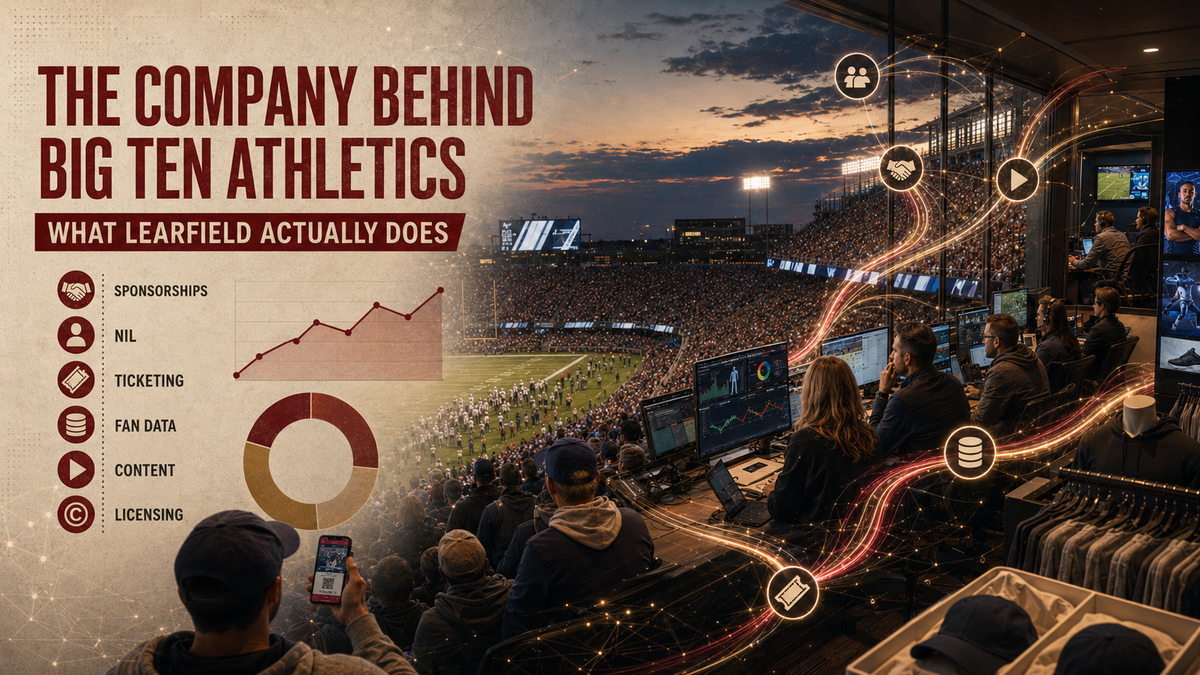
Walk into a Big Ten football stadium on a Saturday, and there's a good chance Learfield is everywhere around you, even though you'll never see the name printed anywhere.
The local office that sold the scoreboard sponsorship? Probably Learfield. The radio network broadcasting the game? Could be Learfield too. The app you used to pull up your ticket? That's likely Paciolan, one of Learfield's companies. The athletic department's website? SIDEARM Sports, another Learfield brand. Even that sweatshirt you bought before kickoff may have been licensed through CLC, yet another Learfield company.
And if all those products connect through Learfield's Fanbase platform, the athletic department can potentially link your ticket purchase, your donation history, your merchandise buys, and your app activity into one detailed profile of you as a fan.
For a long time, Learfield was known mainly as a multimedia rights holder—basically, an outside company a university hired to sell advertising and sponsorships tied to its sports teams. That's still true, but it's nowhere near the whole story anymore.
These days, Learfield provides sponsorship salespeople, content producers, data systems, NIL specialists, ticketing tech, licensing know-how, and digital platforms. At some schools, Learfield employees work right on campus under locally branded names like Hawkeye Sports Properties, Ohio State Sports Properties or Huskies Sports Properties. To the average fan, those offices might look like part of the athletic department itself. Legally, though, they're operations run by a private company hired to help generate revenue.
That makes Learfield one of the most influential and least understood companies in Big Ten athletics today.
One quick note before we dig in: unless stated otherwise, the stats in this piece come from Learfield or from joint announcements with its university partners. Think of them as company-reported results rather than independently audited numbers.
Learfield's Big Ten Footprint
As of August 2026, Learfield's public partner directory lists 12 of the Big Ten's 18 schools as institutional partners: Illinois, Indiana, Iowa, Michigan, Minnesota, Ohio State, Oregon, Purdue, Rutgers, USC, Washington, and Wisconsin.
That directory doesn't specify exactly which services each school buys, so it shouldn't be read as proof that all 12 have identical contracts. A school can also use just one Learfield product without making the company its main sponsorship partner. A department might use Paciolan for ticketing or CLC for merchandise licensing, while a different company handles its core sponsorship deals. On the flip side, a school with a local Learfield sports-properties office might skip other Learfield services entirely.
So "Learfield School" isn't really a yes-or-no label. The better question is how much of Learfield's system a given department uses.
Multimedia Rights and Sponsorship Sales
This is still the foundation of Learfield's business.
Athletic departments control a bunch of commercial assets: radio ads, stadium signage, sponsor shoutouts on websites and apps, hospitality suites, coaches' show ad slots, naming rights, and sometimes even logos on fields or uniforms. A school could sell all that itself, but many hire an outside rights holder who already has sales relationships.
At its partner schools, Learfield typically sets up a local sports-properties office that finds sponsors, packages the available inventory, and negotiates deals. A hospital system might become the "official health-care provider" of a program. A bank might sponsor the field or a weekly video series. A restaurant chain might get signage, digital ads, and athlete appearances rolled into one deal.
Learfield says its broader network includes more than 12,000 local and national brand partners, a scale that lets it reach advertisers that an individual athletic department might struggle to reach on its own.
Ohio State shows what this looks like at the high end. Learfield's local Ohio State Sports Properties office works on sponsorships, premium assets, and new revenue ideas, and the two sides have flagged field naming rights, on-field logos, jersey patches, and paid fan experiences as growth areas.
Illinois takes things a step further. Under a partnership announced in July 2025, Learfield's sponsorship and NIL staff were integrated into the athletic department's commercial structure. Illinois Chief Commercial Officer Tom Moreland kept oversight of strategy and revenue, while Learfield's people handled sponsorship development, brand activation, NIL deals, and related work.
Illinois is a good example of just how blurry the line between "university" and "vendor" can get. The school still owns its brand and the oversight rights spelled out in its contract, but Learfield supplies the people, the tech, the sales expertise, and the brand connections.
Bottom line: Learfield doesn't just sell signage anymore. It helps figure out how physical, digital, and experiential assets get packaged into products advertisers want to buy.
Radio Networks, Audio and Publishing
Radio is one of Learfield's oldest businesses.
Depending on the contract, a local Learfield property might manage advertising and distribution for a school's radio network: affiliate stations, ad inventory, pregame and postgame shows, coaches' shows, podcasts, and streaming audio. At some schools, Learfield even helps pick the on-air talent. In July 2026, Washington Athletics and Learfield's Huskies Sports Properties jointly announced Elise Woodward as the new radio play-by-play voice for Husky football.
It's worth separating this from the Big Ten's TV deals. The conference's main television inventory runs through FOX, CBS, NBC, Peacock, and Big Ten Network. Learfield generally deals with school-controlled inventory instead, like radio, digital audio, locally produced shows, official publications, and sponsor-backed content.
That distinction matters because plenty of fans probably don't realize the university-branded radio broadcast they're listening to is run, ad sales and all, by an outside company.
NIL Services Through Learfield Impact and Compass
Name, image, and likeness have pulled Learfield's business much closer to the athletes themselves.
Learfield Impact combines NIL staff, content production, and technology. Depending on the school's agreement, Learfield's NIL team might recruit brands, run campaigns, coordinate what athletes need to deliver, and help produce sponsored content. Compass, meanwhile, is Learfield's NIL transaction platform; the company says athletes can use it to browse opportunities, sign agreements, verify they complete the work, and get paid through a digital wallet.
It's important not to confuse this with the direct payments schools make under the House v. NCAA settlement. That settlement, approved in June 2025, allows participating Division I schools to pay athletes directly, with an initial cap of around $20.5 million per school for the 2025–26 academic year. Third-party NIL deals, the kind Learfield facilitates, are a separate category involving outside businesses paying for legitimate use of an athlete's name, image, or likeness.
Learfield likes to sell institutional sponsorships and athlete NIL deals together when it makes sense. A company buying stadium signage might also want athlete endorsements, and Learfield's NIL pitch specifically promotes campaigns that blend school branding with athlete influencer marketing.
A few Big Ten examples show how far this has expanded:
- Illinois added NIL business-development staff and a Learfield Studios content creator, plus access to Compass.
- Iowa's 2025 renewal added two NIL-dedicated employees and another content specialist to Hawkeye Sports Properties.
- Ohio State launched Buckeye Sports Group, a full NIL initiative powered by Learfield Impact. By January 2026, Ohio State and Learfield reported that Buckeye athletes had done more than 650 NIL activations with over 100 brands.
- USC's 15-year Learfield deal includes NIL leadership, content production, and Compass access as core pieces.
Learfield used to focus on monetizing school-owned stuff: logos, broadcasts, sponsor inventory. Now it's also helping create commercial opportunities for individual athletes.
Original and Sponsored Content Through Learfield Studios
Sponsorship inventory today means a lot more than a sign next to the scoreboard. Brands want videos, social posts, athlete stories, and year-round access to fans, even in the offseason.
That's where Learfield Studios comes in, producing documentary series, behind-the-scenes features, short-form social videos, branded segments, and athlete-focused NIL campaigns for distribution across a school's website, app, and social accounts.
In USC's 2025 partnership announcement, Learfield said its studios' operation had generated more than 1.2 billion impressions and $50 million in branded-content revenue over the prior fiscal year. At Iowa, Learfield's Social+ team reportedly increased its sponsored social content output by 90% year over year. Michigan, meanwhile, has worked with Learfield Studios on its "Michigan Made" digital series, including a five-part production on the men's basketball program.
The logic here is simple: a stadium has a finite number of walls for signage, but a digital content operation can keep generating new sponsor inventory indefinitely. That doesn't mean every video is secretly an ad; it means storytelling itself has become a commercial asset. A practice video or offseason documentary can serve as both fan content and sponsor inventory.
Fan Data Through Fanbase
Fanbase might be Learfield's most consequential product, mainly because it can tie so many of the company's other services together.
According to Learfield, Fanbase can combine first-party data from ticketing, donations, merchandise purchases, athletic websites, apps, surveys, and sponsorship activity. Exactly what information gets pulled in depends on the school, the service package, and the technical integrations in place, but instead of treating a ticket buyer, a website visitor, and a merchandise customer as three separate people, Fanbase tries to build one complete profile.
That profile can include demographics, location, purchase history, ticket activity, and inferred brand preferences, which athletic departments then use to identify likely ticket buyers, target fundraising appeals, build audience segments, and measure the performance of sponsor campaigns.
The numbers involved are striking. In recent partnership announcements:
- Illinois had more than 2.3 million fan profiles in Fanbase.
- Ohio State had more than 2.18 million fan records.
- USC's existing Paciolan and SIDEARM relationships gave it insight into more than 3.2 million profiles.
- Indiana's Fanbase database grew from roughly 674,000 profiles to 1.68 million over two years.
Learfield has also said its Fanbase systems contain more than 28 million records tied to Big Ten fans overall. That figure comes straight from Learfield, so it's best understood as a measurement of records in its platform, not necessarily 28 million unique people.
Fanbase also feeds into sponsorship valuation by providing advertisers with data on the audiences their campaigns reach, helping Learfield's sales teams make the case for renewing or expanding deals. This is why the whole collection of Learfield businesses matters; where the right integrations exist, Paciolan ticketing data, SIDEARM engagement numbers, merchandise activity, donations, and sponsorship interactions can all feed a bigger picture of who a fan actually is.
The old sponsorship model sold access to a crowd. This newer model tries to sell access to a categorized, measurable, repeatedly reachable audience.
Targeted Digital Advertising Through Fan365
Fan365 takes Learfield's data and puts it to work for digital ad campaigns, letting athletic departments and sponsors target specific audience segments year-round instead of blasting the same message to every supporter.
Iowa reported that Fan365 campaigns delivered 28 million impressions for its brand partners in the year before its 2025 Learfield renewal. Ohio State and Learfield reported more than 40 million impressions from targeted digital sponsorship campaigns, and Illinois uses the platform to deliver sponsor messages based on fan interests.
For athletic departments, this creates commercial inventory that exists entirely outside games and venues. For sponsors, it makes a college partnership feel a lot more like a digital ad buy, complete with targeting and performance reports. For fans, it means your interactions with an athletic department can quietly shape which sponsored messages show up in your feed later.
Websites, Mobile Apps and Streaming Through SIDEARM Sports
SIDEARM Sports handles official athletic websites, mobile apps, stats tools, and streaming products; schedules, rosters, stats, stories, videos, live audio, and sponsor placements all run through it, though exact features vary by school.
These platforms aren't just communication tools; they're commercial ones too. A university app is where fans read news, encounter sponsor messages, buy tickets, and generate the kind of digital engagement data that can feed into Fanbase later.
Indiana offers a good example of the scale involved. During the 2025 football season, Learfield reported that traffic to Indiana's SIDEARM-powered website and app jumped significantly: game-day traffic rose 50% year over year, website users climbed 21%, website sessions increased 27%, mobile-app users grew 16%, and mobile-app session durations increased 24%. Those numbers came from a Learfield case study and weren't independently audited.
SIDEARM obviously doesn't decide whether a football team wins. What it does is help the athletic department capture and potentially monetize the attention that shows up when it does.
Ticketing and Fundraising Technology Through Paciolan
Paciolan handles the tech side of ticket sales: account management, mobile delivery, transfers, resale integration, marketing, and fundraising tools for university development offices. Its "My Account" system lets fans buy, transfer, sell, and renew digital tickets, and it integrates with SeatGeek for secondary-market sales.
The value here goes beyond just processing an order. Every digital ticket transaction creates an identifiable record, and when a season-ticket holder transfers a seat to someone new, that transfer can generate a brand-new customer account for the department to track.
Illinois reported that new accounts created through Paciolan ticket transfers jumped 400% over three years. Iowa's numbers from the three years before its 2025 renewal were similarly strong: ticket transfers up 111%, new accounts from transfers up 39%, secondary-market sales through the Paciolan-SeatGeek link up 52%, and mobile-ticket downloads up 101%.
At Indiana, Learfield reported a 40% jump in football season-ticket sales from 2024 to 2025, along with $2 million in incremental donations processed through Paciolan during the 2025 season.
This is a major reason ticketing sits at the center of Learfield's strategy. A transferred ticket isn't just a seat changing hands; it can also turn a previously unknown attendee into someone the department can now market to directly.
Ticket Sales, Fundraising and Premium Seating Through Learfield Amplify
If Paciolan is the technology, Learfield Amplify is the people. Amplify provides outbound ticket sales, premium-seat sales, fundraising development, and customer service, with the exact scope varying by school.
Basically, Paciolan provides customers with a place to buy tickets, and Amplify staff work to convince them to do so.
At Iowa, Learfield credited its Amplify operation with helping football, women's basketball, and men's wrestling sell out season-ticket inventory before their first home events. At Indiana, Learfield's Amplify team was credited with a 113% increase in football ticket revenue from 2023 to 2025, more than $500,000 in incremental fundraising during 2025, eight straight Big Ten football sellouts, and a 63% year-over-year jump in per-game revenue.
Those numbers came from a Learfield case study, so they should be read as the company's own attribution of results; results that also came alongside Indiana football's improved on-field performance.
This kind of service is especially useful for departments with thousands of potential customers but limited internal sales capacity. Where the systems connect, Fanbase can identify the prospects, Amplify can reach out, and Paciolan can close the sale, meaning Learfield can be involved at multiple stages of the exact same transaction.
Trademark Licensing and Merchandise Through CLC
CLC, short for Collegiate Licensing Company, handles trademark licensing, brand protection, retail development, and marketing. That includes approving licensees, managing product rights, supporting trademark registration, watching for counterfeits, and helping schools grow sales of officially licensed gear.
When a manufacturer wants to slap a university's logo on a shirt or collectible, CLC often manages the authorization and royalty process. It also runs national programs such as College Colors Day and collaborates with retailers on product development.
Illinois reported that its gross sales of licensed merchandise doubled over three years working with CLC. Indiana reported a 33% increase in team-store sales during the early part of the 2025 football season compared with the year before, with Learfield also crediting CLC marketing and in-venue activations for boosting the school's national exposure.
Worth noting that Indiana's increase happened during an especially strong football season, so it shouldn't be chalked up to CLC alone: team performance, fan excitement, and other factors clearly played a role too.
Still, licensing reaches well past a school's own team store. It lets universities earn royalties from products sold at national retailers while protecting how their names and logos are used out in the world.
Premium Experiences and New Commercial Inventory
Learfield also helps schools monetize assets that may never have been sold before. Ohio State's renewed agreement includes management of "Buckeye Experiences," VIP venue access, behind-the-scenes activities, and other immersive game-day perks. Learfield and its partners are also chasing newer sponsorship categories like playing-surface logos, field names, jersey patches, and specialized digital content, though what's sellable depends on NCAA rules, conference policy, and each school's specific contract.
This all reflects a basic pressure facing athletic departments since the House settlement. Schools have taken on a major new athlete compensation expense without any guaranteed new revenue to match it, so the extra money must come from somewhere: sponsorships, tickets, donations, premium experiences, merchandise, you name it.
Increasingly, Learfield's job is to find commercially usable assets, physical, digital ,or experiential, and figure out whether a brand or a fan is willing to pay for them.
Why Big Ten Departments Outsource These Services
The main appeal is scale.
A university could build its own sponsorship sales team, its own software, its own data analysts, NIL staff, video producers, licensing specialists, and outbound ticket reps. Some big departments already do plenty of that in-house. But matching Learfield's national advertiser relationships, technology, and specialized staff from scratch would cost a fortune. Learfield spreads those costs across a huge portfolio of college properties instead.
That means the company can pitch an advertiser opportunity spanning multiple schools, compare campaign performance across markets, and take a strategy that worked at one athletic department and apply it somewhere else. Its 2025 reorganization aligned Sports Properties leadership by conference specifically to improve communication and revenue collaboration among similar schools.
Learfield can also move faster. When rules change, or a new commercial opportunity opens, an established outside company can often build and sell a new product more quickly than a university could stand up an entirely new department from scratch
The tradeoff, of course, is dependence. When one company touches sponsorships, athlete marketing, ticketing, websites, fan data, content, and merchandise all at once, switching vendors becomes much harder. Universities must carefully consider who can access their customer data, how revenue guarantees are calculated, who bears the financial risk, and whether the school still has sufficient in-house expertise to evaluate the vendor's work.
Public conversations about multimedia-rights deals tend to focus on the guaranteed payment a school receives. That number matters, but it's not the whole relationship. The deeper question is about control: who designs the commercial strategy, who employs the people running it, who owns the data, and who ends up with the most complete picture of the fan.
Learfield Is Becoming Part of the Athletic Department's Operating System
Calling Learfield a "middleman" doesn't really cut it anymore, at least not for schools that use several of its divisions.
A traditional middleman just connects a buyer and a seller. Learfield can build the commercial product, find the buyer, supply the sales staff, produce the ad, distribute the content, process the ticket, and measure the audience response, all at once. At schools using multiple Learfield services, the company starts to look less like a vendor and more like a connected commercial operating system running underneath the athletic department.
That doesn't mean the athletic department disappears. Universities still own their brands and keep the rights built into their contracts, and athletic directors still set institutional policy. But Learfield increasingly supplies the machinery that turns university-owned assets and fan attention into actual revenue.
That relationship will only matter more as the Big Ten's financial arms race heats up. Direct athlete payments, coaching salaries, travel costs, and facility spending are all pushing schools to find more sponsors, sell more premium seats, and identify more potential customers, since they can no longer lean solely on TV distributions and packed stadiums to cover the bill.
So next time you open a school's app, transfer a ticket, hear a radio ad, watch a sponsored player profile, and buy an officially licensed sweatshirt, you might think you interacted with one university.
Commercially, you probably interacted with Learfield five separate times.
Comments ()