
Michigan's NIL and Revenue Sharing Athletic Ecosystem
Michigan will distribute millions through NIL and revenue sharing. The numbers reveal what the university truly values in modern college sports.
Following the Money
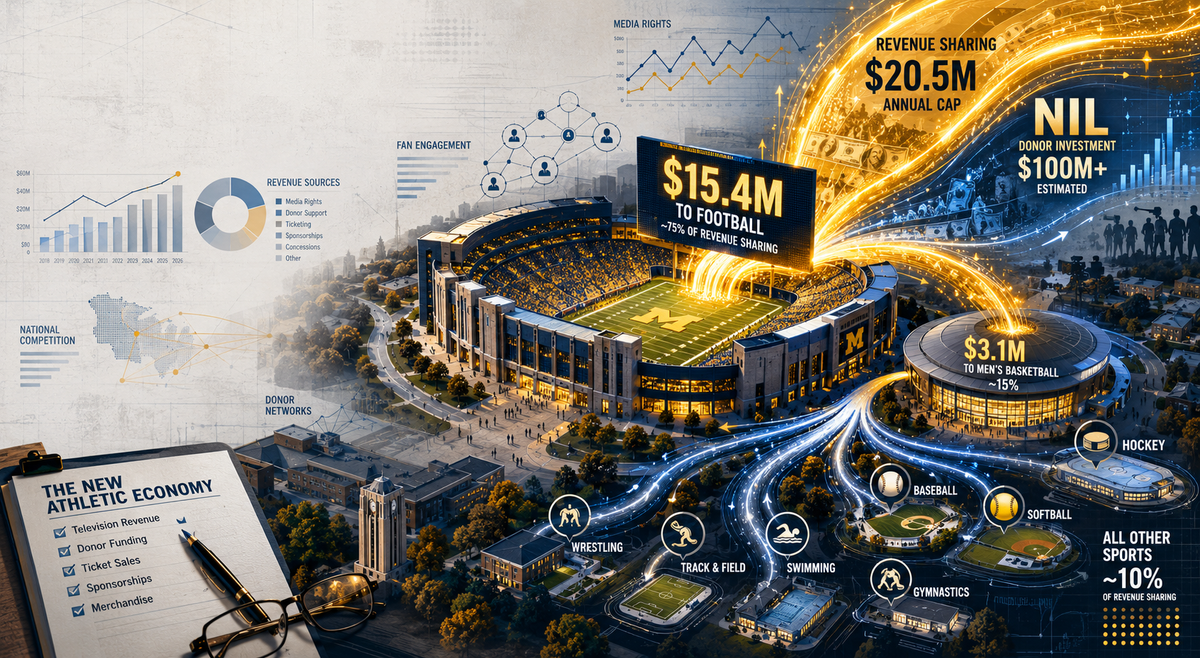
The University of Michigan's athletic department projects fiscal year 2026 revenues and expenses of approximately $266.3 million, placing it among the largest athletic enterprises in American higher education. Yet the most important number in Michigan's current budget is not the overall revenue figure. It is approximately $26.7 million in new annual costs associated with the House settlement, including $20.5 million in direct athlete revenue sharing and roughly $6.2 million in additional scholarship expenses. Michigan's own budget presentation makes clear that these new obligations represent one of the most significant structural changes in the economics of college athletics in decades.
Most coverage of the settlement focuses on the size of the payments, but the significant question is where the money goes. Michigan is going all-in on primary revenue-generating sports and simply maintaining the other offerings.
Michigan Athletic Director Warde Manuel has repeatedly indicated that approximately 75 percent of the available revenue-sharing pool will flow to football players. Using the current $20.5 million cap established under the settlement, that allocation directs approximately $15.4 million annually to football alone.
The remaining funds are concentrated primarily on men's and women's basketball. That allocation pattern immediately reveals something important about Michigan's athletic enterprise. The university sponsors nearly thirty varsity sports, but most direct athlete compensation will go to a small fraction of them. The House settlement did not create this hierarchy but did require Michigan to place explicit numbers beside priorities that had long existed implicitly.
The significance of those numbers becomes clearer when placed in context. Michigan's projected revenue-sharing commitment alone exceeds the entire annual operating budgets of many Division I athletic departments. Even within the Big Ten, only a relatively small group of institutions possess sufficient revenue generation to absorb these new obligations while remaining fully competitive. Michigan's willingness to participate at the maximum level signals that athletic leadership views direct athlete compensation not as a discretionary expense but as a core component of maintaining competitive position within the emerging college sports marketplace.
The Existing Marketplace
The revenue-sharing model did not emerge in isolation. By the time the House settlement arrived, Michigan had already spent several years adapting to the NIL economy.
Michigan's primary NIL organization, Champions Circle, was formally recognized as an official partner of Michigan Athletics in 2023 and has since evolved into one of the most significant athlete-support organizations in college sports. Champions Circle describes itself as a fan engagement platform supporting Michigan athletes across sports through memberships, events, sponsorships, merchandise, and athlete opportunities. While exact NIL expenditure remains difficult to verify due to limited market transparency, there is little disagreement about where the largest flows of money occur.
Football sits at the center of the ecosystem.
The most visible example emerged during Michigan's pursuit of quarterback Bryce Underwood. Reporting surrounding Underwood's recruitment indicated that Michigan's NIL apparatus assembled a package reportedly worth at least $10 million over four years, a figure that immediately attracted national attention and demonstrated the scale at which elite football recruiting had begun to operate
Whether individual reports ultimately prove completely accurate is less important than what they reveal about the marketplace itself. No comparable public bidding wars emerged around rowing, tennis, wrestling, or baseball recruits. The largest NIL resources consistently flowed toward the sports that generated the largest audiences and the largest revenues.
Basketball occupies a similar, although smaller, position within the hierarchy. Multiple reports on Michigan's national championship roster suggested NIL expenditures in the range of $8 million to $12 million for the 2025-26 season. Again, the precise figure matters less than the pattern. Football attracts the largest NIL commitments. Basketball attracts the next tier. Every other sport operates at a substantially different scale.
What makes the Michigan case particularly instructive is that donor-directed NIL spending and institution-directed revenue-sharing spending are producing nearly identical outcomes. Different decision-makers, operating under different rules, continue to arrive at the same allocation model.
Three Independent Systems, One Conclusion
The most persuasive evidence regarding institutional priorities rarely comes from official statements. It comes from observing where independent systems direct resources.
Television contracts overwhelmingly derive their value from football and men's basketball. Attendance patterns show the same concentration. Donor behavior produces similar results: NIL spending and revenue-sharing formulas now point in the same direction. Each system operates independently. Television executives do not coordinate with NIL collectives, NIL donors do not control athletic department budgets, and athletic directors do not negotiate media contracts. Yet all three systems repeatedly produce the same conclusion regarding relative value.
This consistency matters because it reduces the likelihood that the observed outcome is simply the result of individual preference or administrative philosophy. If one system favors football, that may reflect bias, but if three independent systems consistently favor football, the pattern begins to look structural.
Michigan therefore offers a useful case study in the changing economics of college athletics. For decades, universities described their athletic departments as broad educational enterprises that supported dozens of sports. That description remains partially true. Michigan continues to field one of the nation's broadest and most successful athletic portfolios. The university wins championships across multiple sports, produces Olympians, and invests heavily in facilities and coaching staff throughout the department. Yet the financial architecture increasingly resembles something different. Revenue generation, donor behavior, media markets, NIL spending, and direct athlete compensation all point toward the same small collection of programs.
What the Ledger Reveals
Public discussion of NIL often focuses on fairness. Public discussion of revenue sharing often focuses on legality. Both conversations are important, but neither fully captures what is occurring.
The more significant development is transparency.
For generations, college athletics operated with an understood but largely unspoken hierarchy. Everyone knew football mattered most and that men’s basketball occupied a privileged position. Universities rarely quantified those realities because they did not need to. Revenue-sharing formulas now force institutions to assign actual dollar values to those assumptions. The resulting numbers reveal what budgets have always revealed: organizations express priorities through resource allocation.
Michigan's emerging model suggests that the university's athletic and economic identities are no longer perfectly aligned. The athletic department continues to sponsor nearly thirty varsity sports, but the economic engine increasingly revolves around two. The House settlement did not create that reality. NIL did not create that reality. Both illuminated a structure that had existed beneath the surface for decades.
The novelty is not the concentration of resources but that everyone can now see the ledger.


Comments ()