
Northwestern's NIL and Revenue Sharing Athletic Ecosystem
Can Northwestern manage the new economics of college sports? Revenue sharing, NIL, Ryan Field, and governance challenges are colliding.
Following the Money
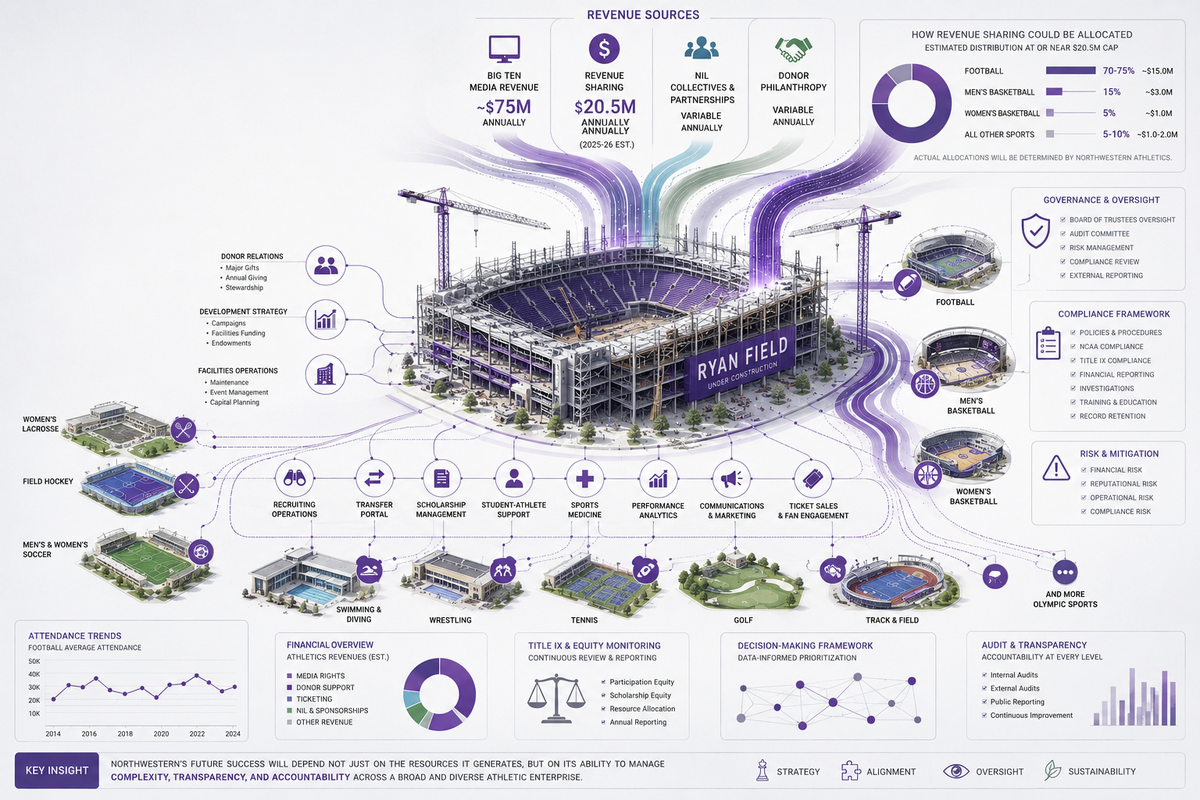
Northwestern University is entering the most consequential period in the history of its athletic department. The university is simultaneously implementing the House settlement's revenue-sharing model, participating in an increasingly competitive NIL marketplace, implementing expanded scholarship opportunities, adapting to transfer portal realities, and completing the most expensive stadium project in college football. The new Ryan Field is expected to cost between $850 million and $862 million and is scheduled to open during the 2026 season. Northwestern officials have emphasized that the project is being funded primarily through private donations and represents a long-term investment in the university's athletic future.
Viewed individually, each of these developments would represent a significant administrative undertaking. Taken together, they amount to a wholesale transformation of how the athletic department operates. The House settlement alone permits schools to distribute approximately $20.5 million annually in direct athlete compensation beginning with the 2025-26 academic year. Northwestern has publicly stated that it intends to compete aggressively in this new environment and views revenue sharing as part of its future strategy.
Most public discussions focus on whether Northwestern can afford these changes. The university's position inside the Big Ten suggests that it can. Industry estimates place annual Big Ten distributions to Northwestern at approximately $75 million, while the university itself possesses substantial institutional resources and one of the strongest alumni networks in higher education. The more interesting question is not whether Northwestern can find the money. The more interesting question is what happens after the money is allocated.
The Allocation Problem
Northwestern sponsors twenty-one varsity sports. That breadth is not incidental to the university's athletic identity. Women's lacrosse has won national championships. Field hockey, soccer, tennis, golf, swimming, wrestling, and numerous other programs have enjoyed sustained success. Northwestern's reputation within college athletics has historically been built upon broad-based excellence rather than overwhelming dominance in a single sport.
The emerging economics of college athletics increasingly reward a different model.
Across the Power Four conferences, revenue-sharing distributions are converging around a similar pattern. Football receives most direct compensation resources, men's basketball receives most of what remains, and women's basketball receives a portion of the balance. All the other sports share the remainder. Although exact allocations vary by institution, the broad structure is becoming increasingly consistent because television contracts, media rights, sponsorship agreements, attendance patterns, and donor behavior all point toward the same conclusion. Football generates the largest audience and revenue and therefore receives the largest share of available resources.
At Northwestern, that reality creates a tension that is less visible at institutions whose athletic identities have revolved around football for generations. If football ultimately receives something approaching seventy-five percent of revenue-sharing resources and men's basketball receives another significant portion, then a department built around twenty-one varsity sports must increasingly operate within an economic structure dominated by two. That observation is not a criticism of football, but a description of the incentives currently shaping major college athletics.
The same pattern appears within NIL markets. Donors consistently direct the largest commitments toward football and basketball because those sports produce the greatest visibility, the largest audiences, and the strongest recruiting leverage. Independent systems continue to arrive at similar outcomes. Television markets reward football. NIL donors reward football. Revenue-sharing formulas reward football. When multiple systems operating independently produce the same allocation pattern, the pattern begins to look structural rather than discretionary.
Northwestern’s NIL Status
Northwestern's NIL resources have expanded significantly since the NCAA first permitted athlete compensation in 2021, though the university entered the marketplace more cautiously than many of its Big Ten peers. The primary vehicle for Northwestern NIL activity became TrueNU, a donor-supported collective that connected athletes with endorsement, appearance, and promotional opportunities.
TrueNU distributed roughly $25 million over three years, or about $8.3 million annually, before revenue sharing arrived, when Northwestern altered its model to
When revenue sharing started, Northwestern shut down TrueNU because the university was moving athlete compensation into the institutional bucket. Athletic director Mark Jackson explicitly said the focus was shifting toward creating "real NIL opportunities" through commercial relationships rather than the old charitable collective model.
Northwestern is a private school, so it does not publicly report its athletic budget, and there is no publicly available data on NIL funding in general, making estimates problematic. Best estimates indicate that Northwestern athletes have access to roughly $5.5 million to $8.8 million in external NIL opportunities in 2026, with $7 million as the most reasonable midpoint.
Using a midpoint estimate of $7 million, Northwestern's NIL resources would likely break down to roughly $4.5 million for football, $1.8 million for men's basketball, $300,000 for women's basketball, and about $400,000 for all other sports combined. This would place Northwestern in the middle tier of the Big Ten NIL landscape; well behind the conference's biggest spenders but still possessing enough resources to remain competitive in recruiting and retention.
The broader pattern mirrors the national marketplace: NIL dollars flow disproportionately toward the sports that generate the largest audiences, the greatest media exposure, and the most direct influence on recruiting outcomes. Northwestern's NIL ecosystem therefore evolved from a broad-based athlete support model into an increasingly football- and basketball-centered marketplace, consistent with trends across the Big Ten and the Power Four as a whole.
Governance Under Stress
Financial challenges receive the most attention. The governance challenge may ultimately prove more significant.
Northwestern enters this transition less than three years removed from the athletic department's most serious governance crisis in decades. The 2023 hazing investigation found evidence supporting hazing allegations within the football program and ultimately led to the dismissal of longtime head coach Pat Fitzgerald. University leadership subsequently implemented reforms, expanded reporting mechanisms, and commissioned additional reviews of athletic department practices. The institution has also spent years navigating litigation and settlements associated with the scandal.
The relevance of those events extends beyond football.
Large organizations reveal their administrative strengths during periods of stability. They reveal their weaknesses during periods of stress. The hazing investigation exposed failures of visibility, oversight, reporting, and organizational awareness that Northwestern has since attempted to address. Whether those reforms have fully resolved the underlying issues is impossible to know from the outside, but timing can be observed. Northwestern is attempting to implement one of the most complex administrative transitions in modern college athletics while still emerging from a period when the department's governance systems came under national scrutiny.
Revenue sharing is often discussed as a compensation issue. In practice, it is also an organizational issue. Athletic departments must now coordinate athlete compensation, NIL activities, scholarship management, roster limits, transfer portal movement, compliance reporting, donor engagement, Title IX considerations, recruiting operations, and conference requirements simultaneously. These responsibilities do not replace existing duties but are layered on top of them. Each decision increasingly affects multiple parts of the system: compensation influences recruiting, recruiting influences roster construction, roster construction influences competitive performance, competitive performance influences donor behavior, which influences NIL opportunities.
The result is an athletic department that increasingly resembles a complex enterprise rather than a collection of sports programs.
What the Ledger Reveals
The most revealing aspect of Northwestern's current transformation may not be the new stadium or the revenue-sharing pool. It may be the way these developments expose institutional priorities that were previously obscured by older athletic models.
For decades, universities could speak broadly about supporting all sports while allowing the underlying economics to remain largely invisible. A department that sponsors twenty-one sports can still value all twenty-one, but it cannot compensate them equally.
That distinction may define the next decade of college athletics.
Northwestern possesses many advantages as it enters this environment. It benefits from Big Ten membership, substantial institutional resources, strong academic prestige, and a donor base willing to support ambitious projects. Yet the university is also confronting a challenge that extends beyond fundraising, as it attempts to manage increasing organizational complexity while college athletics becomes more transparent, more commercialized, and more dependent on sophisticated administrative systems.
The cranes surrounding Ryan Field will eventually disappear, and the stadium will open. The larger transition will continue long afterward.
Northwestern is not simply building a stadium. It is attempting to build an athletic department capable of operating within a fundamentally different economic system than the one it inherited. Whether that effort succeeds will depend less on the size of any individual investment than on the institution's ability to manage the complexity created by all of them.



Comments ()