
USC and the Big Ten: When Hollywood Football Meets Industrial Scale Athletics
USC entered the Big Ten seeking national relevance and revenue. Instead, it faces a brutal sports economy driven by money, scale, and competition.
USC Finally Left the Pac-12 Fantasy World
For years, USC operated within a conference that increasingly resembled a support group for institutions slowly realizing that television executives no longer cared much about West Coast football. The Trojans still possessed prestige, recruiting advantages, NFL history, celebrity adjacency, and enough historical weight to remain nationally relevant even while the Pac-12 quietly dissolved around them.
That environment allowed USC to survive levels of organizational inconsistency that would have triggered panic elsewhere. Elite recruiting territory covered many sins, as did the logo, and its Los Angeles locale. So did decades of accumulated mythology about USC being one coaching hire away from becoming a dynasty again.
Then USC joined the Big Ten Conference and walked directly into a completely different economic ecosystem. The Big Ten is not really a football conference anymore. It increasingly resembles an industrial revenue consortium attached to giant universities that treat athletics like a permanent capital project tied directly to institutional prestige, enrollment visibility, donor cultivation, and statewide political identity.
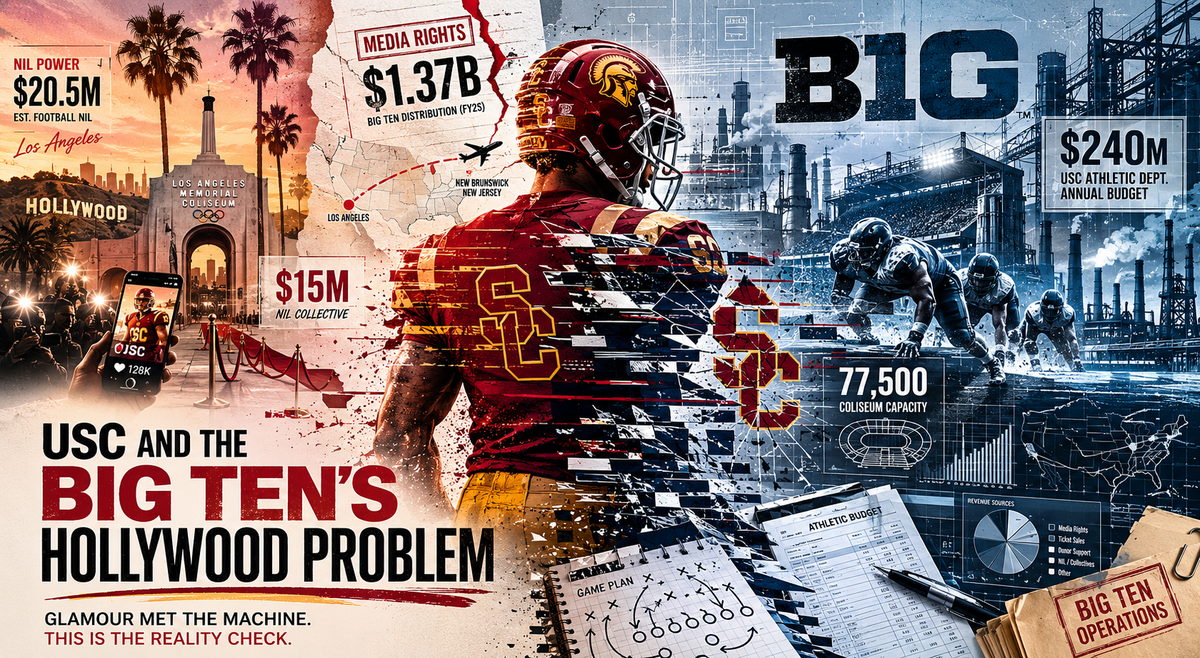
The conference distributed roughly $1.37 billion to member institutions during fiscal year 2025, averaging more than $76 million per school. Those are no longer athletic department numbers. Those are mid-sized corporate revenue figures attached to institutions with alumni bases larger than those of many American cities. Unlike the old Pac-12, the Big Ten does not particularly care about aesthetics. The conference cares about throughput, durability, staffing depth, and the ability to survive a decade-long spending war without blinking.
Jen Cohen Inherited a Beautiful Mess
USC athletic director Jen Cohen arrived from Washington in 2023, inheriting one of the strangest jobs in college sports. On paper, USC should be one of the easiest athletic departments in America to run. The school possesses an elite national brand, prime recruiting geography, massive donor potential, Los Angeles visibility, strong academics, and historic football relevance.
In practice, USC increasingly resembles a luxury sports brand trying to retrofit itself into an industrial Midwestern economy while simultaneously pretending the transition is completely natural. Cohen now oversees an athletic department operating in the $240 million annual range, once escalating costs for staffing, facilities, travel, and athlete compensation are layered together. USC reported roughly $212 million in athletic department revenue and expenses during the 2022-23 academic year, and the numbers are only climbing as NIL and revenue-sharing obligations continue to accelerate.
That budget sounds enormous until you realize USC has just entered a conference filled with institutions structurally designed for exactly this level of spending. Schools like the University of Michigan, Ohio State, and Penn State spent decades building gigantic operational ecosystems around football money, donor layering, media leverage, and statewide institutional loyalty. These departments increasingly function like vertically integrated sports corporations attached to universities that happen to teach chemistry and engineering classes on weekdays.
USC often behaved more like a prestige luxury label than a fully industrialized football machine. That distinction matters now because the Big Ten season increasingly resembles an organizational stress test disguised as a football schedule.
Lincoln Riley Was Supposed to Be the Shortcut
The logic behind hiring Lincoln Riley looked straightforward enough. USC would combine elite quarterback play, elite offensive branding, Southern California recruiting, and NIL visibility to bypass the slow rebuild process most programs endure. For a while, the strategy worked well enough to restart the hype machine. Caleb Williams became a star, USC games returned to national relevance, and the celebrity ecosystem surrounding the program came back online almost immediately because Los Angeles always wants a football product that feels glamorous and important.
Then the roster problems became impossible to hide. The defensive issues looked structural, the offensive line depth looked thin, and the physicality gap against stronger teams kept appearing. Then USC entered the Big Ten and discovered that the conference contains a disturbing number of giant human beings specifically engineered to make finesse football miserable by mid-November.
Even mediocre Big Ten teams now operate with huge offensive lines, veteran defensive fronts, advanced sports science departments, and donor-coordinated roster retention systems. USC spent years building a roster optimized for speed and star power inside a weakened Pac-12 environment. The Big Ten rewards mass, redundancy, and institutional patience. It rewards programs comfortable winning ugly games in freezing weather against teams whose fan bases consider punting strategy a legitimate personality trait rather than an unfortunate necessity.
That adjustment is not schematic. It is cultural. USC does not merely need better defensive tackles. The institution itself needs to decide whether it wants to operate like a glamour brand or like a hardened industrial football operation capable of surviving repeated collisions with the largest and richest conference ecosystem in the country.
USC’s NIL Machine Is Big. The Big Ten’s Is Bigger.
National media discussions about USC and NIL usually sound like people describing a nightclub they have never actually visited. The assumption goes something like this: USC sits in Los Angeles; therefore, the Trojans should dominate athlete compensation forever because celebrities and influencers exist nearby.
Reality looks far more complicated than that. USC absolutely has access to wealth and branding opportunities. Jen Cohen recently noted that USC athletes completed more than 250 third-party NIL deals involving more than 80 businesses across 23 athletic programs. The Trojans almost certainly operate near the top tier nationally in football NIL spending, with industry estimates suggesting top-end programs now spend somewhere between $12 million and $25 million annually once collectives and revenue-sharing structures are blended.
But NIL stopped being primarily about flashy endorsement deals a while ago. The real advantage now comes from coordination. The Big Ten increasingly contains donor ecosystems that behave less like booster clubs and more like organized capital pools. Schools have layered together collectives, donor databases, corporate partnerships, alumni fundraising systems, athlete retention departments, and direct revenue-sharing plans that increasingly resemble professional payroll structures.
USC historically sold aspirations. The Trojans sold access to glamour, celebrity, lifestyle, and NFL visibility. The Big Ten increasingly sells durability. That distinction matters because modern roster management now resembles maintaining a medium-sized investment portfolio, where 19-year-olds occasionally threaten to enter the transfer portal after another school offers them an extra $250,000 and a luxury apartment near campus.
The Los Angeles Problem Nobody Wants to Admit
One of the strangest myths in college sports says Los Angeles automatically guarantees athletic dominance. In reality, Los Angeles may be one of the hardest serious football markets in America because the city contains endless substitutes for emotional attention. USC football competes against the Lakers, Dodgers, beaches, nightlife, concerts, restaurants, influencer culture, and approximately nine million other ways wealthy people can spend a Saturday afternoon pretending they are too sophisticated for college football.
The Los Angeles Memorial Coliseum still seats roughly 77,500 after renovations reduced its capacity from its previous peak of over 90,000. USC can still generate major crowds for elite games, especially when the program feels nationally relevant, but emotional saturation and attendance numbers are not the same thing.
In places like the University of Iowa Athletics or the University of Nebraska Athletics, football functions as civic religion. Entire states emotionally organize around those programs. Fan engagement endures mediocre seasons because there are few alternatives and because those institutions carry enormous symbolic weight within their regions.
In Los Angeles, consumers simply move on to the next thing. That creates enormous pressure on USC because the Trojans do not merely need to win games. They need to remain culturally relevant enough to command oxygen in one of the most distracted entertainment markets on Earth. Seven wins and five losses at USC do not feel like rebuilding; they feel like irrelevance, which may be even worse in a city built entirely on attention economics.
Basketball Reveals the Same Structural Tension
USC men’s basketball periodically produces NBA talent and moments of national relevance, but the program still struggles to establish lasting gravity inside Los Angeles. The Galen Center seats roughly 10,200 fans and remains one of the cleaner modern arenas in college basketball, yet the atmosphere often fluctuates because USC basketball exists inside one of the most oversaturated sports markets in America.
Ironically, women’s basketball may currently possess more genuine momentum than parts of the men’s athletic operation outside football itself. The arrival of JuJu Watkins transformed USC women’s basketball into a national television property almost overnight. Attendance surged, national attention followed, and suddenly USC possessed a basketball product capable of generating actual emotional energy rather than vague professional class networking enthusiasm from people sitting courtside while checking email.
But again, the Big Ten changes the equation. USC women’s basketball now enters a conference containing Iowa’s massive women’s basketball culture, UCLA’s basketball identity, and giant Midwestern fan bases that treat winter sports as part of their regional DNA. The issue is not whether USC has talent. The issue is whether USC possesses enough institutional density to sustain success across multiple sports simultaneously while competing against schools whose fan engagement resembles a hereditary condition passed down through generations.
Olympic Sports Are About to Become an Administrative Migraine
Football receives the headlines because football pays the bills. Olympic sports may eventually generate real operational stress inside USC’s athletic department. The Trojans now must move entire athletic programs repeatedly across a conference footprint stretching from Southern California to New Jersey. Volleyball, soccer, softball, baseball, tennis, swimming, lacrosse, and track now operate inside a logistical structure that increasingly resembles a cross-continental airline route map designed by somebody who actively dislikes assistant athletic directors.
That means escalating costs involving airfare, hotels, staffing, scheduling, recovery management, and missed class time. Historically, Big Ten schools built their Olympic sports ecosystems around geographic clustering and regional travel efficiency. USC inherited a transcontinental conference structure layered atop one of the most expensive athletic departments in America.
Unlike football, Olympic sports rarely generate meaningful revenue to offset operational inflation. That matters because USC already operates one of the most expensive athletic departments nationally while entering an era in which NIL spending rises, revenue sharing expands, staffing grows, and facilities obligations continue to climb. At some point, someone in the athletic department will stare at a spreadsheet of Rutgers softball travel costs and quietly question every decision that led them into college athletics administration.
USC Still Looks Like a Blue Blood. The Question Is Structural.
The strange irony is that USC absolutely possesses the resources to remain nationally elite. Some recent valuation estimates place USC football itself near $1.4 billion in enterprise value. The brand remains enormously powerful, the recruiting geography still matters, and Los Angeles visibility still matters. The academic reputation still matters.
But modern college sports increasingly punish institutions that rely too heavily on aesthetics without building deep operational systems. The Big Ten is uniquely capable of exposing those weaknesses because the conference itself serves as a stress test of organizational depth. It rewards redundancy over glamour, infrastructure over symbolism, and operational patience over hype cycles.
USC can absolutely adapt to this environment, but adaptation may require something psychologically difficult for the institution itself. The Trojans may need to become less Hollywood and more Midwestern and build infrastructure and redundancy.
That transition sounds boring, which is precisely why it may be necessary. For years, college football treated USC as a permanent aristocrat because the logo itself guaranteed relevance regardless of actual performance. But conferences now matter more than brands. The SEC and Big Ten increasingly function as economic superstructures that absorb universities into larger systems of capital, staffing, media leverage, and operational scale.
USC thought it was bringing Hollywood glamour into the Midwest. Instead, the Trojans may have entered a conference specifically designed to expose every layer of institutional weakness underneath glamour branding.
Comments ()