
Washington's NIL in 2026: Revenue Sharing, Football Spending, and Seattle's Corporate Advantage
Washington is betting on Seattle's corporate power, not boosters, to build one of the Big Ten's smartest NIL models.
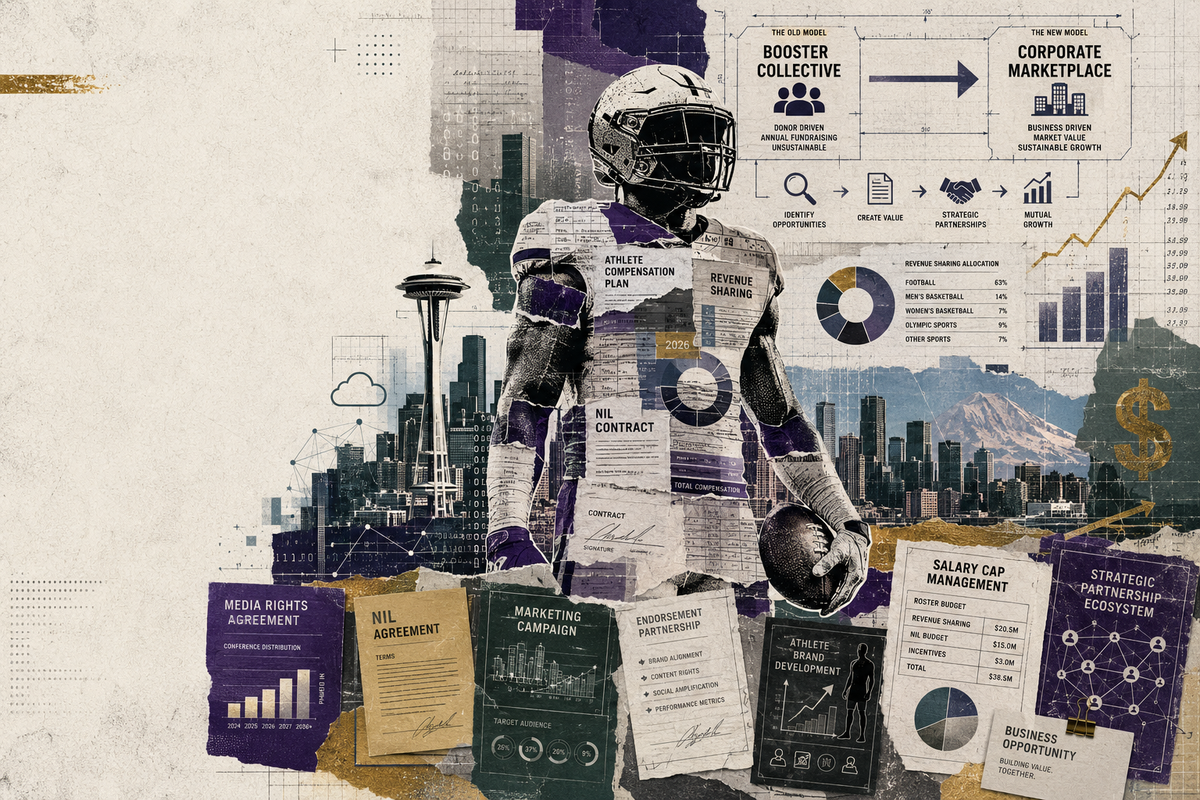
Ask most people about college NIL, and they'll start talking about boosters. Which collective has the richest donors? Who's the billionaire bankrolling the next recruiting class? How much will fans pony up this year? Washington is trying to write a different playbook.
That doesn't mean the Huskies plan to spend small. Like nearly every Power Four school, Washington intends to hand out the full revenue-sharing amount allowed under the House settlement, roughly $20.5 million starting in 2026. According to Athletic Director Pat Chun's announcement, the school also expects to generate millions more through legitimate third-party NIL opportunities.
What makes Washington's approach different is the thinking behind it. Instead of leaning on donor collectives as the long-term backbone of athlete pay, the school wants to shift toward a real business model, one where revenue sharing sets the floor, and corporate endorsements build the ceiling on top of it. That philosophy is embodied in Dawgs Unleashed and Washington's expanded partnership with Learfield. It might be the boldest financial experiment happening anywhere in the Big Ten right now.
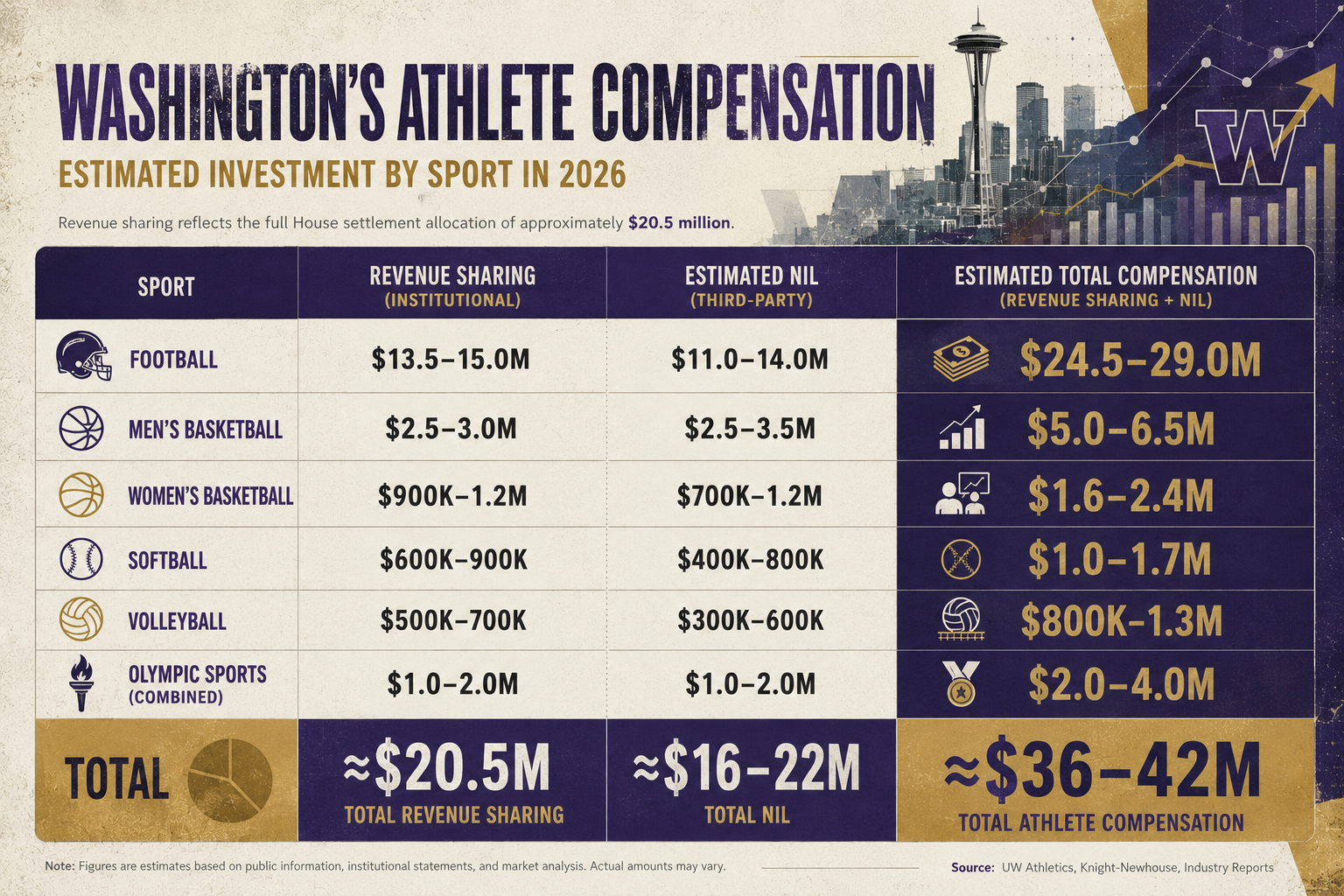
Estimated Washington Athlete Compensation in 2026
These figures are derived from public institutional commitments, comparisons across the Big Ten, roster spending patterns, recruiting trends, Knight-Newhouse College Athletics Database financial information, and Washington's stated move away from a donor-only collective toward a department-backed NIL structure.
Spending Big During a Tight Financial Stretch
Here's the part that catches people off guard: it's not how much Washington plans to spend, it's when they're choosing to spend it.
Washington didn't join the Big Ten with the same media-rights deal as the conference's longtime members. Instead, the school is working under a phased agreement that only pays out a partial share of Big Ten television revenue during its first several years in the league, a fact discussed by Pat Chun.
Meanwhile, the university's own financial documents point to real operating deficits inside the athletic department. Public budget discussions have included advances against future conference revenue, internal financial restructuring, and cost-management measures as the department prepares for revenue sharing. Most programs staring down numbers like that would pull back, but Washington is doing the opposite, pushing to stay as competitive as possible anyway. (See the University of Washington athletics budget approval and Knight-Newhouse financial database.)
By committing publicly to the full House revenue-sharing allocation, Athletic Director Pat Chun made it clear that Washington sees athlete compensation as something the program can't afford to skimp on, not a line item to trim when money gets tight. The school seems willing to take on short-term financial strain to protect its standing in one of the richest conferences in the country.
Seattle Might Be Washington's Best NIL Weapon
Most NIL conversations circle back to wealthy alums writing checks, but Washington has something arguably more valuable sitting in its backyard.
Seattle holds one of the largest clusters of Fortune 500 headquarters and technology companies in the country. According to the Fortune 500, companies including Amazon, Costco, Starbucks, and others are headquartered in the region, while Microsoft, T-Mobile, Alaska Airlines, Expedia, Zillow, Nintendo of America, and Nordstrom all maintain major operations nearby.
That kind of corporate density opens doors most college towns don't have.
Rather than depending mainly on donors funneling money into a collective every year, Washington can chase real endorsement deals: marketing campaigns, speaking engagements, digital partnerships, product launches, and brand collaborations. Washington's Dawgs Unleashed initiative and its partnership with Learfield are specifically designed to facilitate those relationships.
The more Seattle's companies buy in, the less Washington has to lean on annual fundraising drives to keep the lights on.
Moving From Booster Collective to Corporate Marketplace
This transition is already happening.
Washington's original collective, Montlake Futures, is gradually giving way to Dawgs Unleashed, a university-backed NIL program built in partnership with Learfield.
Instead of acting purely as a pipeline for donor money, the program focuses on connecting athletes with real business opportunities through corporate partnerships, endorsement agreements, and professional development. Examples include the Student-Athlete Ticket Ambassador Program and numerous Dawgs Unleashed campaigns.
The mindset shift is small on paper but huge in practice. The old question was how much boosters can give; the new question is how much value athletes can actually create in the marketplace.
Building a Front Office That Looks Like the NFL's
Washington's staffing choices back up that strategy.
The athletic department has brought in specialized staff to oversee athlete contracts, compensation planning, NIL administration, and compliance, reflecting the more professional structure described by Pat Chun and the Learfield partnership announcement.
Winning in college sports is increasingly determined by contract management, financial planning, roster valuation, and business development as much as recruiting and coaching.
Football Still Drives the Numbers
For all the structural changes, football remains the financial engine.
Based on Washington's public revenue-sharing priorities announced by Pat Chun and spending patterns across comparable Big Ten institutions, football likely generates between $11 million and $14 million annually in third-party NIL opportunities while also receiving the largest share of institutional revenue-sharing funds.
Football continues to produce the overwhelming majority of television revenue, ticket sales, donor engagement, and conference distributions, making it the logical recipient of the largest share of athlete compensation.
Could Washington's Experiment Change College Sports for Good?
Most schools are asking a simple question: How much do we need to spend to stay competitive?
Washington is asking something much bigger: Can an athletic department build an athlete economy that depends less on boosters and more on genuine commercial demand?
If Washington proves that corporate partnerships can replace much of the traditional collective model, schools located in major metropolitan markets may follow. If it fails, donor collectives will likely remain the dominant financing model throughout college athletics.
Either way, Washington has become one of the most important test cases of the post-House era. The Huskies aren't simply spending tens of millions of dollars on athletes. They're attempting to prove that college athletics can evolve from a booster-funded economy into a professionally managed commercial enterprise, a strategy outlined by Pat Chun and reinforced through Dawgs Unleashed and the university's long-term partnership with Learfield.

Comments ()