
Ohio State Strauss Settlements Top $167 Million
Ohio State’s Strauss scandal has cost over $167 million. Settlements, legal fees, investigations, and survivor care drive the actual cost higher.
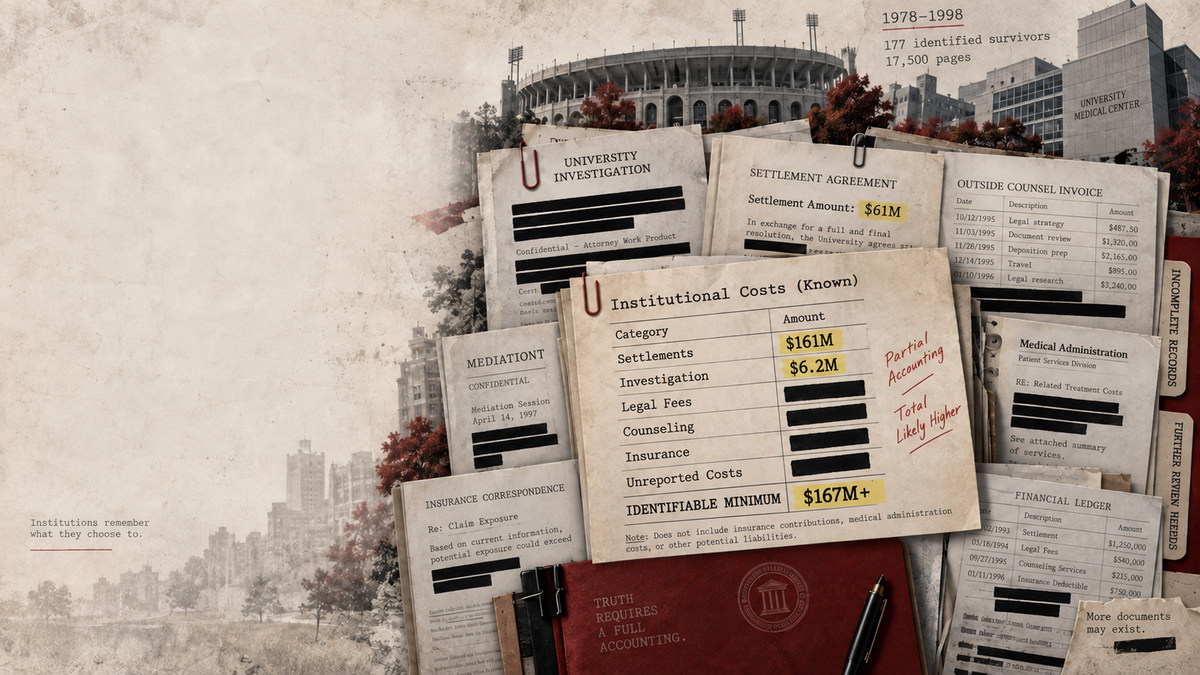
Ohio State has now put more than $161 million toward settling claims tied to Richard Strauss, the former university doctor who sexually abused students for two decades. Add in what the school has said it spent on the investigation that exposed the whole mess, and the number climbs past $167 million. That's not a guess or a rough estimate pulled together by outside reporters. It's the floor, built entirely from figures Ohio State and other credible sources have already put on the record: more than $61 million paid out to 317 survivors, roughly $100 million approved in June 2026 for 279 more claimants, and about $6.2 million spent on the independent investigation that produced its report back in 2019.
But $167 million isn't the whole story. It's just the part Ohio State has chosen to show.
Left out of that number are the school's outside legal bills, years of federal court fights, mediation costs, the expense of digging through mountains of old records, insurance disputes, survivor counseling and medical care, the time university staff spent managing the crisis, communications consultants, compliance reforms, and the cost of defending the university's legal position on statutes of limitations all the way up through the federal court system. It may not even include settlements or judgments still to come.
Ohio State has told the public about the biggest checks it's written. It hasn't told the public what the whole thing cost.
That gap matters more than it might seem. The financial history of a scandal like this isn't some side detail separate from the scandal itself. It shows how long an institution dragged its feet, how it decided to spread around responsibility, and how much extra money got spent after the abuse itself had already ended, not to stop it, but to investigate it, fight it in court, manage the fallout, and eventually make it go away.
Twenty Years of Abuse, Twenty Years of Looking the Other Way
Strauss worked at Ohio State from 1978 to 1998. He treated students and athletes and served as a team physician, which gave him access most doctors never get. The university says it received its first report of misconduct from a former student-athlete in March 2018, and it announced an independent investigation less than a week later.
That investigation, run by the law firm Perkins Coie, produced a 182-page report concluding that Strauss had sexually abused at least 177 male students. The abuse involved genital exams and other acts carried out under the guise of medical treatment.
The most damning part of the report wasn't about Strauss at all. It was about everyone around him. University staff knew students were complaining about Strauss as far back as 1979. Coaches, trainers, and medical personnel either heard complaints directly or saw behavior that should have set off alarm bells. None of it stopped him. He kept treating students for almost twenty more years.
Ohio State doesn't dispute any of this anymore. Its own Strauss investigation website states plainly that university personnel failed to prevent the abuse and failed to properly investigate the complaints raised by students and staff at the time.
The school also points to the scale of its later response. It reached 115,000 alumni and former athletes, notified 147,000 people, and released more than 17,500 pages of supporting records alongside the Perkins Coie report. That's an unusual level of documentation for a university scandal, but it isn't the same thing as complete financial accounting.
The Visible Bill: More Than $167 Million
The easiest part of this to pin down is the money that went directly to survivors.
Ohio State says it's paid more than $61 million to 317 people through a series of earlier settlements, reached in batches over several years as the school tried to resolve some claims while still fighting others in court. In February 2026, it announced eight more settlements. In April, 13 additional survivors settled for a combined total of roughly $1.8 million. That process was still grinding along when Ohio State's board of trustees approved a much bigger agreement in June.
That June deal committed about $100 million to settle claims from 279 of the 280 remaining plaintiffs, according to both Reuters and the Associated Press. It followed years of litigation and mediation, and it pushed the university's total publicly acknowledged settlement commitments above $161 million.
Look at the settlement math and something interesting shows up. The earlier $61 million, split among 317 people, works out to roughly $192,000 per person on average. The newer $100 million agreement, covering 279 claimants, averages closer to $358,000 per person. Those averages shouldn't be read as what any individual received, since real settlement amounts vary case by case and the two rounds were negotiated years apart under different circumstances. Still, the jump tells you something. Ohio State's financial exposure grew the longer this dragged on, not shrank.
The other solidly documented number is the investigation itself. By the time Perkins Coie released its report in May 2019, the firm had reportedly billed around $6.2 million. That paid for hundreds of interviews, mountains of document collection, historical reconstruction work, and legal analysis stretching back decades.
Put it all together and you get a conservative floor. More than $61 million in earlier survivor settlements. About $100 million from the June 2026 settlement. Roughly $6.2 million for the investigation through May 2019. That adds up to more than $167.2 million in publicly identifiable cost.
That number matters for what it includes. It matters just as much for what it leaves out.
The Missing Legal Bill
Ohio State has been fighting Strauss-related lawsuits for years, and the legal questions at the center of those fights weren't simple. When did survivors know, or when should they reasonably have known, that the university had failed them? Were the federal civil rights claims filed within the applicable time limits? Did the university's alleged concealment of what it knew stop those clocks from running out in the first place?
Those questions worked their way through federal district court, then the Sixth Circuit Court of Appeals, and eventually the United States Supreme Court. Every stage of that process required attorneys, filings, research, discovery, expert witnesses, and administrative support, none of which comes cheap.
The legal costs don't stop at courtroom appearances, either. Litigation on this scale usually means combing through decades of old records, responding to discovery requests, prepping witnesses, hiring experts, coordinating with insurers, sitting through mediation, and negotiating separately with dozens of plaintiffs' attorneys. It's slow, expensive work that happens almost entirely out of public view.
Ohio State has never given the public one clear number for what it's paid outside law firms across the entire Strauss matter. That silence makes the $167 million floor fundamentally incomplete. Even a modest annual legal bill, sustained across eight years of investigation and litigation, would add millions more. A case this complex, with hundreds of plaintiffs and appellate litigation stretching to the Supreme Court, could easily add far more.
There's also a deeper point buried in that missing number. Money paid to survivors is the university acknowledging harm. Money spent fighting their claims in court serves a different purpose: limiting what the university owes. Both might get lumped together under the broad label of "Strauss-related costs" in a press release, but they shouldn't be treated as morally equivalent, because they aren't.
Counseling, Medical Care, and an Open-Ended Promise
Since February 2019, Ohio State says it has paid for certified counseling and other medical treatment for Strauss survivors and their families and reimbursed some people for treatment they'd already paid for on their own related to the abuse. The program runs through Praesidium, an outside firm that specializes in abuse prevention and survivor services. Ohio State has promised to keep covering those services for as long as survivors need them.
That's a real financial commitment, and it's open-ended. Yet the university's public Strauss summary doesn't say how much it's paid Praesidium, how much has gone toward reimbursements, or what future liability the school has set aside for ongoing care.
Confidentiality is important here, and no one should expect Ohio State to name individual recipients or disclose private medical details. But aggregate numbers wouldn't require that. A single total figure, reported the way a university reports any other major expense, wouldn't identify a single survivor.
Without that number, Ohio State ends up in an odd position. It points to the counseling program as proof of its commitment to survivors, while keeping the actual scale of that commitment hidden from the same public it's trying to reassure.
Insurance Might Have Shifted the Cost, But It Didn't Erase It
There's another missing piece here: insurance. Universities typically carry layers of liability coverage, though those policies often exclude intentional misconduct, previously known claims, specific types of abuse, or anything that happened outside a defined coverage window. Strauss's conduct spanned twenty years, which means it could touch dozens of different policies, insurers, and coverage terms, each with its own fight attached.
The real financial questions aren't whether Ohio State had insurance. They're more specific than that. How much have insurers reimbursed so far, and how much is still being disputed? What deductibles or self-insured amounts did the university absorb on its own, and which settlements came straight out of university funds instead? Did Ohio State end up suing its own insurers over coverage, as sometimes happens in cases like this? Did any of this affect future premiums, and did the school set aside a specific reserve fund for the litigation?
Without answering those questions, nobody outside the university can figure out the scandal's true net cost to Ohio State. A $100 million settlement paid partly by insurers hits the school's budget very differently than one paid entirely out of reserves. But insurance doesn't make institutional failure free. Premiums go up, deductibles get paid, and some claims never get covered at all. Those costs don't disappear; they just move further down the road.
There's a bigger question tangled up in all of this, too: whose money is paying for it. Ohio State's revenue comes from a mix of tuition, medical operations, research funding, investments, athletics, other university businesses, donations, and state support. Unless the school says exactly which accounts covered which Strauss-related expenses, there's no way to know which parts of the institution absorbed the cost.
What Two Decades of Delay Actually Cost
Strauss retired from Ohio State in 1998 and died in 2005. The university didn't start the investigation that exposed the full scope of what he did until 2018, two decades after he left campus and thirteen years after he died.
That gap sits at the center of the financial story here, and it's easy to miss if you only look at the settlement totals.
If Ohio State had responded seriously to complaints back in 1979, it might have stopped years of additional abuse before it happened. If it had thoroughly investigated the warning signs that kept surfacing over the following decades, it might have nailed down the facts while witnesses were still around, and records were easier to find. Instead, the university eventually spent millions of dollars trying to reconstruct events from decades earlier, often relying on aging memories and incomplete paperwork.
That $6.2 million investigation wasn't just the price of finding out what Strauss had done. Part of it was lost because nobody acted sooner.
The delay also made the legal fights harder. Ohio State leaned on statutes of limitations as a defense; survivors argued that the university's own concealment, and the fact that they couldn't have known the full truth earlier, should let their claims move forward anyway. Courts had to work through what victims knew at various points, what the university had disclosed and when, and whether the school's own conduct had effectively blocked earlier lawsuits from being filed at all.
Every one of those disputes generated its own expense. Every unresolved factual question meant more investigation. Every extra year of resistance from the university meant more mediation, more legal representation, more administrative overhead. Institutions tend to frame settlement costs as simply the price of finally closing out a crisis. In this case, a meaningful chunk of that price exists only because the university spent years fighting the crisis instead of confronting it.
What Ohio State Should Actually Publish
To be fair, Ohio State has released far more documentation about what Strauss did than most universities bother to share after a scandal like this. The Perkins Coie report and the records released alongside it laid out the essential facts and acknowledged serious institutional failures in plain language.
Its financial transparency hasn't matched that standard, and there's no real reason it couldn't.
The university could fix this without touching survivor identities, privileged legal strategy, or confidential settlement terms. A simple annual accounting would do it: settlement payments, independent investigation expenses, outside legal fees, mediation and expert costs, the cost of sorting through electronic records, counseling and medical treatment payments, money paid to compliance and abuse-prevention consultants, communications and crisis-management spending, insurance reimbursements received, amounts drawn from university reserves, and whatever reserves remain set aside for claims that haven't been resolved yet.
None of that would undo the harm Strauss caused or excuse the university's failure to stop him sooner. It would just let the public evaluate the institutional fallout with the same clarity Ohio State applies to just about every other major financial commitment it makes.
More Than a Settlement Total
Most people who've followed this story know two numbers: at least 177 men identified by investigators as having been abused, and more than $161 million committed to survivor settlements. Neither number tells the whole story.
The 177 figure was always a floor set by investigators, not necessarily the complete count of everyone harmed. The $161 million figure works the same way. It's a minimum, and just one category within a much bigger institutional response that stretches well beyond it.
Once you add in the investigation, Ohio State's identifiable cost tops $167 million. Once you factor in legal fees, medical care, consultants, administrative overhead, insurance disputes, and ongoing obligations that haven't even been quantified yet, the real number is higher. Nobody outside Ohio State's finance office currently knows exactly how much higher, because the public record doesn't say.
Bottom Line
That uncertainty isn't a reason to start guessing at bigger numbers. It's the actual finding here. Ohio State has been transparent about the biggest checks it's written to settle claims from Strauss survivors. It has never given the public a full account of what its two decades of failure cost, from top to bottom. Until it does, $167 million shouldn't be treated as the final price of the Strauss scandal. It's just the portion of that price the public has been allowed to see.

Comments ()