
The Cost of the Iowa Way: Inside Iowa Athletics’ Scandals and $11 Million in Legal Settlements
Iowa Athletics faced rhabdo, discrimination, racism claims, and $11M+ in settlements. We trace what happened and who paid.
For almost 25 years, Iowa football has sold stability as its brand. Kirk Ferentz showed up in 1999 and outlasted coaching trends, athletic directors, conference shakeups, and pretty much everyone else in the business. Gary Barta ran the athletic department for 17 years, and Chris Doyle, Ferentz's longtime strength coach, spent two decades turning overlooked recruits into NFL linemen. People started calling it the "Iowa Way," a phrase meant to signal discipline and development instead of chasing recruiting stars.
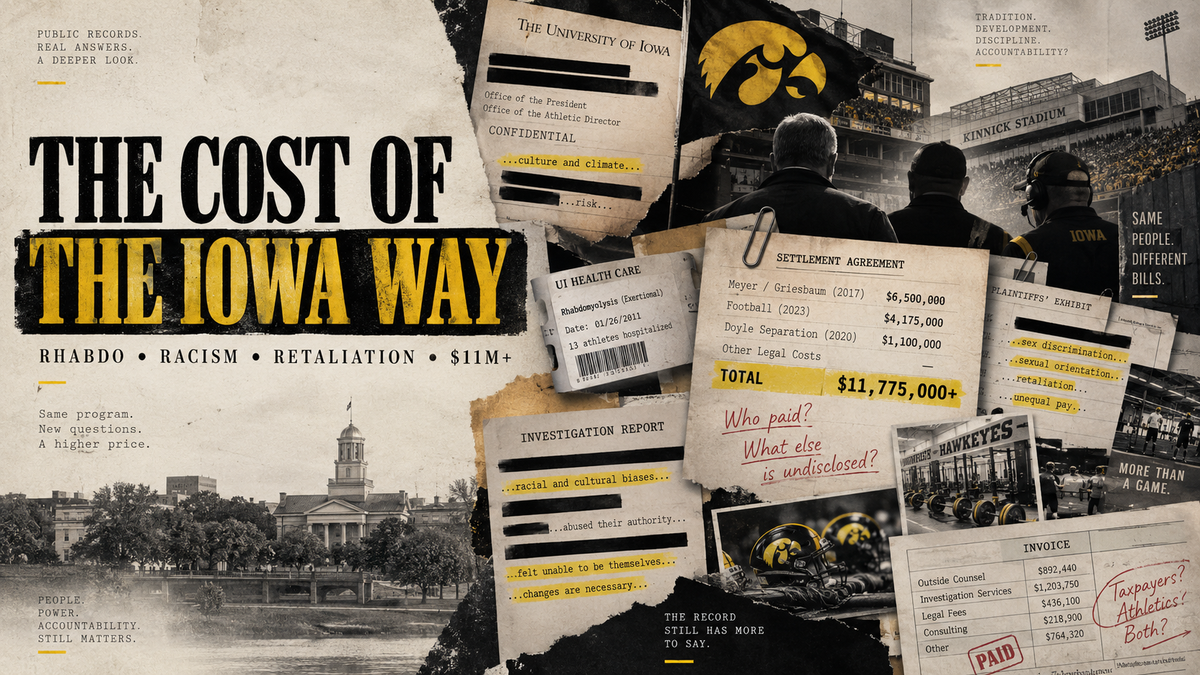
Another version of that history exists, though, in court records, settlement agreements, and Iowa's own investigations. In 2011, 13 Iowa football players landed in the hospital with rhabdomyolysis after an offseason workout. In 2017, Iowa paid $6.5 million to settle a lawsuit from former field hockey coach Tracey Griesbaum and her partner, former senior administrator Jane Meyer, after a jury found the university had discriminated against Meyer for her sex and sexual orientation. In 2020, Black former players spoke publicly about racial disparities inside the Ferentz program, which pushed Iowa to hire outside investigators who confirmed real problems existed. Doyle left with a separation deal worth around $1.1 million, and former players later sued, leading Iowa to settle that case in 2023 for $4.175 million.
We usually hear about these as separate scandals, but maybe that's the wrong way to look at them. Together, they raise a bigger question about the Barta-Ferentz era: when serious complaints came in, did Iowa fix what was broken, or did it just contain each crisis while keeping the same people in charge?
That question connects a hospital ward in 2011 to a jury verdict in 2017, a racial reckoning inside the locker room in 2020, and a fight in 2023 over whether Iowa taxpayers should help cover another multimillion-dollar settlement. It also raises two things we still don't know: whether Chris Doyle became the fall guy for a scandal that reached further, including to Brian Ferentz, and whether all this legal trouble had anything to do with Gary Barta's decision to retire less than three months after the state auditor publicly called for him to go. Neither claim should be treated as fact, but both deserve real digging.
Thirteen Players in the Hospital
The first big warning sign came in January 2011. Players had just returned from winter break when an offseason workout sent 13 Hawkeyes to the hospital with rhabdomyolysis, a condition where muscle tissue breaks down and can damage your kidneys. One Iowa team doctor said he'd been at the university for 32 years and had never seen anything like it, and the scale of what happened demanded answers.
The review that followed pointed to overexertion as the cause. The workout came right after break and loaded on an unusual amount of lower-body training. Players reportedly lifted weights, pushed sleds, and then did 100 back squats at half their max. Their blood tests showed just how extreme it got: the lowest creatine-kinase reading among the affected players was around 97,000 U/L, four players topped 200,000, and the highest hit roughly 330,000.
Iowa's panel didn't find that anyone acted negligently or recklessly, and that distinction matters. There's no evidence Doyle set out to hurt 13 players on purpose, and Iowa concluded the workout wasn't punishment. Still, looking back, the episode shows how much power the strength program held inside the building, and how willing Iowa was to keep that structure intact after something went seriously wrong.
Doyle didn't just survive the fallout. His influence grew, and ESPN later reported that Ferentz named him assistant coach of the year that April. Over time, Doyle became one of the highest-paid strength coaches in the country and one of the most powerful voices in the building, with responsibilities that went way beyond the weight room. The strength program became one of the main ways Iowa football communicated and enforced its behavioral expectations.
That's why 2011 matters, and what came later. Rhabdo wasn't a racism scandal, but it showed how much authority the strength staff had, and how far Iowa would go to protect that structure after a crisis.
Two Women Who Wouldn't Go Quietly
Before the racism allegations hit Iowa football, Barta's department was already tangled up in another discrimination case, and this one ended in something the football lawsuit never got: a jury verdict.
Tracey Griesbaum coached Iowa field hockey for 14 seasons before Barta fired her in August 2014 after complaints about how she treated athletes. Iowa said the decision came down to legitimate concerns about coaching methods and player welfare, while Griesbaum argued the university held demanding female coaches to a different standard than it held demanding male coaches.
Her partner, Jane Meyer, wasn't an outsider in this story. Meyer was a senior associate athletic director, one of the most powerful women in the department, and their being a lesbian couple wasn't a side detail. Sexual orientation became one of the grounds a jury later cited when it found Iowa had illegally discriminated against Meyer.
Meyer challenged Griesbaum's firing and raised concerns about broader discrimination against women in the department. The timeline that followed became a huge part of her case: she filed a written complaint with Barta on December 4, 2014, and the very next day, Iowa pulled her out of the athletic department and reassigned her elsewhere in the university.
Iowa had an explanation for that. A senior administrator dating a coach who was threatening to sue created an obvious management headache, and the university argued Meyer's relationships with Barta and other coaches had broken down enough to make her position untenable. Iowa was entitled to make that case, but a jury heard it and didn't buy it.
Meyer's case went to trial in 2017. Unlike the football lawsuit years later, this one didn't settle before a jury weighed in. After hearing the evidence, jurors ruled for Meyer on sex discrimination, sexual-orientation discrimination, retaliation, whistleblower retaliation, and unequal pay.
That verdict matters for everything that followed. It means we can't reduce the Meyer-Griesbaum story to two former employees making accusations, because a jury found discrimination. Then Iowa had to decide whether to try Griesbaum's case too, and it chose not to. Instead, the university reached a combined $6.5 million settlement covering both Meyer and Griesbaum and announced it would bring in outside reviewers to look at employment practices across the athletic department.
That pattern- complaint, lawsuit, big payout, outside review, promises of change- would repeat itself three years later with football.
The Griesbaum Comparison Iowa Still Hasn't Explained
The Griesbaum case gets a lot more interesting when you set it next to how Iowa treated powerful men. To be fair, the complaints against Griesbaum weren't identical to anything involving male coaches. Different sports, different people, different situations. Athletes who complained about her deserved to be heard, and a discrimination verdict doesn't automatically clear her of every concern raised about her coaching.
But her core argument deserves a closer look, especially because Iowa football gives us such a clean comparison. Thirteen football players ended up in the hospital after a workout run by Doyle's strength program. Iowa investigated and kept him on, and former players later described Doyle as wielding enormous power. His status only rose after 2011. Griesbaum, meanwhile, got fired over complaints about how she treated athletes.
The real question isn't whether Griesbaum was demanding. It's what Iowa was willing to tolerate from demanding men that it wasn't willing to tolerate from a demanding woman.
A real investigation would need to pull the records: athlete complaints about Griesbaum, complaints about Doyle before 2020, complaints about other male coaches, how each one got investigated, what standards Iowa applied, who made the calls, and what punishment followed. If the treatment looks comparable, Griesbaum's argument gets weaker. If it doesn't, that's a much bigger problem, and that's exactly the kind of thing good records requests are built to answer.
Who Actually Paid the $6.5 Million?
One detail from the Meyer-Griesbaum case often gets lost: who footed the bill? Iowa explicitly said the $6.5 million would come from the athletics department itself, which the university described as a self-sustaining operation that doesn't rely on tuition or tax dollars.
There's no evidence Iowa borrowed money or issued debt to cover it. It looks like Athletics absorbed the payment from its own resources, which makes sense given the department was already a nine-figure operation running on Big Ten TV money, ticket sales, donations, and sponsorships. Still, that doesn't mean the check didn't hurt, since every dollar spent settling a lawsuit is a dollar that didn't go toward salaries, facilities, or athlete programs. The real question isn't whether Iowa could afford it. It's what got cut or delayed because of it, and the department's financial records for that year should be able to answer that.
Then Black Players Started Speaking Up
In June 2020, the crisis shifted to football. Former offensive lineman James Daniels said publicly there were "too many racial disparities" inside the program, and other former players echoed him, though not everyone told the same story. Some Black players spoke positively about their time under Ferentz and Doyle, but enough players described similar experiences that couldn't be waved off as one disgruntled alum.
Players talked about uneven discipline, racial stereotyping, bullying, and pressure to suppress parts of their identity to fit what Iowa football expected a player to look and act like. Doyle came up a lot in these accounts, but he wasn't the only name mentioned. Brian Ferentz was also accused of making racially insensitive comments. He denied it, and those specific claims were never proven in court. The individual allegations against Brian, his father Kirk, and Barta were all eventually dropped before the lawsuit was settled.
That distinction between an allegation and an actual finding matters a lot here, which is exactly why Iowa's own internal investigation carries so much weight.
Iowa Investigated Itself and Found Something Real
Iowa hired the law firm Husch Blackwell to review the program. Investigators talked to current and former players, coaches, and staff, and when the results came out, university president Bruce Harreld said the program's "climate and culture must and will change." The Husch Blackwell review made clear this wasn't just social media noise.
Investigators found that some team rules reinforced racial and cultural bias, that Black players often felt like they couldn't be themselves, and that some staff members abused their authority or bullied and demeaned players. That didn't mean every allegation was confirmed or that the whole program was racist, but it did mean there were real cultural problems.
Here's the part most people don't know. Alongside the public report, Husch Blackwell also delivered four separate personnel reports about specific current and former employees, and Iowa filed those away in confidential personnel files instead of releasing them. Those four reports might be some of the most important, unreleased documents in this entire story, because by the time the public report came out, Doyle was already gone.
Doyle Left Before the Investigation Even Finished
On June 15, 2020, Iowa announced a separation agreement with Chris Doyle, effective immediately. The same statement said Iowa's general counsel had hired Husch Blackwell to investigate the program, and the university officially announced that review the next day.
Think about that order of events for a second. Iowa decided Doyle was out before the independent investigation into the broader culture was even finished. There could be perfectly reasonable explanations. Doyle had been named in many allegations, and Iowa may have already had enough to know he had to go. He might have decided leaving was better than sticking around through an investigation.
But this wasn't a straightforward firing for misconduct. Iowa negotiated a separation deal worth roughly $1.1 million. What exactly was Iowa paying for? A quiet exit, protection from future lawsuits, a way to get ahead of a spiraling PR crisis? Probably some combination. But the payout becomes even more interesting once you remember that former players said Iowa's problems went beyond just Doyle.
Was Doyle the Fall Guy?
Here's the boldest version of the theory: Iowa sacrificed Chris Doyle to protect Brian Ferentz, and by extension, his father. The public record doesn't prove that, but there's enough here to warrant real investigation instead of a shrug.
Former players named both Doyle and Brian Ferentz when describing the program's problems. Husch Blackwell found issues that went beyond one employee, and four separate personnel reports were written. Yet the top leadership structure barely changed. Doyle left but Kirk Ferentz, Brian Ferentz, and Barta stayed.
A person doesn't have to be innocent to also be a scapegoat. Doyle could have done things that justified his exit while also becoming the person Iowa used to absorb the blame for a much bigger institutional failure. Both things can be true at once.
The real answers are probably sitting in records nobody's pulled together yet: complaints about Doyle from before June 2020, complaints about Brian Ferentz, communications between Barta and Kirk Ferentz, discussions about whether Brian or other staffers should've been suspended, correspondence around Doyle's exit deal, and whatever portions of those Husch Blackwell personnel reports can legally be released. If Doyle's camp argued at the time that he was being singled out while others got protected, that's significant. If they didn't, that matters too, but either way it's worth finding out instead of guessing.
The $4.175 Million Football Settlement
Former Black players eventually took their claims to federal court, alleging racial discrimination and a hostile environment inside the program. Iowa and the coaches disputed the allegations, and the individual claims against Kirk Ferentz, Brian Ferentz, and Barta got dropped before the case settled, so no jury ever ruled against them personally. That's a real legal difference from the Meyer case: Meyer won at trial, while the football players settled.
A settlement doesn't mean every allegation was proven true, but it can't be separated from Husch Blackwell's own conclusion that real racial and cultural problems existed inside the program. In 2023, both sides agreed to a $4.175 million settlement, and then Iowa decided who should pay, which turned into a political mess.
Iowa Tried to Bill Taxpayers $2 Million
Back in 2017, Iowa said athletics alone would cover the $6.5 million Meyer-Griesbaum settlement. This time was different. The original plan called for roughly $2 million to come from state funds, with the athletic department covering the rest, and that decision turned a football lawsuit into a statewide political fight.
State Auditor Rob Sand pushed back hard. His argument was simple: Iowa Athletics had plenty of money to cover this itself, and taxpayers shouldn't keep absorbing the cost of discrimination lawsuits coming out of the athletic department. He went further and publicly called for Barta's removal, tying it directly to his management record.
The State Appeal Board approved the settlement anyway, over Sand's objections, but the political damage stuck. University president Barbara Wilson later announced that Athletics would reimburse the state's General Fund for that $2 million, which meant the department ended up covering the entire settlement after all.
So why did the original plan ask taxpayers to chip in when Athletics could clearly afford it alone? That's worth its own records request. Who proposed pulling from the General Fund? What financial analysis backed that up? What did Barta and university counsel recommend? What did Wilson know before that board meeting, and what changed her mind afterward? The emails from those few days could be some of the most revealing documents in this whole saga.
The Real Legal Bill Tops $11 Million
Add up the headline numbers, and it's already staggering, but the full picture probably runs even higher. Meyer-Griesbaum cost $6.5 million, the football settlement cost $4.175 million, and separate Title IX litigation over women's sports generated roughly $400,000 in plaintiffs' attorneys' fees, on top of real changes to Iowa's athletic offerings.
That puts the commonly cited total above $11 million, and that's not even the full number. Doyle's separation adds about $1.1 million more, though that's technically a different category since it was an employment payout, not damages to a plaintiff. Then there's everything else: Iowa's own outside counsel, Husch Blackwell's fees, employment consultants, court costs, expert witnesses, internal legal work, and any insurance money Iowa might have recovered along the way.
A real accounting shouldn't just smash all these numbers together into one scary headline figure. It should break out three totals: legal settlements and judgments, employment and separation payments, and the final net cost after any reimbursements or insurance kicked in. As far as we know, nobody has put that full number together yet. Somebody should.
Gary Barta Retires
On March 6, 2023, the football settlement was approved amid a public fight over taxpayer funding and the state auditor's public demand that Barta be removed. On May 26, Iowa announced that Gary Barta would retire, effective August 1, after 17 years running the department. Less than three months separated those two events.
There's no public evidence that President Wilson or the Board of Regents forced Barta out. Iowa called it his decision, and Barta said he'd thought it over carefully. His tenure had real wins too: championships, major facility upgrades, strong academics, and a level of job security most athletic directors never get close to.
But a fair look at his exit can't pretend the timing was a coincidence. Barta was retiring after a tenure that included millions in discrimination settlements, a jury verdict against his department, an outside investigation confirming racial problems in football, and a state official publicly calling for his head over the most recent settlement.
Did the football settlement directly cause Barta's retirement? The public record doesn't say that. Was the pileup of legal and political pressure part of why he decided 2023 was the moment to walk away? That's a much more reasonable question, and one that's answerable.
The records request writes itself: Barta's communications with Wilson, the Regents, university counsel, and senior athletics staff about his employment and retirement, from the start of settlement talks through the May 26 announcement. Calendars could show when retirement talks began. Draft statements could reveal how the university framed things internally. Communications with the Regents could show whether anyone suggested he should go. Until those records surface, anything more than that is speculation, but ignoring the timeline entirely would be just as irresponsible.
Brian Ferentz Outlasted the Scandal
One more piece makes the Doyle question harder to ignore. Brian Ferentz didn't lose his job over the racial discrimination controversy. He survived Husch Blackwell's investigation, the lawsuit, and stayed on as offensive coordinator. What eventually got him fired was a completely different problem: an offense that had become historically bad.
That tells you something about how Iowa weighed the 2020 allegations. Whatever the university concluded about the claims against Brian, it didn't conclude they were serious enough to cost him his job. That's especially notable given he was the head coach's son, and Iowa had already tried to manage the obvious nepotism concern by having Brian report through Barta instead of directly through his father. That setup was supposed to make Barta the independent check on the situation, which brings us right back to the central question: who was holding whom accountable?
Bottom Line
The easy version of this story has a clean ending: players complained, Iowa investigated, Doyle left, the program changed, and the problem was solved. The documents don't really support that tidy version. Iowa's own investigators found a real culture problem that went beyond one coach. Former players named other people besides Doyle. Four personnel reports never saw daylight. The university admitted things needed to change. And yet the leadership at the top stayed almost the same.
Doyle became the visible casualty of all this. That alone doesn't prove he was sacrificed to protect Brian Ferentz, but it explains why the question keeps coming back. It also fits a pattern: Iowa Athletics kept running into serious complaints, kept hiring lawyers and investigators, kept writing big checks, and kept the same people in charge at the end.
Barta and Kirk Ferentz built something genuinely successful. Facilities improved, the program stayed nationally relevant despite recruiting disadvantages, and Ferentz sent a steady stream of players to the NFL. That deserves credit. But stability built around powerful, long-tenured leaders comes with real risks. Institutions like that build deep internal loyalty, and that loyalty can make them hard to challenge from the inside. They start treating problems as one-off aberrations instead of warning signs.
Thirteen players ended up in the hospital. A senior female administrator complained about discrimination and got reassigned the next day, and a jury later found Iowa had discriminated and retaliated against her. Her partner, a successful coach, said Iowa held her to a different standard than it held men to. Iowa paid $6.5 million to make it go away.
Black players described a culture with real racial problems, and Iowa's own investigators confirmed it. Doyle left with $1.1 million, and the people above him stayed. Players sued, and Iowa settled for $4.175 million, initially trying to bill taxpayers for roughly $2 million of it before backing off under political pressure. Less than three months after the state auditor demanded his removal, Barta announced his retirement.
None of this proves Chris Doyle was sacrificed to protect Brian Ferentz, and none of it proves Barta was pushed out. It doesn't confirm that every allegation against Iowa was true. But it does show that an athletic department famous for stability spent an awful lot of time and money defending how it treated the people inside it. Iowa is a public university, which means the records exist: the complaints, the invoices, the settlement accounting, the Doyle negotiations, whatever Husch Blackwell material can legally be released, the communications about the taxpayer request, and Barta's messages with the university before he retired.
Iowa spent decades building the Iowa Way. The public still doesn't know what it cost.
Comments ()