
Rutgers NIL in 2026: Revenue Sharing, Finances, and Football
Rutgers enters the revenue-sharing era facing enormous financial challenges. See how NIL and Big Ten money shape its future.
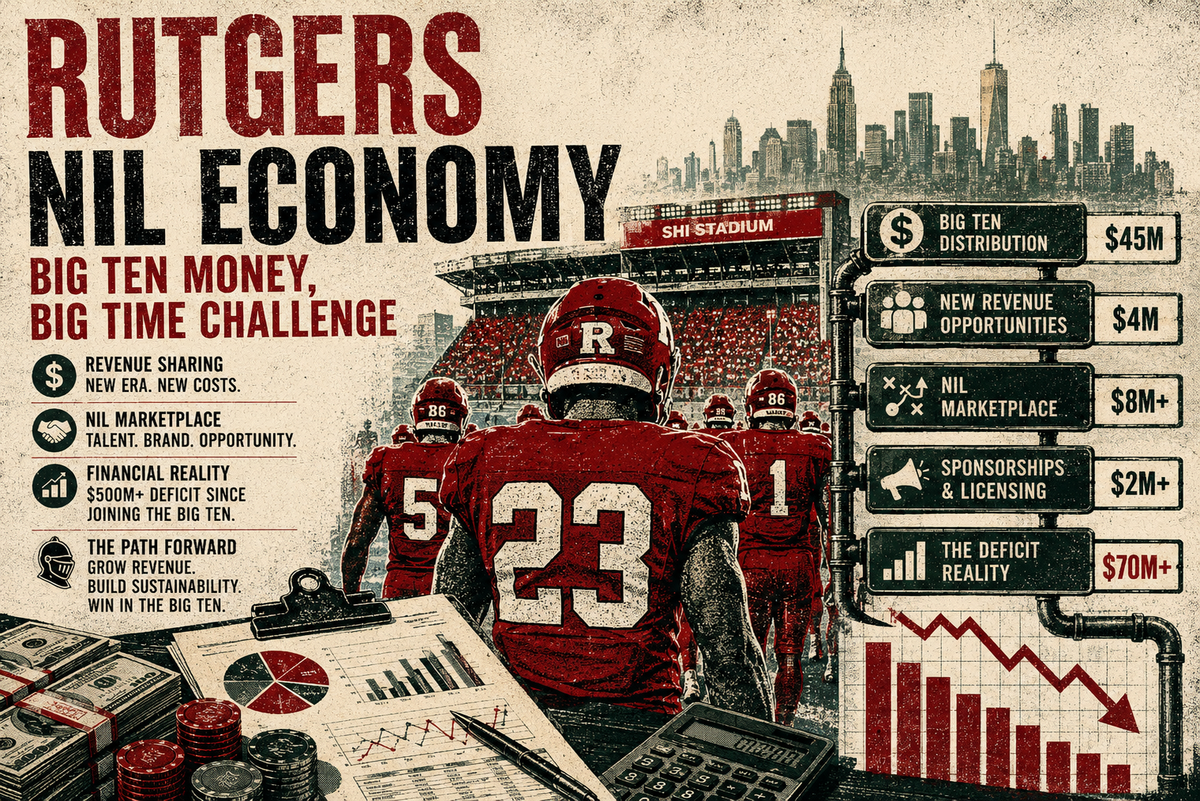
Back in 2014, on paper, Rutgers joining the Big Ten looked like a steal. The Scarlet Knights would suddenly have a seat at the table for the richest TV contract in college sports, and they'd be doing it from the middle of the biggest media market in the country. New York City sat right next door, along with northern New Jersey and a dense cluster of Fortune 500 companies. On paper, this was a school built to print money.
More than ten years later, things haven't gone quite that smoothly.
Rutgers now collects a full share of Big Ten media revenue. And yet the athletic department is still carrying one of the largest structural deficits in all of college sports. Revenue sharing showed up right as Rutgers was already trying to dig itself out of a financial hole, which makes this one of the more interesting money stories in the conference right now.
Rutgers Athlete Payroll in 2026
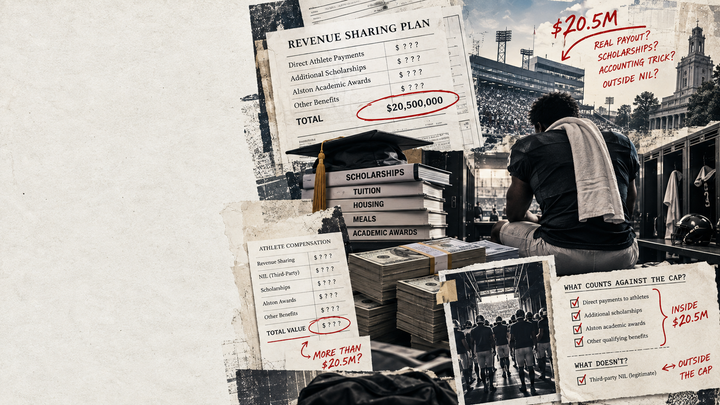
The House settlement changed the rules for how schools pay their athletes. Rutgers, like almost every other Big Ten school, is expected to hand out close to the full allowed amount in direct revenue sharing, and it'll keep leaning on NIL collectives and outside endorsement deals on top of that.
Estimated annual athlete compensation
Direct revenue sharing:
- Football: $15.5–16.0 million
- Men's Basketball: $3.0–3.5 million
- Women's Basketball: $0.8–1.0 million
- Olympic Sports: $0.5–0.7 million
Estimated NIL marketplace:
- Football: $8–10 million
- Men's Basketball: $2.5–4 million
- Other sports: $0.5–1 million
Estimated total athlete compensation: roughly $31–35 million a year.
That puts Rutgers right in the middle of the Big Ten pack. It's not catching Ohio State, Oregon, Michigan, or Penn State anytime soon, but it stacks up reasonably well against schools like Washington, Maryland, and UCLA.
One thing worth noting: Rutgers hasn't built its roster by chasing huge transfer portal classes. Greg Schiano has leaned more on high school recruiting and developing players over time. That approach probably explains why Rutgers' NIL numbers run lower than what the conference's biggest spenders are putting up.
Rutgers has a Card Almost Nobody Else Can Play
If NIL success came down to location alone, Rutgers would be sitting near the top of the sport.
Drive just a few minutes from campus and you'll pass corporate headquarters covering healthcare, pharmaceuticals, finance, insurance, telecom, consumer goods, and tech. Johnson & Johnson is nearby. So are Prudential Financial, RWJBarnabas Health, Horizon Blue Cross Blue Shield of New Jersey, PSEG, Panasonic North America, Verizon, and Audible. Add in a long list of Wall Street firms with New Jersey offices, and you've got a corporate ecosystem most athletic departments could only dream about.
So, the problem was never location. The problem has always been turning that location into actual dollars.
Financial Reality is Rough
Even with record Big Ten payouts coming in, Rutgers is still fighting an uphill battle.
The athletic department posted roughly a $78 million operating deficit in fiscal year 2024-25. That's the third time in five years the department has blown past $70 million in annual losses. Since joining the Big Ten, Rutgers athletics has racked up more than $500 million in cumulative deficits; an eye-popping number for any Power Four program.
Now layer revenue sharing on top of that. It's another big, recurring expense for a department that was already struggling to balance the books. Athletic director Keli Zinn has said openly that 2025-26 could be Rutgers' hardest financial year yet, mainly because the revenue-sharing bills are due now, while a lot of the department's new revenue plans haven't started paying off.
Rutgers doesn't seem interested in just slashing costs to fix this. Instead, the plan appears to center on growing revenue; through premium seating, sponsorships, fundraising, licensing, and bigger corporate partnerships. Honestly, that's probably the only path that works here, although Rutgers is like Northwestern in having failed to develop an organic fan base.
Football is Still the Engine
No sport matters more to Rutgers' bottom line than football.
Schiano has brought real stability back to the program, to the point where bowl games feel like an expectation instead of a bonus. Every extra win helps in more ways than one — ticket sales go up, donations go up, sponsors get more interested, and recruiting gets a little easier.
Rutgers really can't afford a step back here. With revenue sharing now part of the picture, football success matters even more, since the sport will keep generating most of the department's income.
Basketball is Pulling More Weight Than It Used To
Basketball has quietly become a bigger piece of the puzzle too.
The program has shown it can land NBA-level talent and get the whole country talking. Ace Bailey and Dylan Harper are proof of that: both helped Rutgers' recruiting reputation even though the team's results were up and down. A basketball program that stays competitive keeps donors engaged and opens NIL opportunities that football just can't offer on its own.
Can Rutgers Finally Cash in on its Location?
It's hard to think of a school with a bigger gap between opportunity and results than Rutgers right now.
Rutgers is in the richest conference in the sport. It sits next to the largest TV market in the country. It has access to hundreds of major corporations within a short drive. And somehow, it's still near the bottom of the Big Ten in donations, sponsorship revenue, and licensing income.
The upside is that none of those problems are permanent. Rutgers isn't stuck the way a school in a small media market would be: it just needs to do a better job monetizing what's already sitting right outside its front door. That seems to be exactly what Keli Zinn's team is trying to do. There's already talk of expanded corporate sponsorship deals, including jersey patch sponsorships, which other college programs have already rolled out successfully.
Final thoughts
Revenue sharing didn't create Rutgers' financial mess. It just made fixing that mess a lot more urgent.
The pieces are there for Rutgers to become a financially healthy Big Ten program: full conference revenue, access to one of the strongest corporate markets in the country, a football program on the rise, real basketball talent, and one of the biggest alumni bases in the sport. What happens next comes down to execution, not geography.
If Rutgers can turn its massive commercial advantages into steady athletic revenue, this could become one of the best long-term success stories in the conference. If it can't, it stays exactly what it's been for years: the Big Ten's most confusing financial contradiction.
Comments ()