
Why the Civil War Stopped Exchanging Prisoners and Why It Turned Deadly
The 1863 collapse of Civil War prisoner exchanges transformed POW camps into systems of mass death and exposed a deeper truth about the war: it relied on coercion and fell hardest on those without the means to avoid it.
How 1863 Turned a Limited War into a System of Mass Death, and Why It Still Matters
By 1863, the American Civil War no longer resembled the limited conflicts that European powers had once framed with rules and rituals. The war hardened into something more modern and far less restrained. The collapse of prisoner exchanges did not simply worsen conditions in prison camps; it exposed the underlying structure of the conflict. Once exchanges ended, captivity became a prolonged and often fatal condition, and the war revealed its dependence on expendable men.
At the same time, both governments moved decisively toward conscription. These policies stripped away any remaining illusion that ideology alone sustained the war effort. Coercion entered the system, and it did not apply evenly. Wealth insulated some men, while others found themselves locked into a conflict with no exit.
The year 1863 marked the pivot. Not just on battlefields, but in the internal logic of the war itself.
The Exchange System and Its Collapse
Early in the war, Union and Confederate authorities attempted to maintain a workable framework for handling captured soldiers. The Dix–Hill Cartel established a formal exchange system based on rank equivalencies and parole agreements. This arrangement did more than manage prisoners. It preserved a sense of continuity between armies that still viewed themselves as operating within recognizable rules.
The system functioned because both sides accepted a basic premise of reciprocity. Capture did not mean disappearance. A soldier expected eventual return through exchange or parole. That expectation helped sustain morale and limited the burden on prison facilities.
The breakdown came in 1863, and it stemmed from an issue neither side could sidestep. The Confederacy refused to recognize Black Union soldiers as legitimate combatants. Confederate policy threatened to return captured Black soldiers to slavery or subject them to execution. Union leadership, including Abraham Lincoln and Edwin Stanton, rejected any exchange system that treated part of its army as property.
Once that position hardened, the exchange system could not survive. Neither side found a workable compromise. Exchanges slowed, then stopped. The consequences followed quickly.
From Temporary Holding to Permanent Confinement
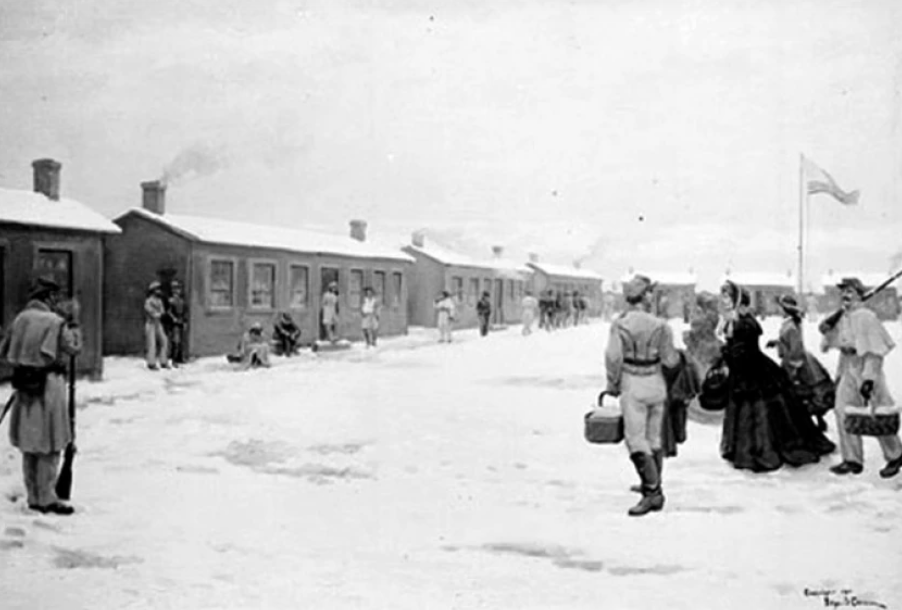
Without exchanges, prisoner populations grew with each engagement. Camps that had functioned as short-term holding areas now absorbed a constant inflow of captured men. No mechanism existed to reduce the numbers.
At Andersonville Prison, the Confederacy built a facility designed for 10,000 prisoners. More than 45,000 men passed through its stockade. Nearly 13,000 died from exposure, disease, and malnutrition. Guards enforced the perimeter, but the camp itself operated as a system of unmanaged scarcity. Food supplies faltered, sanitation collapsed, and contaminated water spread illness through the population.
Northern camps produced similar patterns under different conditions. At Elmira Prison, Confederate prisoners endured harsh winters, inadequate shelter, and limited medical care. Mortality approached one quarter of the camp population. At Camp Douglas, poor drainage and contaminated water combined with exposure to produce high death rates. Prisoners lived in overcrowded conditions that amplified disease and accelerated decline.
Even improvised camps revealed the same structural weakness. Camp Randall briefly held Confederate prisoners under conditions for which it had not been designed. Cold weather, insufficient supplies, and limited medical capacity produced rapid deterioration among men unprepared for northern climates. At Rock Island Prison, the Union attempted to provide a more durable facility, yet disease and supply limitations still produced thousands of deaths.
These camps differed in administration and geography, but they converged in outcome. Once the exchange system disappeared, no camp possessed the capacity to manage long-term confinement at scale.
The End of the Soldier’s Safety Net
The collapse of exchanges altered more than logistics. It changed the expectations that soldiers carried into battle. Before 1863, capture implied interruption. After 1863, capture implied indefinite confinement under deteriorating conditions.
Commanders could no longer assure their men that capture would lead to eventual return. Soldiers understood that imprisonment might last for the duration of the war, and that survival depended on factors outside their control. This shift eroded trust between the rank-and-file and the institutions that directed them.
At the same time, both governments expanded their manpower demands.
Conscription and the Economics of Avoidance
The Union’s Enrollment Act required eligible men to serve, but it also included a provision that exposed the North's social structure. A drafted man could pay $300 or hire a substitute. For working-class men, that sum represented a year’s wages. For professionals and property holders, it represented a manageable expense.
The resulting resentment found expression in the New York City Draft Riots. Protesters recognized that the burden of the war did not distribute evenly. The system allowed some men to exit while compelling others to serve.
The Confederacy implemented its own draft earlier and embedded inequality more directly. The “Twenty Negro Law” exempted slaveholders with large holdings, reinforcing the perception that those who benefited most from the system bore the least risk. In both regions, policy choices ensured that poorer men filled the ranks.
Conscription did not simply increase troop numbers. It formalized a hierarchy of exposure to danger.
Systems Under Strain
The collapse of prisoner exchanges reflected a broader failure of wartime systems under pressure. Both governments faced competing demands. Armies required food, transportation, and administrative attention. Prisoners required the same resources, yet they did not contribute to battlefield success.
Rather than reduce the scale of conflict or reestablish exchange mechanisms, both sides allowed prison systems to absorb the strain. Shortages became routine. Disease spread unchecked. Administrators adapted to conditions rather than correcting them.
This pattern reveals a critical dynamic. When systems reach capacity, they do not fail uniformly. They transfer stress to the least protected populations. In this case, prisoners and conscripts absorbed the consequences of institutional limits.
The War Beneath the Narrative
Popular accounts of the Civil War emphasize ideology, leadership, and decisive battles. Those elements matter, but they do not capture the full structure of the conflict after 1863. Beneath the familiar narrative lies a system that trapped its participants.
Captured soldiers could not exit. Drafted men could not refuse without penalty. Substitution and exemption provided escape routes for those with resources, but most participants remained bound to the system. The war required continuous input of manpower and offered limited means of release.
This dynamic transformed the conflict into a self-sustaining mechanism. It consumed men at the front and confined them behind stockades, while administrative structures struggled to keep pace.
Memory and Omission
Battlefields such as Gettysburg dominate public memory because they offer clarity and resolution. Prison camps present a different reality. They represent prolonged suffering, administrative failure, and the absence of decisive moments. As a result, they occupy a smaller place in collective memory.
That imbalance obscures an important truth. The experience of imprisonment shaped the war as profoundly as any single battle. Camps revealed the limits of both governments and the consequences of policy decisions made under pressure.
Conclusion: The Pattern That Persists
The collapse of prisoner exchanges in 1863 marked a structural turning point in the Civil War. It eliminated a key constraint on suffering and forced both sides to confront the limits of their systems. Prison camps expanded beyond their capacity. Conscription drew in men who lacked the means to avoid service. Policy decisions reinforced existing inequalities rather than correcting them.
This episode does more than illuminate a moment in the nineteenth century. It exposes a recurring pattern in large-scale systems under stress. Institutions abandon reciprocal norms when those norms impose unequal costs. Resource constraints shift burdens onto those with the least influence. Individuals with wealth or status retain options that others do not possess.
The Civil War did not invent these dynamics, but it made them visible in stark form. Once the exchange system failed, the war revealed its underlying structure with unusual clarity. It became a conflict sustained by compulsion, managed through imperfect systems, and borne most heavily by those who could not escape it.

Comments ()