
Why Rural America Is Declining and What It Will Look Like in 50 Years
Rural America is being reshaped by agricultural consolidation, capital extraction, and the collapse of local systems. A 50-year forecast of depopulation, food deserts, and who profits.
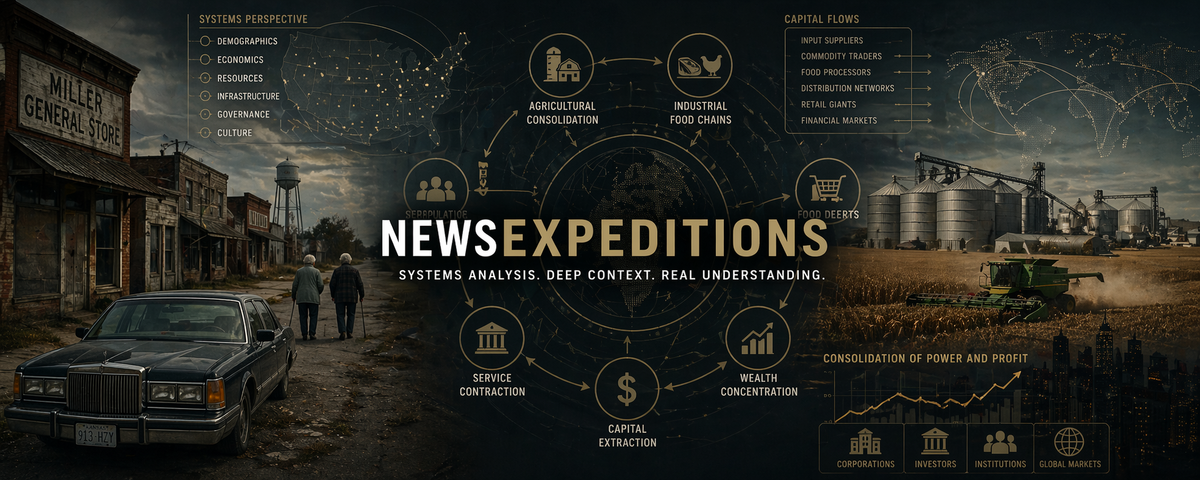
How the System Changed
The decline of rural America did not begin with empty storefronts or population loss. It began with a structural shift in how the country produces food and organizes economic value. Over the past half century, agriculture moved away from a dispersed, labor-intensive model tied to local communities and toward a consolidated system built on industrial crops and vertically integrated meat production. Corn and soy came to dominate enormous stretches of land, feeding centralized processing networks rather than local markets. Livestock production followed the same logic, with confined operations and integrated supply chains replacing smaller farms that once circulated income through rural towns.
This transition increased efficiency and output, but it also severed the economic link between land and community. Fewer people now produce more food, and a growing share of the value created along the way accrues far from where that production occurs. Small towns that once existed to support farmers, processors, and local commerce remained physically in place but lost their functional role in the system. What followed was not a collapse but a gradual hollowing out, as jobs disappeared, local businesses lost their customer base, and the remaining population aged in place. By the time depopulation became visible, the system that had sustained these communities had already been replaced.
The Planning That Never Comes
Forecasting what happens next requires abandoning the assumption that visible problems eventually produce coordinated responses. That assumption belongs to a different era, one in which long-term planning and geographic balance carried political and economic weight. The current system operates under a distinct set of incentives. Capital flows toward environments where returns scale quickly, where density reduces cost, and where growth compounds. Rural America offers little of that, and it has not existed for decades.
This does not reflect a lack of awareness. It reflects alignment between incentives and outcomes. Investment rarely moves to stabilize places that have already fallen outside the growth pattern unless there is a clear and immediate return. That condition seldom exists in low-density regions with aging populations and declining demand. The future of rural America will not be shaped by a comprehensive recovery effort. It will take shape through continuation, local adaptation, and a broader system that simply moves on.
Phase One (Now to Around 2040): Systems Under Strain That Still Function
In the near term, rural America continues to operate well enough to avoid triggering decisive intervention. Population declines remain steady but not dramatic, often one to two percent per year, which allows the trend to blend into the background. Over time, however, the composition of the population shifts in ways that matter more than the headline numbers. Younger residents leave, birth rates fall, and the median age rises, gradually reshaping the economic base.
Agricultural consolidation continues to advance during this period. Farms grow larger, more automated, and more capital intensive. From a national perspective, this looks like success. Output remains high, efficiency improves, and supply chains remain stable. At the local level, the effect is different. Income circulates less within the community, and the number of people directly tied to production continues to shrink.
The first visible cracks appear in services that depend on consistent demand. Hospitals close where patient volumes no longer justify the cost of operation. Grocery stores disappear in towns that cannot support steady turnover, replaced by smaller-format retail that offers limited selection. These changes do not immediately render a place unlivable, but they alter the texture of daily life in ways that accumulate over time.
Despite these pressures, most communities remain intact. Schools operate through consolidation, infrastructure continues to function, and local governments provide basic services. The system appears stable, even as the underlying capacity for recovery continues to erode.
Phase Two (2040 to 2060): When the Arithmetic Turns Against the System
The second phase emerges when demographic and economic trends begin to reinforce each other. By the 2040s, many rural counties will have median ages approaching fifty or higher, with fewer working-age residents supporting a growing number of retirees. This imbalance places sustained pressure on tax bases, school systems, and healthcare infrastructure.
At this point, consolidation becomes unavoidable rather than strategic. Schools merge because enrollment falls below viable thresholds. Healthcare centralizes further, forcing residents to travel greater distances for both routine and emergency care. The change does not occur at all, but it gradually shifts how people evaluate the viability of remaining in place.
Food access follows a similar path. As grocery stores close, the distance to full-service retail increases, often to twenty or thirty miles or more. For households with reliable transportation, this becomes a logistical burden. For those without it, access narrows significantly, leaving limited local options that do not provide the same level of nutrition or variety. Over time, this contributes to measurable health outcomes that feed back into an already strained healthcare system.
Infrastructure begins to reflect these pressures more visibly. Deferred maintenance results in deteriorating roads, aging water systems, and periodic service disruptions. Smaller municipalities face decisions that require resources they do not have, leading to partial fixes rather than full replacements. As these conditions accumulate, outmigration accelerates, particularly among younger households.
What defines this phase is not collapse, but loss of cohesion. Communities remain in place geographically, but their ability to function as integrated systems weakens.
Who Profits While This Happens
The hollowing out of rural America does not occur in a vacuum. It produces clear winners, and those winners sit at points in the system where scale and aggregation capture the most value.
Large agribusiness firms benefit as production consolidates. Seed companies, fertilizer suppliers, equipment manufacturers, and commodity traders all operate within a system that rewards volume and efficiency. Farmers remain essential, but they function increasingly as participants in a broader supply chain rather than as independent economic anchors. Much of the margin that once stayed local now moves outward.
Meat production reflects an even tighter version of this structure. A small number of firms control processing and distribution, while contract growers absorb operational risk. The geography of production remains rural, but the financial returns concentrate elsewhere, often far removed from the communities where the work takes place.
Logistics and distribution companies capture another layer of value. As local supply chains weaken, long-distance transport becomes more important. Rail, trucking, and warehousing systems expand to connect centralized production to national and global markets. These networks extract margin from movement itself, turning distance into a source of profit.
Retail consolidation completes the shift. National chains replace local businesses where population allows, and in lower-density areas, smaller corporate formats fill the gap. In both cases, revenue no longer circulates locally. Profits move upward, leaving behind wages that are typically lower and less stable than the income streams they replaced.
Financial capital plays a quieter but decisive role. Farmland increasingly functions as an investment asset, attracting institutional buyers such as pension funds and private equity. Ownership separates from place, and land becomes part of a portfolio rather than the foundation of a community. The economic benefits tied to that land follow the ownership structure, not the geography.
How Capital Actually Moves
The pattern that emerges is consistent. Value originates in rural regions through land and production, but it does not remain there. It moves outward through supply chains, financial systems, and corporate structures that capture margin at each stage.
A farmer purchases goods from national suppliers, finances operations through large lenders, sells into global markets, and ships through centralized logistics networks. At each step, a portion of the value leaves the local economy. What remains is limited to wages and a shrinking pool of service activity.
Historically, income generated in rural communities circulated locally, supporting businesses, services, and institutions. Today, that circulation breaks down quickly. Money exits faster than it recirculates, which reduces the local multiplier effect. Over time, that dynamic alone is enough to hollow out a place, even if production levels remain high.
On the receiving end, capital concentrates in metropolitan regions and financial centers. Corporate headquarters, distribution hubs, and investment firms aggregate returns generated across dispersed rural geographies. Those returns are then reinvested in environments that promise further growth, reinforcing the same pattern.
Phase Three (2060 to 2075): A Landscape Reorganized
By the latter half of the century, rural America reorganizes into a different structure. Instead of a dense network of small towns, the dominant pattern consists of regional centers surrounded by large areas of low-density territory. These centers concentrate essential services, including healthcare, education, and retail.
Agriculture remains productive but operates with minimal connection to nearby communities. Automation and centralized logistics reduce the need for local labor, further weakening the relationship between land and population. The economic benefits of production flow through systems that extend far beyond the regions where the work takes place.
Food access becomes increasingly uneven. Residents within range of regional hubs maintain access to full-service grocery systems, while those outside rely on a combination of delivery, mobile markets, and limited retail. The idea of a nearby, comprehensive grocery store no longer applies across much of the rural landscape.
Housing and governance follow similar patterns. Some areas stabilize at lower density with consolidated services, while others operate with reduced capacity. The result is not empty space, but a fragmented landscape defined by uneven functionality.
The Likely End State
By 2075, rural America remains, but it no longer resembles the version that still exists in public imagination. Population concentrates in fewer locations, services cluster in regional hubs, and large areas operate at reduced density. Access to healthcare, food, and opportunity varies significantly depending on geography.
The image of the self-sustaining small town persists culturally, but it reflects a system that no longer exists. That system depended on distributed labor and localized economic activity. The current system does not require either.
Final Assessment
The question is often framed as whether intervention will come in time. A more grounded assessment suggests that the type of intervention required does not align with prevailing incentives and therefore remains unlikely. What follows instead is a gradual sorting process in which some regions adapt, others consolidate, and many continue to thin out over time.
This process unfolds slowly enough to avoid drawing sustained attention, but not slowly enough to reverse itself. By the time it becomes widely recognized, the structure that produced it will already be firmly in place.



Comments ()