
When the Humanities Lost the Public: Dead-End Degrees, Academic Celebrity, and Donnelly's Law
Rising tuition, weak labor-market outcomes, academic celebrity culture, and increasingly speculative public theories combined to erode public trust in the humanities and accelerate their institutional decline.
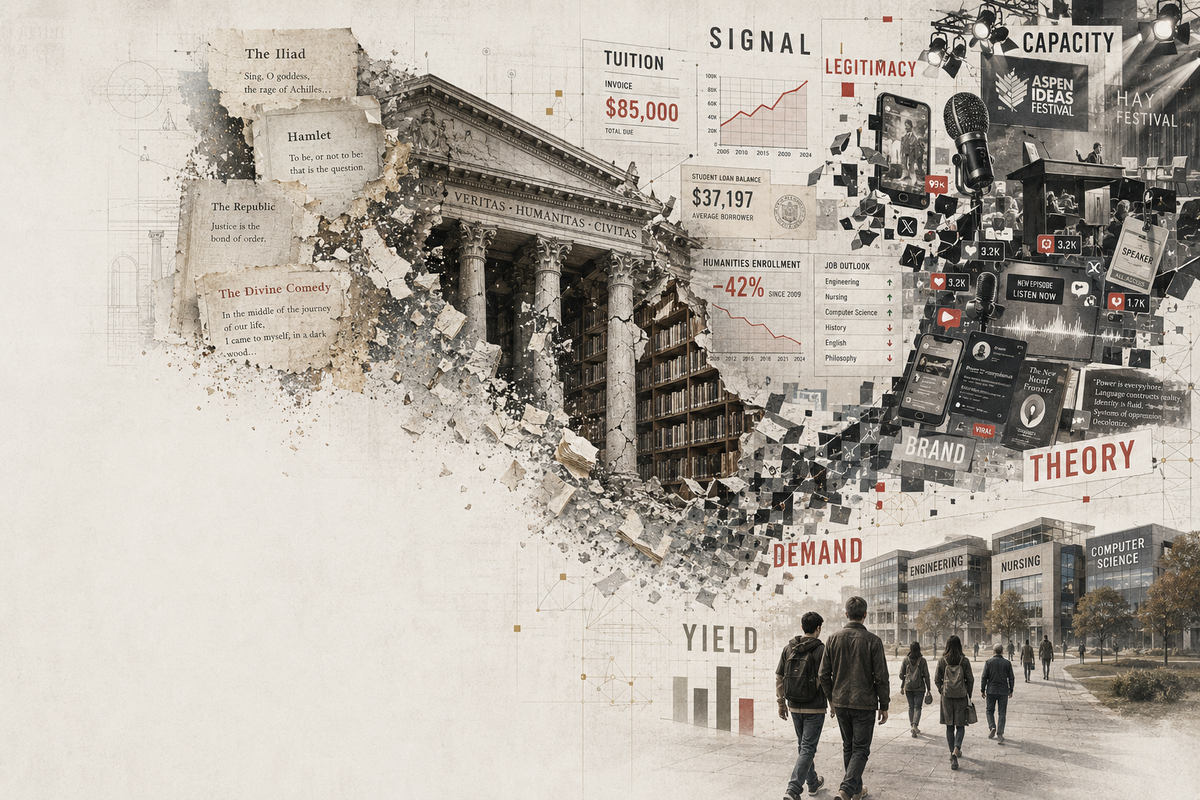
There was a time when the humanities stood at the center of the university, much as a cathedral once stood at the center of a medieval town. They were not merely another collection of departments competing for credit hours and faculty lines. They represented the institution's highest aspirations. In classrooms devoted to literature, history, philosophy, classics, and religion, students encountered the long conversation of civilization and wrestled with questions that no society can permanently evade: What is justice? What makes a life worth living? How should free people govern themselves? What obligations do we owe to the dead, to the living, and to those who will come after us?
The practical value of these disciplines was never entirely obvious, yet for decades, that ambiguity caused little concern. Families assumed that students who could read difficult texts, construct persuasive arguments, and understand the historical roots of modern institutions would eventually find their footing. Employers often shared that assumption. Law firms, consulting companies, publishers, government agencies, and graduate schools treated a humanities degree as evidence of disciplined intelligence. The pathway was not linear, but it was intelligible. One studied Homer and Shakespeare not because either author provided a job description, but because intellectual seriousness itself carried economic and social value.
That older settlement has steadily unraveled. The change began with economics, accelerated through technology, and culminated in a broader crisis of legitimacy. As tuition climbed, families became less willing to purchase a diffuse educational experience and more determined to buy a credential with visible market value. As communication systems expanded, professors gained unprecedented opportunities to become public intellectuals. As academic theories moved from seminar rooms into mainstream politics, the humanities became associated not only with uncertain career outcomes but also with controversial and often highly abstract claims about identity, power, and social organization.
Each development might have been manageable in isolation. Together, they proved corrosive. The humanities did not lose public support because literature ceased to matter, because history became irrelevant, or because philosophy stopped asking necessary questions. They lost public support because an expensive and economically ambiguous product became increasingly linked to a style of public discourse that many citizens found politically divisive, conceptually opaque, and at times detached from ordinary experience.
To understand the force of the backlash, it helps to define the humanities more precisely. These disciplines investigate how human beings create meaning. They examine the stories societies tell, the institutions they build, the moral frameworks they adopt, and the symbols through which they understand themselves. The subject matter ranges from The Iliad to Hamlet, from The Republic to The Divine Comedy. Their practical contribution lies not in teaching students to build a bridge or write a line of code, but in teaching them to interpret evidence, evaluate arguments, and situate present conflicts within a larger historical and moral context.
That contribution remains substantial, yet it has become more difficult to monetize and harder to explain in a transactional age. A degree in civil engineering naturally leads to engineering. A degree in nursing points directly toward licensure and clinical practice. A degree in accounting provides a recognizable route into public and corporate finance. The humanities offer something both broader and less explicit. They develop judgment rather than certification, interpretive skill rather than technical specialization, and intellectual range rather than vocational specificity. For highly motivated students, this flexibility can become an advantage. For families staring at six-figure tuition bills, it can look like a costly exercise in uncertainty.
The phrase "dead-end degree" overstates the case, but its persistence reveals a structural weakness in the humanities' economic narrative. The problem is not that graduates fail. Many build successful careers in law, consulting, management, education, and entrepreneurship. The problem is that the causal chain from major to occupation is less visible and less predictable. In an era dominated by spreadsheets, rankings, and return-on-investment calculations, ambiguity becomes a liability. What earlier generations regarded as intellectual breadth, today's consumers of higher education often interpret as insufficient specificity.
This growing economic pressure might still have been manageable had the humanities retained their reputation as politically neutral custodians of civilization. Instead, the media environment changed, and with it the incentives governing academic behavior. Professors who once reached narrow scholarly audiences through books and journals suddenly found themselves in a world of podcasts, social media platforms, newsletters, video interviews, and ideas festivals. The gatekeepers did not disappear, but their power weakened dramatically. Distribution became cheap, immediate, and virtually unlimited.
This transformation illustrates Donnelly's Law, a principle that applies far beyond universities: when communication capacity expands, the available bandwidth does not remain empty for long. It fills. Newspapers with more pages seek more stories. Cable channels with twenty-four hours to program generate endless commentary. Social platforms with infinite scroll require constant updates. The academic world followed the same logic. Once the technical barriers to publication fell, scholars gained both the opportunity and the incentive to produce an ever-larger stream of public analysis.
The new ecosystem rewarded not only insight, but also visibility; not only rigor, but also fluency; not only scholarship, but also performance. Prestige accrued through book sales, podcast invitations, keynote addresses, and appearances at gatherings such as the Aspen Ideas Festival, Hay Festival, and New Yorker Festival. These forums often showcased thoughtful and important work, yet they also rewarded academics who could package complex theories into memorable, emotionally resonant narratives for affluent and influential audiences.
In this environment, a relatively small number of scholars came to represent the humanities in the public imagination. Judith Butler developed a theory of gender performativity, arguing that gender identity is shaped through repeated social practices rather than functioning solely as a direct expression of biological sex. Within academic circles, Butler's work opened a profound and productive inquiry into the relationship between language, norms, and identity. Outside those circles, the broader public often encountered a simplified version of the theory and concluded that universities were questioning distinctions they regarded as obvious and deeply rooted in biological reality.
Ibram X. Kendi advanced a framework in which policies and ideas are judged by whether they perpetuate or reduce racial disparities. The appeal of this formulation lies in its moral clarity. The criticism lies in its compression of complex policy disagreements into a binary moral taxonomy. When neutrality itself is described as a form of complicity, many citizens hear not an invitation to inquiry but a demand for ideological alignment.
Robin DiAngelo popularized the concept of white fragility to explain defensive responses to discussions of race. The framework resonated strongly in educational and corporate settings because it offered a language for interpreting resistance. Yet its detractors argued that disagreement could be treated as confirming evidence, thereby placing ordinary skepticism within the theory's explanatory structure. For many observers, this quality made the argument feel less like a hypothesis to be tested and more like a doctrine to be accepted.
Kimberlé Crenshaw introduced intersectionality to explain how overlapping identities can shape legal and social outcomes. The concept captured an important truth: social experience cannot always be understood by isolating a single category such as race or sex. In public discourse, however, the framework sometimes expanded into increasingly elaborate classifications of advantage and disadvantage that proved difficult to operationalize and even more difficult to communicate in plain language.
These scholars are neither charlatans nor fools. Each produced work that influenced academic debate and public life. The problem lies elsewhere. Their ideas moved rapidly from specialized scholarship into administrative policy, corporate training, and national politics, where they encountered audiences with different assumptions, different priorities, and a lower tolerance for abstraction. What seemed theoretically illuminating in graduate seminars could appear, to the broader public, remote from common experience and resistant to ordinary forms of disagreement.
At the same time, the financial proposition facing families grew increasingly stark. Universities were asking students to assume large debts for degrees whose labor-market pathways remained indirect while the most visible representatives of those disciplines offered theories that many Americans considered esoteric, politically charged, or simply difficult to accept. The resulting skepticism was not irrational. It reflected a straightforward question: why should parents invest heavily in programs whose economic outcomes are uncertain and whose public image has become controversial?
Once that question gained traction, administrators began making predictable calculations. Departments with declining enrollment, limited grant revenue, and rising political exposure became harder to defend. Engineering could point to licensure and strong salaries. Nursing could point to workforce shortages. Computer science could point to direct industry demand. The humanities had to rely on arguments about judgment, citizenship, and cultural literacy at the very moment when those arguments were being drowned out by concerns about cost and ideology.
Public perception, of course, is never perfectly fair. Thousands of humanities professors continue to teach ancient languages, intellectual history, ethics, and literature with seriousness and humility. Their work remains indispensable. Yet institutions are judged disproportionately by their most visible representatives. The professor quietly guiding students through Dante rarely becomes a household name. The professor making sweeping claims about identity, power, and social transformation often does. In an age defined by attention markets, the exceptional becomes representative.
The humanities therefore entered a classic systems trap. Their economic proposition grew weaker just as their reputational risk increased. Their degrees appeared less certain in the marketplace just as their public image became more controversial. Their institutional defenses eroded at precisely the moment their opponents found it easiest to frame them as costly, ideological, and expendable. In such a system, decline becomes not a mystery but an expected outcome.
None of this diminishes the enduring importance of the humanities themselves. Societies still require historical perspective, moral reasoning, and interpretive judgment. Leaders still need to understand how institutions rise and fall, how language shapes perception, and how inherited ideas continue to structure modern life. The intellectual foundations remain sound. What has changed is the coalition willing to finance and defend them.
The central lesson is not that professors should avoid public engagement, nor that controversial ideas should be suppressed. Universities flourish when scholars challenge assumptions and participate in civic life. The lesson is more structural. When an academically diffuse degree becomes economically difficult to justify, and when the public face of that degree becomes associated with abstract theories and ideological conflict, legitimacy erodes. When legitimacy erodes, budgets follow.
The humanities did not fail because Homer, Shakespeare, and Plato ceased to matter. They faltered because the institutions charged with preserving those traditions became entangled in a communications environment that rewarded constant production, conceptual escalation, and personal branding. Donnelly's Law explains why the content proliferated. Market logic explains why students and parents hesitated. Political polarization explains why public support fractured. Together, these forces transformed some of the university's oldest and most valuable disciplines from cultural crown jewels into departments that many institutions now struggle to protect.


Comments ()