
Why the Pat Fitzgerald Hire Signals a Deeper Problem at Michigan State
A sharp analysis of Michigan State athletics examining the Fitzgerald hire, the lingering impact of the Nassar and Tucker scandals, and why the eventual replacement of Tom Izzo may expose deeper institutional failures.
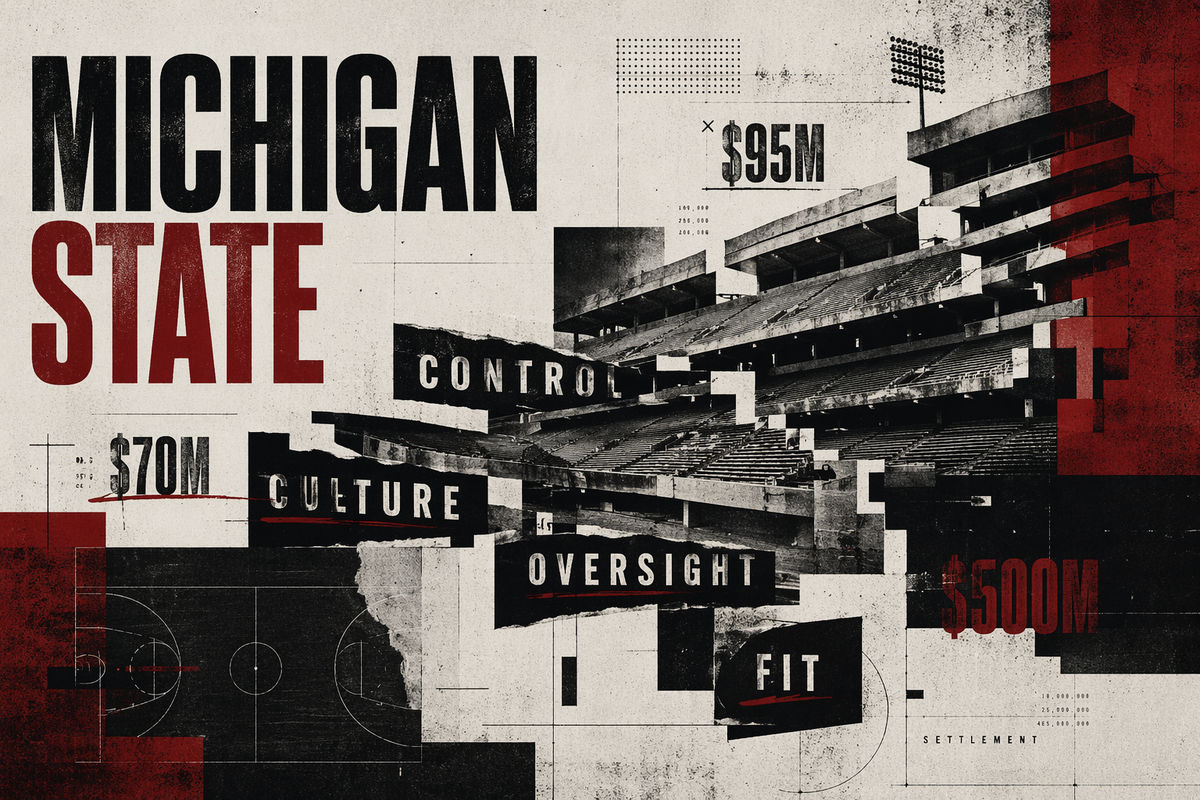
The Michigan State Athletic Department is a headline waiting to happen, a ticking time bomb that will detonate, but the time is yet to be determined. Cultural problems seem to keep the department in a continual cycle of disasters, and the administration is unable to change that story arc.
Michigan State does not really have a crisis in the way people usually mean it. What it has is something worse, and harder to fix: a system that keeps producing crises and then treating each one like a surprise. That distinction matters because it explains why the resets never quite stick. Every time something breaks, the institution reacts, changes the faces, adjusts the messaging, and leaves the underlying decision logic mostly untouched. A few years pass, the pressure builds again, and the same type of failure reappears, wearing a different label.
If you strip away the fan perspective and look at this the way a management consultant would, the pattern becomes almost uncomfortably clean. The issue is not football, or gymnastics, or any single coach. It is how the place evaluates risk, how it distributes authority, and how it convinces itself that a new hire equals a new system. It doesn’t. It rarely does.
Strong Money, Weak Controls
Financially, Michigan State remains in a solid position within the Big Ten. Revenues sit in that upper middle band, facilities are not the problem, and donor support has held up better than it probably should have, given the last decade. In a strange way, that stability may be part of the problem. When the money keeps flowing, the urgency to fix structural issues fades just enough to delay real change.
On the field, especially in football, the results have been uneven to the point of unpredictability. The program has moved from playoff relevance to something closer to managed instability, cycling through resets without establishing a clear direction. Meanwhile, men’s basketball continues to serve as the one dependable pillar, creating a kind of institutional cover. As long as one major program works, it becomes easier to ignore the fact that the rest of the system doesn’t function all that cleanly.
NIL Economics, Budget Reality, and the Coming Squeeze
Michigan State’s budget looks solid until you start pulling apart where the money goes. On paper, the department still sits comfortably in the Big Ten’s upper-middle range, with annual revenue somewhere in the $160–$180 million band depending on how you count distributions and one-off items. Facilities are in good shape, media payouts keep rising, and the donor base has held together better than most people would have guessed a few years ago. If you stopped there, you could convince yourself the foundation is fine.
It gets less convincing once you isolate NIL.
That is where the gap shows up, and it shows up quickly. Around the conference, there is now a clear pecking order. The top programs are effectively operating with football NIL pools in the mid-to-high teens annually, sometimes pushing past that when they need to close on a quarterback or a handful of portal pieces. The next tier sits somewhere in the low double digits. Then there is a middle group, where Michigan State appears to be operating, in a range that feels closer to $6–$9 million, depending on the year and the urgency.
That difference matters more than people like to admit. It is not just about landing one big recruit. It is about whether you can hold a roster together after a 6–6 season, or whether your best players start fielding calls the minute the portal opens. It is about whether you can fix a problem position in one cycle or spend two years chasing it.
The other issue is how the money is organized. At Michigan State, NIL still feels somewhat pieced together. There are collectives, there are donor-driven efforts, and there are deals that get done when they need to. It works, in the sense that something always gets funded, but it does not feel tightly coordinated with roster construction. Programs that have moved ahead in this space tend to operate more deliberately. They have a plan for how dollars map to positions, how retention is handled, and how donor messaging ties into all of it. Michigan State’s approach feels more reactive than that, even if people inside the building would push back on that characterization.
Then you layer in the broader budget reality. A lot of the department’s revenue is already allocated before NIL even comes up. Coaching salaries have climbed, and not just in football. Facilities do not maintain themselves, and past upgrades come with ongoing costs that are easy to overlook until you try to redirect money somewhere else. Add in buyouts and the financial aftershocks from earlier decisions, and the room to maneuver gets tighter than the headline revenue number suggests.
So, when people say, “just raise more NIL money,” it is not quite that simple. Every dollar must come from somewhere, and in a donor base that is not unlimited, there is a quiet competition between traditional giving and NIL-specific contributions. Some schools have leaned into that and basically told donors, this is the game now, pick your lane. Michigan State has tried to keep both tracks moving at once, which sounds reasonable but can dilute the sense of urgency. You end up with enough to function, not always enough to dictate outcomes.
The competitive environment is not easing up either. If anything, the cost of staying even has gone up. Being a few million dollars short in NIL used to mean you missed on a recruit. Now it can mean losing players you already have, or spending an entire offseason trying to patch holes that better-funded programs never let open in the first place.
That feeds into roster stability, which is becoming the real separator. Teams with strong, well-organized NIL setups are not just adding talent; they are keeping it. Michigan State has had to work harder for the same result, and sometimes it has not gotten there. When that happens, you end up in a cycle where you rely more heavily on the portal, which raises costs, which then makes the next cycle harder to manage.
There is a path out of that, but it requires a more coordinated approach than the one in place. NIL likely needs to be treated less as an extension of fundraising and more as core infrastructure, with clearer alignment among donors, collectives, and the staff who make roster decisions. Until that happens, the overall budget will continue to look fine from a distance while the competitive position drifts just enough to be noticeable, especially to the players who now have options.
Wellness That Looks Better Than It Works
Michigan State has invested heavily in athlete wellness, and on paper, it checks all the right boxes. Facilities are modern, staffing levels are strong, and the language around mental health and athlete support sounds exactly like what you would expect from a program trying to present itself as forward-looking.
The problem is that none of that translates into authority when it matters. During the Larry Nassar years, the issue was not a lack of resources; it was a lack of power. Support systems existed, but they lacked the ability to override entrenched authority or trigger escalation. When tensions emerged, they were absorbed rather than acted on. The same general dynamic recurred during the Mel Tucker situation, where warning signs did not prompt a timely, decisive intervention.
It is one thing to build a wellness infrastructure. It is another to embed it into the chain of command. Michigan State has done the first part well enough and the second part inconsistently at best.
Paying for Upside, Ignoring Downside
The Tucker contract remains one of the clearest examples of how the department mispriced risk. Michigan State committed elite-level money to a coach without building meaningful behavioral safeguards. The structure leaned heavily toward retention and perception, as if locking in the upside would somehow make the downside less relevant.
That approach only works if you believe the downside is unlikely or manageable. In this case, it was neither. When things went sideways, the university discovered that it had limited mechanisms to contain the fallout. The failure was not just about the individual involved. It was about the absence of a framework designed to anticipate and control exactly that kind of scenario.
You can call it aggressive if you want. It reads more like an incomplete.
The Nassar Lesson That Didn’t Quite Land
The most uncomfortable truth in all of this is that the Nassar scandal already exposed the core weakness. The institution placed too much trust in individuals and not enough in systems. Authority figures operated with limited challenge, reporting channels lacked clarity and force, and reputation substituted for verification in ways that should have set off alarms much earlier.
Michigan State responded with visible actions: settlements, leadership changes, public commitments to doing better. What it did not fully do was rewire the decision-making structure that allowed the problem to develop in the first place. That distinction explains why the same categories of failure keep reappearing. The surface changes, the underlying incentives mostly don’t.
The Fitzgerald Hire and the Return to Comfortable Thinking
This is where the recent decision-making becomes harder to defend. Moving on from Jonathan Smith and bringing in Pat Fitzgerald looks, at first glance, like a shift toward familiarity and tradition. Fitzgerald fits the Big Ten mold, carries name recognition, and presents as someone who understands program identity in a way donors tend to appreciate.
That is precisely the problem.
Smith, for all his limitations, offered something Michigan State needed at this stage. He was methodical, relatively low profile, and oriented toward building structure over time. It was not flashy, but it aligned with a program trying to stabilize after repeated shocks. Replacing that with a figure whose previous tenure at Northwestern University ended amid serious cultural questions suggests that the institution is still evaluating leadership through narrative comfort rather than operational control.
Fitzgerald’s situation at Northwestern did not unravel because of a bad season or a recruiting dip. It unraveled due to issues that developed within the program over time, which is exactly the category Michigan State should be most sensitive to, given its own history. Choosing to treat that as irrelevant or context-specific feels like a misread. Maybe not immediately, but over a longer horizon it is hard to see how it doesn’t reintroduce the same type of risk.
The Culture Fit Trap, Again
“Culture fit” sounds like a responsible criterion until you look closely at how it functions in practice. It tends to reward familiarity, reinforce existing assumptions, and reduce the likelihood of meaningful internal challenge. Leaders who embody the institution are often granted more latitude, not less, which can soften oversight at precisely the wrong moments.
That dynamic sits underneath both the Nassar and Fitzgerald situations, even if the specifics differ. When people stop questioning leadership because leadership “is the culture,” problems have more room to grow quietly. Michigan State, intentionally or not, keeps circling back to that model.
The Next Phase Probably Won’t Look Dramatic at First
If you try to map out what happens next, it is unlikely to begin with anything explosive. Early returns will probably look stable enough. Messaging will emphasize alignment, discipline, and a return to basics, and that will resonate for a while. There may even be modest on-field improvement, which tends to buy time and soften criticism.
The more relevant question is what happens underneath that surface. If the same structural issues persist, small signals tend to accumulate before anyone feels compelled to act. By the time those signals become visible externally, the situation is usually further along than it appears. That has been the pattern more than once, and there is little evidence that the underlying conditions have changed meaningfully.
The Izzo Question That No One Really Wants to Answer
While all of this plays out in football, men’s basketball continues to function as the stabilizer, largely because of Tom Izzo. His presence does more than produce wins. It provides credibility, continuity, and a kind of institutional cover that smooths over problems elsewhere.
That dynamic cannot last indefinitely.
When Izzo eventually steps away, Michigan State will have to make a decision that is far more consequential than any recent football hire. The temptation will be to look for a successor who feels like Izzo, someone who carries the same tone, the same connection to the program, the same general identity. That approach is understandable, and it is also risky in a way that should feel familiar by now.
If the selection process leans on narrative similarity rather than structural fit, the university risks destabilizing the one program that has consistently worked. Replacing Izzo is not just about maintaining performance. It is about testing whether Michigan State has learned to evaluate leadership differently than in the past. Right now, based on recent decisions, that remains an open question, maybe more open than they’d admit.
Structural Issues That Don’t Go Away on Their Own
At a basic level, the problems are not especially complicated. Contract structures still lean too heavily on performance and not enough on behavior. Compliance lacks the independent authority to force escalation when needed. Wellness functions are not fully integrated into leadership evaluation, which limits their effectiveness in practice. Hiring frameworks continue to favor familiarity over verifiable control mechanisms.
None of these is impossible to fix, but none of them fix themselves either.
Final Assessment
Michigan State would probably describe its current position as a rebuild, and there is some truth to that. Rosters turn over, staff change, and programs do reset over time. What makes this situation different is how often the reset seems to land in roughly the same place.
The Fitzgerald hire does not necessarily guarantee another failure, but it does suggest that the underlying decision logic has not shifted as much as it needs to. The eventual transition from Izzo will provide a clearer answer. If that process looks like what we have already seen, the next major problem will not feel like bad luck.
It will feel familiar, which is usually the bigger issue.
Comments ()