
Congress as Content: How Bipartisan Governance Hides Beneath America’s Political Theater
Most consequential federal laws, including defense budgets, appropriations, and debt-limit agreements, pass with bipartisan support. Political infotainment focuses on symbolic bills that generate outrage but rarely become law.
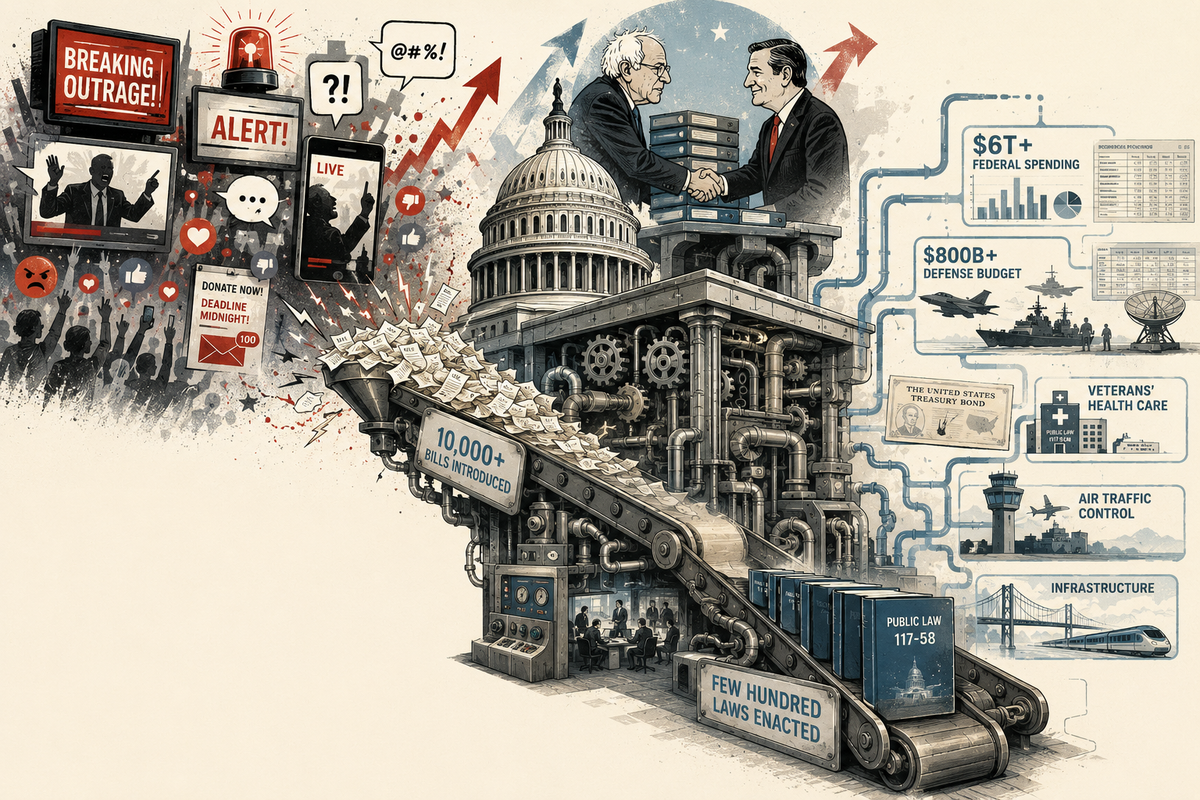
The American public receives a theatrical version of Congress that bears only partial resemblance to how the institution functions.
Spend an evening with political infotainment, and the message feels unmistakable. The nation hovers on the brink of collapse because the bill introduced this morning appears to disregard reason, morality, and basic literacy.
Commentators widen their eyes, donors receive urgent emails demanding action before midnight, and social media fills with declarations that democracy will expire sometime between dinner and the late local news.
Then, in a quieter, much less cinematic process, Congress authorizes the defense budget, funds veterans' hospitals, finances highways, extends aviation programs, and raises the debt ceiling before the Treasury's borrowing authority is constrained.
This contrast captures one of the most important and least appreciated truths in American politics. Congress produces two distinct outputs. One output consists of actual law: appropriations, authorizations, and statutes that allocate money and legal authority across the federal government. The other output consists of content: symbolic bills, hearings, speeches, and clips that help legislators raise money, energize supporters, and signal loyalty to their political tribe.
The first output governs the country. The second output dominates the public imagination.
Most Americans consume the content and miss the governance.
The Quiet Bipartisan Core of the Federal Government
Despite the constant impression of partisan warfare, the United States remains a remarkably stable administrative machine. According to USAspending.gov, the federal government spends trillions of dollars each year. It employs millions of civilian and military personnel, administers transfer programs on a continental scale, and manages debt markets that underpin global finance.
Congress must periodically perform a set of tasks that no responsible governing coalition can ignore. Lawmakers fund agencies, authorize military operations, support veterans' care, reauthorize transportation programs, respond to disasters, and preserve the government's borrowing authority. These actions determine whether aircraft carriers deploy, Social Security checks arrive, air traffic controllers report to work, and Medicare reimbursements clear.
When Congress addresses these matters, ideology tends to encounter a far less emotional but more formidable force: arithmetic.
Members may express strong concerns about the final package. They may denounce specific provisions and issue press releases explaining their dissatisfaction in heroic terms. Yet they often vote for the broader measure because the consequences of failure are immediate and tangible. Voters who enjoy ideological combat in the abstract tend to lose enthusiasm when airports close, Treasury markets convulse, or military paychecks are delayed.
The republic, for all its theatrics, continues to run on negotiated spreadsheets.
The Trillions That Actually Matter: Where Bipartisan Voting Shows Up in the Real World
If one wants to know whether Congress still functions on a bipartisan basis, the best place to look is not the latest symbolic bill with a provocative title. The best place to look is where trillions of dollars move, and institutional failure would produce immediate and measurable consequences.
By that standard, bipartisan voting remains a central feature of American governance.
According to USAspending.gov, annual federal outlays exceed $6 trillion. Much of the legal authority that directs those funds flows through legislation that routinely attracts votes from both parties. The Congressional Budget Office, Congress.gov, and Congressional Research Service document a recurring pattern: when the issue involves military readiness, debt markets, transportation systems, veterans' care, or the basic operating budget of the federal government, legislators who spend the rest of the year denouncing one another often end up on the same side of the roll call.
The annual National Defense Authorization Act authorizes more than $800 billion in defense activity and has historically passed with broad bipartisan margins. Annual appropriations and omnibus spending packages determine how trillions of dollars are distributed across agencies and programs that touch every state and congressional district. Debt ceiling agreements preserve the full faith and credit of the United States, a phrase that sounds like an accounting footnote until one realizes it underpins global capital markets. The Infrastructure Investment and Jobs Act committed $1.2 trillion to roads, bridges, transit, water systems, and broadband. The CHIPS and Science Act directed tens of billions toward semiconductor manufacturing and scientific research.
These are not symbolic gestures. They are industrial-scale reallocations of capital and authority.
Taken together, these bipartisan measures govern a substantial share of the federal government's most consequential activities. They determine whether aircraft carriers deploy, airports remain operational, veterans receive medical care, chip fabrication plants are built, and Treasury securities continue to trade as the world's benchmark safe asset. In other words, the legislation that attracts bipartisan support tends to involve the precise areas where institutional continuity matters most.
The political fights that dominate infotainment may generate more emotional energy, but the roll calls that move trillions of dollars tell a different story. When the stakes become concrete and the costs of failure become unacceptable, Congress still behaves less like a blood feud and more like a board of directors arguing loudly before approving payroll.
Thousands of Bills, Very Few Laws
The difference between symbolic politics and substantive lawmaking becomes obvious when one examines the legislative pipeline. Congress.gov tracks every bill introduced in Congress. During a typical two-year session, lawmakers introduce well over 10,000 bills and resolutions. Only a small fraction become law.
That disparity reflects a simple institutional reality. Filing a bill is easy. Enacting a law is difficult.
A member of Congress can introduce legislation, hold a press conference, and send a fundraising email before lunch. Advancing that proposal through committee, securing floor consideration, navigating Senate procedures, reconciling House and Senate versions, and obtaining a presidential signature requires a broad coalition and a significant investment of political capital.
The incentives are therefore highly asymmetrical. Legislators can receive media attention and donor enthusiasm merely by proposing legislation, even when everyone involved understands that the bill has no realistic path to enactment. In Washington, filing a bill often resembles planting a flag rather than pouring a foundation. The symbolism matters politically, even when no structure will ever rise on the site.
David Mayhew and the Logic of Position Taking
Political scientist David Mayhew explained this dynamic in Congress: The Electoral Connection, a work that remains essential reading for understanding congressional incentives.
Mayhew argued that legislators devote much of their effort to advertising, credit claiming, and position taking. Position taking allows elected officials to communicate values and affiliations to constituents without necessarily changing public policy. A senator can introduce sweeping legislation, condemn entrenched interests, and receive enthusiastic applause while knowing the proposal will expire quietly in committee.
From an electoral perspective, the bill may perform exactly as intended. Its primary function is signaling rather than governing.
Congress as a Dual-Output System
Congress becomes easier to understand when viewed as a dual-output institution.
The first output is governance. Appropriations, authorizations, and statutes direct real money and legal authority. These measures determine which agencies expand, which programs contract, and where trillions of dollars flow through the national economy.
The second output is content. Speeches, hearings, symbolic bills, and social media clips generate attention and reinforce political identities.
Governance changes the structure of the state. Content shapes how citizens perceive politics.
The second output is vastly more visible than the first. Citizens encounter a continuous stream of outrage, while the most consequential work unfolds in committee rooms and conference reports that receive comparatively modest coverage. The result is an information environment in which rhetorical conflict appears central, even when the most important decisions emerge through routine bargaining.
The political system generates an ocean of rhetoric around a small number of decisions that alter the machinery of government.
The National Defense Authorization Act and the Persistence of Bipartisanship
The annual National Defense Authorization Act offers one of the clearest demonstrations of bipartisan governance. According to Department of Defense budget materials, annual defense spending exceeds $800 billion.
The NDAA authorizes military procurement, compensation, research, force structure, and readiness. Members may wage loud battles over controversial amendments, but the core bill typically attracts support from both parties because the operational needs of the armed forces do not pause for partisan branding exercises.
Service members expect paychecks, shipyards expect contracts, and military planners require continuity. The world's largest military does not operate on hashtags, nor does it accept payment in moral indignation.
After the speeches end, Congress votes to keep the system functioning.
Appropriations: The Boring Machinery That Runs the Republic
Appropriations bills rarely inspire viral clips, but they determine whether federal agencies can function. These measures fund salaries, national parks, research grants, veterans' hospitals, border operations, courts, and air traffic control.
The Congressional Budget Office and Congressional Research Service provide detailed analyses demonstrating how these decisions shape every sector of the American economy.
Because appropriations affect every district, lawmakers face strong incentives to compromise. Universities depend on grants, hospitals depend on reimbursements, contractors depend on federal work, and local economies depend on uninterrupted flows of public money. Constituents who cheer ideological combat on television often adopt a more practical attitude when payrolls and procurement contracts are at stake.
Politics rewards outrage in public, but arithmetic imposes sobriety in private.
Debt Ceiling Votes: Ritualized Panic with a Familiar Ending
Debt ceiling negotiations have become Washington's most predictable recurring drama.
The script rarely changes. Leaders warn of catastrophe, while commentators speculate about default. Fundraising emails multiply like algae in a nutrient-rich pond, and markets grow uneasy. Negotiators assemble a package, and enough members from both parties provide the votes necessary to avoid a self-inflicted fiscal crisis.
The U.S. Department of the Treasury describes the consequences of debt-limit impasses in sober bureaucratic prose, which is less entertaining than flashing graphics but more useful.
The rhetoric sounds apocalyptic, but conversely, the ending usually looks actuarial The federal government resembles an aging but well-capitalized industrial conglomerate that complains bitterly while continuing to meet payroll.
Bernie Sanders and the Gravity of Governance
Bernie Sanders offers a revealing example of how ideological rhetoric coexists with practical voting behavior.
Sanders built his national reputation by criticizing billionaires, defense contractors, and concentrated economic power. His speeches often convey the impression that he stands in permanent opposition to much of the American political economy.
Yet when Congress addresses veterans' care, appropriations, and other essential governmental functions, Sanders has repeatedly joined broader governing coalitions. As former chair of the United States Senate Committee on Veterans' Affairs, he worked extensively with Republicans to advance legislation affecting veterans' health care and benefits. He has criticized Pentagon spending levels while still supporting measures that fund military pay and core operations.
This pattern does not reflect inconsistency so much as institutional gravity. Legislators may oppose portions of a bill and still support the larger package because they understand the cost of systemic failure.
Even the revolutionaries vote to keep the elevators running.
Why Political Infotainment Prefers Symbolic Conflict
Modern media organizations operate in an attention market, and attention responds strongly to conflict. Routine competence rarely generates the same emotional reaction as a dramatic showdown framed as a battle for the nation's soul.
Symbolic legislation provides an endless supply of narrative fuel. Whether a bill has any realistic chance of becoming law often matters less than its usefulness as a moral signal and a source of outrage.
The result resembles a financial network that covers meme stocks around the clock while ignoring the bond market. The spectacle captures the audience, but the dull instruments move vastly more money and exert far greater influence over daily life.
Tribal Media and the Manufacture of Political Anxiety
Partisan outlets convert symbolic proposals into identity-reinforcing stories. A bill introduced by a single member can become proof that the opposing party intends to destroy civilization, even when the proposal lacks committee support and no legislative path exists.
This transformation benefits every participant in the political information economy. Politicians raise money, media organizations generate engagement, activists recruit supporters, and consultants produce PowerPoint decks explaining why the current moment is uniquely urgent.
Citizens absorb stress and often confuse a proposal with an enactment. The public receives an industrial quantity of political drama and a surprisingly modest amount of procedural context.
Donnelly's Law and the Expansion of Political Content
Donnelly's Law states that digital content expands to fill available data capacity.
Politics illustrates this principle with almost comic precision. A budget agreement involving a finite number of substantive decisions generates an infinite ecosystem of articles, podcasts, videos, social posts, and fundraising appeals. The underlying legislative event may consist of spending tables and legal text, yet the surrounding commentary expands without obvious limit.
The signal remains finite. The noise grows to planetary scale. The political information economy has mastered the art of manufacturing a hundred hours of outrage from a single spreadsheet.
The Public Gets Snookered
“Snookered” remains the most precise technical term.
Citizens devote enormous emotional energy to symbolic proposals while paying comparatively little attention to the bipartisan decisions that govern national life. They come to believe that every legislative introduction represents an imminent threat, even though the most significant laws typically emerge from negotiated compromises among lawmakers who publicly denounce one another.
The shouting dominates the soundtrack, but the arithmetic controls the machinery.
Final Thoughts: The Republic Runs on Arithmetic
The most visible aspects of American politics reward theatrical confrontation. Legislators perform for voters, political infotainment monetizes conflict, and tribal media transform symbolic proposals into evidence of civilizational peril.
Beneath the noise, Congress continues to perform a practical and surprisingly durable task. It authorizes defense programs, funds agencies, supports veterans, finances infrastructure, and protects the credit of the United States through coalitions that routinely cross ideological lines.
The result is less dramatic than the headlines suggest and more reassuring than many citizens realize.
The republic persists because, when the stakes become genuinely consequential, enough legislators set aside their costumes, enter the conference room, and do the math.
A larger argument concerns actual representative governance: gridlock applies to tribal issues, yet the entire system continues to plod along without meaningful change. For instance, one could argue that the growing wealth disparity in the United States contributes to societal instability. Regardless, the tax code remains unreformed, and the disparities continue to widen, while the electorate bickers over inconsequential issues such as which bathroom which kind of person can use.
That is the core issue and is an indictment of both journalistic ethics and most Americans’ critical thinking abilities.



Comments ()