
Meetings as Status Ritual: Why Modern Organizations Spend More Time Talking Than Working
Why do organizations hold so many meetings? Research on meeting overload, productivity, and Donnelly’s Law explains how calendar bloat turns coordination into performative work.
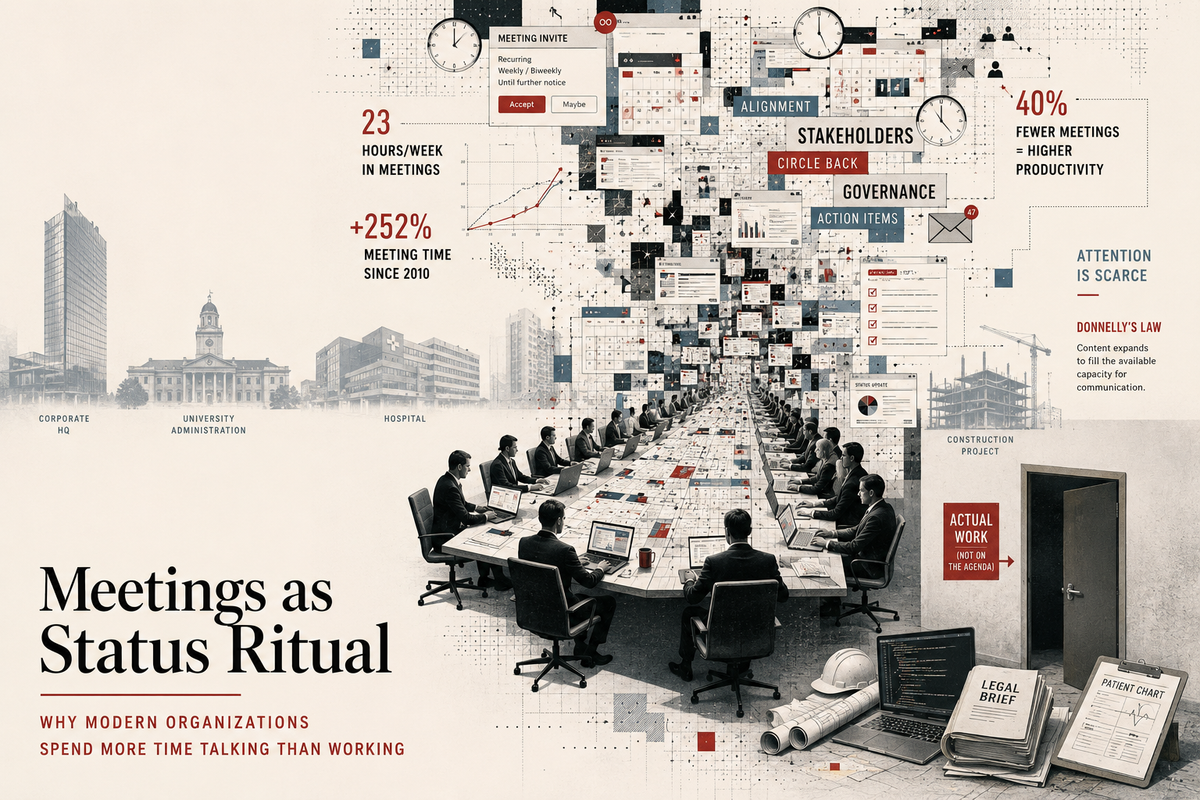
The Workday Turned Inside Out
At some point over the last several decades, the professional workday underwent a quiet but profound inversion. The hours once reserved for designing buildings, writing code, analyzing financial statements, preparing legal arguments, treating patients, and making consequential decisions are now frequently consumed by the apparatus surrounding those activities. By the time the last status call concludes and the final action items are entered into the shared tracker, many professionals discover that the actual substance of their jobs has been pushed to the edges of the day. The visible workday is devoted to coordination, while the real work begins after coordination has exhausted itself.
Anyone who has spent time inside a large institution recognizes the pattern immediately. The software engineer writes production code after dinner because the afternoon was consumed by sprint reviews and architecture discussions. The physician finishes clinical notes at home because the official schedule includes compliance meetings and documentation requirements.
The construction project manager updates the critical path schedule in the evening because the morning was devoted to owner meetings, subcontractor coordination sessions, and procurement calls. The university administrator revises a strategic plan that will be presented to one committee, edited by another, and ultimately endorsed by a third body that is best known for maintaining the appearance of thoughtful governance.
The absurdity is familiar enough to be funny, though the humor fades when one considers how highly compensated labor is consumed by these often frivolous rituals. Modern organizations increasingly devote their most valuable cognitive hours to discussing work rather than performing it, a pattern so widespread that many people assume it is simply the unavoidable price of complexity.
Donnelly's Law and the Expansion of Coordination
Donnelly's Law provides a useful framework for understanding what happened. As communication and data capacity expand, institutions generate additional content until that content saturates the available cognitive and organizational bandwidth. Meetings are among the most visible manifestations of this tendency. Each improvement in communication technology reduces the cost of convening people, distributing information, and documenting participation. Organizations respond as organizations usually do when a constraint disappears: they exploit the new capacity until a different constraint emerges. In this case, the scarce resource is no longer information. It is sustained human attention.
The meeting, therefore, follows a familiar institutional trajectory. It begins as a practical instrument for exchanging information and making decisions. Over time, it evolves into a mechanism for demonstrating diligence, inclusion, and managerial seriousness. The practical function remains, but the symbolic function grows steadily larger until, in some organizations, the ritual consumes more energy than the underlying work.
When Meetings Were Actually Expensive
For much of modern history, meetings were constrained by practical realities. Participants had to gather physically, often traveling significant distances and interrupting ongoing work. Information moved slowly, and managers worked with less frequent reporting. Because assembling a group required genuine effort, organizations typically reserved meetings for issues that justified the cost. A major contract dispute, a capital allocation decision, or a critical operational problem warranted bringing people together. Routine matters were handled more directly because the mechanics of coordination imposed a natural discipline.
That discipline eroded as digital tools transformed the economics of communication. Email made it effortless to copy dozens of recipients. Shared calendars turned scheduling into a nearly frictionless activity. Microsoft Outlook normalized recurring invitations. Zoom, Microsoft Teams, and Google Meet eliminated geography as a meaningful barrier. By the early 2020s, almost any question, no matter how narrow, could be transformed into a recurring meeting involving participants scattered across multiple time zones.
The Economics of Zero-Friction Scheduling
When the cost of convening falls toward zero, demand rarely remains constant. Organizations tend to consume whatever becomes easier to obtain, whether that resource is cloud storage, email distribution lists, or industrial quantities of paper towels purchased from a warehouse club, because they seem too economical to resist. Meetings followed the same pattern. The new tools unquestionably improved communication, but they also made overcommunication nearly inevitable.
The financial cost of meetings remains substantial even though it is largely invisible. A one-hour meeting involving ten well-paid professionals can easily consume thousands of dollars in labor, yet no purchase order appears for "one hour of collective attention." Because the cost is buried within salaries and overhead, organizations treat meetings as if they were free. They are anything but free; they are simply billed to a budget category that nobody experiences directly.
What the Data Show
The empirical evidence suggests that meeting growth has been substantial. Microsoft has reported marked increases in meeting volume, recurring invitations, and after-hours collaboration across its user base. The company’s Work Trend Index describes a workday increasingly fragmented by calendar interruptions, chat messages, and constant context switching. Microsoft Work Trend Index
Academic research points in the same direction. Organizational psychologist Steven Rogelberg has shown that employees value meetings that are focused, purposeful, and decisional, but consistently report frustration with sessions that exist largely because they have always existed. Poorly structured meetings correlate with lower engagement, greater fatigue, and a stronger sense that organizational life has become performative.
One of the most striking recent studies, published in Nature Human Behaviour in 2022, reduced recurring meetings by 40 percent within participating organizations. Researchers found that employees reported higher productivity, greater job satisfaction, and lower stress, largely because they regained longer blocks of uninterrupted time. The findings were notable for their simplicity. When organizations removed a substantial share of recurring meetings, work improved rather than deteriorated. This outcome should not surprise anyone who has ever spent ninety minutes discussing the importance of efficiency with fourteen colleagues while privately wondering whether the entire matter could have been resolved by two competent adults and a phone call.
Meetings as Status Displays
The persistence of meetings despite this evidence reflects that they serve functions beyond operational coordination. They are highly visible and, in environments where direct contribution is difficult to measure, visibility acquires economic and social value. A crowded calendar signals relevance. Leading a steering committee suggests authority. Presenting a polished slide deck conveys ownership and preparedness, even when the presentation mostly explains why no decision has been made yet.
In this respect, meetings operate as status rituals. Their practical purpose is to exchange information and make decisions, but their symbolic purpose is to demonstrate engagement. Participants demonstrate attentiveness, information, and appropriate concern. They speak the specialized dialect of contemporary management, invoking "alignment," "escalation," "stakeholder buy-in," and "operationalization" with the solemnity of clergy reciting a familiar liturgy.
Bureaucratic Insurance Against Blame
Meetings also provide bureaucratic insurance. When projects fail, those who attended can point to the record of discussions as evidence that they were informed and involved. If a schedule slips, managers can reference weekly progress reviews. If costs escalate, the team can cite risk workshops and governance meetings. If the strategic initiative collapses due to overly optimistic assumptions and misaligned spreadsheets, everyone can acknowledge that the issue received extensive attention.
The meeting may not have prevented the problem, but it created a documentary trail showing that the problem was observed from several angles and discussed in excellent detail.
Construction: Where the Building Waits Outside
Construction offers an especially vivid example because the underlying output remains stubbornly physical. Yet a large project can generate an elaborate ecosystem of owner meetings, architect meetings, subcontractor coordination sessions, schedule reviews, procurement updates, and safety briefings. Many of these are indispensable, but beyond a certain point, however, the administrative machinery begins reproducing for its own sake.
The project manager updates the schedule to prepare for the schedule meeting. The design team revises the submittal log for the submittal-log review. The superintendent spends the morning discussing field productivity rather than observing it directly. Outside the trailer, the building continues its slow, indifferent rise, displaying a level of stoicism that would be admirable were it not surrounded by so many color-coded action items.
The Donnelly Threshold
This observation does not imply that meetings are inherently wasteful. Complex institutions require structured communication, and well-designed meetings can prevent costly mistakes. The more important question concerns the point at which additional coordination yields diminishing returns. Within the Donnelly framework, this inflection point is known as the Donnelly Threshold, the moment when each additional meeting consumes more attention than the information exchanged is worth.
Organizations that cross this threshold exhibit familiar symptoms. The same issues reappear without resolution, slide decks summarize earlier slide decks, attendee lists expand, while meaningful participation contracts. Employees report that the most substantive parts of their jobs must be completed before breakfast, after dinner, or during the occasional blessed stretch of calendar whitespace. Everyone appears intensely occupied, yet important decisions advance with the stately tempo of a historic-preservation commission evaluating whether a downspout should be painted eggshell or antique ivory.
What Effective Leaders Do Differently
The most effective leaders recognize the danger intuitively. They convene the relevant participants, frame the decision, assign accountability, and move on. Their calendars may appear less heroic than those of colleagues who spend the week moderating alignment sessions, but their organizations tend to move with greater clarity and speed because they treat attention as a scarce asset rather than an inexhaustible public utility.
The objective is not to eliminate meetings. The objective is to ensure that meetings serve execution rather than replace it.
The Broader Meaning of Meetings as Status Ritual
The broader significance extends well beyond workplace scheduling. Donnelly’s Law describes a recurring tendency of modern institutions to transform every increase in informational capacity into additional layers of reporting, coordination, and symbolic oversight. Dashboards multiply, notifications proliferate, and meetings spread across the calendar with the persistence of a particularly resilient invasive species that nobody recalls planting, but everyone now accepts as part of the landscape.
The institution becomes more elaborate, more communicative, and less decisive.
Seen from this perspective, the crowded calendar is not simply a personal inconvenience. It is a visible symptom of a deeper institutional condition. In an era defined by abundant information, attention has become a truly scarce resource.
Organizations that fail to protect it gradually convert talented professionals into custodians of issue logs, manufacturers of iterative presentation decks, and recurring invitations. The machinery of management continues to hum, and the indicators of activity remain impressively robust, yet genuine progress increasingly depends on those increasingly rare moments when the meetings end, the notifications quiet down, and someone is finally left alone long enough to do the work that mattered all along.
Comments ()