
When Data Becomes a Religion
Donnelly’s Law explains why institutions generate endless reports, dashboards, and analytics while becoming slower and less decisive. The professional managerial class has powerful incentives to treat more data as inherently valuable.
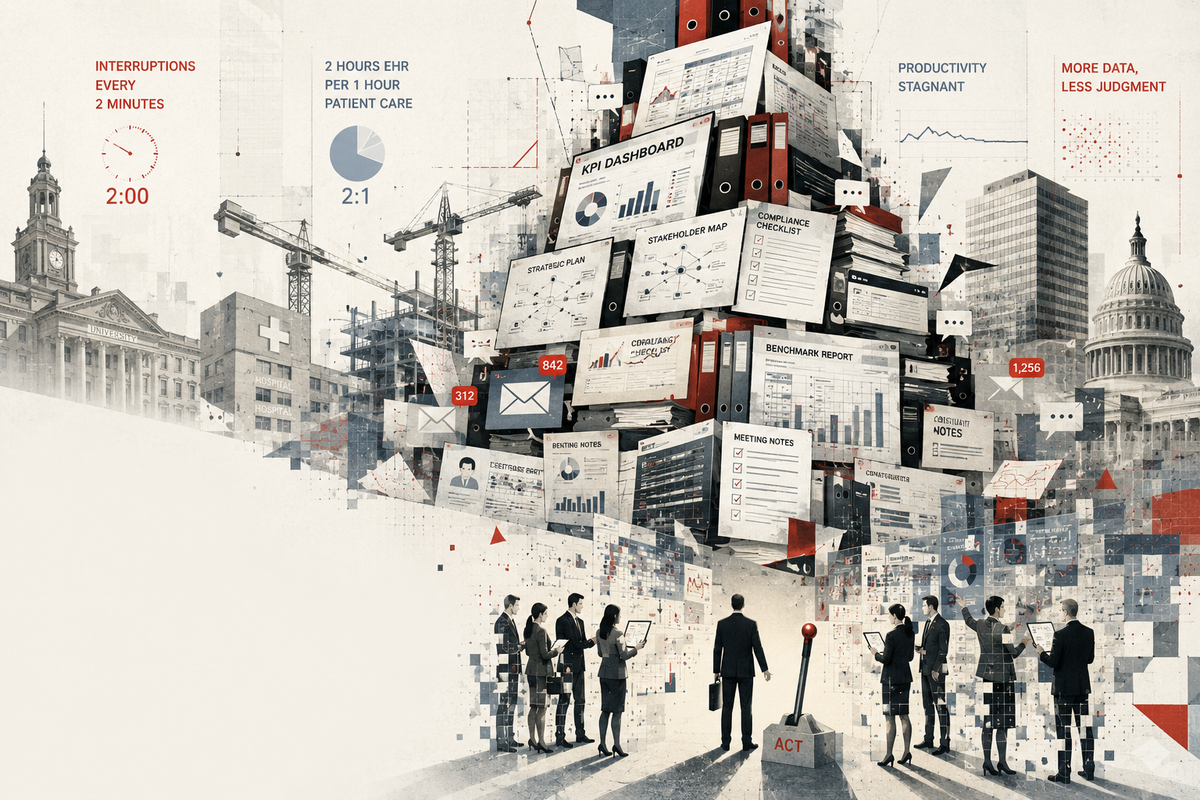
Every institution has the same instinct when performance begins to slip. A construction project falls behind schedule, and the project team responds with another dashboard, a longer RFI log, and twice as many coordination meetings. A university sees enrollment soften and commissions a strategic plan, a benchmarking exercise, and a consultant presentation. A hospital reports physician burnout and adds more documentation requirements to the electronic health record. A corporation misses its quarterly targets, and executives demand revised KPIs, fresh analytics, and a new set of slides.
The assumption behind these responses almost never receives serious scrutiny. If an organization struggles, it needs more information. That belief has become one of the governing myths of modern institutional life. More data is treated as inherently clarifying, more reporting is a surrogate for greater rigor, and more analysis is assumed to reduce uncertainty.
In many cases, the opposite occurs. Reports accumulate while accountability dissipates. Meetings proliferate while decisions are delayed. Metrics multiply while performance remains flat. Institutions become increasingly sophisticated in the language they use to describe problems, even as their ability to solve those problems deteriorates.
Donnelly’s Law describes this pattern succinctly. Digital content expands to fill available data capacity. As the cost of producing, storing, transmitting, and summarizing information approaches zero, organizations generate more analysis than human beings can meaningfully absorb. The fundamental constraint shifts away from access to information and toward attention, judgment, and execution.
This dynamic helps explain one of the most visible paradoxes of contemporary life. We live in the most measured, benchmarked, and documented era in history, yet many institutions feel slower, more expensive, and less decisive than they did decades ago. The issue is not that leaders lack information. The issue is that they possess more information than they can convert into action.
Evidence Is Everywhere
The empirical case for information overload extends across nearly every sector of the economy. Microsoft reported in its 2025 Work Trend Index that knowledge workers are interrupted roughly every two minutes by meetings, emails, and chat messages. More than half of meetings are ad hoc. Large portions of the workday are now devoted to reacting to incoming signals rather than completing substantive work.
Healthcare offers a more consequential example. Studies published in the Annals of Internal Medicine found that physicians often spend substantially more time interacting with electronic health records than with patients. In some primary care settings, clinicians devote approximately two hours to documentation and computer tasks for every hour of face-to-face clinical care. Technology has improved access to information, but it has also shifted a large share of physicians' effort away from direct patient care.
Construction shows the same pattern in a different form. McKinsey & Company has repeatedly noted that construction productivity has remained stubbornly weak despite enormous investments in BIM, scheduling software, cloud collaboration platforms, drone imaging, and digital field reporting. The industry generates vastly more information than it did twenty years ago, yet the conversion of that information into faster and cheaper project delivery remains inconsistent.
Higher education provides another example. Universities have added substantial layers of assessment offices, student success teams, compliance staff, communications professionals, and strategic planning units. Public confidence in higher education has declined even as administrative complexity has expanded. Institutions have become increasingly adept at measuring and documenting their activities, while the cost and perceived value of their core mission continue to face skepticism.
Taken together, these examples suggest that information growth and organizational effectiveness are not synonymous. More data can improve decisions, but beyond a certain point, it often produces diminishing returns and, eventually, institutional drag.
Why the Professional Managerial Class Has Little Incentive to Resist
The persistence of this pattern raises an obvious question. Why do the most educated and analytically sophisticated professionals rarely challenge the assumption that more information is always better?
The answer lies in the economic role of the professional managerial class. Consultants, analysts, administrators, compliance officers, communications specialists, strategists, and layers of management derive much of their authority from collecting, interpreting, and organizing information. Their work is not primarily the direct production of goods and services. Their work consists of mediating complexity.
That mediation takes the form of reports, dashboards, assessments, benchmarking studies, stakeholder meetings, strategic plans, and compliance systems. As these informational structures expand, demand for the professionals who create and interpret them expands as well.
No conspiracy is necessary as the incentive structure is straightforward. Additional reporting creates additional managerial work. New compliance requirements create new compliance roles, and expanded analytics require more analysts. Strategic planning exercises sustain consultants and administrators, and information growth increases the institutional importance of those whose expertise centers on information itself.
Data as Status and Symbolic Power
The sociology of this process matters as much as the economics. Pierre Bourdieu argued that elites maintain authority by controlling symbolic systems, credentials, and the language of legitimacy. In contemporary institutions, fluency in metrics, frameworks, and procedural terminology functions as a form of symbolic capital.
Those who command dashboards and analytical vocabulary appear objective, sophisticated, and rigorous. Those who rely on practical judgment and experience may be correct, but they often appear less systematic. The spreadsheet becomes a credential, the presentation deck a signal of expertise, and the dashboard an instrument of authority.
This helps explain why additional data carries prestige even when its practical value is uncertain. Producing analysis does not merely inform decisions. It reinforces status within the institutional hierarchy.
The Report as Institutional Ritual
Many reports serve a symbolic function that extends well beyond their informational content. A lengthy presentation signals diligence, while a stakeholder matrix signals inclusiveness, and a benchmarking appendix signals rigor. A dashboard filled with indicators signals control.
These artifacts often resemble ritual objects. They reassure participants that the institution has acted responsibly and followed an appropriate process. Whether the resulting decision proves effective is, in some cases, secondary to the process itself appearing legitimate.
The report therefore performs two functions at once. It conveys information, and it provides institutional insurance.
The Alibi Economy
Documentation also distributes responsibility. When a decision fails, leaders can point to the consultant study, the legal review, the stakeholder outreach, and the KPI dashboard. The outcome may have been poor, but the process appears defensible.
In this environment, paperwork becomes an alibi. Additional analysis reduces personal risk more reliably than it improves institutional performance. Requesting another study appears prudent, and conversely, acting decisively without one appears reckless.
The safest career strategy is often to ask for more information, even when the organization already knows enough to proceed.
Construction as a Clear Example
Construction makes this dynamic easy to see. A complex project may generate thousands of RFIs, submittals, meeting minutes, change logs, and schedule updates. These tools are often essential, but they also consume significant managerial attention.
The success of the project still depends on fundamentals: labor productivity, sequencing, material availability, trade coordination, and decisive field leadership. No amount of documentation can compensate for weak execution.
The same principle applies to universities, hospitals, corporations, and governments. Information supports action, but it cannot substitute for action.
Artificial Intelligence Will Intensify the Problem
Artificial intelligence reduces the cost of producing memos, reports, slide decks, forecasts, and summaries to almost nothing. OpenAI, Anthropic, and similar firms are making professional-looking analysis available instantly.
This development will not solve information overload. It will magnify it. When analysis becomes nearly free, institutions will face an even larger supply of polished content. The scarce resource will become the willingness to say that the remaining uncertainty cannot be eliminated and that a decision must be made.
That shift will expose a central truth: information production is abundant while sound judgment remains scarce.
What Actually Matters
The economy no longer suffers from a shortage of data. It suffers from shortages of attention, judgment, courage, and accountability. These capacities remain difficult to automate and difficult to institutionalize.
The most valuable professionals of the next decade will not be those who produce the most reports. They will be those who can separate signals from noise, decide under uncertainty, and accept responsibility for the consequences.
Conclusion
Donnelly’s Law is not merely a comment on email overload or bureaucratic excess. It is a theory of how modern institutions preserve and reproduce themselves. As information becomes cheaper to generate, organizations produce more of it. Entire professional ecosystems arise to organize, interpret, and legitimize that growing stream of content. Over time, the production of analysis becomes partially detached from the practical outcomes it was meant to improve.
The result is a world in which institutions document more and accomplish less, measure more and understand less, and communicate more while becoming less decisive.
The modern world does not suffer from a shortage of information. It suffers from an overproduction of professionally mediated interpretation. In many cases, organizations already possess enough data to act, but what they lack is the willingness to accept uncertainty, exercise judgment, and bear responsibility for the result.
Information is abundant, bandwidth is cheap, but judgment is scarce, and accountability is the rarest thing of all.


Comments ()