
Why Northwestern Extending Chris Collins Signals a Program Losing Direction
Northwestern’s extension of Chris Collins ignores clear warning signs: transfer portal losses, inconsistent results, and a failure to adapt to the NIL era. A deeper look reveals a program stuck between past success and modern demands.
Northwestern did not just extend Chris Collins. It made a choice about how it intends to operate in a sport that has already moved past the assumptions on which Collins built his career. Strip away the polite language and the donor-friendly messaging, and the decision comes into focus. Northwestern is betting that continuity can still compete with adaptation.
That is a strange bet in 2026.
Collins deserves credit for pulling the Northwestern Wildcats out of irrelevance and into something resembling a real program. Tournament appearances matter in Evanston in a way they do not in East Lansing or Bloomington. He gave Northwestern legitimacy, and for a time, that looked like the beginning of something sustainable. The problem is that the sport did not stay still long enough for that foundation to harden into anything permanent.
The Moment Everyone Celebrated Now Looks Like a Peak
The most telling snapshot of Collins’ tenure came in March 2024, when WGN-TV ran a segment built around the phrase “what a difference a year makes.” Northwestern had just secured its second consecutive NCAA Tournament appearance, and Collins looked like a coach who had finally stabilized the program. One year earlier, he had broken through after a long drought, under public heat from the Northwestern Athletic Director, Derrick Gragg. The repeat performance turned that breakthrough into what felt like a trend.
That narrative made sense in the moment. It also froze the story at exactly the wrong time.
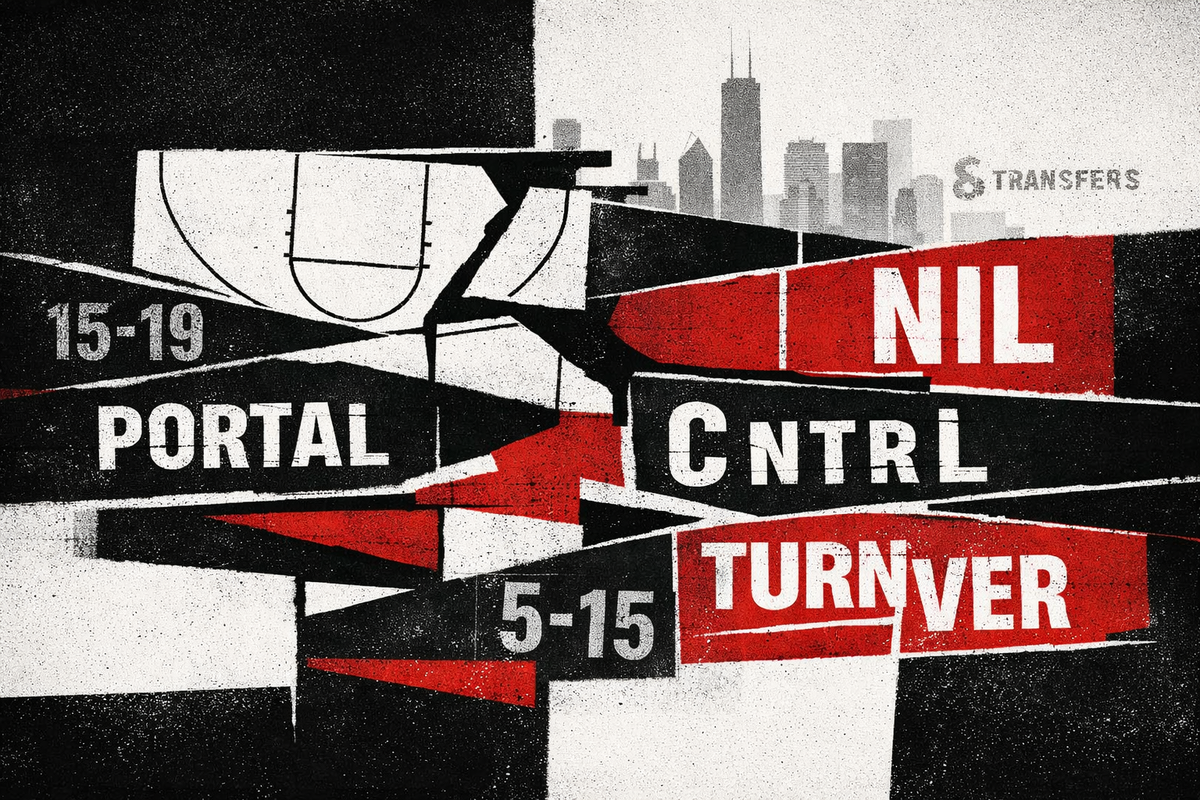
Because the same phrase is very different now. Within a year of that segment, Northwestern slid back toward its baseline. The 2025–2026 season ended with a record of 15 -19 overall and 5 -15 in conference play, and then the roster fell apart in the transfer portal. What looked like forward momentum now looks more like a temporary spike. The WGN segment captured the high point, not the direction of travel.
A Program That Oscillates Instead of Building
Once you step back, the pattern becomes difficult to ignore. Collins’ tenure has not followed a steady upward climb. It has moved in waves, long stretches of ordinary results interrupted by brief surges that reset expectations just enough to keep the larger questions at bay. And those surges were preceded by extreme pressure to perform.
That matters because sustainable programs do not behave this way. They may not win the conference every year, but their floor rises and stays elevated. Northwestern keeps returning to the same neighborhood. The record settles near .500, the offense stagnates, and the roster composition starts to look thin. Then, under pressure, the program tightens up, produces a respectable season or two, and the cycle resets.
That is not growth. It is repetition.
Pressure Produced Results, Not a System
Northwestern never publicly framed it this way, but Collins entered his best stretch with real pressure behind him. The program had stalled, and the patience that defines private institutions began to look more like quiet impatience. When the results finally came, they came quickly and decisively. Collins showed he could coach at a high level when the urgency became unavoidable.
That should count in his favor. It also reframes the entire conversation.
If the best results arrive only when the pressure becomes unmistakable, then success is reactive rather than structural. It suggests a coach who responds to circumstances rather than one who consistently stays ahead of them. In the current version of college basketball, where the ground shifts every offseason, that distinction becomes the difference between keeping pace and falling behind.
Built in a System That No Longer Exists
Collins’ background explains why this tension persists. He trained in the Duke Blue Devils men's basketball program under Mike Krzyzewski, a system built on hierarchy, discipline, and control. Players stayed long enough to be developed, and the program dictated the timeline. That model produced excellent teams because it controlled the variables that mattered.
Modern college basketball removed those controls.
Players now operate in an open market, reassessing their value every offseason and moving accordingly. Coaches no longer shape four-year arcs. They manage twelve-month cycles. Programs that thrive accept that reality and build around it, treating the transfer portal as a primary tool rather than a last resort.
Northwestern still shows the imprint of the older system. It leans on development, continuity, and internal culture, all of which still matter but no longer carry the weight they once did. In a league that has embraced constant roster construction, that approach leaves too much to chance.
The Chicago Advantage That Rarely Shows Up
If there is one area where this misalignment becomes impossible to ignore, it is recruiting. Northwestern sits in the middle of one of the most productive basketball regions in the country. The Chicago area produces high-major guards and wings every year, and the broader Midwest pipeline feeds the Big Ten with reliable depth. Geography alone should give Northwestern a structural edge.
It rarely looks like one.
Programs across the conference consistently pull talent out of Chicago, often without Northwestern seriously threatening to keep those players home. That is not a matter of distance or visibility. It is a matter of presence and execution. Chicago recruiting runs on relationships, repetition, and credibility within a tight network of high school programs and AAU circuits. The programs that win locally show up constantly and build those connections over time.
Northwestern has too often felt peripheral in that ecosystem, and the modern NIL layer only sharpens the gap. Prospects now evaluate opportunities through a combination of role, exposure, and compensation. When a program cannot consistently compete across those dimensions, proximity ceases to be an advantage and becomes a wasted opportunity.
For a program sitting in that location, the expectation should be simple. You do not get outworked in your own backyard. When that happens repeatedly, the issue is not access. It is a strategy, a chosen disability, or perhaps a cultural misalignment.
The Portal Did Not Create the Problem, It Exposed It
The transfer portal has a way of clarifying things that used to remain hidden. It strips away the language of culture and continuity, replacing it with decisions that carry immediate consequences. Players stay when the situation aligns with their interests. They leave when they do not.
Northwestern’s recent roster churn is not random noise. It reflects a program that has not fully aligned itself with the incentives driving the modern game. Key contributors left, replacements lagged, and what should have been a manageable transition turned into a reset.
A portal departure of this magnitude, eight players departing, indicates issues, like a lack of NIL cash, internal morale issues, or both.
A system that depends on keeping players cannot survive in an environment that encourages movement. That contradiction sits at the center of Collins’ current challenge.
Extending Collins Locks In the Wrong Model
Contract extensions are supposed to answer a forward-looking question about fit. Northwestern answered that question by committing to a coach whose strengths were built in a different version of the sport and whose adjustments have tended to follow pressure rather than anticipate change.
That does not mean Collins cannot evolve. Coaches do adapt, and he has already shown flashes of it. The issue is timing and consistency. The rest of the conference is not waiting. Programs are investing in NIL as a core budget item and treating roster construction as an annual exercise in acquisition and replacement.
Northwestern extended a coach who still appears more comfortable preserving structure than constantly rebuilding it. That is not a fatal flaw on its own, but it becomes one when the entire ecosystem rewards the opposite approach.
The Danger Is a Comfortable Middle
Northwestern is not going to collapse under Collins. The team may remain competitive enough to avoid embarrassment, and there may be seasons that generate optimism and even a sense of relevance. That is precisely what makes the current path risky.
Programs rarely fade by failing outright. They fade by settling into a version of themselves that feels acceptable but never quite advances. They finish in the bottom third of the Big Ten Conference, generate just enough momentum to maintain the status quo, and watch the gap between themselves and the top tier widen gradually.
That is where Northwestern is headed if nothing changes.
What “A Difference a Year Makes” Really Means
The WGN segment captured a moment that felt like validation. In hindsight, it captured something else as well. It showed how quickly a narrative can shift when the underlying structure does not support it.
One year, Collins looked like a coach who had solved the problem. The next, the same questions returned, reinforced by a losing record and a roster in flux. That is not what stability looks like. It is what a temporary correction looks like when the deeper issues remain unresolved.
Conclusion
Chris Collins proved he can win when the situation demands it. He proved he can adjust under pressure and produce results that matter for a program like Northwestern. What he has not proven is that he can consistently operate in a system that demands constant adaptation and aggressive roster management.
Northwestern chose to extend him anyway.
That decision does not guarantee failure, but it does suggest a misunderstanding of where the sport is heading. The conditions that once allowed Collins to succeed no longer define the landscape, and treating them as if they still do invites the same cycle to repeat.
In a league that is moving quickly, standing still is not neutral. It is a decision.

Comments ()