
System Failure Without Collapse: Why Outcomes Are Breaking While Everything Still Looks Normal
Why college sports, media, dating, and the professional class feel unstable right now. A systems-level analysis of why inputs keep rising while outcomes become unpredictable.
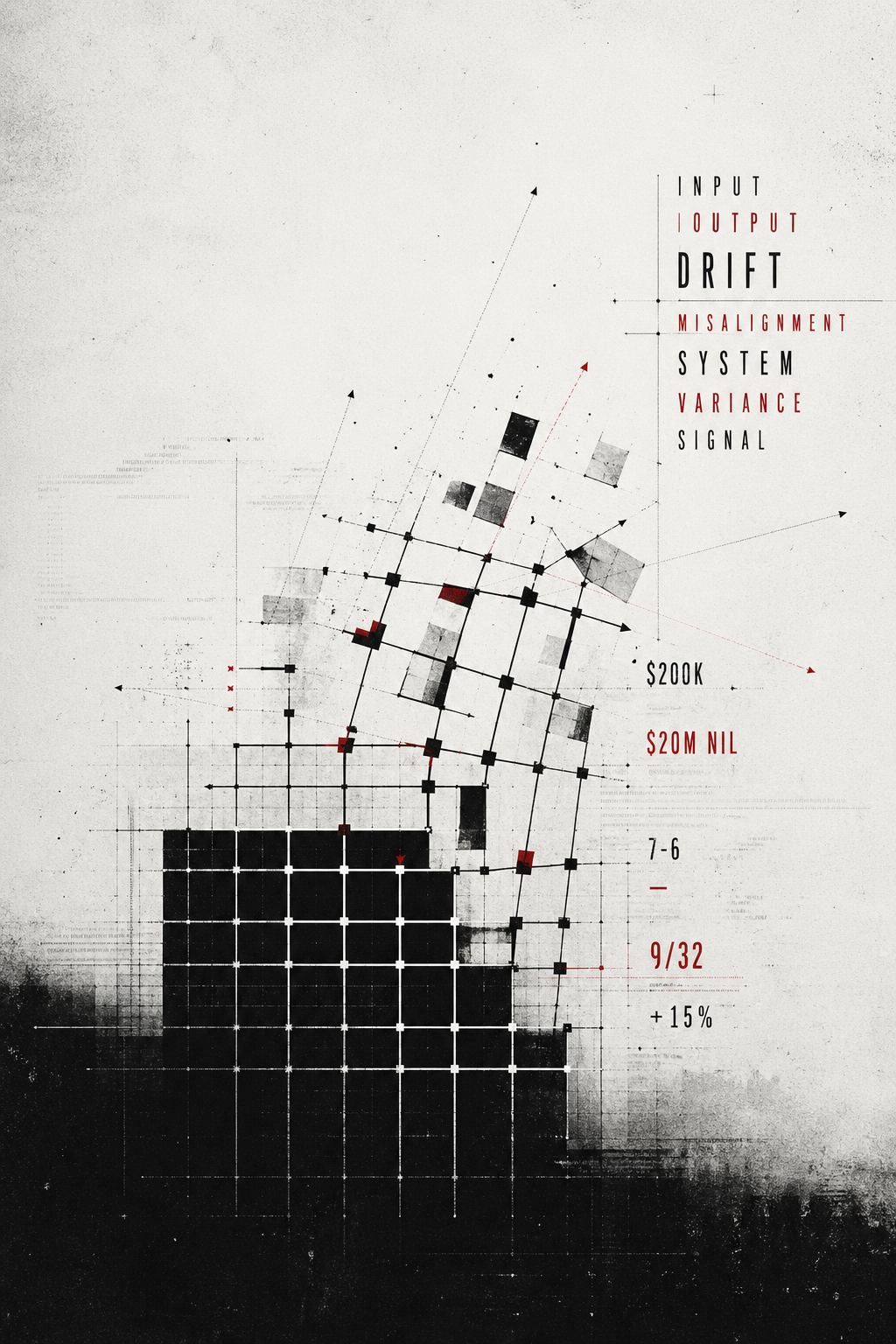
The System Didn't Collapse. It Drifted.
Spend a day moving through ordinary American life, and nothing immediately signals that anything fundamental has broken. Stadiums fill on Saturdays, offices remain busy during the week, and the same platforms that dominated attention five years ago still do. People continue to date, apply for jobs, pursue degrees, and consume media in patterns that feel familiar enough to avoid triggering alarm.
That surface continuity is precisely what makes the current moment difficult to interpret. The structure is still standing, participation remains high, and the rituals have not changed. What has changed is the reliability of outcomes.
Across multiple domains, the relationship between effort and result has weakened. High investment no longer guarantees performance in college athletics. Information is more abundant than ever, yet harder to trust or synthesize. Credentials continue to accumulate, but their signaling power has diluted. Dating produces more interaction but less stability. These are not isolated anecdotes. They reflect a consistent pattern.
The system did not collapse. It drifted.
That distinction matters because drift does not trigger immediate correction. Collapse forces recognition. Drift invites denial, or at least delay, because the system continues to function well enough to justify continued participation. People keep investing in structures that no longer deliver what they once did, often increasing their level of effort in response to declining returns.
Why Systems Feel Broken Right Now
Search for explanations of why "everything feels off" and most answers lean cultural. They point to generational shifts, changing values, or declining norms. Those factors exist, but they do not fully explain why similar patterns are appearing across unrelated domains.
A more precise explanation sits at the systems level.
For decades, many core American systems operated on a relatively stable equation. Resources went in, a defined process followed, and outcomes emerged within a predictable range. That predictability allowed individuals and institutions to make long-term decisions with some confidence. It created a sense that while outcomes were not guaranteed, they were at least bounded.
What has changed is not the presence of those systems, but the strength of the connection between their inputs and outputs.
Inputs continue to rise. Tuition increases, facilities expand, time commitments grow, and informational bandwidth multiplies. Processes remain in place, often becoming more complex rather than less. Yet outputs have become more variable, less predictable, and in some cases detached from the level of investment altogether.
This is the core dynamic driving the current sense of instability. It is not that systems have disappeared. It is that they no longer behave in ways that align with the assumptions people bring into them.
College Athletics and NIL: A System Rewritten in Real Time
If you want a domain where the shift is visible without much interpretation, college athletics provides one of the cleanest case studies.
The traditional model depended on constraint. Player movement was limited, compensation was restricted, and recruiting was restricted to geographic and institutional boundaries. Programs built advantages through facilities, coaching continuity, and long-term development. The result was not perfect parity, but it was a system where inputs and outputs generally tracked over time.
That structure has changed quickly.
Name, image, and likeness compensation, along with the transfer portal, have introduced a level of fluidity that did not previously exist. Talent can move across programs with far less friction. Financial resources can be deployed directly to influence roster composition. Development cycles that once took years can now be bypassed through targeted acquisitions.
The visible structure of college athletics remains familiar. Teams still represent universities, conferences still organize competition, and fans still engage in the same rituals. Underneath, the operating logic has shifted toward a marketplace dynamic that resembles professional sports without the same regulatory framework.
This shift weakens the predictive power of traditional inputs. Investment in facilities or long-term development no longer guarantees continuity. Coaching stability matters, but it competes with immediate financial incentives that can quickly alter rosters. Programs that were built to optimize under the old model now find themselves adapting to a system that rewards different behaviors.
The result is not immediate collapse. It is uneven performance, sudden swings, and a growing sense that outcomes are harder to anticipate, even when resources are known. As NIL collectives become more sophisticated, the next phase will likely involve internal resource-allocation decisions that resemble salary-cap management, even if they are not labeled as such.
The Attention Economy: More Information, Less Signal
The modern media environment offers a different version of the same structural shift.
The legacy system imposed friction through editorial processes. Information moved more slowly, but it passed through filters that prioritized coherence and verification. This limited volume, but helped maintain a shared baseline of reality.
The current system removes much of that friction and replaces it with algorithmic distribution. Content moves instantly, and engagement metrics determine visibility. This dramatically increases the amount of available information, but it also changes what gets seen.
Content that generates strong reactions tends to outperform content that is measured or nuanced. Over time, this creates a selection effect where certain types of information become more prominent, not because they are more accurate, but because they are more engaging. Moderate perspectives often receive less distribution, while extreme or emotionally charged content is amplified.
The system still produces information at scale, which can create the impression of comprehensiveness. In reality, it is shaping perception through its distribution mechanics. Audiences are not just consuming information. They are consuming the output of a system optimized for attention.
This does not mean that accurate information is unavailable. It means that the path to finding and trusting it has become more complex. The burden shifts from the system to the individual, who must now navigate an environment where visibility and reliability are not aligned.
Why Dating Feels Broken in the App Era
Few domains make the effects of system drift more personal than dating.
At a surface level, the process still looks familiar. People meet, communicate, and form relationships. The language and rituals have not disappeared. What has changed is the structure within which those interactions occur.
Historically, dating operated within constraints that limited choice and increased accountability. Geographic proximity narrowed the pool of potential partners. Social networks overlapped, creating feedback loops where behavior had reputational consequences. These constraints were not always comfortable, but they helped align expectations with reality.
Modern dating platforms remove many of those constraints. They expand the pool of potential partners and introduce algorithmic systems that determine visibility. This creates an environment where individuals are exposed to more options but with less context.
When perceived choice expands dramatically, expectations tend to rise. When alternatives appear abundant, the cost of committing to any single option increases. At the same time, visibility is influenced by engagement patterns, which can elevate certain traits while suppressing others.
The result is a system that produces a high volume of interactions but struggles to produce stable outcomes at the same rate. Participants remain engaged because the system continues to generate opportunities, yet the durability of those opportunities declines.
This dynamic is not a reflection of individual failure. It is a structural outcome of a system that maximizes exposure without providing mechanisms to stabilize selection. Over time, systems like this often generate new constraints, whether through social norms, platform changes, or shifts in behavior, because unconstrained environments rarely sustain equilibrium.
The Professional Management Class and Credential Inflation
The professional management class illustrates how system drift can occur even when the language of stability remains intact.
For decades, education and credentials functioned as reliable signals of competence and commitment. Career paths, while not identical for everyone, followed recognizable trajectories within organizations. Economic outcomes varied, but the system provided some predictability for those who followed its rules.
That predictability has weakened.
Credentials have become more widespread, which reduces their ability to differentiate candidates. At the same time, the cost of obtaining those credentials has increased, raising the required investment to enter the system. Technological change and organizational restructuring have introduced additional variability into career outcomes.
The result is a wider distribution of outcomes for individuals with similar inputs. High performers can still achieve significant success, but the middle of the distribution experiences more uncertainty than in previous decades. Following the traditional path no longer guarantees the same level of stability.
This shift changes behavior. Individuals pursue additional credentials, seek alternative career paths, or remain in transitional states longer. These responses are rational within the new environment, but they also contribute to increased competition and rising expectations, reinforcing the system's underlying dynamics.
The Structural Forces Behind System Drift
The similarities across these domains are not coincidental. They reflect a set of common forces that are reshaping how systems operate.
One of the most significant forces is the removal of friction. Technology has reduced barriers that once limited participation and stabilized outcomes. While this increases access and efficiency, it also removes constraints that helped align expectations with reality.
A second force is the expansion of choice without corresponding mechanisms for alignment. More options can improve outcomes when individuals have the tools and information to evaluate them effectively. Without those tools, expanded choice can lead to fragmentation and instability.
A third force is incentive misalignment. Many systems are now optimized for metrics such as engagement, growth, or short-term performance rather than long-term stability or quality. When incentives shift, behavior follows, often in ways that degrade the system's original function.
When these forces operate together, systems tend to drift rather than collapse. Outputs become less reliable, and participants adjust their behavior, further destabilizing the system. Trust erodes gradually, which makes the problem harder to identify and address.
Transitional Stability and Why It Misleads People
The current moment is one of transitional stability.
Legacy systems continue to operate, and their visible structures remain in place. New dynamics are emerging, but they are not yet fully understood or uniformly applied. Surface indicators suggest continuity, delaying recognition of a larger change.
This creates a period where individuals and institutions continue to make decisions based on outdated assumptions. Investments are made with expectations that no longer align with how systems function. When outcomes fall short, the explanation is often framed in terms of individual performance rather than structural change.
Because the system has not visibly failed, feedback signals are weak. This allows the drift to continue longer than it would in a scenario where failure is immediate and obvious.
Transitional stability is not a permanent condition. It is a phase that precedes either re-stabilization under new rules or more visible forms of disruption.
What Comes Next
Systems that drift eventually move toward a new equilibrium or experience pressures that force change.
In some cases, new rules and incentives emerge that restore a degree of predictability. In others, systems fragment into smaller units that operate under different logics. In still others, visible breakdown accelerates adaptation by making the underlying issues impossible to ignore.
The pace of change will differ across domains. College athletics is already deep into its transition. The media environment continues to operate under strong engagement incentives that shape its output. Dating and professional life remain in more fluid states where individual adaptation plays a larger role.
The critical factor is recognition. Individuals and institutions that understand how systems have changed are better positioned to adjust their strategies. Those who continue to operate under previous assumptions are more likely to experience repeated mismatches between effort and outcome.
The Real Divide
The emerging divide is not primarily political or generational. It is perceptual.
It separates those who recognize that systems have changed from those who continue to assume continuity. This difference in perception influences decision-making in ways that compound over time.
The systems themselves have not disappeared. They still exist, and they still produce outcomes. What has changed is how those outcomes are generated and how reliably they can be predicted.
Understanding that shift is no longer optional. It is becoming a prerequisite for navigating systems that look familiar but operate under different rules.



Comments ()