
Northwestern Athletics Scandal Settlements: What Remains Hidden
Northwestern settled its athletics hazing lawsuits and Pat Fitzgerald’s $130 million claim, but the costs, evidence, and institutional accountability remain hidden.
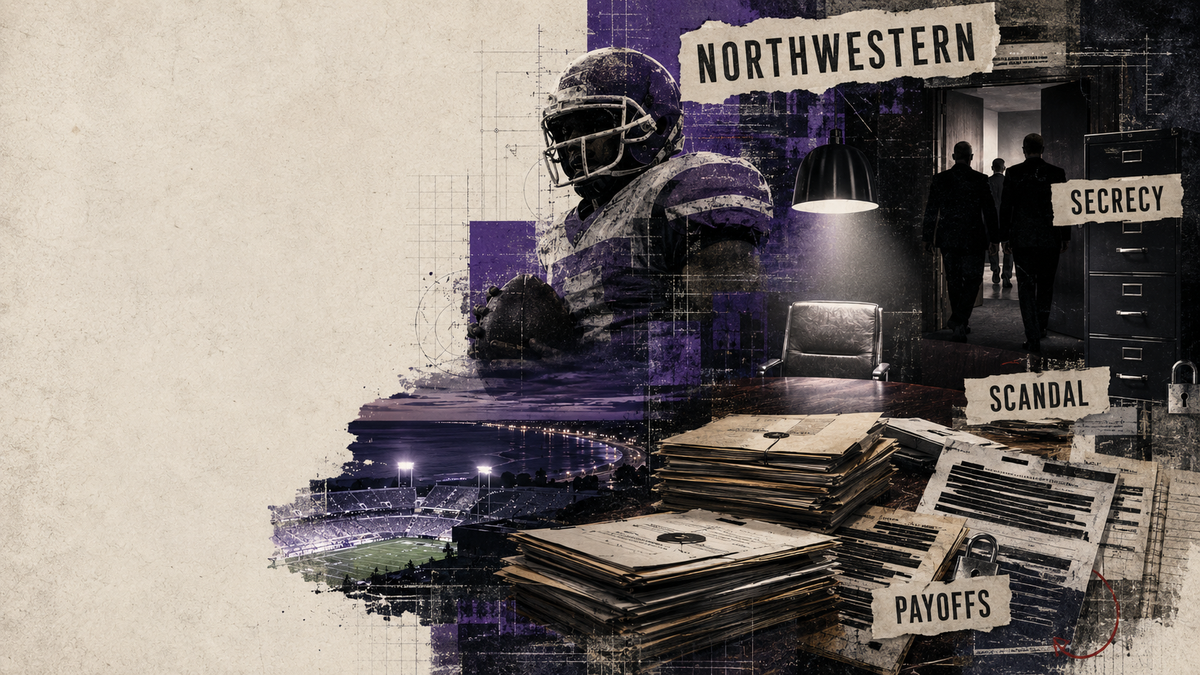
Northwestern quietly ended dozens of athlete lawsuits and Pat Fitzgerald's $130 million case without a trial, a disclosed settlement amount, or a public record of what happened. The school's own financial report admits litigation hurt its bottom line, but it won't say how much of that damage came from athletics.
Northwestern spent most of 2025 staring down something it had dodged since the football hazing scandal broke: a courtroom where it would have to answer questions under oath.
Five former players had cases reportedly headed for trial in November. Fitzgerald's $130 million wrongful-termination suit was on the same calendar. The two tracks were tangled in discovery, meaning testimony and documents from one case could bleed into the other. Players who said the football program subjected them to sexualized hazing were set to testify in the fired coach's lawsuit. For the first time, Northwestern couldn't just manage the story with press releases and outside reviews. It would have had to present witnesses, internal emails, and its actual reasoning for firing Fitzgerald to a judge.
None of that happened.
Northwestern settled the remaining athlete cases quietly in the spring. Then, in August, it settled with Fitzgerald too. The trials vanished. The settlement amounts stayed sealed. Two years of discovery, all that digging into what the university knew and when, never turned into anything the public could read. Northwestern admitted "highly inappropriate conduct" had taken place and hurt players, then turned around and said discovery never proved any player told Fitzgerald about the hazing or that he condoned it. Fitzgerald called himself vindicated. Weeks later, he was back in the Big Ten as Michigan State's head coach.
News Expeditions has covered the Michigan State hiring of Fitzgerald as a potential liability, from the standpoint that the settlement didn’t exonerate him, and that Michigan State can ill afford another scandal.
There's no proof Northwestern settled specifically to bury information. Settlements protect plaintiffs from more exposure, save defendants from the gamble of trial, and let everyone skip years of legal bills. The former players had every reason to want privacy, and confidentiality may well have been the price of getting them to agree to anything at all.
But here's what actually happened either way: the settlements wiped out the only proceedings that were ever going to explain how Northwestern athletics really operated, what the university's leaders knew and when, why the school flipped its punishment of Fitzgerald within three days, and what the whole mess cost. And Northwestern hasn't lifted a finger, voluntarily, to rebuild any part of that record.
That's the real scandal now. Hazing is what dragged Northwestern into court. Secrecy is what let it walk without ever explaining itself.
The Trials That Never Happened
The timing here matters because the athlete cases and Fitzgerald's lawsuit put Northwestern in a bind from two directions at once.
Former players said Northwestern let a football culture take root that included physical abuse, racial humiliation, and sexualized hazing. Fitzgerald denied knowing anything about it. His suit claimed that Northwestern had no real cause to fire him and that it broke an oral agreement that his original two-week suspension would be his entire punishment. He wanted roughly $68 million left on his contract, plus more, pushing the total claim past $130 million. Northwestern had to defend two things at once: its original investigation, and its abrupt reversal after deciding a short suspension was enough, then firing him days later once student reporters exposed how graphic the alleged conduct was.
By April 2025, Northwestern told the court that mediation with the athletes had produced a tentative settlement. Lawyers for the former players confirmed the terms would stay confidential. Northwestern also noted that the athlete plaintiffs were expected to testify in Fitzgerald's ongoing case, showing how closely the two fights were linked. ESPN reported that Fitzgerald's case was still on track for a November trial, with the former coach still alleging illegal termination, breach of contract, and defamation.
Northwestern locked in the athlete settlements in May. It reached a separate deal with Fitzgerald on August 21. The university's official statement left out the dollar figure but handed Fitzgerald something almost as useful: an institutional endorsement to help rebuild his career.
Northwestern said extensive discovery never established that any player reported hazing directly to Fitzgerald or that he condoned or directed it. The school praised his team’s academic record and wished him well. Fitzgerald said discovery proved he never knew about or encouraged any of it. By November, he was calling himself "100% vindicated." In December, Michigan State hired him as its head coach.
So Northwestern got the best of both worlds. It affirmed that the athletes were genuinely harmed, and it helped rehabilitate the coach it fired because of that harm. It settled with both sides of a contradiction it created for itself. It never explained what the discovery actually revealed about the administrators standing between the players and the head coach.
The Financial Report Admits Litigation Hurt, Then Stops Talking
Northwestern's 2025 financial statements are the clearest evidence that this litigation wasn't just a public relations headache. They also show how little the university is willing to say out loud.
In the report's opening letter, Northwestern's chief financial officer pointed to rising benefit costs, new labor contracts, federal actions, and litigation as pressures on the budget. More telling, she wrote that "the effects of litigation caused operating expenses to outpace modest revenue growth," which is a blunt admission that lawsuits dragged the university into the red. Northwestern closed fiscal 2025 with a $147.9 million operating deficit. The year before, it had posted a $54.6 million surplus. "Services, supplies, maintenance, and other" expenses jumped from about $1.136 billion to $1.293 billion, a nearly $157 million increase. Accounts payable and accrued liabilities roughly doubled, from about $321 million to $647 million.
Those numbers all come from Northwestern's own audited 2025 financial report. To be fair, they don't prove the hazing settlements or the Fitzgerald deal caused the deficit on their own. The same fiscal year included a separate, high-stakes federal legal fight and a resolution agreement with the U.S. government, and the report never breaks the numbers apart by case. Blaming the deficit entirely on athletics litigation would be a guess.
But that's exactly the problem. Northwestern was happy to tell the public that litigation hurt its finances in a real, measurable way. It just won't say how much of that came specifically from athletics. It never reported the total paid to former players, the amount paid to Fitzgerald, what it spent on outside lawyers and investigators, its insurance deductibles, or any insurance money it recovered. It never said whether athletics revenue, general university funds, or insurance covered the football-related costs.
That's a strange kind of transparency. Northwestern will tell its faculty, staff, and donors that lawsuits helped blow a $147.9 million hole in the budget. It won't tell any of them how much of that hole athletics dug.
This isn't a small distinction, either. Northwestern was rebuilding Ryan Field, cutting costs across the university, and navigating a federal research-funding crisis at the same time. Litigation expenses compete with everything else, even at a school with a $16.2 billion net asset base. A private university is legally allowed to lump all these costs together. That doesn't make the lumping honest.
The numbers audited prove that litigation costs Northwestern real money. Its own confidentiality habits make it impossible to say how much of that came from athletics.
The Original Sin Was Also About Hiding Information
Northwestern's secrecy problem didn't start with the settlements. It's been there since the beginning.
After an anonymous complaint about the football program that landed in November 2022, Northwestern hired attorney Maggie Hickey and the firm ArentFox Schiff to investigate. The university never released the full report. Instead, in July 2023, it released an executive summary stating that the complaint's allegations were "largely supported by the evidence," that hazing was widely known among players, and that coaches had opportunities to catch and report it. At the same time, investigators said the evidence didn't prove the coaching staff knew.
Northwestern turned that shaky finding into a two-week unpaid suspension for Fitzgerald. That decision lasted about a day. The Daily Northwestern then published details of "running," where masked upperclassmen allegedly held down younger players for simulated sexual acts. Former players also described forced nudity and a naked "car wash" during training camp.
Notice what didn't happen next. The public didn't get a new investigation. It got information Northwestern already had and had simply left out of its summary. President Michael Schill later admitted he'd focused too much on what Fitzgerald didn't know and not enough on what the coach should have known. Northwestern fired Fitzgerald three days after announcing his suspension.
People have often described this as Northwestern acting only once public pressure became unbearable. That's fair, but it understates the real issue. Northwestern's first move depended entirely on the gap between what its leaders knew and what everyone else knew. The moment student journalists closed that gap, the university's original punishment fell apart in public.
Northwestern wasn't hiding that hazing happened. It had already said so. What it was doing was managing how seriously the public took it by controlling which details came out and when. The strategy collapsed because the details it left out were the exact ones that made the story look so bad.
Northwestern fixed the punishment later. It never fixed the transparency failure that caused the whole mess, because it still hasn't released the full Hickey report.
Northwestern's Own Review Found a Reporting Problem It Still Hasn't Fully Fixed
The university's follow-up athletics review backs up a bigger, uglier pattern.
Northwestern hired former U.S. Attorney General Loretta Lynch and the firm Paul, Weiss to look at athletics culture and accountability. Investigators spoke with more than 120 people, including current and former athletes, administrators, faculty, and all varsity head coaches. Northwestern leaned hard on the fact that the findings were "largely positive." But buried in there was a real weakness: athletics had no "clear, standardized guidance" for handling misconduct reports that didn't automatically go to the university's civil rights and Title IX office.
That gap, the review said, created the perception that concerns raised within athletics might disappear rather than be escalated. It was also found that athletes spent almost all their time inside their teams and athletic facilities, making it even harder to hold anyone accountable when players believed teammates or staff were involved in the misconduct. Coverage of the Lynch findings highlighted the gap between how positively Northwestern framed the report and the warning buried inside it about how complaints got lost.
None of this proves top officials deliberately ignored reports. It shows Northwestern never built a reliable system to ensure important information reached anyone outside the team. That's how an organization can hold enormous power while knowing very little.
Coaches and administrators controlled scholarships, access to medical care, travel, playing time, jobs, and discipline. Athletes and staff had to report problems to the very structure they depended on. When the reporting path wasn't clear, university leaders could stay one step removed from what was happening beneath them. "We didn't know" stayed technically true, even if someone closer to the program believed the university had been warned.
The Lynch review recommended clearer procedures, and Northwestern says it's implementing them. What's still missing is any retrospective record showing which reports reached which officials, how each one was classified, and why some responses fell so short.
Reform without that record just asks the public to trust Northwestern's own diagnosis, with no way to check its work.
Other Programs Made It Impossible to Call This a Football-Only Problem
Northwestern might like to frame football as one isolated failure, except similar fights over reporting and retaliation kept showing up in other sports.
Former cheerleader Hayden Richardson alleged that Spirit Squad members were required to mingle with intoxicated fans, donors, and alumni at university events, where some faced sexual comments and unwanted touching. Her lawsuit pushed a federal sex-trafficking theory built partly around the economic pressure created by cheerleading scholarship money. A judge let that claim move forward past Northwestern's motion to dismiss, though that ruling didn't decide whether the allegations were true. Richardson dropped the case voluntarily in 2024, so the claims were never tested at trial.
The lawsuit still shook up Northwestern's leadership. Trustees promoted athletics administrator Mike Polisky, who'd been named as a defendant in the case, to athletic director in May 2021. He resigned just ten days after fierce backlash on campus. Northwestern ran its own internal search and defended the hire until public pressure made it impossible to keep him.
In baseball, three former staff members said head coach Jim Foster bullied employees, pushed staff to break NCAA rules, and denied medical care to some players. They said they started warning administrators in October 2022 and filed a formal HR complaint the next month, only to face demotion or firing themselves. Northwestern denied the claims and fired Foster in July 2023, three days after it fired Fitzgerald. The staffers' lawsuit didn't describe a lack of reporting channels. It described the price for using them.
A former volleyball player made a similar claim, saying she faced bullying and retaliation after reporting mistreatment and that she met directly with athletic director Derrick Gragg about it. Gragg later left the athletic director job but stayed at Northwestern as vice president for athletic strategy. The university has described the move as a shift into work on NIL, revenue sharing, and conference realignment, not as any kind of discipline.
Not every allegation here was proven. Richardson dropped her case, and settlements kept plenty of other claims from ever reaching a verdict. The fair conclusion isn't that every Northwestern official knowingly took part in some grand cover-up. It's that program after program produced the same basic dispute, over whether complaints got heard, escalated, and acted on, and that Northwestern almost never gave outsiders enough information to judge its response for themselves.
Being Private Turned Northwestern's Secrecy into a Real Advantage
Northwestern's spot in the Big Ten makes this transparency problem stand out even more. Public conference schools operate under open-records laws, state oversight boards, and sometimes public votes. When Iowa settled a football racial-discrimination lawsuit for $4.175 million, the use of $2 million in state funds required a public vote and sparked a fight with the state auditor.
Northwestern never had to deal with anything like that. It settled dozens of athlete cases and Fitzgerald's nine-figure claim without disclosing either number. Its trustees didn't have to approve any of it in an open meeting. Its communications with lawyers mostly remained outside the reach of public records requests. Its audited financial statements could admit that litigation hurt the bottom line while burying the relevant expenses inside a much bigger, vague number.
That creates a genuinely unfair comparison across the Big Ten. Public universities can end up looking more dysfunctional simply because their settlements, invoices, and board debates leave a paper trail. Northwestern's liabilities probably aren't smaller. They're just harder to see.
That secrecy protects the people running the place, not just the money. The public still doesn't know what trustees heard before Fitzgerald's original suspension, who backed Polisky's promotion, when the board first learned about the baseball complaints, what it approved in any of these settlements, or how it evaluated moving Gragg into a new role. Northwestern shows up in public only through carefully worded statements. The people making these calls stay almost entirely out of the story.
Being private gives Northwestern the legal right to withhold this information. It doesn't excuse a university that keeps claiming reform and accountability while refusing to explain itself.
What Northwestern Could Disclose Without Hurting Anyone
Confidential settlements don't stop Northwestern from being honest about everything else. The university could protect every former athlete's privacy and still release real information about its own decisions and what this all cost.
It could release the full Hickey report with names and identifying details blacked out. It could disclose the combined total of the athlete settlements without breaking down individual payouts. It could report the Fitzgerald settlement separately or, at the very least, state plainly whether confidentiality is why it won't share the number. It could reveal the total legal and investigative costs associated with the athletics cases, how much was covered by insurance, and where any remaining university funds came from.
Northwestern could also publish a timeline showing when senior administrators and trustees received these reports, without naming or exposing a single victim. It could establish an athletics misconduct office outside the athletic department that reports directly to a board committee. Annual public reports could show the number and type of complaints, how long they took to resolve, where they got escalated, and how many involved alleged retaliation, all without identifying anyone who came forward.
Finally, the trustees could adopt a clear policy limiting the extent of confidentiality the university uses in settlements involving systemic student-safety claims. Individuals deserve privacy. Northwestern does not need privacy regarding its total costs, the policies it changed, or the names of the people responsible for those changes.
None of this requires releasing court files or victims' identities. It's just the minimum needed to test whether Northwestern's reforms fix the problems its own review found.
Bottom Line
Northwestern can accurately say it investigated, disciplined, settled, and reformed. Every one of those is a real action the university took. Put together, they still don't add up to accountability, because Northwestern controls nearly all the information anyone would need to judge whether any of it worked.
The full football investigation never came out. The athlete settlements stayed sealed. The Fitzgerald settlement stayed sealed. The discovery record stayed private. The financial statements acknowledged that litigation hurt operations without ever isolating the cost of athletics. The trustees' actual role stayed hidden. And Fitzgerald walked away with an institutional endorsement that helped land him a new head coaching job in the same conference.
None of this proves Northwestern settled everything specifically to bury the truth. It didn't need to plan that. Settling in secret buried the truth anyway, and Northwestern has repeatedly chosen not to dig any of it back up voluntarily.
That's the part that should bother people more than the original scandal did. The question isn't just whether Northwestern's leaders should have known what was happening inside the football program. It's why a university that insists it learned its lesson still won't show anyone what that lesson cost, who was responsible, or what evidence it's actually basing that claim on.
Northwestern settled everything but failed to reckon with the truth, the exact philosophy that caused the problem. One suspects that lack of transparency is an operating procedure, meaning it's a matter of when, not if, the next scandal erupts.
Comments ()