
Ohio State NIL in 2026: Revenue Sharing, Football Spending and Athletic Priorities
Ohio State NIL in 2026: We estimate Buckeye athlete compensation, revenue sharing, football spending, and athletic priorities.
For years, Ohio State has operated with one of the largest advantages in college athletics. The Buckeyes recruit nationally, fill one of the country's largest stadiums, dominate television windows, and attract donors who rarely need much convincing to open their checkbooks. NIL and revenue sharing have not changed that reality. If anything, they have transformed Ohio State's traditional strengths into even larger competitive advantages.
The Buckeyes enter the 2026-27 academic year as one of the best-positioned athletic departments in the country. Ohio State generated approximately $336 million in athletic department revenue during fiscal year 2025, a school record fueled by a national championship season. Ticket sales exceeded $81 million, while donor contributions surpassed $68 million. Merchandise sales remain among the strongest in college athletics, and Ohio State's national brand continues to produce sponsorship opportunities that many schools cannot replicate. While some athletic departments still chase donors every offseason to patch holes in their rosters, Ohio State begins the conversation with a large, recurring revenue base already in place.
Revenue Sharing Establishes the Foundation
The House settlement fundamentally changed college athletics by allowing schools to compensate athletes with athletic department revenues directly. During the 2026-27 academic year, schools may distribute approximately $21.3 million to athletes, with annual increases expected in future years. Ohio State Athletic Director Ross Bjork has publicly stated that the university intends to distribute the maximum amount permitted under the settlement.
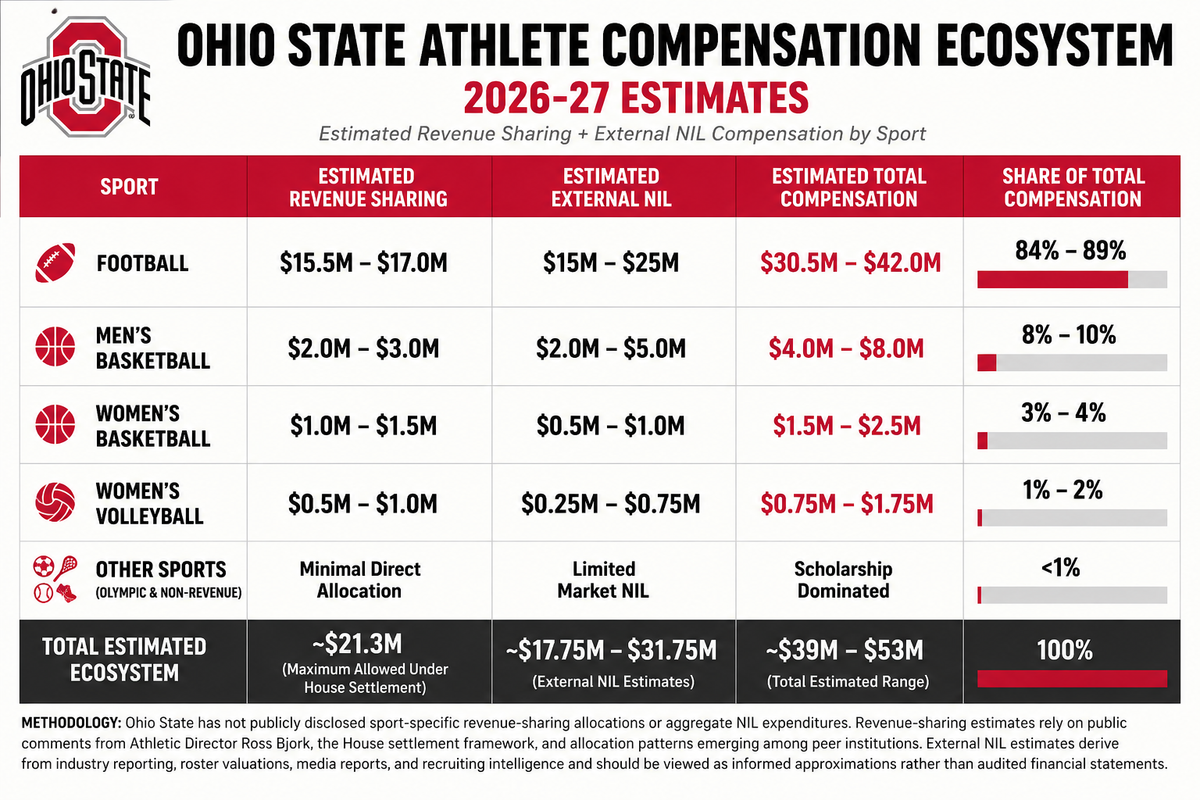
Ohio State has not released a detailed sport-by-sport allocation plan. Still, comments from administrators and compensation patterns emerging throughout the Power Four provide enough information to make reasonable estimates. Football likely receives between $15.5 million and $17 million annually through revenue sharing. Men's basketball probably commands another $2 million to $3 million, while women's basketball may receive approximately $1 million to $1.5 million. Women's volleyball appears positioned to receive between $500,000 and $1 million, a larger allocation than many peer institutions devote to Olympic sports.
The accompanying compensation table illustrates these estimates and is an informed approximation rather than an audited financial statement. Nevertheless, the broader picture becomes difficult to ignore. Ohio State is not interested in distributing compensation evenly among sports, a common trend. Instead, the university is going all in on football, allocating a small share to men's basketball and even smaller portions to women's basketball and volleyball. The Olympic sports contributions seem an afterthought.
Football Still Consumes the Largest Share
Football remains the centerpiece of Ohio State's athletic business model. It generates the largest television audiences, commands premium ticket prices, drives donor activity, and provides the greatest national exposure. Unsurprisingly, football also appears to consume the overwhelming majority of athletes' compensation.
Revenue sharing represents only part of the story. Ohio State athletes continue to benefit from outside NIL opportunities through endorsements, sponsorships, appearances, licensing agreements, and business partnerships. The Buckeyes have gradually moved beyond the booster collective model that defined the early NIL era. The Buckeye Sports Group now coordinates branding opportunities, supports recruiting and retention efforts, and helps athletes monetize their visibility in a more organized manner.
Estimating external NIL compensation remains challenging because private contracts rarely become public. However, Bjork previously acknowledged that Ohio State football players collectively received approximately $20 million in NIL compensation during the 2024 cycle. Industry observers subsequently estimated that compensation levels increased significantly as Ohio State assembled a championship-caliber roster. Several roster valuation models now suggest that Ohio State football may operate within a compensation ecosystem worth between $30 million and $42 million annually when direct revenue sharing and external NIL opportunities are combined.
Those estimates depend heavily on recruiting intelligence, media reporting, and market assumptions. They should not be interpreted as precise accounting. At the same time, they reinforce an obvious conclusion. Ohio State football probably ranks among the top three or four most expensive talent-acquisition operations in college athletics.
Following the Money Reveals Ohio State's Priorities
Athletic departments often talk about values, traditions, and competitive balance. Budgets tend to tell a more honest story.
Based on available information, football likely accounts for approximately 85-90 percent of Ohio State's athlete compensation resources. Men's basketball occupies a meaningful second tier, while women's basketball and women's volleyball maintain funding levels that exceed those found at many peer institutions. Other sports still benefit from scholarships, facilities, coaching support, and the prestige associated with competing at Ohio State. Still, they do not appear positioned to participate extensively in the new compensation marketplace.
That allocation strategy makes sense from a business perspective. Football delivers the largest audiences, attracts the greatest donor interest, and produces the most valuable television inventory. Men's basketball remains commercially important. Women's basketball continues to grow nationally, while volleyball provides Ohio State with an opportunity to build a nationally competitive program in a sport where relatively modest investments can still move the needle.
Football still eats first at the dinner table in Columbus.
Ohio State May Be Building the Blueprint
Many schools continue to approach NIL as a fundraising campaign. Administrators gather donors, respond to roster emergencies, and hope another transfer portal season does not arrive too quickly. Ohio State increasingly resembles something different.
The Buckeyes possess institutional revenue, direct athlete payments, donor support, corporate partnerships, and an established NIL infrastructure that work together as a single system. That structure provides stability. Ohio State can retain players, replace departures, and pursue elite recruits without dramatically altering its financial strategy each offseason.
Money alone does not guarantee championships. Plenty of expensive teams underperform every year. Yet Ohio State appears to enjoy an advantage that extends beyond raw spending. The Buckeyes know where next year's money will come from, and in an increasingly chaotic marketplace, certainty may prove just as valuable as cash.
If Ohio State consistently converts that financial confidence into championships, the Buckeyes may accomplish something larger than simply winning games. They may establish the operating model that other athletic departments spend the next decade trying to imitate.



Comments ()