
Iowa NIL in 2026: Revenue Sharing, Football Spending, and the Hawkeyes' Financial Strategy
Iowa NIL in 2026: How the Hawkeyes use revenue sharing, NIL, and roster retention to compete in the Big Ten.
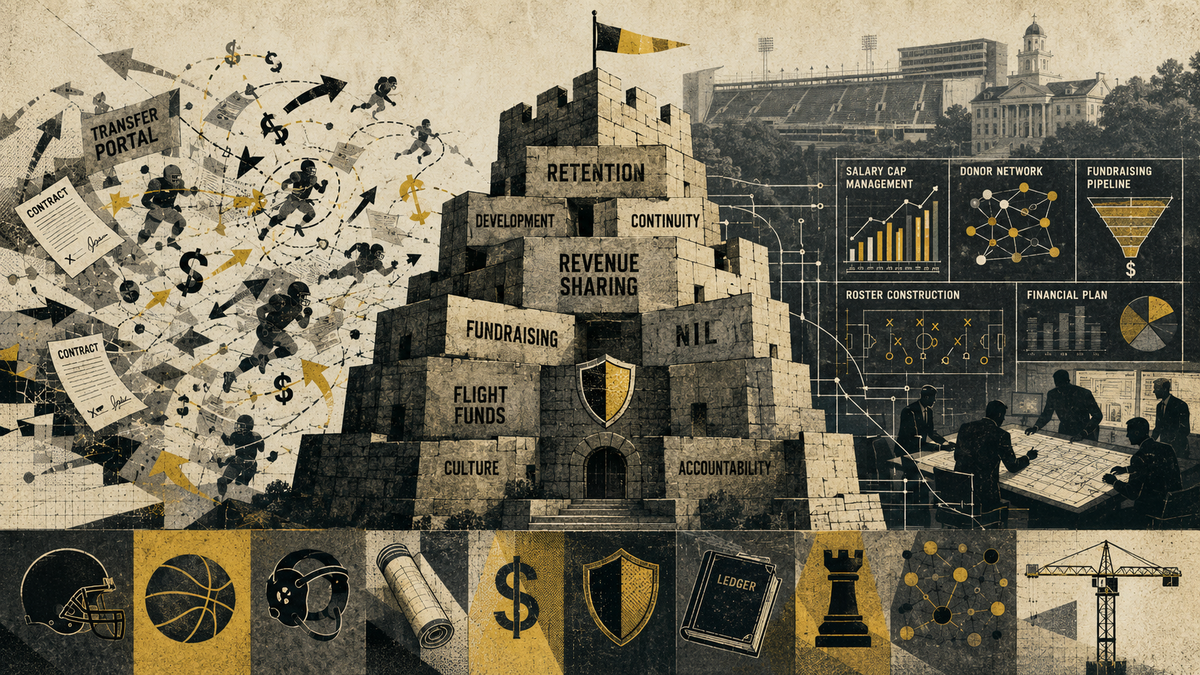
Iowa has spent most of the NIL era looking like the conference's frugal uncle: the program everyone assumed was scraping by while Ohio State, Oregon, and Michigan rewrote the rules of what recruiting could cost. That read made sense back when NIL was mostly an arms race between boosters and collectives, but it makes a lot less sense now.
The House settlement reset the board. Every power-conference department now starts from roughly the same revenue-sharing number before anyone talks about outside deals, and the conversation has shifted from "who has the richest collective" to something closer to "who can actually run this as a business." Judged on that question, Iowa looks less like a program falling behind and more like one that quietly decided years ago what game it wanted to play.
Spending Less Isn't the Same as Losing
Nobody seriously expects Iowa to match Ohio State or Oregon dollar for dollar in any given cycle, and the athletic department doesn't appear to be trying. That's probably the wrong comparison anyway. The more useful question is whether Iowa can win enough of the right fights, the ones over retention rather than acquisition, to make the spending gap matter less than it looks on paper.
That's not a new idea in Iowa City; the Hawkeyes are simply applying it to a new problem.
The Business Iowa Already Understood
For two decades, Iowa football has run on patience instead of star power. Offensive linemen redshirt, then spend years inside the same strength program before they're all-conference. Defensive backs sit behind veterans until Phil Parker's system clicks, at which point they leave for the NFL. Tight ends show up as three-star afterthoughts and leave as draft picks. None of that works if your best players walk out the door every December for a bigger check somewhere else.
That's the actual threat NIL posed to Iowa, not that it couldn't recruit, but that it couldn't retain. Losing a third-year starter right before his best season isn't just a football problem; it's a balance-sheet problem: every departure sends the staff back into the portal, where proven players are never cheap, and integration always costs something you can't put a price tag on.
Retention, in other words, quietly turned into an asset. Iowa's response has been to treat it like one.
What Iowa Actually Committed To
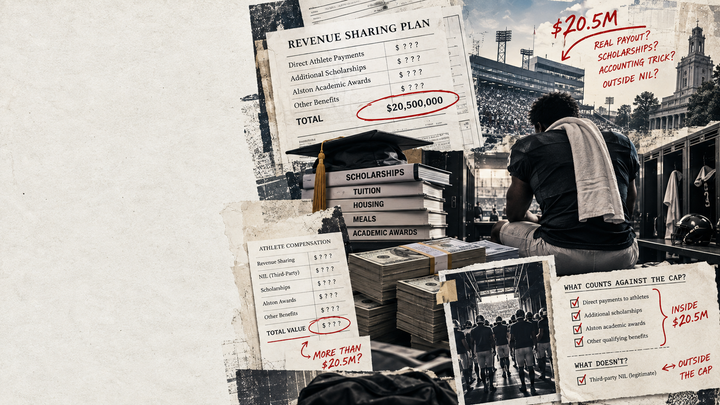
Iowa publicly said it plans to fund the full revenue-sharing allowance permitted by the House settlement, roughly $20.5 million in year one, and built Flight Funds as the mechanism to pay for it. That's a meaningfully different posture than treating NIL as an outside booster project that the athletic department merely tolerates. Iowa folded the compensation obligation directly into how the department operates and built the fundraising pipeline to match.
That's easy to skim past, but it's the more interesting decision. Most coverage of the House settlement fixates on the size of the cap. The better question is what a department does the moment it accepts that cap as a permanent line item rather than a one-time announcement. Iowa's answer wasn't simply "write bigger checks." It was "rebuild the office that writes them."
Flight Funds reflects that. Donors aren't funding a scoreboard or an endowment anymore; they're funding recurring payroll, administered by the university rather than a loosely affiliated collective. Iowa also kept the door open to outside NIL, sponsorships, endorsements, and commercial deals, running alongside revenue sharing rather than replacing it. Iowa didn't kill NIL. It stacked institutional money on top of it, which means the number most people quote for Iowa badly understates what's actually available to its athletes.
Trying to Put a Number on It
Iowa doesn't publish a consolidated compensation ledger; no school does, so anything here is an estimate, not a disclosure. But there's enough publicly available information to establish a reasonable range.
Football takes the largest cut. Between direct revenue sharing and outside NIL, Iowa's football compensation ecosystem probably lands somewhere around $16–18 million a year. That's well behind the conference's biggest spenders, but it's a comfortable seat in the Big Ten's upper-middle tier. Iowa is nobody's afterthought.
Basketball is where the old numbers stopped making sense. Estimates built during the collective era assumed donor money was still doing almost all the work. That framework is out of date. Revenue sharing, tighter donor coordination, and a more competitive portal market have all pushed basketball economics up, and Iowa's actual roster moves have further boosted them. Ben McCollum inherited a program with low expectations, but took Iowa to the Elite Eight in his first year as head coach. He also somehow retained most of a successful roster while adding 7-foot-3 transfer center Andrew McKeever from Saint Mary's. Keeping proven players and adding a rare big man in the same offseason isn't cheap on either side of that ledger, which makes the modest numbers still floating around nationally look increasingly wrong.
A more realistic figure for Iowa basketball's total compensation ecosystem is somewhere in the $5–7 million range. Add it up across football, basketball, wrestling, women's basketball, and the rest of the department, and Iowa's full athlete-compensation footprint is probably somewhere between $32.5 million and $38.5 million a year. That's an informed estimate, not a financial statement, but it's a far more accurate read on where Iowa actually sits than the old collective-era numbers ever were.
The bigger point isn't the number itself. It's that Iowa stopped trying to solve this with a single collective and started building something closer to a recurring revenue model.
The Most Important Hire Nobody Will Notice
The most consequential addition to Iowa athletics this offseason may never call a play or coach a snap. In June, Iowa brought Adam Schneberger home as Associate Vice President for Athletics Development, pulling him from Stanford after nearly 15 years there, the last 2 of which he spent running development for the athletic department. On the surface, that's a fundraising hire. In practice, it's closer to a hire built for the moment. Schneberger helped run one of the sport's most sophisticated fundraising operations, personally bringing in more than $200 million during Stanford's billion-dollar campaign.
Athletic departments hire for the problems they're actually facing. Compliance staff grew as the NCAA rulebook became more complex. Digital teams got built out once recruiting became a content business. Iowa is now staffing up fundraising and compensation management because paying players isn't a seasonal campaign anymore; it's a permanent function, like payroll at any other organization.
Schneberger wasn't brought in to fund a new weight room. He was brought in because Iowa needs an institutional engine that produces compensation revenue every single year, not just in flush times.
That's the piece that ties everything else together. Iowa didn't just launch Flight Funds; it restructured the department around revenue sharing. Marcus Wilson was brought on to run cap management. Altius Sports Partners was retained to coordinate NIL strategy. Former NFL executive Scott Pioli signed on as an advisor. Learfield expanded its role in handling NIL commercialization and corporate partnerships. Any one of those moves reads as a minor org-chart update. Stacked together, they describe an athletic department building itself into something closer to a professional front office.
Two Sports, Not One
There's a persistent assumption that Iowa athletics is basically a football budget with a few other sports attached. Iowa's own Flight Funds structure argues otherwise; it carves out dedicated giving tracks for football, men's and women's basketball, wrestling, and general athletics. Wrestling in particular occupies a spot few programs can claim; there's no real substitute for Iowa's brand in that sport, and building dedicated fundraising infrastructure around it signals the department isn't treating it as an afterthought.
That diversification cuts both ways: every dollar a wrestling donor gives isn't a dollar going to football, but it also means Iowa isn't relying on a single donor pool for everything. Wrestling supporters, football season-ticket holders, and the newly energized women's basketball fanbase (which has grown considerably under the program's recent success) are three distinct constituencies with distinct reasons to give. Segmenting philanthropy that way is more work than running a single big campaign, but it's also a hedge against any single group losing interest.
Betting the Model Still Works
The lazy read on NIL is that every additional dollar buys an equivalent amount of winning. That's never been true. Two departments can spend nearly identical amounts and get wildly different results depending on coaching continuity, evaluation, and whether the roster actually holds together. That's the argument for paying attention to Iowa in the first place.
Iowa won't lead the Big Ten in total compensation. Ohio State, Oregon, Michigan, and Penn State almost certainly spend more; USC has a Los Angeles corporate market that no one else in the conference can match; and Nebraska, Wisconsin, and Washington are all building out their own operations, too. On raw dollars, Iowa is a second-tier program, and there's no real argument to the contrary.
On organizational discipline, the picture looks different. Kirk Ferentz is entering his third decade as head coach. Phil Parker has built a reputation on repetition, not reinvention. Beth Goetz inherited the same financial disruption every athletic director is dealing with right now and has responded by building capacity rather than chasing headlines. None of the moves Iowa has made this year, Flight Funds, the cap-management hire, the Altius partnership, or Schneberger, generate the kind of attention a record NIL deal does. They're aimed at a duller but more important question: who's paying for this every year, and who's making sure it's spent well?
That question matters more in a revenue-sharing world than it did in the collective era, which rewarded urgency above almost everything else. Programs scrambled to raise enough donor money to keep a star before the portal reopened. The current era rewards whoever can generate predictable revenue and allocate it well across multiple sports; financial discipline counts for as much as financial capacity now, maybe more.
Where the Model Could Break
None of this means Iowa has actually solved anything. A few things are worth questioning.
Retention only pays off if the players being retained are still good enough to justify it, overpaying to keep a declining veteran is just a different flavor of the same mistake as overpaying in the portal. Fundraising growth isn't guaranteed either; donor fatigue is a real, mostly unmeasured risk across the sport, and asking supporters who already fund facilities and season tickets also to cover payroll has a ceiling. And revenue sharing compresses advantages without erasing them; Ohio State and Oregon aren't suddenly ordinary competitors just because everyone starts from a similar cap number. They still have bigger donor bases and more national visibility, and that's not going away.
Iowa is still working from a structural disadvantage. The bet is that a better organization can close enough of that gap to stay relevant. History says that's at least plausible; Iowa built two decades of success without elite recruiting classes, largely because it had no other choice. Whether those same habits translate to an era where roster stability itself costs real money is the open question.
Bottom Line
Iowa was never going to win a spending war with Ohio State or Oregon, and the athletic department doesn't seem interested in pretending otherwise. What it's building instead is closer to what a well-run pro franchise does when it can't win free agency: develop well, keep the players worth keeping, and only spend aggressively when the math actually supports it. Football is still the financial engine. Basketball is getting real investment for the first time. Wrestling and women's basketball have their own dedicated lanes. And behind all of it sits a department that spent the last eighteen months quietly rebuilding itself around the idea that paying players isn't a campaign, it's a permanent job.
That won't show up as a viral recruiting class or a record-setting quarterback deal. It'll show up, if it works, in a program that loses fewer players it didn't want to lose. Whether that's enough to close the gap with the Big Ten's biggest spenders is genuinely unclear, but it's a more interesting bet than most of the conference is making right now.
Comments ()