
Semantic Inflation: How Digital Systems Degrade Communication Between Men and Women
Modern gender discourse increasingly relies on compressed labels over precise communication, accelerating polarization and social fragmentation.
The Language Changed Before Most People Noticed
Something changed in the texture of communication between men and women during the social media era, although people often describe the outcome long before they describe the mechanism. Most discussions focus on dating apps, political polarization, online misogyny, feminism, loneliness, or declining marriage rates. All of those matter. None of them fully explains why ordinary conversations increasingly feel strained before they even begin.
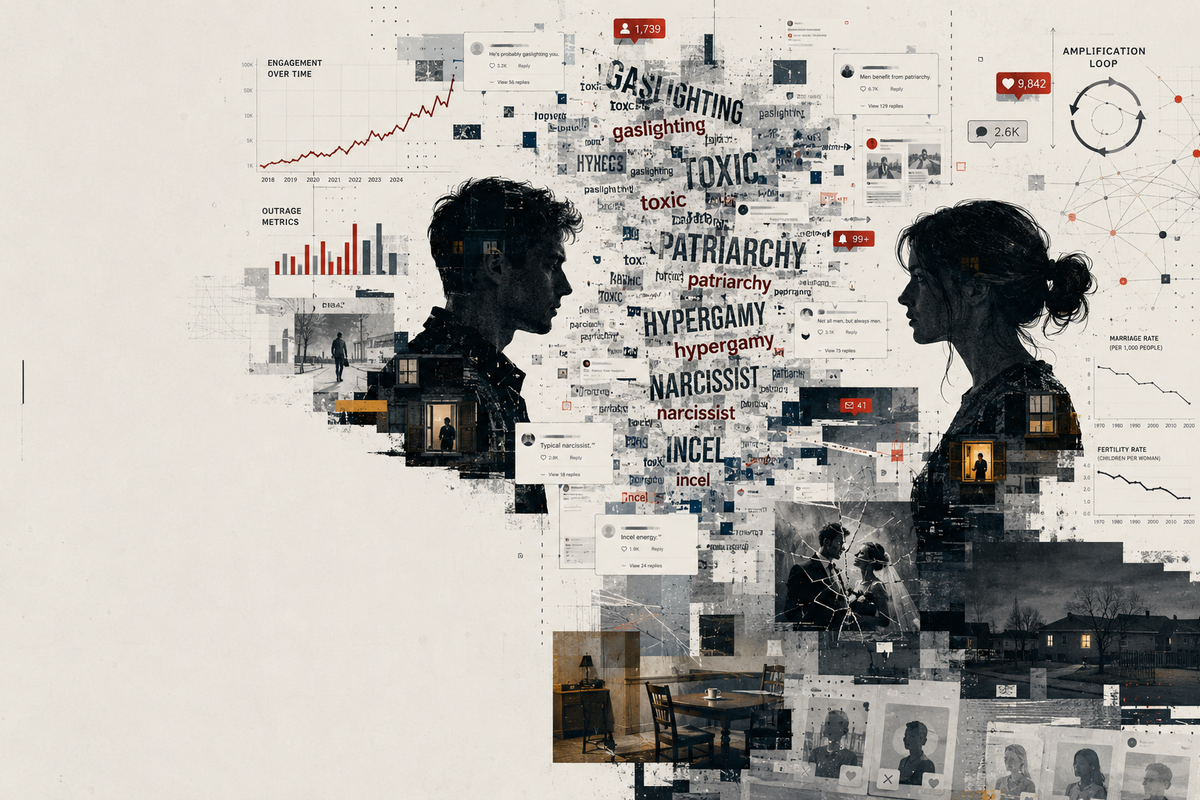
The shift appears linguistic as much as cultural. People now rely on a relatively small set of emotionally charged interpretive labels that carry enormous explanatory weight online. Terms such as “gaslighting,” “toxic masculinity,” “patriarchy,” “narcissist,” “incel,” and “hypergamy” migrated from relatively narrow analytical concepts into sprawling social categories capable of absorbing huge ranges of human behavior. The broadening happened quickly enough that many people barely noticed it occurring in real time.
What makes the trend important is not whether the concepts themselves contain truth. Most of them emerged because they described something real. The issue concerns scale and expansion. Once digital systems discovered that emotionally charged language produced stronger engagement than careful contextual explanations, the incentives began to favor concepts that compressed complexity into instantly recognizable moral narratives. The platforms never needed an ideological master plan. The engagement mechanics alone pushed discourse in that direction.
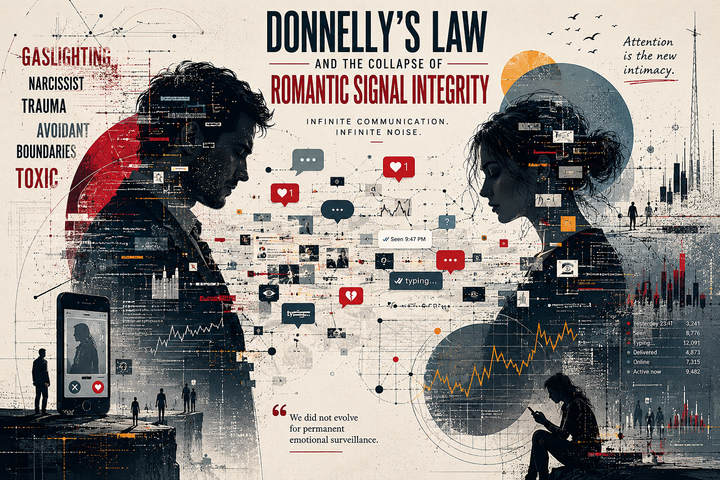
This is where Donnelly’s Law becomes useful. The law proposes that digital content expands to fill available informational and emotional bandwidth. Once outrage, humiliation, tribal signaling, and emotional certainty proved more effective at holding attention than ambiguity or nuance, digital systems naturally amplified those forms of communication. Over time, the same process appears to have reshaped language itself.
How Concepts Expand Online
Most concepts begin with relatively stable meanings tied to specific observable behaviors. “Gaslighting” originally referred to deliberate psychological manipulation intended to destabilize another person’s perception of reality. “Toxic masculinity” referred to destructive forms of male social conditioning involving emotional suppression and compulsive dominance behavior. “Patriarchy” described formal male-dominated institutional systems.
For years, those concepts remained comparatively bounded. Then, social media dramatically accelerated their circulation. Merriam-Webster named “gaslighting” its 2022 Word of the Year after searches increased by more than 1700 percent in a single year. At roughly the same time, therapists and psychologists increasingly complained that online discourse had stretched the term far beyond its original meaning. What once described severe manipulation now frequently describes ordinary disagreement, emotional invalidation, or conflicting recollections.
The same pattern appeared elsewhere. During the mid 2010s, “toxic masculinity” spread rapidly through online activist discourse and mainstream media. Increasingly, many users stopped distinguishing between destructive masculine behavior and masculinity generally. Meanwhile, within male-oriented online spaces, terms such as “incel” and “hypergamy” underwent similar expansion. “Incel” originally emerged during the 1990s inside a support-oriented community discussing loneliness and involuntary celibacy. Following several highly publicized acts of violence associated with extremist online subcultures, the label gradually transformed into a generalized insult directed toward socially awkward, romantically unsuccessful, or resentful men more broadly.
The important point here has less to do with ideology than with structure. Digital systems reward emotionally scalable concepts because they travel farther and faster than precise descriptive language. Broad moral categories simplify social signaling. They allow people to compress complicated interpersonal experiences into recognizable narratives that require little contextual explanation.
Over time, the social usefulness of the term begins rising precisely as its analytical usefulness declines.
Why Reinforcement Matters More Than Deliberation
Most people probably do not consciously adopt these frameworks after careful reflection. Social learning rarely works that way, especially online.
Human beings respond strongly to reinforcement systems. Repetition shapes perception. Prestige and belonging shape perception. Once phrases begin generating validation, visibility, emotional certainty, and coalition approval, people absorb not only the language itself but the interpretive assumptions embedded inside the language.
This process does not require coordinated manipulation. It barely requires intention. Recommendation systems on TikTok, YouTube, Instagram, and X optimize primarily for engagement and retention. Researchers studying social transmission repeatedly found that emotionally activating and morally charged material spreads farther than neutral informational content. MIT researchers examining online diffusion patterns observed that emotionally novel information propagates rapidly across networks, while studies from institutions such as NYU showed that outrage generates unusually high engagement because it encourages sharing and public signaling.
Under those conditions, emotionally compressed interpretive shortcuts possess obvious structural advantages over nuanced contextual reasoning. A careful explanation travels slowly, but a morally charged category travels quickly.
The consequence extends beyond rhetoric. Over time, interpretive shortcuts begin reshaping cognition itself. Historically, people interpreted one another through repeated interaction, overlapping social roles, and long-term community continuity. A difficult coworker might still prove generous during a crisis, or a politically irritating neighbor might nevertheless remain trustworthy, loyal, and dependable across years of ordinary interaction. Real communities forced people to tolerate ambiguity because human beings rarely fit cleanly into singular categories.
Digital systems weaken those stabilizing pressures. Increasingly, people encounter one another through screenshots, clips, fragments, symbolic identity markers, and emotionally amplified stories detached from broader context. Under those conditions, individuals gradually stop asking what specifically happened and begin asking which ideological category the situation appears to fit into.
That shift sounds subtle, but it profoundly changes communication.
The Gender Conflict Industry
The broader ecosystem surrounding modern gender discourse did not create these tendencies out of nothing; it monetized them.
Conflict between men and women possesses nearly perfect engagement characteristics. The subject touches on identity immediately; everyone has personal experience with it, and the emotional stakes remain renewable because relationships themselves remain central to human life. The conflict resists final resolution, allowing digital systems to recycle it endlessly.
The result is a Gender Conflict Industry that increasingly resembles an industrial ecosystem built around emotional escalation. Influencers, therapists, podcasters, online commentators, and media personalities discovered that resentment, betrayal, humiliation, suspicion, and moral certainty generate extraordinary engagement. Stable, healthy relationships generate very little traction online because emotional stability feels informationally dull compared to outrage.
Consequently, many people now encounter the opposite sex primarily through emotionally optimized edge cases rather than statistically representative behavior. Women repeatedly consume stories involving manipulation, coercion, infidelity, emotional incompetence, or abuse. Men repeatedly consume stories involving exploitation, hyper-selective standards, humiliation, rejection, or transactional relationships. Neither side experiences a balanced sample of ordinary human interaction. Both sides increasingly consume narratives optimized for emotional activation.
Once those narratives become ambient, they begin to function as default assumptions rather than isolated stories, resembling racial slurs more than helpful technical definitions.
The Social Consequences Already Appear Measurable
The broader social trends surrounding this shift no longer look entirely theoretical. Pew Research documented substantial divergences between young men and women in political attitudes and relationship expectations. The Survey Center on American Life reported rising social isolation among young men. Marriage rates in the United States declined sharply over recent decades, while fertility rates across much of the developed world now remain below replacement levels. Gallup and Pew continue to record declining institutional trust across broad segments of society.
Obviously, no single variable explains all of these developments. Economic instability, educational divergence, housing costs, delayed adulthood, and institutional decay all matter. But digital systems increasingly amplify distrust between men and women rather than reducing it, and the amplification process appears self-reinforcing.
As trust declines, negative experiences become more emotionally salient. Negative experiences generate stronger engagement online. Stronger engagement leads to wider algorithmic circulation, which further amplifies distrust. The system rewards edge cases because they outperform ordinary stable relationships within attention economies.
Historically, local communities softened many of these pressures because repeated interaction imposed nuance. Individuals could not easily reduce one another into abstract symbolic categories because social continuity forced contextual understanding. Digital systems weaken those constraints. Men and women increasingly encounter one another first through ideological narratives rather than direct human experience.
That distinction matters more than it initially appears. Once populations begin to interpret one another primarily through emotionally compressed, adversarial categories, social cohesion becomes significantly harder to sustain. The issue no longer concerns dating culture alone. The issue concerns the gradual erosion of high-resolution social perception itself.


Comments ()