
Why Construction Productivity Still Looks Stuck in the 1970s
Why has construction productivity improved so little despite increased use of managerial tools, using empirical data? Donnelly’s Law shows how data overload, administrative complexity, and limited managerial attention quietly reduce efficiency across the construction industry.
Donnelly’s Law and the Hidden Cost of Information Overload
Walk onto a major construction site in 2026, and the first impression is one of extraordinary technological sophistication. Superintendents carry tablets loaded with thousands of drawings and specifications. Procore tracks RFIs, submittals, observations, and punch-list items in real time, while Bluebeam allows architects, engineers, and contractors to markup documents instantly. Drones photograph the site from above, BIM models coordinate millions of objects, and owners review dashboards that update daily with schedule, cost, and quality information.
From a distance, this looks like an industry transformed by technology. If information systems were the decisive factor in productivity, construction should be delivering buildings faster and more efficiently than at any point in its history. The empirical record, however, points in a vastly different direction.
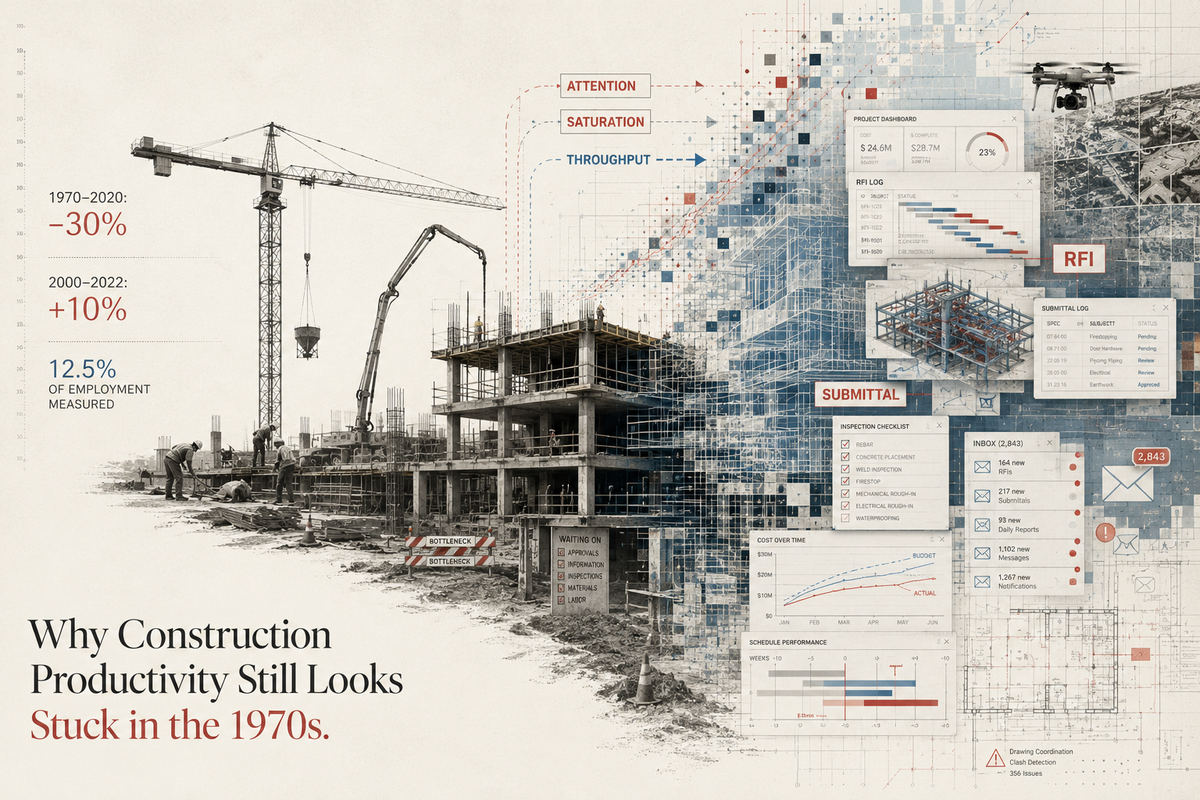
The Federal Reserve Bank of Richmond reports that U.S. construction labor productivity declined by more than 30 percent between 1970 and 2020, even as productivity across the broader economy doubled. McKinsey & Company estimates that global construction productivity increased only 10 percent between 2000 and 2022, compared with 50 percent for the world economy and 90 percent for manufacturing. The scale of this divergence suggests that construction has become dramatically more data-rich without becoming proportionally more productive.
This contradiction sits at the center of Donnelly’s Law: when information capacity expands faster than human execution capacity, organizations become saturated rather than more productive. Construction may be the clearest real-world example of this principle because it has digitized every administrative process while leaving the physical act of building constrained by the same realities that governed the industry fifty years ago.
Construction Built a Digital Nervous System, not a New Body
Over the last three decades, construction firms have invested heavily in technology. Drawings migrated from paper to highly detailed three-dimensional models. Cloud-based systems provide centralized communications, approvals, and issue tracking. Schedules, budgets, commissioning logs, and cost forecasts became instantly accessible to anyone with a login. A large hospital or data center now generates tens of thousands of submittals, hundreds, or thousands of RFIs, continuous progress photography, daily reports, safety observations, quality inspections, and extensive meeting documentation.
For professionals who have spent decades in the industry, the increase in information is unmistakable. A project manager in 1990 worked with far fewer inputs than a project manager does today. Yet the essential production process remains remarkably familiar. Concrete still requires time to cure. Steel must still be fabricated, delivered, and erected. Electricians still pull wire through conduit. Inspectors still control release points. Weather still disrupts schedules, and skilled labor remains scarce and uneven in quality.
The industry, therefore, created a sophisticated digital nervous system around a production body that has changed much more slowly. Administrative capability advanced rapidly, while the core act of assembling buildings continued to operate under enduring physical and human constraints.
Why Data Passes Through Organizations with Minimal Scrutiny
One of the most powerful cultural assumptions in modern management is that more data must be beneficial. Numbers appear objective, dashboards signal rigor, and reports create the impression of professional control. Because information carries this aura of legitimacy, organizations often accept additional reporting with surprisingly little skepticism.
The contrast with other forms of spending is revealing. If a project executive requests ten additional engineers, senior leadership immediately questions the cost and expected return. If the same executive proposes a dashboard that produces fifty new metrics each morning, the proposal often receives far less resistance because it is framed as improved visibility. The information is treated as inherently good before anyone asks whether it will materially improve decisions.
This assumption obscures actual costs. Every report consumes time to prepare. Every metric requires review and interpretation. Every automated notification interrupts ongoing work. Every additional software field adds to the cognitive burden carried by project teams. These costs are dispersed across the organization, which makes them easy to overlook, but they are no less real than labor or equipment costs.
Incentives Encourage Relentless Information Growth
No single participant is responsible for the explosion of documentation because every actor has rational incentives to generate more information. Owners want greater visibility because uncertainty is uncomfortable. Architects and engineers produce detailed comments to reduce liability. Contractors preserve extensive records to support claims and defend against disputes. Safety and quality teams expand reporting to demonstrate diligence, and software vendors encourage deeper adoption because higher engagement strengthens customer retention.
Each decision is sensible when viewed individually. Collectively, these incentives produce a system in which information expands much faster than the capacity to interpret it effectively. The superintendent begins the day confronting an overflowing inbox, overdue submittals, unresolved RFIs, updated schedules, safety issues, quality deficiencies, and owner requests. The problem is no longer obtaining information. The problem is determining which few issues will govern the project's outcome.
When Metrics Crowd Out Judgment
As organizations accumulate more data, measurable indicators can begin to displace experienced judgment. Project leaders may know the exact average response time for RFIs, the percentage of closed punch-list items, and the number of completed inspections. Those figures may be accurate and elegantly presented, yet they can coexist with deeper operational problems that are harder to quantify.
An electrical subcontractor may be critically understaffed. The design may still be unstable. Relationships among key participants may have deteriorated to the point that collaboration is breaking down. These factors often determine whether a project succeeds, but they resist easy measurement. Because dashboards naturally emphasize what can be counted, they can draw attention away from the qualitative realities that matter most.
This is management’s version of Gresham’s Law: low-value data crowds out high-value judgment. The more information accumulates, the easier it becomes to confuse numerical precision with genuine understanding.
The Administrative Productivity Trap
This dynamic leads to what can be called the administrative productivity trap. Technology makes information easier to produce, and the resulting abundance increases the demands on coordination. More coordination requires additional meetings, reviews, approvals, and reporting cycles. Those activities consume the time and attention of the very people responsible for planning and executing the work.
The organization becomes increasingly busy, yet output per labor hour changes little. Project teams devote growing amounts of effort to managing information rather than directly improving sequencing, planning, staffing, and field execution. The sophistication of the administrative apparatus expands, but the underlying production system remains subject to the same bottlenecks.
Why Manufacturing Improved More Than Construction
Manufacturing achieved large productivity gains because processes could be repeated thousands or millions of times under tightly controlled conditions. Each cycle offered opportunities for incremental refinement, and successful improvements compounded over decades.
Construction rarely enjoys that degree of repetition. Most projects are one-off prototypes assembled by temporary coalitions of firms working in unique physical environments. Site conditions differ, local regulations vary, designs evolve, and labor quality fluctuates. These factors make standardization more difficult and limit the extent to which information alone can produce dramatic efficiency gains.
There are notable exceptions. Warehouses, semiconductor plants, and data centers increasingly rely on prefabrication and highly disciplined workflows. In these settings, productivity gains are more substantial because the production model itself becomes more repeatable. The lesson is that information creates the most value when paired with a fundamentally more industrialized method of building.
Information Is Not Control
One of the most persistent management errors is equating visibility with control. A lengthy weekly report can create the impression of rigor. A sophisticated dashboard can reassure owners that every variable is being monitored. A highly detailed BIM model can suggest that coordination is complete.
These tools are undeniably useful, but they can also foster false confidence. Projects fail every year yet generate enormous volumes of documentation. The existence of information does not guarantee that the right decisions are being made or that the most consequential problems are receiving attention.
The most effective builders understand that data must earn its place. They ask a simple question of every report, dashboard, and metric: what specific decision becomes better because this information exists? If the answer is vague, the information is likely to add complexity rather than value.
Donnelly’s Law in Hard Hats
Construction did not resist modernization. It embraced technology enthusiastically and created a powerful digital infrastructure around every project. What it did not do was eliminate the physical and human constraints that continue to govern the pace of building.
Concrete still cures at its own rate, skilled labor remains finite, inspections still create release points, and design errors still trigger rework. As the cost of producing information approached zero, organizations accumulated more data than managers could productively absorb. The result was not a proportional increase in throughput, but a more elaborate administrative system layered over a production process that remains stubbornly constrained.
That is Donnelly’s Law applied to construction. When information becomes abundant and free, the limiting factor shifts to human attention and execution. Once those capacities are saturated, additional data no longer drives meaningful productivity gains. It simply makes managing the project more complex.



Comments ()