
The Iowa Way, Reimagined: Beth Goetz, Big Ten Realities, and the Strategic Construction of Hawkeye Athletics
A data-driven analysis of Iowa Athletics under Beth Goetz, examining NIL economics, football succession, basketball resurgence, and wrestling’s shifting position in a modern Big Ten landscape.
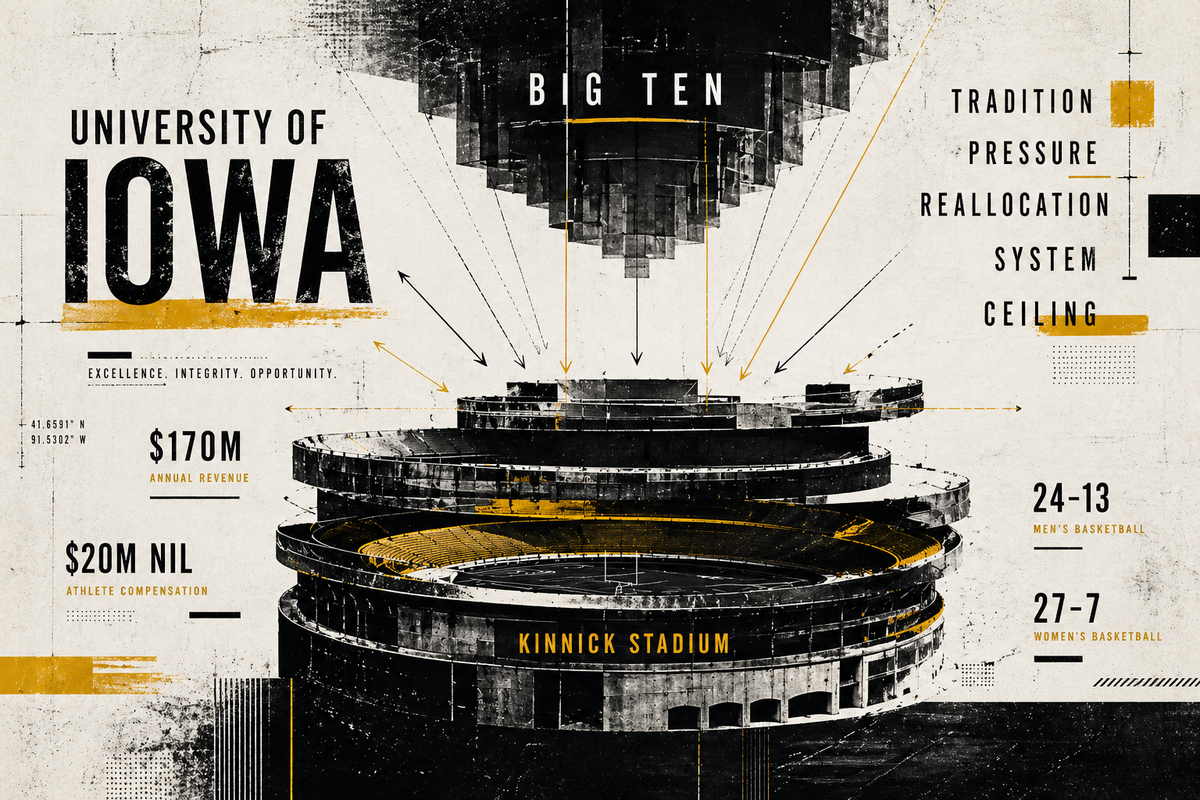
A System That No Longer Matches the Environment
For a long time, Iowa did not need to change because its operating model matched the sport's structure. Develop players, stay disciplined, avoid volatility, and let other programs chase flash while Iowa quietly produced eight to ten-win seasons and NFL linemen. That system was built on restraint, and for decades it produced consistent, defensible results.
The problem is that the surrounding system did not remain stable.
The Big Ten Conference is no longer a regional league in which institutional discipline can quietly close the gap against more talented rosters. It has become a national platform shaped by media rights, NIL economics, and recruiting markets that behave more like open competition than controlled pipelines. In that environment, stability still matters, but it no longer compensates for structural disadvantages. It becomes one variable among several, and not the most important one.
What makes Iowa interesting right now is not that it faces this reality. Every program does. What makes it interesting is that Beth Goetz appears to understand it more clearly than many of her peers, and she is acting on that understanding in ways that run counter to some of the program’s own instincts.
The Financial Myth That No Longer Holds
There has always been a tendency to frame Iowa as a program that succeeds despite financial limitations, as if it operates from a permanent deficit relative to the rest of the conference. That framing is increasingly outdated.
The department’s current operating footprint is in the range of $160–$180 million, with additional growth baked in as conference distributions fully materialize. That level of funding does not place Iowa among the national heavyweights, but it does position it firmly within the conference’s middle tier, alongside programs that are actively trying to improve rather than explaining why they cannot.
This distinction matters because it changes the nature of the problem. Iowa is not constrained by a lack of resources. It is constrained by how effectively it deploys them. In an environment where costs are rising and margins are tightening; inefficient allocation becomes more damaging than limited funding.
NIL and the New Competitive Baseline
NIL has settled into its actual role, regardless of how it is framed publicly. NIL functions as a compensation system that directly affects roster construction, retention, and recruiting outcomes.
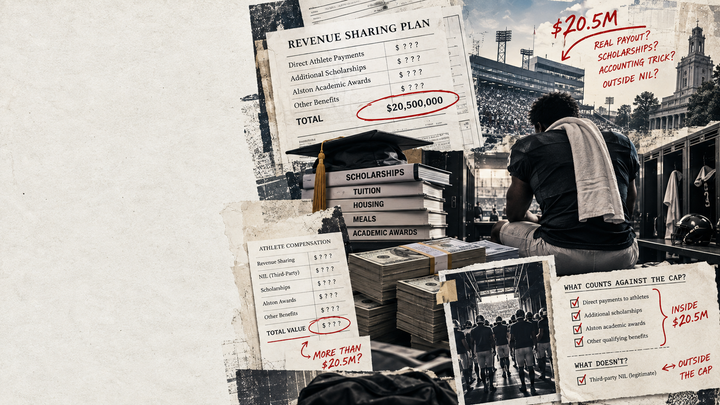
Programs at the top of the sport operate within a range approaching $20 million annually, while Iowa operates in a middle band that requires greater precision in decision-making. That positioning does not eliminate competitiveness, but it narrows the margin for error. Programs in this range must be more accurate in evaluation, more disciplined in development, and more strategic in retention.
Goetz’s approach suggests she understands this dynamic. She has treated NIL as a structural reality rather than a temporary disruption. The open question is whether the broader ecosystem around the program is willing to align with that perspective, because partial commitment in this space tends to yield predictable results.
Football: Stabilized, Which Raises the Stakes
For several seasons, Iowa football operated with a visible imbalance. The defense performed at a high level, while the offense ranked among the worst in the FBS. That imbalance forced the program into a narrow path where success depended on low-scoring margins and minimal mistakes.
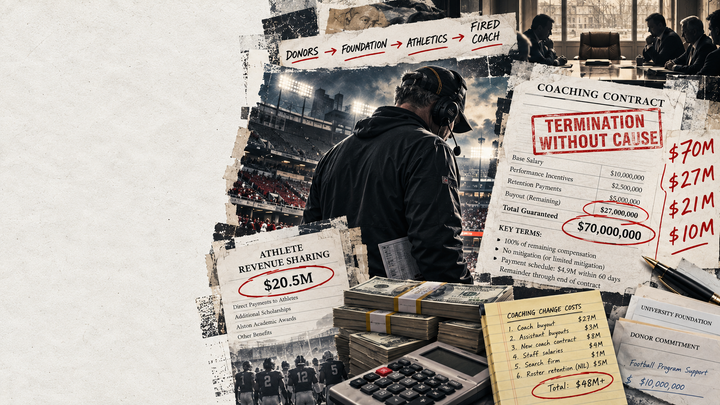
Beth Goetz addressed that issue by terminating Bran Ferentz, which underscores the risks of nepotism, andreplacing him with Tim Lester, who brought a new vision, offense, and energy.
Under Lester, the offense has returned to functional competency. It is not among the most explosive units in the country, but it no longer operates as a structural liability. That change redefines the program’s position.
With stability restored, the focus shifts to succession. Kirk Ferentz has built a consistent program, but consistency eventually leads to transition. The next hire will determine whether Iowa attempts to expand its competitive ceiling or preserve its current identity. That decision will shape the program more than any single season.
Basketball: A Reset That Revealed the Ceiling Was Artificial
Men’s basketball provides a clear example of what happens when expectations shift. Ben McCollum immediately altered the program’s trajectory, producing results not seen in decades while also changing how the team functions on the floor.
The significance lies not only in the outcomes but in the process. Efficiency replaced excess, defensive accountability became foundational, and roles were defined with clarity. The program did not require a fundamental increase in resources to achieve these results. It required a different approach to using those resources.
That realization reflects directly on leadership. It suggests that ceiling limitations were not structural. They were self-imposed.
Women’s Basketball: Proof That Momentum Can Become Structure
The departure of Caitlin Clark could have exposed fragility within the program. Instead, under Jan Jensen, Iowa maintained a strong national position and reinforced the idea that its success was not dependent on a single player.
The program now operates as a durable asset. It generates attention, supports recruiting, and contributes to the department’s broader identity. More importantly, it demonstrates that Iowa can convert peak visibility into sustained relevance when the underlying structure is aligned.
Wrestling: Reputation, Reality, and Subtle Signals
Wrestling remains one of Iowa’s most recognizable programs, but the competitive landscape has shifted. Penn State Nittany Lions wrestling has established a level of dominance that Iowa has not matched, and the gap is evident across multiple dimensions.
Carver-Hawkeye Arena continues to produce strong environments, particularly for high-profile matchups. However, demand has become more concentrated. Marquee events draw attention, while the rest of the schedule does not consistently carry the same weight. That pattern suggests a transition from broad engagement to event-driven interest.
Donor behavior reflects a similar shift. Loyalty remains, but it now operates within a competitive funding environment shaped by NIL and other program needs. Contributions increasingly follow perceived momentum, and wrestling does not currently occupy that position within the department.
This places Tom Brands in a more complex position. His legacy is secure, but we should evaluate the program’s current trajectory. When measured against the standards applied elsewhere, the gap between expectation and outcome becomes difficult to ignore.
Leadership, Alignment, and the Pace of Change
Beth Goetz appears to be operating within an institutional alignment that enables meaningful decision-making. Her actions reflect a willingness to move beyond incremental change and to address structural issues directly.
That approach places her far ahead of many parts of the ecosystem she oversees.
The Real Risk: Partial Adaptation
Iowa is not in danger of sudden decline. Its programs are too stable, and its infrastructure is too strong. The more realistic risk is partial adaptation, where some elements evolve while others remain anchored in outdated assumptions.
That scenario produces a familiar outcome. The program remains respectable, occasionally competitive, and structurally limited. Over time, that position becomes self-reinforcing, making it more difficult to break out of.
Conclusion: A Program Deciding What It Wants to Be
The Iowa Way is not disappearing, but it is no longer sufficient on its own. The qualities that defined it still matter, but they must be integrated into a system that reflects the current environment.
Beth Goetz appears to understand that reality and is acting accordingly. The next phase will determine whether the rest of the program is willing to follow.
Comments ()