
Mistake on the Lake: Northwestern’s $862 Million Stadium Bet
Northwestern’s $862 million Ryan Field is a bold gamble. This analysis examines stadium economics, Big Ten finances, and fan demand.
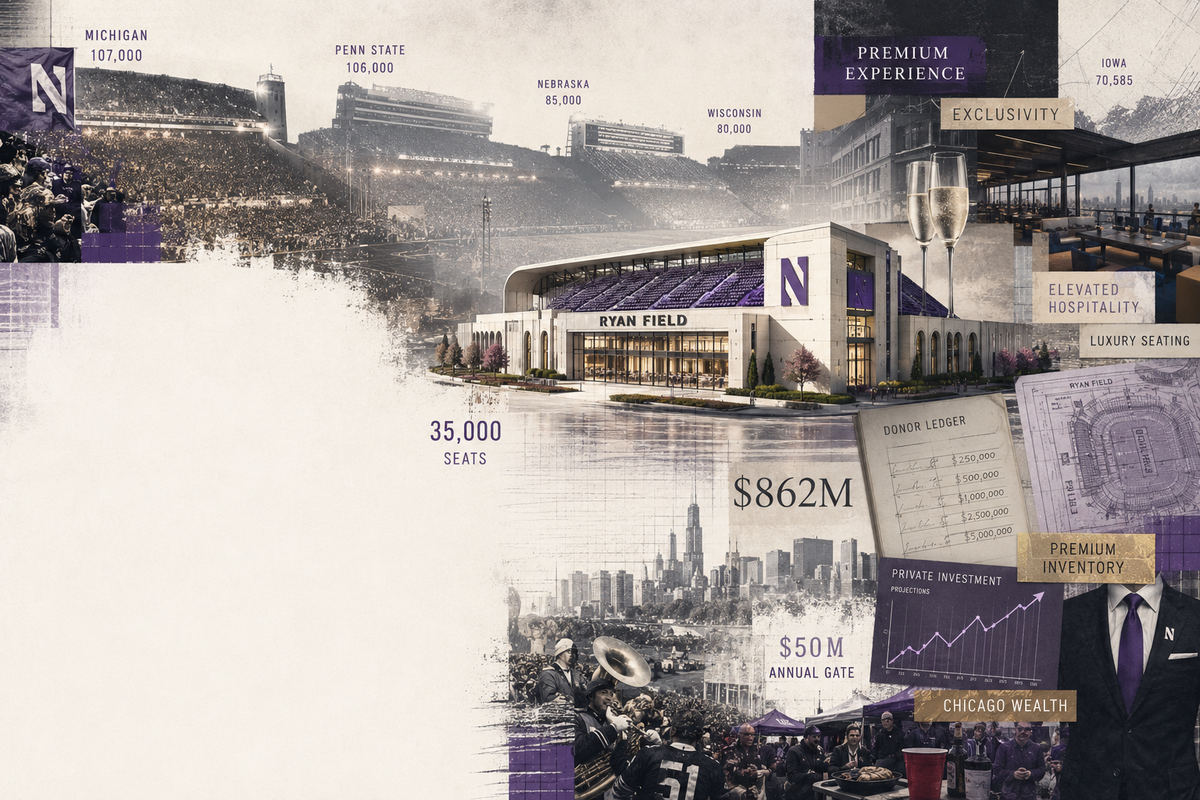
The Most Expensive Small Stadium in America
Northwestern University is building what may become the most revealing stadium project in modern college athletics, not because of the architecture itself, but because of the worldview embedded inside it. The new Ryan Field reportedly costs somewhere between $850 million and $862 million, depending on how the accounting gets sliced up, making it one of the most expensive college football stadium projects ever attempted, according to ESPN’s reporting on the project cost and Ryan family contribution.
At the same time, Northwestern is shrinking its capacity to roughly 35,000 seats, instantly making the venue the smallest stadium in the Big Ten by a massive margin. Sports Business Journal’s analysis of Ryan Field’s unusually small capacity relative to the Big Ten notes that the new stadium will seat about 15,000 fewer people than the conference’s next-smallest venue and will seat fewer than half the league average.
The planned accommodations inside the new Northwestern Wildcats football stadium, Ryan Field, increasingly resemble a luxury development disguised as a stadium. Northwestern’s official Ryan Field materials emphasize upscale clubs, glass-lined lounges, curated food service, premium gathering areas, and hospitality spaces aimed squarely at affluent donors and corporate buyers. The university has especially highlighted concepts like the Loft Club, which Northwestern describes in its own promotional writeup of the space using language modeled far more after Wrigleyville social culture than traditional Big Ten football environments.
The renderings showcase warm wood interiors, skyline-facing lounges, oversized social spaces, and polished premium areas that often look more like a private equity retreat center than a football venue. At nearly $862 million for only 35,000 seats, the project increasingly feels like a monument to the modern billionaire belief that every institutional problem can be solved by making it dramatically more upscale and vastly more expensive. Northwestern appears convinced that what fans truly wanted all along was not noise, chaos, and tradition, but craft cocktails in a curated lounge while football unfolds in the background.
That combination tells you almost everything you need to know about what this project represents. Ryan Field is not really a football stadium in the traditional Big Ten sense. It is a theory of luxury consumption disguised as a football stadium. Northwestern is effectively arguing that giant crowds no longer matter because wealthy people matter more, and that the future of college athletics belongs not to massive fan bases but to affluent consumers willing to pay premium prices for carefully curated experiences.
Maybe they are right. But there is also a very real possibility that this becomes one of the great rich-guy miscalculations in modern sports because the entire project radiates the kind of thinking that emerges when extremely wealthy people spend too much time around other extremely wealthy people and gradually convince themselves that everybody else experiences the world exactly the way they do.
One of the recurring pathologies of elite institutional America is the tendency of affluent leadership classes to mistake their own preferences for universal demand. They begin believing that exclusivity itself creates emotional attachment. They assume scarcity automatically generates desire. They convince themselves that ordinary people secretly want “premium experiences” when most people simply want experiences that feel emotionally alive rather than professionally curated by a branding consultant who says things like “elevated engagement ecosystem” with a straight face.
The Rest of the Big Ten Still Understands Scale
One of the funny things about modern institutional culture is how often executives invent elaborate “disruption” strategies to avoid admitting that older systems still work perfectly well. The rest of the Big Ten continues operating on a brutally simple premise that remains wildly effective: giant crowds make absurd amounts of money.
Michigan Wolverines football packs more than 107,000 people into Michigan Stadium, according to Michigan Stadium’s official capacity information. Penn State Nittany Lions football sits at roughly 106,000 based on Penn State’s Beaver Stadium capacity details. Nebraska Cornhuskers football pushes beyond 85,000 according to Nebraska Memorial Stadium information and sellout history. Meanwhile, Wisconsin Badgers football and Iowa Hawkeyes football regularly operate in the 70,000-80,000 range, according to Camp Randall Stadium’s official capacity figures and Kinnick Stadium’s official capacity information. Northwestern is heading to 35,000. That is not merely “different.” Economically, it is practically another industry.
The raw revenue implications become enormous once the math gets laid out honestly. A major Big Ten football program averaging 80,000 paid attendees across seven home games with a realized average ticket yield around $90 per seat, approaches $50 million annually before parking, concessions, suites, sponsorships, seat-license donations, and local game-day spending even enter the equation. Then the premium inventory gets layered on top of that scale; television optics and recruiting value matter. Eventually, the crowds themselves become a self-sustaining marketing engine because human beings instinctively gravitate toward visible collective participation.
Programs like Iowa and Nebraska no longer merely sell football tickets. They operate civic rituals. Entire regions organize themselves around game day. Families pass season tickets through generations. Tailgating becomes an inherent culture. Attendance stops behaving like discretionary entertainment spending and starts behaving more like religion, with parking passes attached. Northwestern has never possessed that kind of emotional infrastructure, and that reality matters enormously because the university is attempting to skip directly to luxury monetization without first building the kind of mass emotional attachment that usually supports premium pricing models.
That is what makes the Ryan Field strategy so fascinating. Northwestern appears convinced that scarcity, exclusivity, and hospitality experiences can compensate for the absence of giant crowds. In theory, the logic is understandable because professional sports franchises increasingly generate disproportionate revenue from premium inventory rather than upper-deck seating. Suites, clubs, field-level experiences, donor lounges, and curated social environments now drive much of the profitability of modern venues. Northwestern clearly believes it can import portions of that professionalized model into college football.
The Billionaire Blind Spot
The university repeatedly emphasizes intimacy, premium experiences, proximity to the field, and “better-than-TV” environments in its public messaging about the stadium project, as conveyed through Northwestern’s official Ryan Field vision materials. The planned Loft Club reportedly channels the social atmosphere of Wrigley Field's hospitality culture more than traditional Midwestern football culture, according to Northwestern’s description of the Loft Club concept.
Northwestern is no longer really selling football in the traditional sense. The university is attempting to package institutional prestige, curated hospitality, exclusivity, affluent social signaling, and a high-end Chicago entertainment environment into a single product loosely connected to football itself. The actual game increasingly feels like the excuse for the surrounding lifestyle presentation.
The problem is that this model depends heavily on assumptions about consumer behavior that may not generalize outside affluent donor circles. To billionaire donors and executive-class buyers, luxury hospitality pricing may feel entirely normal. Premium seating may feel expected. Exclusive clubs may seem inherently attractive. Six-figure donations tied to seating access may barely register psychologically. But most sports consumers do not experience fandom through that framework, even when they possess significant disposable income.
Most fans still want noise, tribal identity, packed stadiums, emotional chaos, tailgates, traditions, mildly irresponsible alcohol consumption, and the feeling of participating in something larger than themselves. Northwestern, by contrast, is trying to replace portions of that experience with something that increasingly resembles an upscale airport lounge attached to a football field. There is a reason the entire project often sounds less like traditional college football and more like a management consultant’s presentation deck created by somebody who refers to fans as “stakeholders in the live-event vertical.”
This is where the entire thing starts to feel less like sports strategy and more like a sociology experiment accidentally conducted by wealthy people who have not sat in a normal stadium concourse in twenty years.
The Country Club Pricing Problem
The new Ryan Field is not really being priced like a Big Ten football stadium. It is being priced like a private hospitality club where football occasionally breaks out in the background.
Once Northwestern’s annual donation requirements get layered onto ticket prices, some premium seats effectively climb into the $500 to $700 per game range before parking, drinks, or food even enter the equation. A family of four in the higher-end club sections could realistically spend well into five figures annually to watch a program that has recently struggled to fill temporary lakefront seating against mediocre opponents.
And Northwestern still has not made entirely clear how much food and beverage service will actually be included versus sold separately. That matters because there is a meaningful difference between “all-inclusive luxury experience” and “paying NFL suite prices before buying a $19 Old Fashioned.”
The entire strategy feels less like Midwestern college football and more like a boutique wealth-signaling exercise for affluent Chicago alumni who enjoy the idea of football more than the football itself.
Northwestern’s Marketing Problem
This is where Northwestern’s actual institutional history becomes a serious problem. Why exactly should anyone believe Northwestern suddenly becomes elite at sports marketing because it now possesses an expensive building?
Historically, Northwestern athletics has struggled for decades to build much excitement in one of the country's largest markets. Football attendance fluctuates significantly with short-term success but remains tethered to opponents who travel well. Basketball attendance has often remained mediocre even during competitive stretches. The Olympic sports attendance is like that of a large high school. The university has repeatedly failed to convert Chicago’s enormous population into durable athletic enthusiasm.
That pattern is not an accident. It is an institutional reality spanning decades.
The old Ryan Field certainly had problems, but Northwestern fans and administrators sometimes talk about the old stadium as though it singlehandedly suppressed decades of latent football fanaticism hiding somewhere inside the North Shore suburbs. That explanation collapses quickly once you remember that Northwestern has struggled to sell every sport it offers.
The deeper issue may simply be that Northwestern athletics does not occupy a central emotional place within Chicago sports culture. A billion-dollar building does not automatically solve that problem. In fact, the challenge may become substantially harder because Northwestern is no longer trying to sell ordinary football tickets. It is trying to sell luxury football tickets inside one of the most crowded entertainment markets in America.
That requires operational sophistication bordering on professional sports franchises. Corporate relationship management, premium hospitality sales, donor retention systems, experiential branding, concierge-style customer management, and year-round engagement strategies are all critical components of the business model. NFL organizations dedicate an enormous staff specifically to these functions. Northwestern has historically set the wrong curve in sports marketing its products.
That is the part nobody inside the donor bubble seems especially eager to discuss. Wealthy institutions often behave as though expensive buildings automatically generate emotional demand, which is roughly the same logic as believing a luxury mall can save a dying retail chain. Infrastructure matters, but institutional energy matters more. There are plenty of gorgeous facilities across college athletics attached to programs that nobody particularly cares about by mid-October.
The Abandoned Fan Who Might Not Return
For over two years, the Wildcats have performed at a pop-up stadium on the lakefront, a scenic and idiosyncratic temporary structure that seats about 14,000 fans. As noted previously, athletic directors are terrified of losing fans because it is very difficult to regain spectators. Fans lose the vibe of attending games, replace those rituals with other activities, and schools struggle to regain them.
With two years gone for traditional Northwestern fans, the return might prove difficult, compounded by the late delivery of the new Ryan Field, which forced Northwestern to use the temporary stadium for the first two home games of this season.
The Chicago Problem
Chicago itself further complicates the entire equation because it is simultaneously one of the wealthiest and most fragmented sports markets in America. Northwestern is competing not only against the Chicago Bears, Chicago Cubs, Chicago Bulls, and Chicago Blackhawks, but also against restaurants, theater, concerts, private clubs, golf, travel, lake houses, and endless other forms of high-end discretionary spending.
At the same time, Chicago contains gigantic alumni populations from Michigan, Wisconsin, Iowa, Ohio State, Penn State, Notre Dame, and Illinois. Many of those fan bases possess a far stronger emotional attachment than Northwestern has ever generated. That creates a deeply funny possible outcome: Northwestern may spend nearly $1 billion constructing a boutique luxury stadium, only to discover that a substantial portion of the premium inventory is absorbed by opposing fans with larger alumni ecosystems and stronger tribal identities.
Financially, Northwestern might still be able to monetize those seats. Atmospherically, however, the optics could become brutal. Imagine constructing the most expensive boutique stadium in college football only to watch visiting fan bases transform it into an upscale road venue six Saturdays a year. The university may accidentally create the world’s fanciest neutral-site game experience, which is probably not the emotional atmosphere donors envisioned while staring at renderings over catered lunches.
Luxury Usually Amplifies Existing Demand
There is another contradiction hiding underneath the project that feels very familiar to anyone who has watched elite institutions attempt “premium repositioning” over the past fifteen years. The luxury bubble often ends up existing awkwardly beside a much more ordinary surrounding reality.
Ryan Field may indeed contain beautiful clubs, premium lounges, elevated hospitality spaces, and carefully curated donor environments. But the broader Northwestern athletic ecosystem still often feels modest compared to the conference's major powers. That contrast matters psychologically because luxury experiences work best when the surrounding environment reinforces the same message. If the premium club feels exclusive but the overall athletic culture remains half-engaged, lightly attended, and secondary within the broader city, consumers begin to question the pricing logic as a whole.
This is where wealthy institutional decision-makers frequently lose the plot because they assume luxury itself creates demand, when it amplifies preexisting demand. The NFL can charge absurd prices because people already care deeply. Alabama football can charge crazy prices because people already organize their identities around Alabama football. Northwestern appears to believe the premium environment itself will partially manufacture the emotional attachment.
That is an extraordinarily risky assumption because emotional energy in sports always rises from mass participation rather than falls from donor suites.
What Happens If This Goes Sideways?
The truly fascinating thing about Ryan Field is that the failure scenario probably will not look catastrophic initially. It will look subtle.
The first signs will likely involve quiet discounting beneath the public-facing exclusivity narrative. Donation minimums soften. Corporate packages quietly expand, hospitality inventory gets bundled, and secondary-market support mechanisms appear. Premium sections begin filling with one-off corporate entertainment guests rather than emotionally invested fans.
Then the atmosphere problem emerges. College football depends heavily on emotional intensity. Giant crowds create energy almost automatically. Smaller venues can produce noise and atmosphere, but only when emotional investment remains extremely high. If Northwestern ends up with a half-corporate, half-social, partially detached crowd environment, the building risks feeling strangely sterile despite its architectural sophistication.
Once that perception takes hold publicly, the narrative surrounding the project could turn vicious very quickly. The stadium currently gets framed as innovative, forward-thinking, intimate, and premium. But when attendance softens after the novelty fades, the language will change overnight. Suddenly, Ryan Field becomes a billionaire vanity project built by people who assumed that everybody else wanted to consume football like a private-equity networking retreat.
Frankly, there is a decent chance that the critique ends up being accurate because the entire project increasingly feels like a perfect metaphor for modern elite America itself: a small group of extraordinarily wealthy people constructing an exquisitely expensive system optimized around their own lifestyle assumptions while remaining vaguely confused about why mass enthusiasm does not automatically materialize around it.



Comments ()