
Nebraska Football's 7–6 Machine: $200M Spending, 4–7 Wins, and a Program Stuck in the Middle
Nebraska football operates at a $200M scale but delivers 4–7 to 7–6 seasons. This analysis explains the coaching cycle, soft schedules, and Iowa’s edge.
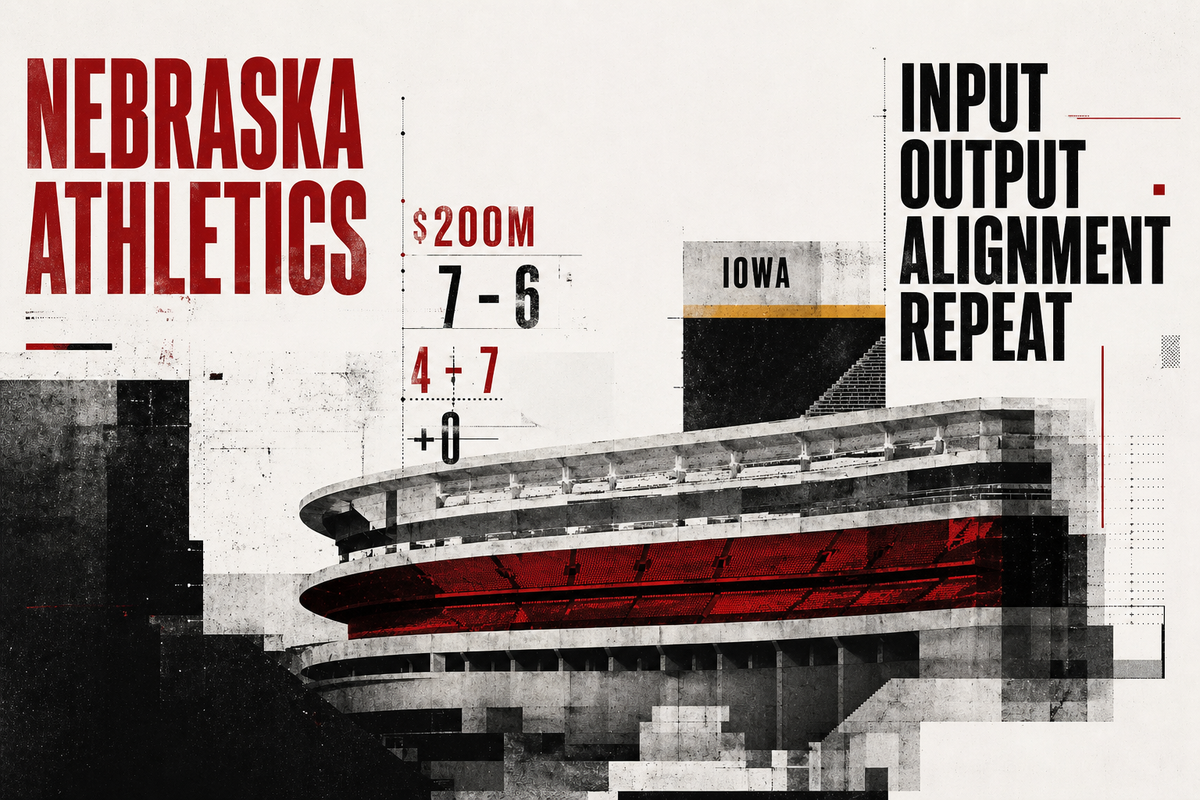
The Nebraska Cornhuskers generate more than $200 million a year and keep landing in the same standings band as programs that spend far less. Over the past decade, the football team has oscillated between four and seven wins, rarely threatening the top of the Big Ten. At some point, that stops being a rebuild and starts looking like the business model.
Call it the 7–6 Machine, even if the machine occasionally sputters down to four wins. It still resets to the same place, produces the same conversations, and sends everyone into the offseason convinced the next turn of the wheel will be different.
Premium Inputs, Sub-Peer Outputs
Start with the simplest frame available. Nebraska spends like a top-10 program and performs like a top-35 one. That gap becomes obvious by late November, when the Big Ten sorts itself out and the same programs separate from the pack. Michigan Wolverines football and Ohio State Buckeyes football operate at a level Nebraska has not reached in years.
The more uncomfortable comparison sits closer to home. Iowa Hawkeyes football has been the more reliable, more physical, and more consistent program across the last decade. Under Kirk Ferentz, Iowa routinely produces eight- to ten-win seasons, competes deep into the conference schedule, and, notably, has grown comfortable winning in Memorial Stadium. That is not a theory. That is recent history.
Nebraska is not operating at Iowa's level. It is chasing it, and it has not closed the gap. When a lower-cost program consistently outperforms a higher-cost one, the issue is not resources. It is how those resources are used.
The Schedule Does Half the Work
Context sharpens the picture. Nebraska's scheduling has quietly reduced the difficulty of many seasons. Nonconference opponents are often overmatched, which effectively places two or three wins on the board before conference play begins. That structure matters because it sets the baseline expectation.
Once Big Ten play starts, Nebraska typically faces a mix of mid-tier and lower-tier teams that make bowl eligibility attainable without requiring elite performance. The math becomes straightforward. Stack a few early wins, prevail against the lowest-tier Big Ten teams, and six wins appear within reach.
The problem is what that means in practice. Nebraska is not consistently clearing that bar. It reaches its goal in some years and falls short in others, which exposes the underlying instability. Seven wins, when they occur, represent the upper edge of the range rather than a step forward. The floor has not held, and the ceiling has not moved.
The Coaching Cycle Explains the Pattern
Nebraska's coaching history over the past two decades reflects a program that keeps redefining success instead of building toward it.
Bo Pelini established a consistent baseline with nine- and ten-win seasons. That level of performance was dismissed because it did not lead to national contention. Nebraska chose to pursue a higher ceiling.
Mike Riley represented a shift in tone and philosophy that never aligned with Nebraska's competitive environment. The reset came quickly, and the results declined.
Scott Frost arrived with a narrative that was almost too perfect: former player, rapid rise, broad support. The execution did not match the story. We closed losses, development stalled, and the program extended patience longer than performance justified. The eventual change carried both competitive and financial consequences.
Each transition reset recruiting pipelines, altered schemes, and rebuilt staffs. Nebraska did not build continuity. It restarted repeatedly, which erased any advantage gained in previous cycles.
Matt Rhule: Stability, Not Separation
Matt Rhule fits the job description better than his predecessors did. He builds programs through structure, discipline, and development. The difference is visible. Nebraska looks more organized, more prepared, and less prone to the kind of errors that defined earlier seasons.
However, Rhule seems to have structural issues in his approach, including transfer-portal churn and seemingly arbitrary assistant-coaching changes. This strategy keeps fans engaged in debate and elevates hopes after every portal season, but it also results in the implementation of new systems with different players, with mixed results.
That progress is real, but it has not changed the range of outcomes. The results still fall within the same band that has defined the program, with another 7–6 season sitting at the top of a range that includes four- and five-win years. That is not sustained upward movement. It is controlled variance.
Rhule has stabilized the operation, but at this level, stabilization produces middle-tier results. The program is more organized, but it still falls far short of the conference's top tier. He looks like the coach who stops the bleeding. It remains an open question whether he is the coach who drives meaningful progress.
The Extension and the Cost of Timing
Nebraska's decision to extend Matt Rhule came before a clear jump in performance. The timing coincided with an active coaching market in which salaries increased, and leverage shifted toward established coaches. Nebraska chose to secure stability early rather than wait for results to confirm the trajectory.
That decision carries consequences. The extension increases guaranteed compensation and expands buyout obligations, reducing flexibility if results remain in the current range. The move signals commitment, but it also locks in cost based on projected rather than demonstrated performance.
The issue is not whether the extension can be justified. It is whether it reflects disciplined decision-making tied to measurable outcomes. In this case, the timing suggests a response to external pressure rather than a clear internal benchmark.
Iowa as the Structural Counterexample
The contrast with the Iowa Hawkeyes football highlights the underlying difference. Iowa operates within a more centralized model, where decision-making authority is clear and consistent. The athletic director establishes the framework, and the head coach executes within it. The system values continuity and incremental improvement over repeated reinvention.
Under Kirk Ferentz, Iowa has maintained a defined identity centered on defense, physical play, and player development. The program does not chase trends or reset its philosophy every few seasons. It refines what it already does.
The results follow that approach. Iowa consistently produces winning seasons, competes within the upper half of the conference, and maintains control over matchups against Nebraska. The gap between the two programs is not rooted in facilities or funding. It is rooted in alignment and discipline.
System Diagnosis
Nebraska's inputs and outputs do not align. Decision authority is distributed among multiple stakeholders, leading to shifting priorities and an inconsistent strategy. Coaching hires reset identity instead of reinforcing it. Contract decisions are driven by timing and external pressure rather than by clearly defined performance thresholds. The outcome is predictable: a program that oscillates between four and seven wins while spending at an elite level.
Nebraska is not consistently good. It is consistently average, with periodic dips below that line.
The Money Masks the Problem
Nebraska's financial strength allows the system to continue without immediate correction. Fan support remains strong, donor contributions continue, and conference revenue provides a stable foundation. The program does not experience the kind of pressure that forces rapid structural change.
The stadium renovation reinforces this dynamic. The project will enhance the experience and generate additional revenue, but it does not directly address the competitive gap. If performance remains in the current range, Nebraska risks pairing a premium environment with a product that does not justify it.
The Rest of the Department Shows the Path
Other Nebraska programs demonstrate what alignment can produce. Nebraska Cornhuskers women's volleyball operates at an elite level, combining stable leadership, a clear identity, and full institutional support. The results are consistent and measurable.
Nebraska Cornhuskers wrestling remains competitive, though it has not consistently ranked in the conference's top tier. Basketball programs show flashes of success but lack sustained performance. The Olympic sports perform steadily, benefiting from clearer expectations and fewer competing influences.
These programs suggest that Nebraska can succeed when its systems align. Football has yet to achieve that alignment.
What Happens Next
If Nebraska continues on its current path, the most likely outcome is continued oscillation within the same band. Four to seven wins, intermittent bowl appearances, and recurring optimism that fades once conference play establishes the hierarchy. Costs will continue to rise as facilities improve and contracts expand, while results remain uneven.
Nebraska is not rebuilding. It is repeating.
Bottom Line
Nebraska does not need more resources. It needs a clearer structure for using them. The program must define success, align its decisions with that definition, and maintain that alignment long enough for results to compound. Until that happens, the 7–6 Machine will continue to operate, delivering seasons that are good enough to sustain belief and not strong enough to meet expectations.
Comments ()