
Wisconsin NIL in 2026: Revenue Sharing, Football Spending, and a Program Starting Over Twice
Wisconsin's 2026 NIL and revenue-sharing strategy faces its biggest test under new AD Shawn Eichorst.

Wisconsin spent most of the NIL era looking like a program that refused to play the new game. While Ohio State, Oregon, and Michigan turned collectives into arms races, the Badgers stuck with a single donor group, The Varsity Collective. They leaned on the same pitch that had worked for two decades: come here, get developed, leave as a pro. For a while, that felt like a principle. After a 4-8 season and a second straight missed bowl game, it started to look a lot more like falling behind.
The House settlement should have simplified things. Every power-conference school now starts from roughly the same revenue-sharing number, which was supposed to turn the conversation away from "whose collective raised more" and toward "who's actually running this well." Wisconsin arrived at that conversation in the middle of two experiments: a coaching change that hadn't yet produced results and a leadership change at the top of the athletic department that landed four days ago. Judging the program's financial strategy right now means judging a moving target.
Behind, Not Broke
Nobody at Wisconsin is claiming the Badgers can match Ohio State or Oregon dollar-for-dollar, and the numbers back that up. Ted Kellner, one of the program's largest donors and a founding figure of The Varsity Collective, has publicly said that Wisconsin ranks in the bottom third of the Big Ten in financial resources. That's not spin. It's the starting point for everything else the department has done over the last eighteen months.
The more useful question isn't whether Wisconsin can out-spend the conference's wealthiest programs. It's whether an athletic department that built its identity on patience and development can retrofit that identity fast enough to matter in a market that increasingly punishes anyone who waits.
The Model Wisconsin Already Knew
Wisconsin football has never been a recruiting-ranking program. Offensive linemen redshirt, spend years in the same strength program, and turn into all-conference players and NFL draft picks by their fourth or fifth season. Running backs who arrive as afterthoughts leave as workhorses. None of that works if the roster turns over every December.
That's the actual problem NIL created for Wisconsin, not that it couldn't identify talent, but that it had no mechanism to keep the talent it developed once someone else was willing to pay for it. The clearest example wasn't even about money leaving Wisconsin; it was about money Wisconsin had already spent walking out the door. In 2025, Wisconsin sued the University of Miami, alleging that Miami had tampered with defensive back Xavier Lucas after the Badgers' own collective bargaining agreement had already paid him. Whatever the legal outcome, the episode made a point better than any press release could: retention isn't a football issue anymore. It's a contract issue, and Wisconsin was late to treat it that way.
What Wisconsin Actually Built
The Varsity Collective, launched by boosters including Kellner and former Wisconsin quarterback Brooks Bollinger in 2022, was, for years, the Badgers' only real NIL infrastructure. It brought in recognizable alumni, Russell Wilson, J.J. Watt, Joe Thomas, and did real work. Still, it was a donor-run operation sitting outside the university, which limited how directly the athletic department could coordinate it with actual roster strategy.
That started changing in 2023, when Wisconsin brought in Altius Sports Partners to help oversee NIL support and staffed an in-house Partner Services Manager role to work alongside the collective. It changed further in December 2025, when Wisconsin Athletics launched Badger Athlete Partners, an NIL initiative run directly by the department rather than by an outside donor group. Where the Varsity Collective raises and distributes booster money, Badger Athlete Partners is built to manage deal facilitation, content, and storytelling from inside the building; the department's own answer to the question every athletic department is now asking: who actually runs this operation day to day?
Wisconsin also went to the state legislature for help, which is not something most athletic departments have to do. Assembly Bill 1034, backed heavily by former athletic director Chris McIntosh, does two things: it directs state funding toward debt service on athletic facilities, freeing up department revenue that would otherwise go toward construction bonds, and it exempts NIL-related university records from Wisconsin's open records law; the same protection most of Wisconsin's competitors already have under their home states' NIL statutes. McIntosh was blunt about why the department needed it, telling lawmakers the bill was about keeping Wisconsin competitive "across all 23 of its varsity sports and 600 student-athletes." That's a very different pitch than "we need more NIL money for football," and it tells you something about how Wisconsin actually thinks about the problem.
Trying to Put a Number on It
Wisconsin doesn't publish a consolidated compensation ledger, and Assembly Bill 1034 was written in part to make sure it never has to. Everything here is an estimate built from public reporting and donor commentary, not a disclosure.
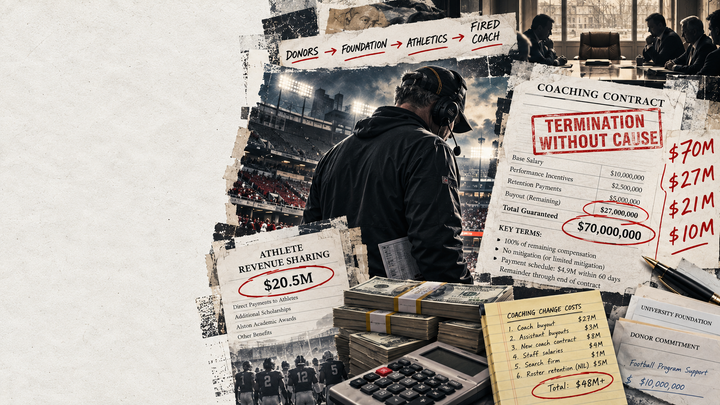
Wisconsin is expected to fund at or near the full revenue-sharing cap, which sits at roughly $20.5 million for 2025-26 and is projected to rise to around $21.3 million the following year. Football's share is likely in the range of $13 million to $15 million once revenue sharing and Varsity Collective NIL activity are combined — a real number, but one that donor commentary and the program's own recruiting results suggest still trails the Big Ten's top tier by a meaningful margin, not a small one.
Men's basketball, volleyball, and both hockey programs pull from the same finite pool, and Wisconsin has been unusually explicit that it isn't willing to gut those programs to inflate the football number. Combined across the department, Wisconsin's full athlete-compensation footprint for 2026 is probably somewhere in the $28 million to $33 million range; competitive with the Big Ten's middle tier, behind the conference's biggest spenders, and short of where the department wants to be within a couple of budget cycles if Assembly Bill 1034's facility savings materialize as projected.
The Hire That Actually Matters
The most consequential move Wisconsin athletics has made all year didn't involve a coordinator title or a fundraising campaign. It happened four days ago, when the university named Shawn Eichorst its new athletic director, replacing Chris McIntosh, who left in April to take a job with the Big Ten conference.
Eichorst isn't a stranger to Wisconsin; he worked under Barry Alvarez as deputy athletic director from 2006 to 2011, but the résumé he's bringing back with him is the more relevant part. He has run athletic departments at Nebraska and Miami, and spent the last several years as deputy athletic director and chief operating officer for football at Texas, a program operating at the absolute top of the sport's new financial hierarchy. Wisconsin didn't hire someone whose background is protecting tradition. It hired someone who spent the last stretch of his career inside one of the two or three most aggressively resourced athletic departments in the country.
That matters because Wisconsin's NIL infrastructure, Badger Athlete Partners, the Altius partnership, Assembly Bill 1034, was mostly built under McIntosh's direction, and it now belongs to someone else to run. Whether Eichorst inherits that framework or rebuilds it around what he learned at Texas is probably the single biggest variable in how Wisconsin's financial strategy looks a year from now.
Twenty-Three Sports, One Budget
It's tempting to treat Wisconsin athletics as a football department with volleyball and hockey attached. The department itself doesn't operate that way, and it's been fairly consistent about saying so. Kelly Sheffield's volleyball program competes for national championships as a stated expectation rather than an aspiration. Both hockey programs carry real national relevance. Wrestling and cross country maintain a level of institutional support that has nothing to do with their revenue generation.
That breadth is a genuine part of Wisconsin's identity, and it's also a real constraint on how much football can absorb. Every dollar Assembly Bill 1034 frees up by covering facility debt service is a dollar the department can choose to spend on any of twenty-three programs, not a dedicated football fund. Wisconsin is betting that keeping its broader athletic identity intact is worth a smaller football number than some of its rivals are willing to accept.
Where the Bet Could Fail
None of this guarantees that Wisconsin will close the gap. A few things could go wrong.
An athletic director transition in the middle of a financial buildout is a real risk, not a formality; new leadership can just as easily slow down decisions as accelerate them, and Eichorst inherits a football program that has now missed bowl games in back-to-back seasons under a coach whose seat is not obviously secure. Donor fatigue is also a live concern: Wisconsin is now asking the same alum base to fund the Varsity Collective, Badger Athlete Partners, and facility debt service simultaneously, and there's a ceiling on how much any fan base will underwrite before enthusiasm turns to skepticism. And even if Assembly Bill 1034 performs exactly as advertised, it closes a gap. It doesn't erase one. Ohio State, Oregon, and Michigan aren't standing still while Wisconsin catches up.
Bottom Line
Wisconsin was never going to out-raise Ohio State or Oregon, and nothing the department has done this year suggests it thinks otherwise. What it's built instead is a two-track approach: a donor collective for the traditional NIL market, an in-house operation to run the parts a collective can't handle, and a state law that does double duty, freeing up facility money while shielding the department's financial strategy from public scrutiny. Whether that framework actually works is now up to someone else. Wisconsin just handed control of it to an athletic director who spent the last several years inside the kind of budget the Badgers are trying to catch up to.
That's either the person who finally closes the gap, or the person who discovers just how much bigger the gap still is up close.

Comments ()