
Why Northwestern Athletics Is Falling Behind in the Big Ten
A data-driven consultant’s analysis of Northwestern athletics, examining NIL deficits, leadership structure, stadium strategy, and brand failure in Chicago, raises the question of whether the program is drifting toward Big Ten “farm club” status.
Northwestern does not look like a crisis program, and that is precisely what makes it difficult to diagnose. There are no public implosions, no frantic coaching searches, no headline-grabbing gambles. Instead, the department projects control. It feels measured, deliberate, and aligned with the university’s broader identity. Within the institution, that likely reads as success. Within the Big Ten, it increasingly reads as a program that has quietly defined the limits of its own ambition.
The concern is not that Northwestern is failing outright. The concern is that it has settled into a version of itself that may no longer be viable in a conference defined by escalation. In today’s environment, stability without upward pressure does not preserve position. It erodes it.
The Resource Gap Is Real. The Response Is the Issue.
Northwestern’s financial position provides the obvious starting point. With roughly $117 million in annual athletic revenue, the program sits in the lower tier of the Big Ten. Schools such as the Ohio State Buckeyes and Michigan Wolverines operate at more than double that scale, and even the middle of the conference maintains a noticeable advantage.
That disparity matters, but it does not dictate outcomes. Programs operating from similar positions typically respond by concentrating resources, taking calculated risks, and creating spikes of competitiveness in a few key sports. Northwestern has taken a different approach, distributing resources more evenly across the department. The result is a flattened performance profile that minimizes embarrassment but also suppresses breakthrough potential. This is less a function of what Northwestern has and more a reflection of how it chooses to deploy it.
NIL: The Cleanest Indicator of Competitive Intent
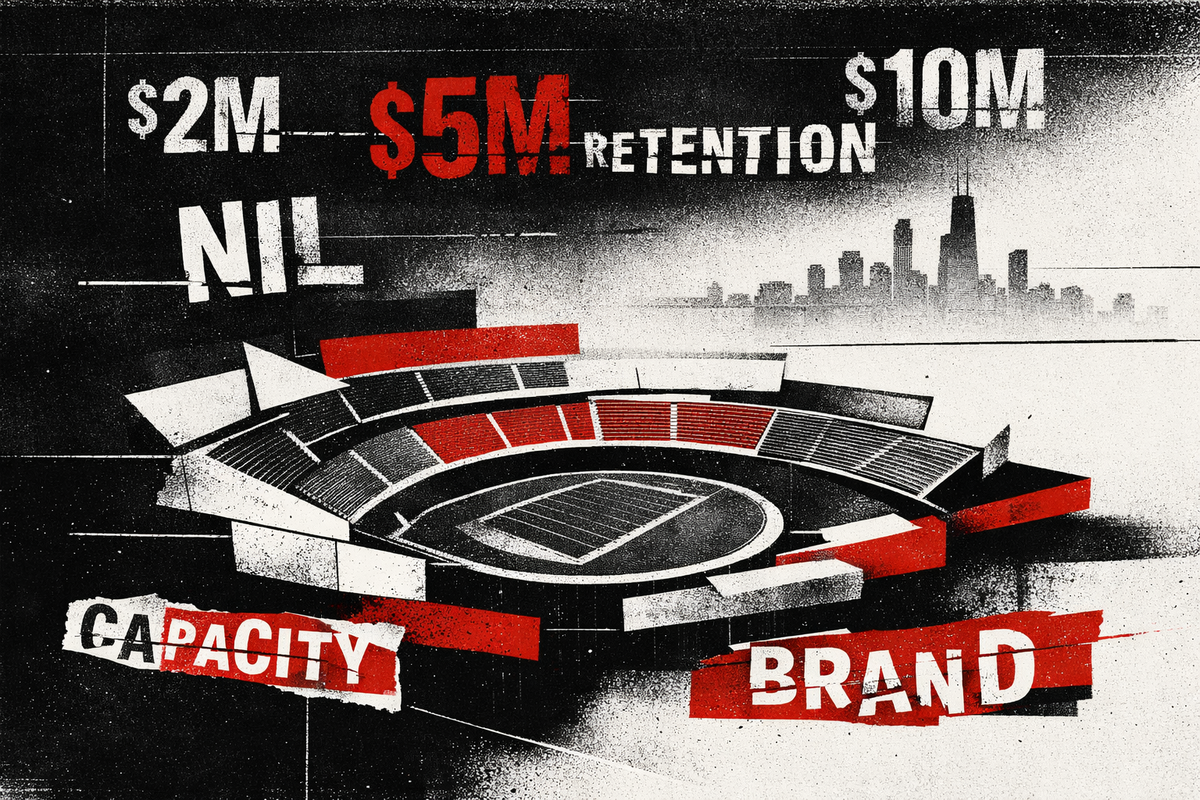
If there is a single metric that cuts through the noise in 2026, it is NIL. The Big Ten market has already sorted itself into tiers. At the top, programs deploy between $10 million and $15 million annually across football and basketball. The next group operates in the $5 million to $9 million range and remains competitive. Once programs fall below roughly $4 million, they begin to lose control of their own rosters.
Northwestern sits in that lower band, with its TrueNU collective likely operating in the low seven figures. That is not simply a disadvantage. It is a structural constraint on competitiveness. At that level, programs struggle to retain their most valuable players, often falling below the roughly 75 percent retention rate that defines roster stability in the modern game. As retention declines, reliance on the transfer portal increases, introducing volatility and undermining continuity.
The issue extends beyond total funding. Northwestern’s NIL apparatus lacks the integration and visibility seen at peer institutions. A few headline deals can shape perception, and the system does not appear to be tightly synchronized with the recruiting and retention strategy. In practical terms, Northwestern can identify and develop talent, but it has limited ability to hold that talent once market forces take over. Over time, that dynamic begins to resemble a developmental pipeline rather than a competitive roster model.
Coaching Decisions That Reinforce the Plateau
Chris Collins's extension fits cleanly into this broader pattern. Over more than a decade, the program has hovered on the edge of relevance, breaking through intermittently before settling back. In most Big Ten environments, that trajectory prompts a push for sustained advancement. Northwestern instead opted for continuity.
There is a logic to that decision. Stability reduces downside risk and preserves institutional alignment. The trade-off is that it also fixes the program’s ceiling. Without explicit pressure to improve, programs tend to remain at their current level. In a conference where marginal gains compound quickly, that lack of upward tension becomes a competitive liability.
Organizational Structure and the Cost of Deliberation
The underlying constraint is structural. Northwestern does not appear to operate with the kind of centralized, rapid decision-making model that now defines high-performing athletic departments. Instead, major decisions seem to move through layers of alignment, reflecting a governance culture that prioritizes consensus and risk management.
That approach works in many parts of the university. In college athletics, it creates drag. NIL negotiations, transfer portal windows, and coaching markets all move quickly, often requiring decisions in days rather than weeks. Programs that can act decisively gain an advantage. Programs that deliberate fall behind.
The role of Athletic Director Mark Jackson sits at the center of this dynamic. His background with Villanova Athletics suggests operational competence, but the critical variable is authority. If the athletic director functions primarily as an administrator within a distributed system rather than as a decision-maker with a clear mandate and autonomy, the department’s ability to pivot will remain limited. The current structure appears designed to avoid mistakes rather than to capture opportunities, and in this environment, those are often the same thing.
A Brand That Reflects Hesitation
The most persistent issue may be brand identity. Northwestern has never fully defined what its athletic program represents, particularly within the Chicago market. It does not operate as Chicago’s team, nor does it project itself as a consistent national contender. Instead, it occupies an ambiguous space shaped by academic prestige and restrained athletic ambition.
Part of this ambiguity stems from the university’s self-perception. Northwestern views itself as an elite academic institution, and there has long been an implicit tension between that identity and the demands of big-time athletics. At times, it can feel as though the program treats competitive sports as something to be managed carefully rather than embraced fully. That posture, whether intentional or not, carries through to recruits, donors, and fans.
In a market like Chicago, that lack of clarity is particularly costly. The city offers enormous potential, yet Northwestern has struggled to establish a meaningful presence. Attendance lags, recruiting penetration remains inconsistent, and the program rarely drives sustained conversation. Programs that succeed in large markets typically anchor themselves either in local identity or competitive success. Northwestern has not committed to either, resulting in limited traction in both.
The Stadium Bet and the Question of Demand
The new stadium plan brings these issues into sharper focus. Northwestern is reducing capacity while emphasizing a more premium, experience-driven model. In theory, higher per-seat revenue can offset lower volume. In practice, that strategy depends on strong, consistent demand.
That is where the logic becomes less convincing. Northwestern has historically struggled to fill seats even at lower price points. The assumption that demand will increase as pricing rises is not supported by past behavior. It represents a bet that the experience itself will drive engagement, even in the absence of sustained on-field success.
There is also a broader strategic question. The project carries the imprint of a major donor vision, and it can be read less as a market-driven response and more as a top-down initiative. Those investments can elevate facilities, but they do not automatically generate demand. Without competitive relevance, the stadium risks becoming an optimized venue for a product that has not yet proven it can scale.
The Direction of Travel
Taken together, these elements form a coherent system. Limited NIL resources constrain retention. A deliberative internal structure slows adaptation. Coaching decisions reduce pressure to improve. Brand ambiguity limits market growth. Facilities strategy caps revenue upside while betting on demand that has yet to materialize.
None of these decisions are reckless. That is what makes the trajectory so clear. They are all reasonable in isolation and collectively reinforcing.
The outcome is a program that develops capable athletes but struggles to retain them, maintains respectability but rarely sustains momentum, and participates in the conference without consistently influencing it. Over time, that begins to resemble a farm system, not in intent but in function.
What Would Have to Change
Reversing that trajectory requires more than incremental adjustment. Northwestern would need to scale its NIL operation into at least the $4 million to $6 million range to stabilize its roster and remain competitive in retention. It would need to centralize decision-making authority to increase speed and accountability, ensuring that opportunities are captured rather than evaluated into irrelevance.
Coaching structures would need to shift toward forward-looking performance metrics, creating sustained pressure for improvement rather than rewarding past milestones. At the same time, the university would need to define a clear external identity, particularly within Chicago, that aligns its academic reputation with a more assertive athletic posture.
These are not minor adjustments. They represent a shift in how the institution views athletics within its broader mission.
Conclusion
Northwestern is not being pushed out of relevance solely by external forces. It is operating within a framework that limits its own ceiling. In a conference focused on aggressive investment and rapid adaptation, that framework leads to predictable outcomes.
Programs that do not compete for talent, attention, and identity at scale eventually become platforms for those that do.



Comments ()