
Why Offensive Lines Are Still Built, Not Bought in the Transfer Portal Era
Offensive line play remains college football's last apprenticeship position. Here's why continuity, development, and chemistry still outperform portal shopping and what it means for the NFL Draft.
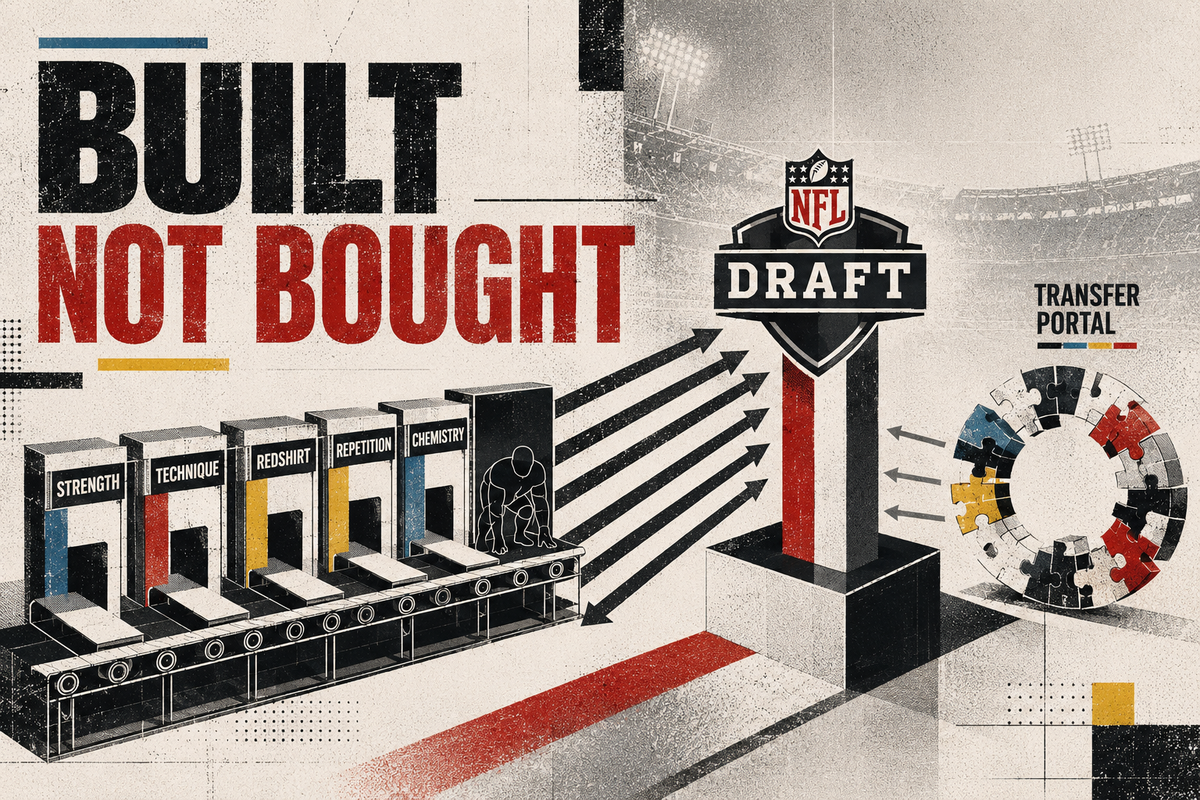
Part I of the News Expeditions Portal Value Series
College Football Coaches Have Made an Expensive Assumption
College football has become increasingly comfortable paying premium prices for offensive linemen in the transfer portal. Veteran tackles command NIL packages that rival top receivers, while experienced guards and centers have become prized offseason acquisitions. The reasoning behind those investments is understandable. Offensive lines are difficult to recruit, injuries can derail otherwise talented teams, and coaches are operating under growing pressure to produce results immediately. If an offensive line struggles, importing older players with dozens of starts appears to offer a relatively quick solution.
The NFL Draft proves the market is making a costly mistake.
For purposes of this analysis, draft position is not intended to measure professional success. Instead, it serves as a report card on collegiate development. NFL franchises collectively invest thousands of hours studying prospects. Scouts review game film, conduct athletic testing, evaluate technique, interview players, review medical histories, and project long-term upside. When an offensive lineman is selected in the first round, the league is effectively making a consensus judgment that his college experience produced elite performance, refined skills, and NFL-caliber ability. Draft position is certainly imperfect, but it remains one of the best independent assessments available for evaluating how effectively college programs transform high school prospects into professional players.
The Draft Keeps Rewarding Developers
Examining first-round offensive linemen selected between 2022 and 2025 reveals a remarkably consistent pattern. The overwhelming majority spent nearly all of their college careers developing within a single program before entering the draft.
The 2022 class included Iowa's Tyler Linderbaum, Alabama's Evan Neal, North Carolina State's Ikem Ekwonu, Mississippi State's Charles Cross and Northern Iowa's Trevor Penning. The most prominent transfer success story was Zion Johnson, who significantly improved his draft profile after moving from Davidson to Boston College.
The same pattern appeared in 2023. Ohio State developed Paris Johnson Jr. Georgia produced Broderick Jones. Northwestern sent Peter Skoronski to the NFL, while Oklahoma developed Anton Harrison into a first-round selection. Florida's O'Cyrus Torrence demonstrated that portal additions can absolutely work, but his rise from Louisiana to SEC standout remains memorable partly because relatively few offensive linemen follow that path.
The 2024 draft reinforced the trend. Notre Dame produced Joe Alt. Penn State developed Olu Fashanu. Oregon State sent Taliese Fuaga to the first round. Alabama continued its offensive line assembly line with JC Latham, while Washington's Troy Fautanu, and Duke's Graham Barton followed traditional developmental trajectories. Tyler Guyton, who transferred from TCU to Oklahoma, again represented an exception rather than evidence that the market has fundamentally changed.
The 2025 class looked strikingly familiar. LSU's Will Campbell, Texas' Kelvin Banks Jr., Alabama's Tyler Booker, Ohio State's Donovan Jackson and North Dakota State's Grey Zabel all emerged from programs that invested years in their growth. Josh Simmons, who transferred from San Diego State to Ohio State, proved that elite portal additions exist, but his success also illustrates an important point. In many cases, transfers who ultimately become NFL prospects arrive after substantial developmental work has already been completed elsewhere.
None of this demonstrates that portal offensive linemen lack value. Experienced transfers can stabilize struggling units, provide depth, and help teams survive recruiting misses. What the draft evidence does suggest is that the highest-end outcomes continue to favor players who spend years developing within coherent systems. College football increasingly values offensive linemen as if experience were entirely portable, but NFL evaluators appear considerably less convinced.
NFL Teams Still Bet on Experience
Professional scouts continue to value offensive linemen who have spent years developing in college programs. Recent draft picks illustrate the point. Texas Tech's Caleb Rogers started 55 consecutive games before becoming a third-round selection in the 2025 NFL Draft. Texas A&M's Trey Zuhn III entered the 2026 draft with 50 career starts. Offensive linemen rarely emerge as instant stars, and NFL teams appear comfortable investing in players who have accumulated thousands of live-game repetitions. The draft itself suggests that experience remains one of the position's most marketable traits.
Elite Offensive Lines Are Usually Homegrown
The best offensive lines in college football are still more likely to be built through recruiting and development than assembled through annual portal shopping. Of the 50 starters who played on a Joe Moore Award semifinalist offensive line in 2024, 39 were developed by the programs they represented. Two of the three finalists, Army and Texas, relied entirely on players they signed out of high school. Similarly, 36 of the 40 offensive linemen recognized as major postseason All-Americans during the NIL era were homegrown players. Programs can supplement the line through the portal, but evidence suggests elite units continue to rely heavily on internal development.
Continuity May Matter, but the Data Is Complicated
Coaches often insist that offensive lines improve simply by playing together longer. The data offers a more nuanced answer. A seven-year study conducted by Sports Info Solutions found little measurable relationship between shared snaps and offensive line performance in either the running game or pass protection. Researchers cautioned, however, that relatively few units remain intact long enough to study the impact of true long-term continuity. The findings suggest that continuity alone does not guarantee success, but they also stop short of proving that continuity is irrelevant. It may be that good lines stay together because they are talented, but it is equally possible that talented players become better by remaining together.
Offensive Line Development Still Looks Different
Most positions in modern college football can be upgraded quickly. Quarterbacks transfer. Wide receivers move freely. Defensive backs often contribute immediately after changing schools. Offensive line play appears to resist that trend. The position requires communication, timing, trust, and an understanding of how four other players react in fractions of a second. While college football increasingly behaves like a talent marketplace, offensive lines still resemble apprenticeship programs. The evidence increasingly suggests that they remain one of the few places in the sport where development continues to outperform acquisition.
Offensive Line May Be the Least Portable Position in Football
Offensive line differs from almost every other position.
Wide receivers can often transfer and rely on speed, route-running, and ball skills. Defensive ends can win through athleticism and explosiveness. Running backs frequently carry vision and instincts from one offense to another. Offensive line play depends upon something less visible and considerably harder to replicate.
Centers spend years learning protections. Guards refine leverage, hand placement, and timing through thousands of repetitions. Tackles adjust pass sets repeatedly until movement patterns become instinctive: strength gains accumulate, trust develops, and communication improves. Five players begin to function as a single organism rather than as five independent athletes.
Offensive line increasingly resembles a skilled trade. Few employers would expect an apprentice electrician who changes contractors every year to develop at the same pace as someone who spends five years inside an elite apprenticeship program. Offensive linemen may follow a similar developmental curve.
Programs such as Iowa, Notre Dame, Alabama, Ohio State, Georgia, Michigan, and Penn State do not merely recruit offensive linemen. They manufacture them.
The NFL keeps rewarding those manufacturers.
Nebraska and the Cost of Rebuilding the Rebuild
Nebraska offers an unusually useful case study because it illustrates what happens when offensive line development repeatedly fails to compound.
Over the past several seasons, the Huskers have pursued transfer solutions, welcomed coaching changes, and reshuffled personnel in search of stability. Ben Scott arrived from Arizona State. Stanford tackle Walter Rouse was heavily pursued before eventually choosing Oklahoma. Additional transfers have supplemented the roster in nearly every cycle. Nebraska added seven transfer offensive linemen from 2022–2026 and produced zero drafted transfer offensive linemen during that period.
Experience has not been Nebraska's problem; the real issue is continuity. Despite liberally using portal transfers during Matt Rhule's tenure, not a single one of those players was drafted. Although this could also be affected by poor talent analysis, the data is consistent with the rest of the FBS dataset.
The offensive line struggled in key moments during the 2025 season, surrendering 7 sacks against Michigan and 9 against Minnesota. Those performances suggested more than a shortage of talent. Communication broke down. Protection assignments failed. Pressure arrived from multiple sources. The unit often seemed more like a collection of experienced individuals than a group that had developed together over time.
Nebraska enters 2026 with another projected lineup that includes several transfer starters. Perhaps this group finally solves the problem, but it is much more likely it will restart the cycle. Either way, Nebraska raises an uncomfortable question for the rest of college football. At what point does rebuilding an offensive line every offseason become evidence that previous rebuilding efforts never actually produced developmental returns? Every day is Groundhog Day for the Nebraska offensive line.
Programs that continuously import offensive linemen may be treating symptoms while neglecting the more difficult task of creating systems that produce NFL-caliber players internally. If the definition of insanity is repeating the same act, failing, and repeating it, then Matt Rhule should be in a straightjacket in a locked, padded room eating his meals from a bowl.
The Question Nobody Wants to Ask
College football's portal economy has largely accepted the notion that offensive linemen can be purchased like replacement parts. Programs miss in recruiting, lose players to graduation, fire position coaches, or watch development stall, and the response is often the same: find three experienced starters and try again.
The NFL appears to value offensive line development differently. Year after year, it continues to reward programs that recruit eighteen-year-olds, redshirt them, teach them, develop them physically, and allow them to spend years working within the same system alongside the same teammates.
Scarcity explains why offensive linemen command premium prices in the portal, but it's a Band-Aid covering a gushing wound. The answer is recruiting and development, a solution some head coaches focused on short-term fixes can't seem to understand.
If the NFL Draft remains college football's most objective talent marketplace, its verdict over the past five years has been surprisingly consistent. The best offensive linemen are still more often built than bought.
Comments ()